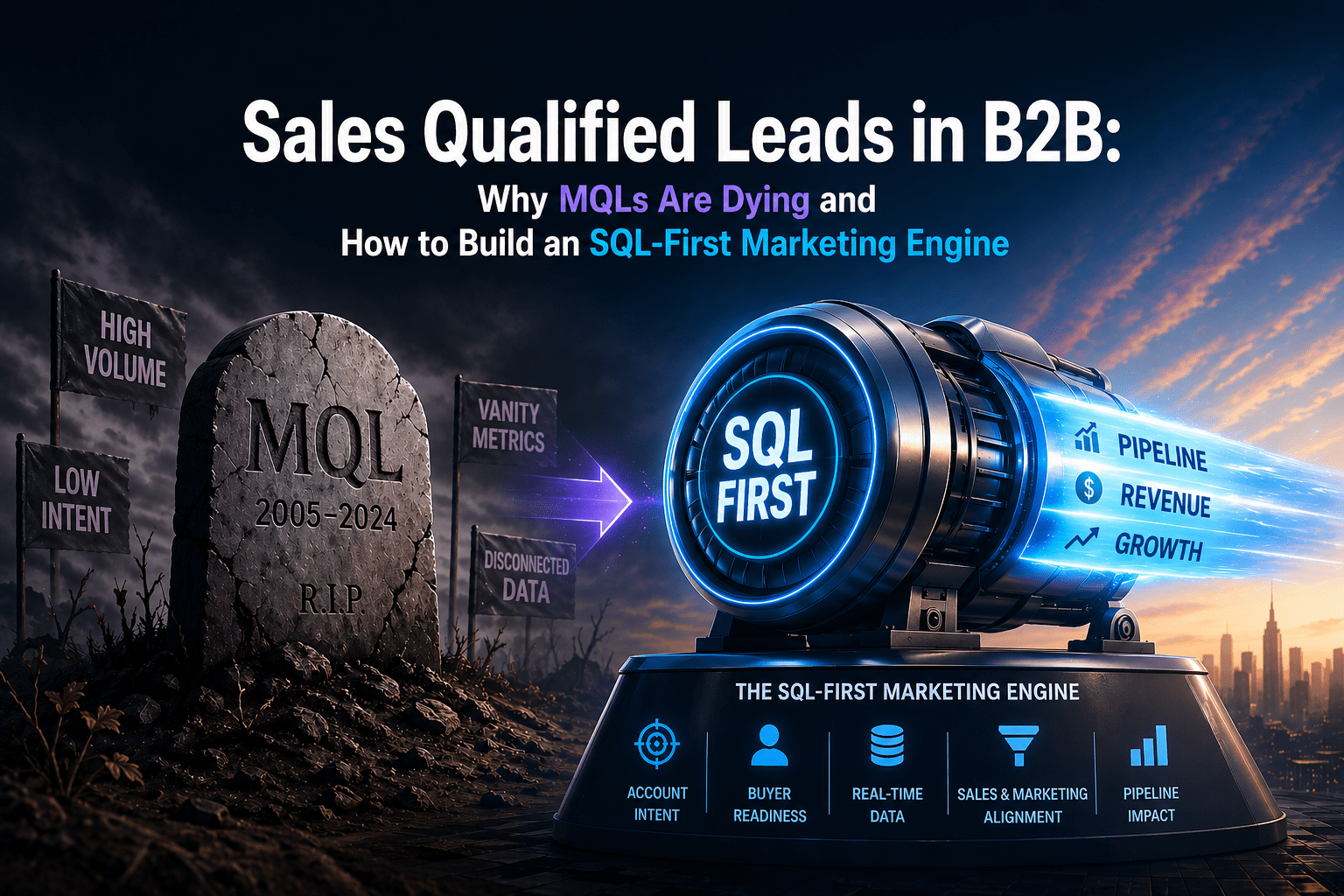
A sales qualified lead (SQL) is a prospect that passes four written tests: it fits your ideal customer profile, shows a real buying signal, involves the right buying committee members, and trips none of your disqualifiers. Sales and marketing then sign one agreement setting those tests, follow-up deadlines, reject reason codes, and recycle rules.
Key facts
- Firms that tried to contact a web lead within an hour were nearly seven times as likely to qualify it as firms that waited even an hour longer, and more than 60 times as likely as firms that waited 24 hours or more, per a study of 1.25 million leads published in Harvard Business Review.
- In a separate audit of 2,241 U.S. companies reported in the same HBR article, 24% took more than 24 hours to respond to a web lead and 23% never responded at all (Harvard Business Review).
- On average, 13 people within an organization are involved in a B2B buying decision, and 89% of purchases involve two or more departments, according to Forrester’s State of Business Buying 2024.
- Forrester reports that over 80% of buying decisions are made by a buying group of more than three people (Forrester).
- 73% of B2B buyers actively avoid suppliers who send irrelevant outreach, per a Gartner survey of 632 B2B buyers.
What a sales qualified lead is, and who gets to say so
An SQL is where marketing hands off to a seller’s calendar. It is not a score. It is a decision, made against criteria both teams wrote down in advance.
In most companies I walk into, “SQL” means something different to the CEO, the VP of Sales, and the marketing manager. Marketing counts every demo request. Sales counts only the ones with budget. Arguments about lead quality never end, because nobody agreed on what quality meant.
Whether marketing should be measured on MQLs or SQLs at all is covered in Is the MQL dead?. This post is about defining and running the SQL.
Two rules make the definition work:
- Sales owns the final call. Marketing proposes. Sales accepts or rejects, with a reason. A lead becomes an SQL when a seller accepts it, not when it crosses a score.
- The criteria are written and live in the CRM. If a criterion cannot be checked with a field, a form answer, or a short qualifying conversation, it is a feeling, not a criterion.


Try two senior CMOs before you hire them
30 minutes with both of us. No hard sell. Written plan in 3 business days.
The four parts of a written SQL definition
Every SQL definition I write has the same four parts. Fill in each row for your business, then put each line into a CRM field.
| Component | Question it answers | Typical criteria | How it is verified |
|---|---|---|---|
| Fit (ICP) | Is this the kind of company we win and keep? | Industry, employee count or revenue band, region, tech stack or equipment base, business model | Enrichment data and form fields, checked by marketing ops before handoff |
| Intent | Are they trying to solve the problem now? | Demo or pricing request, reply to outbound with a stated need, return visits to pricing or comparison pages, a named trigger event (funding, new leader, contract renewal, compliance deadline) | Form answers, website activity, and the first qualifying conversation |
| Buying committee | Are the people who can say yes involved, or reachable? | Contact is the economic buyer, or a champion with a named path to the economic buyer; at least one other function engaged on larger deals | Contact role in the CRM plus what the seller confirms on the first call |
| Disqualifiers | Is there a reason we should not spend seller time here? | Below minimum size, outside served regions, student or job seeker, competitor, existing customer (route to account team), no budget cycle for 12+ months, a must-have we do not offer | Automated rules where possible; seller check on the call |
Fit comes first because it is the cheapest filter. If your ideal customer profile is vague, your SQL definition will be too. Start with how to build an ideal customer profile and come back.
Intent must be an action, not an interest. Reading three blog posts is interest. Asking for pricing, or replying “we are reviewing vendors in Q1,” is an action. Write your intent list as actions.
The buying committee test is where most definitions are weakest. Forrester’s research above shows most decisions involve a group. A single contact with no authority and no path to the person who signs is a conversation, not an SQL. Use BANT or MEDDIC language here if your sales team already speaks it.
Disqualifiers save more seller time than any other line. List every reason a rep has rejected a lead in the last two quarters and turn the repeat ones into automatic rules. Since Gartner found 73% of buyers avoid suppliers who send irrelevant outreach, chasing a poor-fit lead can cost you the account later, when the fit is right.
Three worked examples of SQL definitions
The four parts stay the same. The thresholds change with the business model. Here are three definitions I would start from, then adjust with real win-loss data.
| Component | $20K ACV B2B SaaS | $200K enterprise services | Industrial B2B (equipment or components) |
|---|---|---|---|
| Fit | 50 to 1,000 employees; target verticals; uses a CRM or platform we integrate with; North America | $250M+ revenue or a PE-backed platform company; regulated or complex industry we serve; existing internal team we would work alongside | Plants or OEMs in served industries; production volume above our minimum order economics; within our service and parts territory |
| Intent | Demo request, free trial with a set number of active users, or pricing page plus a reply to outreach | Inbound inquiry naming a project, RFP or RFI received, or a referral with a defined problem and start window | Request for quote with specs or drawings, a sample or spec-in request, or a line expansion or retooling date |
| Buying committee | Department head or director who owns the budget, or a manager champion who confirms the director is involved | Executive sponsor (VP or C-level) identified, plus procurement or finance engaged before proposal | Engineer or plant manager engaged, and purchasing or the plant leader confirmed as part of the decision |
| Disqualifiers | Under 50 employees (route to self-serve); locked into a competitor contract for 12+ months; needs a feature on no roadmap | No budget owner after two conversations; scope under our minimum engagement; wants staff augmentation only | Volumes below minimum run; outside service territory; spec requires a certification we do not hold |
| Who accepts | SDR qualifies, account executive accepts | Partner or practice lead accepts after a discovery call | Inside sales or regional sales manager accepts after spec review |
What to notice:
- The $20K SaaS definition leans on product signals. Trial usage and pricing behavior do much of the qualifying.
- The $200K services definition leans on the committee. At this deal size, a lead without an executive sponsor rarely closes on time. Make that a hard gate.
- The industrial definition leans on specs. A quote request with real drawings beats any web behavior. “Send me a catalog” does not.
The sales-marketing service level agreement
The definition says what an SQL is. The service level agreement says who does what by when. Keep it to one page, have both leaders sign it, and review it every quarter. Here is a sample to adapt.
| Step | Owner | Deadline | What “done” means |
|---|---|---|---|
| Route the lead | Marketing ops | Instant (automated) | Lead matched to fit rules, disqualifiers applied, assigned to a named rep |
| First contact attempt on high-intent leads (demo, pricing, RFQ) | SDR or assigned rep | Within 1 business hour, during business hours | Call and personal email logged in the CRM |
| First contact attempt on other marketing-sourced leads | SDR or assigned rep | Within 1 business day | Call or email logged |
| Follow-up sequence | SDR or assigned rep | Minimum number of attempts over a set number of business days (for example, 6 attempts over 10 days) | Every attempt logged; no lead left untouched |
| Accept or reject | Rep who owns the lead | Within 3 business days of first conversation, or at the end of the sequence | Status set to Accepted or Rejected, with one reason code |
| Convert accepted SQL to opportunity | Account executive | Within 14 days of acceptance | Opportunity created with amount and close date, or SQL returned with a reason |
| Recycle rejected and stalled leads | Marketing | Within 5 business days of rejection | Lead moved to the right nurture track by reason code |
| Report and review | Marketing and sales leaders | Weekly review; quarterly definition review | Shared dashboard; agreed changes logged |
Set your own numbers, but do not soften the first-contact rule. The HBR research above is clear: speed in the first hour decides whether a lead gets qualified at all. A fast, logged first touch is the cheapest pipeline gain most companies have.
Reason codes for rejected leads
A rejection without a reason teaches marketing nothing. Give reps a short pick list of no more than eight codes.
| Reason code | What it means | What happens next |
|---|---|---|
| Not ICP | Fails a fit rule (size, industry, region) | Removed from sales routing; fit rule tightened if the pattern repeats |
| No current need | Right company, no active project | Recycle to nurture; re-check in 90 days |
| Wrong contact | Right company, no path to the decision maker | Marketing targets other roles at the account |
| Timing | Need is real but budget or project is 6+ months out | Recycle with a dated follow-up task |
| Unreachable | No response after the full sequence | Recycle to nurture; re-route on any new high-intent action |
| Competitor or partner | Not a buyer | Removed; excluded from future routing |
| Existing customer | Belongs to the account team | Re-routed to account owner |
| Duplicate | Already in an open opportunity | Merged |
Recycle rules
Most agreements fall apart here, because no one owns the lead after sales says no. Write these down:
- Rejected for timing or no current need: back to marketing nurture, with a re-qualification date.
- Any new high-intent action (demo request, pricing visit plus reply, RFQ) on a recycled lead sends it back to the same rep, with the same first-contact deadline.
- Accepted SQLs that do not become opportunities within the agreed window return to marketing with a reason code. They do not sit in a rep’s queue forever.
- No lead is deleted for being rejected. It is coded and kept. Rejections are your best data for the next quarterly review.
For the broader operating rhythm between the teams (meetings, compensation, joint planning), see my guide to sales and marketing alignment.
How to track SQL acceptance rate and SQL-to-opportunity rate
Two numbers tell you whether the definition and the agreement are working. Both come straight from the CRM fields above.
SQL acceptance rate = leads accepted by sales ÷ leads marketing sent to sales (accepted plus rejected), for the same period.
SQL-to-opportunity rate = accepted SQLs that became opportunities with an amount and close date ÷ accepted SQLs, for the same cohort.
To set them up:
- Add three required fields to the lead or contact record: SQL status (Sent, Accepted, Rejected, Recycled), date of each status change, and reason code. Make reason code required whenever status is Rejected.
- Measure by cohort, not by calendar. Follow the leads sent in March forward. Mixing March leads with April opportunities hides problems.
- Break both rates out by source and by rep. A low acceptance rate on one channel is a targeting problem. A low rate for one rep across all channels is a coaching problem.
- Track speed alongside conversion. Report median time to first contact. If the agreement says one business hour and the median is a day, fix that before you touch the definition.
- Read the two rates together.
| Acceptance rate | SQL-to-opportunity rate | What it usually means | What to do |
|---|---|---|---|
| Low | High | Marketing is sending too many poor-fit leads, but the ones sales accepts are good | Tighten fit rules and disqualifiers; check top rejection reasons |
| High | Low | Sales accepts too easily, or the intent bar is too low | Raise the intent or committee test; audit what reps accept |
| Low | Low | The definition does not match what wins | Rebuild from recent closed-won deals |
| High | High | Working | Look for volume: which sources can you scale without lowering fit? |
There is no universal target for either rate. It depends on deal size and sales motion. Set a baseline from your first full quarter and improve against your own numbers.
How to revise the definition every quarter
Markets shift, your product changes, and reps learn things marketing never sees. Revise the definition on a fixed schedule so changes happen by agreement, not by drift.
- Pull the last two quarters of closed-won and closed-lost deals. List the fit, intent, and committee traits each one had when it first became an SQL.
- Compare winners to the current definition. Are you winning deals the definition would have rejected? Losing deals it accepted? Each gap is a candidate change.
- Review rejection reason codes. If one code makes up a large share of rejections, it points to a rule that belongs in the routing logic.
- Check the buying committee pattern. If closed-won deals almost always had a second function engaged before proposal, make that a requirement at the size where it holds true.
- Agree on no more than two or three changes. Change more and you cannot tell which change moved the numbers.
- Update the CRM rules and the signed one-page agreement the same week. Date the version. Tell the reps what changed and why.
- Re-baseline. Note the change date on the dashboard so nobody mistakes a new definition for a drop in lead quality.
In my career, the biggest gains I have seen (including 6X inbound lead growth and a 77% reduction in paid acquisition costs) did not come from new channels alone. They came from getting this definition right first, so every dollar after it went toward finding more of the right buyers.
Frequently asked questions
Who should write the SQL definition, sales or marketing?
Both, in the same room, with sales holding the final call on acceptance. Marketing knows which signals it can capture. Sales knows which conversations turn into revenue. A definition written by one team alone gets ignored by the other.
Should a demo request automatically count as an SQL?
No. A demo request is a strong intent signal, so it should get the fastest follow-up in your agreement. It still has to pass fit and disqualifier checks, and the rep confirms the committee test on the first call. Many demo requests come from students, competitors, and companies too small to buy.
What happens to a lead sales rejects?
It gets a reason code and goes back to marketing under the recycle rules. Timing and no-current-need rejections go into nurture with a re-qualification date. Poor-fit rejections are removed from sales routing, and repeat patterns become new disqualifier rules at the next quarterly review.
How is an SQL different from an opportunity?
An SQL is a lead that sales has accepted as worth working. An opportunity is a deal sales has confirmed, with an amount, a close date, and a defined buying process. Tracking the step between them, the SQL-to-opportunity rate, shows whether accepted leads are turning into real pipeline.
Do we need different SQL definitions for different products or segments?
Often, yes. If you sell both a self-serve product and an enterprise offering, one definition will either let too much through for enterprise or block good self-serve buyers. Keep the same four-part template and agreement, and set thresholds by segment.
Get a written plan for your SQL definition
If your sales and marketing teams cannot agree on what a qualified lead is, that is usually the first thing I fix. Book a free 30-minute growth plan session on Google Meet with Michael Pecora and me. We will look at how your leads are defined, routed, and followed up today, and you will get a written growth plan within 3 business days. No hard sell. We hold these sessions for 10 companies a month. Book your growth plan session.
Free Written Growth Plan
Wondering if a fractional CMO is right for you?
Try us before you hire us. Book a free 30-minute working session with both of us and get a written growth plan you can use whether or not you hire us.
Get My Free Growth Plan →No hard sell on the call. Your plan arrives within 3 business days. See a sample plan
Sources
- Harvard Business Review, The Short Life of Online Sales Leads
- Forrester, To Master B2B Buying Mayhem, Providers Must Prioritize Buyers’ Needs (The State of Business Buying, 2024)
- Forrester, The Revenue Process Alignment Series, Part 1: The End Of MQLs
- Gartner, Gartner Sales Survey Finds 61% of B2B Buyers Prefer a Rep-Free Buying Experience