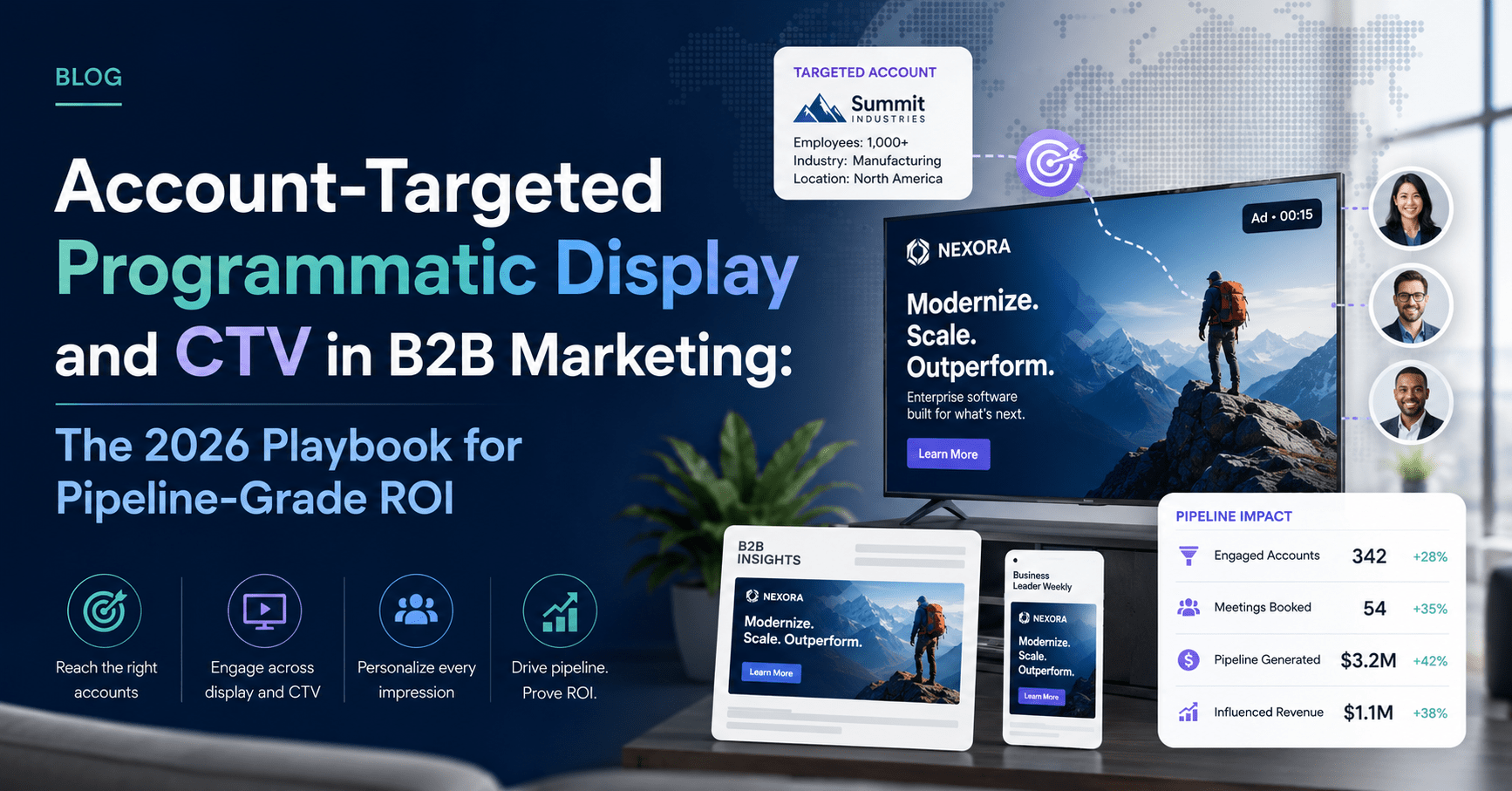
Account-targeted programmatic display and CTV in B2B marketing is the practice of using a demand-side platform to serve banner, native, video, and Connected TV ads exclusively to a defined list of target companies and the specific decision-makers inside them. The approach replaces broad reach with account-level precision; companies running display and CTV together see 46% more domains visited and 54% more clicks from named accounts than those running display alone, per Demandbase customer data.
Key Facts at a Glance
- U.S. CTV ad spend is projected to reach $37.95 billion in 2026, growing 14.5% year-over-year, per EMARKETER (Source: EMARKETER via StackAdapt, March 2026).
- LinkedIn captured 47% of B2B digital display spending in 2024, more than any other single channel, per EMARKETER (Source: EMARKETER via Stream TV Insider, June 2025).
- Forrester’s 2025 predictions found that half of younger B2B buyers will include 10 or more external influencers in their purchase decisions (Source: Forrester, October 2024).
- Account-based marketing increases pipeline conversion rates by 14% and lifts MQL-to-sales-accepted-lead conversion by 25%, per Gartner (Source: Gartner via TheCMO, February 2026).
- 87% of B2B marketers say ABM delivers higher ROI than other marketing approaches, per ITSMA Momentum research (Source: ITSMA Momentum via TheCMO, February 2026).
- CTV ad viewability rates exceed 97% and completion rates exceed 95%, materially higher than mobile or open-web display (Source: Marketing LTB CTV Statistics, 2026).
- 95% of B2B buyers are out-of-market at any given moment, making always-on account-level brand presence the deciding factor in shortlist inclusion (Source: LinkedIn / iSpot via TVREV, July 2025).
If your B2B advertising still treats every impression as equal, you are subsidizing the wrong audience. The companies winning enterprise pipeline in 2026 are the ones that have stopped buying impressions and started buying influence inside specific accounts.
This guide explains exactly how account-targeted programmatic display and CTV work, how they fit together, and the operational decisions that separate B2B programmatic programs that produce pipeline from those that produce only impressions. You will get a side-by-side channel comparison, ROI benchmarks from Forrester, Gartner, EMARKETER, ITSMA, SiriusDecisions, and Demandbase, and a clear set of conditions under which this strategy does and does not earn its keep.
I am Peter Geisheker, Founder and CEO of The Geisheker Group, a Fractional CMO and B2B marketing advisory that helps CEOs and investor-backed companies build capital-efficient revenue systems. Most of the questions I get about programmatic in 2026 are not really about programmatic; they are about how to stop wasting paid media on accounts that will never buy. That is what this article addresses.
In this article:
- What account-targeted programmatic display is, in B2B terms
- What CTV advertising is, and why it is now a B2B channel
- Why display and CTV are stronger together than either is alone
- The five operational decisions that determine whether the program produces pipeline
- How to build a target account list that programmatic can actually act on
- A side-by-side comparison of account-targeted display, CTV, LinkedIn, and linear TV
- Best practices that drive the highest ROI
- When the strategy does NOT make sense
- FAQs
What Is Account-Targeted Programmatic Display in B2B Marketing?
Account-targeted programmatic display is the automated buying of banner, native, and video ad inventory across the open web, served exclusively to devices and individuals associated with a defined list of target companies. In a B2B context, the targeting unit shifts from anonymous audiences to named accounts and the buying committees inside them, with frequency, creative, and bidding all controlled at the account level rather than the impression level.
There are three mechanisms underneath that definition. IP targeting maps known company IP ranges to your account list and serves ads to anyone browsing from those networks (Hey Sid, 2026). Person-level targeting uses identity graphs to match named individuals across the open web, apps, and CTV (AI Digital, April 2026). Firmographic and intent overlays then layer industry, revenue size, and active-research signals from providers like Bombora, G2, and 6sense onto bidding decisions (Madison Logic, May 2025). The Trade Desk, StackAdapt, Demandbase, 6sense, and Madison Logic are the dominant DSPs running this work in the U.S. market.
What Is CTV Advertising, and Why Is It Now a B2B Channel?
Connected TV (CTV) advertising delivers full-screen, sound-on, mostly non-skippable video ads to internet-connected television devices: smart TVs, Roku, Amazon Fire TV, Apple TV, gaming consoles, and the streaming apps running on them. Every CTV impression is digitally bought, served, and measured, which is what separates it from linear cable.
CTV became a credible B2B channel for two reasons. First, the audience moved. Streaming surpassed cable and broadcast combined in mid-2025, and 89.5% of U.S. households now own at least one internet-connected TV device (EMARKETER via StackAdapt, March 2026). Decision-makers are watching Hulu, Peacock, Disney+, ESPN+, Netflix’s ad tier, and Prime Video on their living-room TVs. Second, the targeting matured. LinkedIn’s 2024 CTV launch and its 2025 expansion through The Trade Desk now let advertisers target premium streaming inventory using LinkedIn’s job title, industry, and seniority data (AdExchanger, June 2025). Demandbase’s Piper DSP, Madison Logic’s ABM CTV, and 6sense’s CTV products all do similar work using firmographic and intent signals.
A 2026 Magna Media Trials study cited by AdExchanger reported that 98% of LinkedIn users watch CTV in a given week, with 94% watching ad-supported tiers (AdExchanger, June 2025). For B2B specifically, that is a higher concentration of decision-makers than any feed-based channel can deliver.
Why Combine Account-Targeted Display and CTV Instead of Running Either Alone?
The two channels do different jobs at different stages of the same buying journey, and they compound when paired. CTV creates attention and brand familiarity inside named accounts; display closes the loop with frequency, retargeting, and direct-response prompts.
The performance gap is documented. Demandbase’s customer data, drawn from B2B accounts running both channels, shows a 46% increase in domains visited, 21% higher engagement, and 54% more clicks when CTV runs alongside display, compared to display alone (Demandbase, March 2026). The mechanism is straightforward: a CFO sees a 30-second story-driven ad on Peacock, then encounters the same brand on a banner the next morning while reading industry trades. The familiarity created by the first impression makes the second impression cheaper to convert. ABM-aligned programmatic campaigns that use this pattern report 60% higher win rates than non-aligned programs (Hey Sid, March 2026).
The strategic reason matters more than the tactical lift. With Forrester documenting expanding B2B buying networks, where half of younger buyers now include 10 or more external influencers in their purchase decisions (Forrester, October 2024), no single channel covers the committee. CTV reaches the executive at home; display reaches the practitioner researching at work; LinkedIn reaches the manager validating during the day. Pull any one out and the orchestration breaks.
The Five Operational Decisions That Determine Pipeline Outcomes
Five operational decisions separate account-targeted programmatic programs that produce pipeline from those that produce only impressions. Each one builds on the last.
1. Account Tier Architecture. Build a target account list of 50–500 named accounts with sales-committed buy-in, then segment into tiers (Tier 1A: highest-value strategic accounts; Tier 1B: strong-fit growth accounts; Tier 2: addressable market). Spend per account, frequency caps, and channel mix all vary by tier. Without this segmentation, programmatic budget over-serves accounts that cannot generate enterprise revenue.
2. Signal Layer Activation. Layer first-party signals (CRM activity, website visits to pricing or comparison pages), third-party intent (Bombora, G2 Buyer Intent), and trigger events (funding rounds, executive hires, technology adoption) onto the account list. 6sense reports prediction accuracy of 70–85% in identifying accounts that create opportunities within 90 days, based on layered behavioral analysis (Quota Engine 6sense Review, March 2026). 6sense customer benchmarks show 4x higher conversion rates, 46% larger deal sizes, and 27% faster sales cycles for accounts engaged with this kind of signal-driven targeting (6sense, January 2026). Every signal type should have a documented play attached.
3. Channel Sequencing. CTV opens; display compounds; LinkedIn closes. Run CTV as the brand-awareness layer for top-tier accounts during planning windows, follow with always-on programmatic display for the buying committee, and reserve LinkedIn for direct response to the named individuals already showing intent. Sequence is the variable most teams skip.
4. Creative Tied to Buying Stage. No B2B prospect makes a $250,000 decision after one ad. Develop creative variants for awareness (CTV: 30-second story, no offer), consideration (display: framework or research-led messaging), and decision (display + LinkedIn: case study, ROI calculator, demo). Refresh creative every 60–90 days; ad repetition reduces brand favorability by roughly 14% among heavy streamers when creative goes stale (Marketing LTB, 2026).
5. Account-Level Outcome Measurement. Pipeline-influenced revenue is the only metric that matters. Stop reporting CTR for B2B display; the average is 0.46% and it does not predict revenue (Hey Sid, March 2026). Measure target-account site visit lift, branded search lift inside exposed accounts, opportunity-creation rate by exposed vs. control cohort, deal velocity, and self-reported attribution on demo forms. Geo-lift and account holdout tests give the cleanest causal read on incrementality.
For deeper context on the broader operating model these five decisions sit inside, see the Geisheker Group ABM Operating System guide.
How Do You Build a Target Account List That Programmatic Can Actually Act On?
The list defines the ceiling on every other decision. Programmatic budget against a vague list produces a vague pipeline.
Start with the Ideal Customer Profile (ICP), defined by hard fit criteria: industry, revenue band, employee count, technology stack, geography, regulatory profile, and buying-trigger likelihood. Use ZoomInfo, Clearbit, or 6sense to enrich the ICP into a candidate list of 1,000–5,000 companies in your addressable market. Then narrow ruthlessly to 50–500 named accounts using two filters: signal strength (active intent, fit score, recent triggers) and sales conviction (the AE assigned to the territory has to commit to working it).
The discipline that separates programs that generate pipeline from programs that generate impressions is sales co-ownership. If sales has not committed to the named account list, marketing’s media spend on those accounts is decoration. Build the list jointly, document a Sales-Marketing SLA on what counts as an engaged account, and review the list every quarter using closed-won, closed-lost, and disqualified data. SiriusDecisions research found that B2B organizations with tightly aligned sales and marketing operations achieve 24% faster three-year revenue growth and 27% faster three-year profit growth than misaligned organizations (SiriusDecisions via Inflexion-Point). Yet only 8% of companies report strong alignment between sales and marketing, per ZoomInfo’s compilation of recent industry surveys (ZoomInfo, February 2025), which is why most ABM programs underperform their potential.
How Should You Measure Account-Targeted Display and CTV ROI?
Click-through rate is the wrong metric for B2B. It is the wrong metric in two specific ways: it under-credits CTV (where there is no click) and it over-credits display retargeting (which often takes credit for revenue that brand and content created earlier).
Measure five things instead. Target-account site visit lift answers “did exposed accounts visit our site more than unexposed accounts?” Pipeline influence answers “did exposed accounts create opportunities at higher rates and larger deal sizes?” Deal velocity answers “did exposed accounts move through stages faster?” Brand search lift answers “did branded search inside exposed companies’ geographic markets rise during the campaign?” Self-reported attribution on demo forms (“How did you first hear about us?”) surfaces the dark-funnel touchpoints that no pixel captures. Refine Labs’ study of more than 40 SaaS companies, corroborated by ORM’s research, shows self-reported attribution consistently reveals that 30–50% of pipeline originates from channels digital attribution cannot see, see The Geisheker Group’s deeper analysis of self-reported attribution and dark-funnel measurement.
The cleanest causal read is a geo-lift test or account holdout test. Pick two comparable markets (or two random subsets of your target list), run programmatic in one and not the other, and measure pipeline difference over 90 days minimum (B2B sales cycles demand it). This produces defensible numbers no last-click model can.
The published B2B ROI evidence is concrete. Companies running CTV alongside display see the Demandbase 46/54 lift on domains visited and clicks. ITSMA Momentum research, cited across industry analyses, finds that 87% of B2B marketers report ABM delivers higher ROI than other marketing approaches (ITSMA Momentum via TheCMO, February 2026). Gartner research shows ABM increases pipeline conversion rates by 14% and lifts MQL-to-sales-accepted-lead conversion by 25% (Gartner via TheCMO, February 2026).
Comparison: Account-Targeted Display vs. CTV vs. LinkedIn vs. Linear TV
The four channels compete for attention in different parts of the funnel. The decision is not which one wins; it is which combination produces the most pipeline-influenced revenue per dollar.
| Channel | Typical CPM (B2B) | Account-Level Targeting | Best Funnel Stage | Strength | Limitation |
|---|---|---|---|---|---|
| Account-Targeted Programmatic Display | $5–$15 | High (IP, person-level, firmographic) | Awareness → Consideration | Always-on brand presence at low CPM; cookie-free via IP | Low CTR (0.46% avg); not a direct-response channel |
| Connected TV (CTV) | $35–$60 | High via DSPs and LinkedIn CTV | Awareness → Brand authority | 97%+ viewability, 95%+ completion, premium environment | Higher CPM; requires real video creative |
| LinkedIn (Sponsored Content + InMail) | $30–$80+ | Highest (job title, company, seniority) | Consideration → Decision | Most precise persona targeting; deep B2B intent | Premium pricing; CPM inflation in saturated categories |
| Linear TV | $20–$45 | Low (DMA-level; little to no account precision) | Awareness only | Mass reach for category-defining brands | Cannot reach named accounts; declining viewership |
Sources: Hey Sid 2026 Programmatic Guide; Marketing LTB CTV Statistics 2026; EMARKETER via StackAdapt CTV 2026; AdExchanger LinkedIn CTV 2025.
The takeaway: CTV and account-targeted display are complementary, not substitutes. CTV buys attention; display buys frequency; LinkedIn buys precision; linear TV buys mass without account control. For most mid-market and growth-stage B2B companies, the highest-ROI mix is account-targeted display + CTV + LinkedIn, with no linear TV at all until brand becomes a category-defining priority.
What Are the Best Practices for the Highest ROI?
Eleven practices separate programs that produce pipeline-grade ROI from programs that produce impressions and excuses.
1. Commit a real budget for at least 90 days. B2B sales cycles run 6 to 18 months, and programmatic compounds with frequency. Two- and four-week tests rarely produce measurable B2B results (Hey Sid, March 2026). Plan a 90-day pilot at $3,000–$5,000 per month minimum for a 25–50 account test, and 6–12 months for full-program deployment.
2. Concentrate spend, do not spread it. A 2x ROI on 100 named accounts is dramatically better than 0.5x ROI on 1,000 random impressions. Concentration is the single biggest variance driver in ABM program economics, per multiple ITSMA and Forrester benchmark studies summarized in TheCMO’s 2026 ABM analysis (ITSMA / Forrester via TheCMO, February 2026).
3. Pair CTV with display from day one. The Demandbase 46/54 lift numbers are the floor, not the ceiling. CTV alone struggles to drive direct response; display alone struggles to create memorable brand impression. Run them together.
4. Build creative for B2B reality, not B2C reflexes. A 30-second CTV spot does not need a six-figure production budget; it needs a clear strategic message, a credible business case, and a founder or expert on camera. The bar is quality storytelling in 30 seconds, not Super Bowl polish (SpotlightIQ, March 2026).
5. Frequency-cap at the account level, not the impression level. The Trade Desk’s iABM, Demandbase’s Piper DSP, and Madison Logic’s ML Platform all support account-level frequency capping (AI Digital, April 2026). Use it. Spreading impressions evenly across the buying committee inside an account beats hammering one user 80 times.
6. Refresh creative every 60–90 days. Frequency fatigue is a quiet killer inside small target audiences. Multiple creative variants per account, rotated quarterly, prevent the engagement decay curve.
7. Sequence creative to buying stage. Awareness creative, consideration creative, and decision creative are not interchangeable. CTV opens with story; display retargets with framework or proof point; LinkedIn closes with case study or ROI calculator. Mismatched creative-stage pairings waste impressions.
8. Use intent data to dynamically reallocate budget. Static account lists waste budget on dormant accounts. When a target account hits a buying signal threshold (pricing-page visit, G2 comparison view, executive hire), shift more budget to that account for the next 30–60 days. 6sense customer benchmarks show 4x higher conversion rates from accounts engaged based on layered behavioral signals versus baseline targeting (6sense, January 2026).
9. Coordinate with sales outreach, do not parallel-track it. Programmatic + outbound coordinated against the same accounts in the same week beats either run independently. Sales outreach into accounts that have been ad-warmed converts at materially higher rates.
10. Measure what predicts revenue, not what is easy to count. Reporting CTR and impressions to a CFO is professional malpractice in 2026. Report pipeline-influenced revenue, opportunity creation rate by exposed vs. control cohort, and deal velocity. Use self-reported attribution on demo forms to capture dark-funnel influence, see The Geisheker Group’s dark funnel guide for the measurement layer.
11. Run incrementality tests at least quarterly. Without geo-lift or holdout tests, every ROI number you report is a correlation. Hold out 20–30% of your target accounts from a campaign for 90 days, then measure the pipeline difference. The result will surprise you, and it will give you the only defensible budget conversation you can have with finance.
When Does Account-Targeted Display and CTV NOT Make Sense?
Account-targeted programmatic is not a universal solution. There are clearly defined conditions under which broad-reach demand generation produces better economics, and recognizing them prevents expensive mistakes.
It does not fit when average contract value is under $25,000, because per-account treatment cost cannot be amortized over a small deal even if customer lifetime value is meaningful. It does not fit when the target market is undefined or your ICP is still being validated, because the precision of programmatic compounds with the precision of the list. It does not fit when video creative production is impossible, because CTV without quality video is wasted budget. It does not fit when sales and marketing are not aligned on the named account list, because programmatic spend on accounts the sales team will not work is decoration. And it does not fit when the time horizon is shorter than 90 days; B2B brand and pipeline effects compound, they do not snap into place.
If any of those conditions describe your environment, fix the foundation first.
Frequently Asked Questions
What is account-based programmatic advertising?
Account-based programmatic advertising is the automated buying of digital ad inventory targeted exclusively to a defined list of named B2B accounts and the buying committees inside them. It uses real-time bidding through DSPs to deliver banner, native, video, and CTV ads to specific companies and people identified by IP address, identity graph, firmographic data, or intent signal. The targeting unit is the account, not the anonymous user. Campaigns are typically planned in tiers (Tier 1A strategic, Tier 1B growth, Tier 2 addressable market) with per-account frequency capping, spend allocation, and creative sequencing.
How does CTV work for B2B?
CTV ads in B2B work the same way they work in B2C from a delivery standpoint: programmatic auctions place 15-, 30-, or 60-second video ads inside premium streaming content on smart TVs and streaming devices. The B2B difference is in targeting and measurement. Through DSPs like The Trade Desk, Demandbase Piper, Madison Logic, and LinkedIn CTV, advertisers can target streaming households associated with specific companies, job titles, and industries, then measure account-level outcomes (target-account website visits, pipeline lift, branded search lift) rather than clicks. Premium inventory comes from Hulu, Disney+, Peacock, ESPN+, Paramount+, NBCUniversal streaming, and Roku.
What is the ROI of programmatic ABM?
ITSMA Momentum research, widely cited across industry analyses, finds that 87% of B2B marketers report ABM delivers higher ROI than other marketing approaches (ITSMA Momentum via TheCMO, February 2026). Gartner research shows ABM increases pipeline conversion rates by 14% and lifts MQL-to-sales-accepted-lead conversion by 25% (Gartner via TheCMO, February 2026). Companies running CTV alongside display see 46% more domains visited and 54% more clicks from named accounts than display-only programs, per Demandbase customer data (Demandbase, March 2026). Variance is driven primarily by tier discipline, sales-marketing alignment, and signal-to-action mapping, not by platform choice.
How do you target specific accounts on CTV?
Three mechanisms deliver account-level CTV targeting. First-party data targeting uploads your CRM account list or target list to a CTV platform that maps it to households associated with those companies. IP-based targeting delivers ads to streaming devices on networks owned by target accounts. Identity graph targeting matches named individuals (using LinkedIn’s professional graph or third-party identity providers) to streaming devices in their homes. Demandbase’s Piper, LinkedIn CTV, Madison Logic ABM CTV, and 6sense all support some combination of these. Account-level frequency capping ensures impressions distribute across the buying committee rather than concentrating on one user.
What is the best DSP for B2B programmatic advertising?
The “best” DSP depends on team size, budget, and what you need account targeting to do. The Trade Desk offers the most advanced account-level capabilities through its iABM partnership but requires roughly $20,000/month in spend and trained ad ops. Demandbase and 6sense are integrated ABM platforms with built-in advertising at $18K–$300K/year. StackAdapt is a self-serve DSP starting around $5,000/month. Madison Logic specializes in ABM-integrated programmatic. LinkedIn Campaign Manager runs CTV directly using LinkedIn’s professional graph. For most mid-market B2B companies under $20M revenue, an integrated ABM platform delivers more value than a standalone DSP because it consolidates targeting, measurement, and reporting (Hey Sid, March 2026).
Is CTV worth it for small B2B companies?
CTV is worth testing for B2B companies with a clearly defined ICP, an average contract value above $25,000, and the ability to commit at least $3,000–$5,000 per month for a 90-day pilot. It is not worth running for transactional or low-ACV B2B businesses where the per-impression cost cannot be amortized. The most credible small-business CTV outcome reported publicly is Dialpad’s CTV + retargeting campaign on LinkedIn, which produced a 45% increase in lead form completions and influenced $43 million in pipeline (LinkedIn / iSpot via TVREV, July 2025). The same pattern is reproducible at smaller scales when the account list is concentrated.
How is success measured for account-targeted display and CTV?
Success in B2B is measured at the account and pipeline level, not the impression or click level. The metrics that predict revenue are: target-account website visit lift, branded search volume lift inside exposed account markets, opportunity-creation rate for exposed vs. control cohorts, deal velocity (days from first touch to closed-won), self-reported attribution on demo forms, and pipeline-influenced revenue. The cleanest causal read comes from geo-lift tests (run programmatic in one market, hold out a comparable market) or account holdout tests (exclude 20–30% of the target list and compare pipeline outcomes after 90+ days). CTR is a vanity metric in B2B.
How long should a B2B programmatic campaign run before judging results?
Plan for 90 days minimum, and build budgets for 6 to 12 months for full-program deployment. B2B sales cycles run 6 to 18 months, programmatic compounds with frequency, and brand familiarity inside named accounts builds over weeks of repeated exposure. Two- to four-week tests typically produce no measurable B2B results because the buying journey is longer than the test window. Always-on campaigns running 90+ days produce compounding effects as brand familiarity rises across the buying committee (Hey Sid, March 2026).
Conclusion
Account-targeted programmatic display and CTV in B2B marketing is not a media-buying technique; it is a discipline. The discipline concentrates budget where revenue is likely, surrounds buying committees inside named accounts with coordinated touches across screens, and ties every dollar to a sales-aligned outcome. Companies that run it without the discipline produce impressions; companies that run it with the discipline produce pipeline.
The five operational decisions covered in this article, account tier architecture, signal layer activation, channel sequencing, creative tied to buying stage, and account-level outcome measurement, are the variables that determine whether B2B programmatic produces pipeline or burns budget. Skipping any one of them is the most common failure mode in B2B advertising programs.
If your B2B company is spending on programmatic and cannot answer the question “which named accounts moved into pipeline because of our advertising in the last 90 days,” you have a measurement and orchestration problem, not a media-buying problem. That is fixable in a quarter, and it does not require more budget; it requires better discipline. Schedule a free consultation if you want to walk through how this would apply to your specific account list and channel mix.
About Peter Geisheker
Peter Geisheker is the Founder and CEO of The Geisheker Group, Inc., a Fractional CMO and B2B marketing advisory serving CEOs and investor-backed companies. He specializes in scalable, capital-efficient revenue systems across B2B SaaS, B2B services, and performance-driven environments, with AI embedded across all engagements. His work includes programs delivering 6X inbound lead growth, 100% YoY SaaS revenue growth for three consecutive years, and a 77% reduction in paid acquisition spend while growing revenue.
Ready to explore how a Fractional CMO can accelerate your growth? Schedule a free consultation with Peter.
References and Sources
- Demandbase, “Understanding CTV in B2B advertising: A strategic playbook for 2026” — https://www.demandbase.com/blog/ctv-b2b-advertising/
- EMARKETER via StackAdapt, “Connected TV Statistics: Growth Stats & Trends in 2026” — https://www.stackadapt.com/resources/blog/connected-tv-stats
- EMARKETER via Stream TV Insider, “LinkedIn partners with Paramount, levels up emerging CTV ad game,” June 2025 — https://www.streamtvinsider.com/advertising/linkedin-partners-paramount-levels-emerging-ctv-ad-game
- AdExchanger, “LinkedIn’s CTV Ads Are Helping B2B Advertisers Find Audiences Where They Live,” June 2025 — https://www.adexchanger.com/?p=437318
- Forrester, “Forrester’s B2B Marketing & Sales Predictions 2025,” October 2024 — https://www.forrester.com/press-newsroom/forrester-predictions-2025-b2b-marketing-sales/
- Gartner and ITSMA Momentum, research compiled by TheCMO, “30 Eye-Opening ABM Statistics That Prove Its Effectiveness,” February 2026 — https://thecmo.com/demand-generation/abm-statistics/
- Marketing LTB, “Connected TV Statistics 2026: 93+ Stats & Insights” — https://marketingltb.com/blog/statistics/connected-tv-statistics/
- SpotlightIQ, “CTV vs. Programmatic Display for B2B (2026)” — https://www.spotlightiq.com/insights/ctv-vs-programmatic-display
- SpotlightIQ, “CTV Advertising for B2B: How Account-Based Television Reaches Decision-Makers,” March 2026 — https://www.spotlightiq.com/insights/ctv-advertising-b2b
- Hey Sid, “Programmatic Advertising for B2B: Complete Guide 2026” — https://www.heysid.com/resources/programmatic-advertising-for-b2b-complete-guide
- Hey Sid, “B2B Display Advertising: Channels, Targeting, and ROI Guide,” March 2026 — https://www.heysid.com/resources/b2b-display-advertising-channels-targeting-roi-guide
- Hey Sid, “IP Targeting for B2B: How It Works and When to Use It,” March 2026 — https://www.heysid.com/resources/ip-targeting-for-b2b-how-it-works-and-when-to-use-it
- Hey Sid, “Top Programmatic Advertising Platforms for B2B in 2026” — https://www.heysid.com/resources/top-programmatic-advertising-platforms-for-b2b
- Madison Logic, “How Programmatic Ads Supercharge ABM” — https://www.madisonlogic.com/blog/programmatic-ads-account-based-marketing/
- AI Digital, “Account-Based Marketing in Programmatic Advertising,” April 2026 — https://www.aidigital.com/blog/account-based-marketing
- ZoomInfo Pipeline, “20 Sales and Marketing Alignment Statistics,” February 2025 — https://pipeline.zoominfo.com/sales/sales-and-marketing-alignment-statistics
- SiriusDecisions research summarized by Inflexion-Point, “Why Sales and Marketing Alignment Really, Really Matters” — https://www.inflexion-point.com/Blog/bid/80213/Why-Sales-and-Marketing-Alignment-Really-Really-Matters
- LinkedIn / iSpot via TVREV, “Why B2B Marketers Are Turning To CTV,” July 2025 — https://www.tvrev.com/news/ctv-is-the-new-b2b-power-channel-why-linkedin-and-ispot-say-the-smartest-buyers-are-watching-tv
- 6sense, “The Impact of GenAI and LLMs on B2B Buyer Research,” January 2026 — https://6sense.com/guides/how-genai-and-llms-are-changing-b2b-buyer-research-and-how-to-respond/
- Quota Engine, “6sense Review 2026: AI-Powered ABM & Intent Data Platform,” March 2026 — https://www.quotaengine.com/tools/6sense/