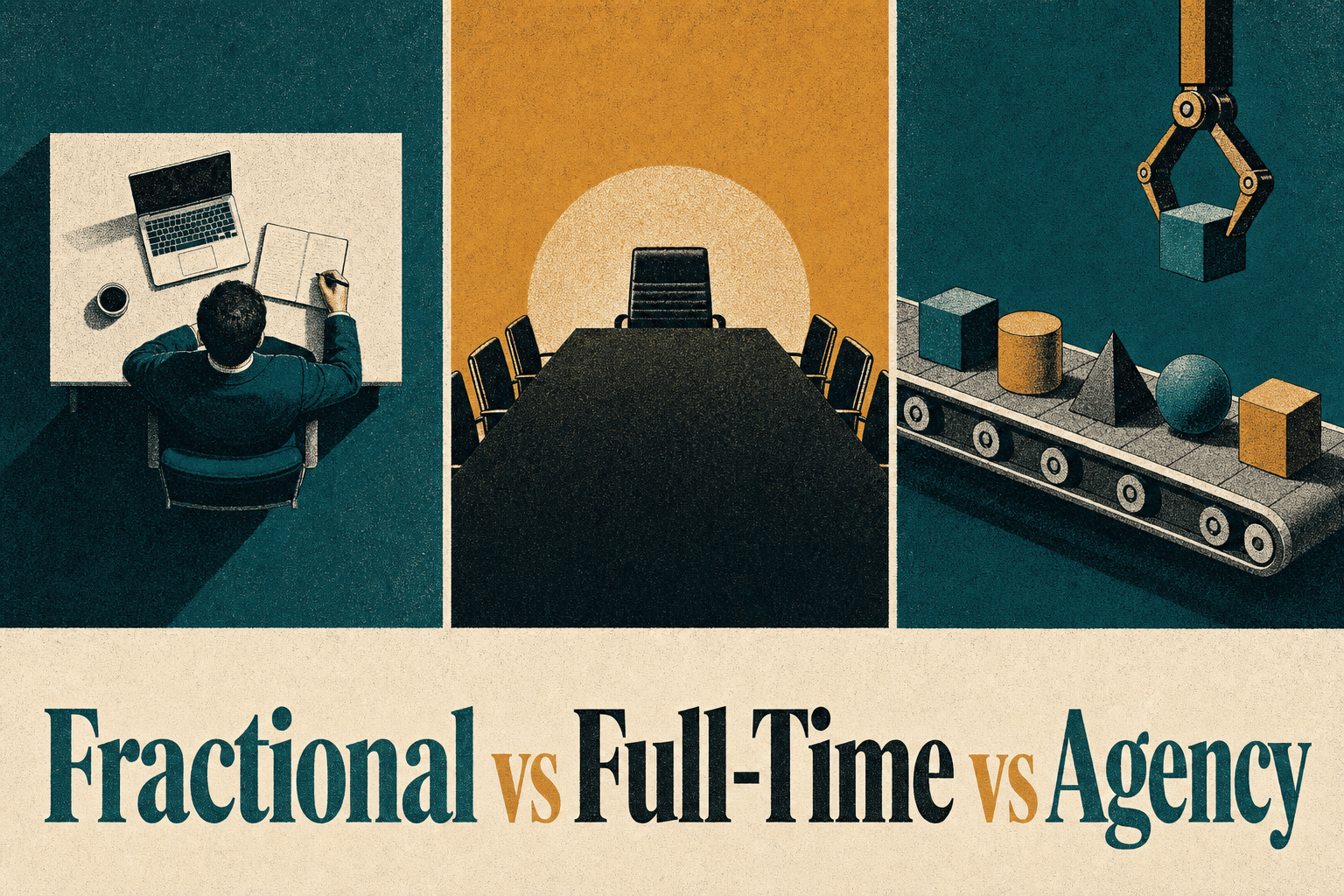
Choose a fractional CMO when you need senior leadership and ownership of pipeline but cannot yet justify a permanent executive. Choose a full-time CMO when marketing is your main growth engine and there is a real team to lead every day. Choose an agency only when the strategy is already right and you need more hands to execute it.
By Peter Geisheker
Key facts
- The average tenure of an S&P 500 CMO is 4.1 years, compared with 5.0 years for all C-suite roles at those companies (Spencer Stuart, CMO Tenure 2026). Plan for the person you hire not being the person who is there at exit.
- Typical private equity deals now need about 10 to 12 percent average annual EBITDA growth to produce a 2.5X return over five years, versus about 5 percent in the 2010s (Bain & Company, Global Private Equity Report 2026 press release). Growth now has to come from operations, and marketing leadership is part of operations.
- A full-time CMO and a fractional CMO both buy leadership. An agency buys execution capacity. An in-house team buys execution you control. These are different products, not different prices for the same thing.
- The Geisheker Group’s Fractional CMO Leadership starts at $10,000 per month with a 90-day minimum sprint (how fractional CMOs charge).
The five marketing leadership models, in one sentence each
Each model buys something different. The wrong choice usually comes from buying capacity when the real gap is leadership, or the reverse.
- Fractional CMO: a senior marketing executive who works with your company on an ongoing, part-time basis, reports to the CEO, owns the marketing strategy and the pipeline number, and directs the people and vendors who do the work. If you want the full definition, see what a fractional CMO is.
- Full-time CMO: a permanent executive hire who owns strategy, the team, the budget and revenue accountability, and carries full-time salary, benefits, usually equity, and severance exposure.
- Interim CMO: a senior executive who fills a vacant CMO seat full-time for a defined period, usually until a permanent hire is made.
- Marketing agency: an outside vendor that supplies execution in one or more channels (paid media, SEO, content, events, design) and is accountable for the deliverables in its scope of work, not for your revenue.
- In-house team: your own marketing employees (a marketing manager, a demand generation specialist, a content lead, a marketing operations person) who execute day to day.
The single most useful distinction on this page: two of these are leadership (fractional and full-time CMO), one is a temporary seat-filler (interim), and two are capacity (agency and in-house team). Capacity without leadership produces activity. Leadership without capacity produces a plan nobody runs.

Try two senior CMOs before you hire them
30 minutes with both of us. No hard sell. Written plan in 3 business days.
Side-by-side comparison
| Fractional CMO | Full-time CMO | Interim CMO | Marketing agency | In-house team | |
|---|---|---|---|---|---|
| What you get | Senior strategy, ownership of the number, direction of team and vendors | Senior strategy, ownership, daily presence and team management | A senior executive in the empty seat, full-time, for a set period | Channel execution and specialist skills | Day-to-day execution and institutional knowledge |
| Who owns strategy | The fractional CMO, with the CEO | The CMO | The interim CMO, usually to hold the line until a permanent hire | Nobody inside the company; the agency recommends within its scope | Nobody, unless a senior leader sits above the team |
| Accountability for pipeline | Yes: pipeline, CAC and payback are the scorecard | Yes, fully | Yes, for the term of the assignment | No: accountable for deliverables and channel metrics | Indirect: accountable for tasks set by someone else |
| Commitment and exit | 90-day minimum sprint, then ongoing; no search, no severance | Executive search, salary, benefits, often equity; costly to unwind | Fixed term; ends when the permanent CMO starts | Monthly retainer or project; exit terms set by contract | Permanent headcount; hiring and termination costs |
| Best for | A leadership gap without the scale or certainty to justify a permanent executive | Marketing is the main growth engine and there is a real team to lead | A sudden vacancy that cannot wait for a search | Strategy is set and correct; you need hands or deep channel skill | Steady, ongoing work that benefits from people who know the product |
| Main risk | Hired to fix an execution problem it cannot staff | Expensive mis-hire, slow ramp, tenure shorter than your plan | Treated as permanent; no system left behind when they go | Optimizes its own channel while the real growth problem goes untouched | Busy team with no strategy, so activity rises and pipeline does not |
On cost: a full-time CMO is the most expensive option in fixed cost. You pay an executive salary and benefits, usually equity, often a search fee, and you carry severance risk if it does not work. I am not going to quote a CMO pay figure here because I could not verify one from a primary source,. Interim CMOs are typically priced for full-time commitment over a short term. Agencies are priced by scope, so the cost rises with every channel you add. Our own Fractional CMO Leadership starts at $10,000 per month with a 90-day minimum sprint; the pricing models page explains how fees are structured. My view is that the fee should be based on senior experience and outcomes, not time.
Two rows in that table decide most cases. “Who owns strategy” tells you whether anyone is responsible for direction. “Accountability for pipeline” tells you whether anyone is responsible for the result. If the honest answer to both is “nobody,” you have a leadership gap, and adding an agency or another coordinator will not close it.
Decision guide: which model fits your situation
Here are the seven situations I see most often in B2B companies with $2M or more in revenue and in PE-backed portfolio companies, with the model I would recommend and why.
| Your situation | Recommended model | Why |
|---|---|---|
| 1. First senior marketing leader | Fractional CMO | You need strategy, positioning and a pipeline plan before you know what the permanent role should look like. |
| 2. PE-backed, first 100 days after close | Fractional CMO | The value creation plan needs a marketing owner immediately, and adding permanent overhead is the wrong direction. |
| 3. Turnaround: pipeline falling, no clear reason | Fractional CMO, then decide | You need a diagnosis from someone senior before committing to a hire or a new agency. |
| 4. Preparing for exit in 12 to 24 months | Fractional CMO | Buyers want documented, repeatable pipeline. You need the system built and proven, not a new executive still ramping. |
| 5. Agency not performing | Fractional CMO above the agency | The problem is usually the brief and the scorecard, not the agency. Someone senior has to own both. |
| 6. Your CMO just left | Interim CMO or fractional CMO | Interim if you need a full-time seat-filler while you search; fractional if the role should be rethought first. |
| 7. Scaling a proven engine with a real team | Full-time CMO | The playbook works, the team is growing, and the role needs daily leadership. |
1. You are hiring your first senior marketing leader
This is the most common case and the one most often gotten wrong. A company that has never had senior marketing leadership usually does not know what the permanent job is yet. Is it a demand generation role, a product marketing role, or a brand and category role? Hiring a full-time CMO before you know the answer is how companies end up with an expensive mismatch. The cost of a bad marketing hire is covered in detail elsewhere; the short version is that you lose the salary and, worse, the months. A fractional CMO sets the strategy, builds the first version of the engine, and helps you define the role you eventually hire. The question of which title you actually need is covered in CMO vs VP of marketing vs marketing director, and the sequence of hires that follows is in what to hire first.
2. You are a PE-backed company in the first 100 days
The value creation plan almost always assumes revenue growth, and Bain’s numbers above explain why: returns now depend on operational growth, not leverage. The plan needs a marketing owner on day one, not after a search. A fractional CMO can own the marketing part of the plan, set the pipeline targets the board will track, and decide which existing vendors stay. The way funds deploy this model across a portfolio is covered in how private equity firms use fractional CMOs.
3. You are in a turnaround
When pipeline is falling and nobody can say why, the worst move is to buy more activity. Before choosing a permanent model, get a senior diagnosis: Is it positioning, the ideal customer profile, channel mix, sales handoff, or the market itself? A fractional CMO can make that call and fix what is broken. Once the engine is stable, you will know whether you need a full-time CMO or whether a strong director plus fractional oversight is enough.
4. You are preparing for an exit
A buyer will ask how pipeline is generated, what it costs, and whether it will keep working after the sale. A new full-time CMO who is still learning the business makes that story weaker, not stronger. A fractional CMO can document the engine, clean up attribution, and show a trend line. If the buyer wants a permanent CMO in place, the documented system makes that hire easier for them.
5. Your agency is not performing
In most cases I review, the agency is doing what it was hired to do. Nobody gave it a brief tied to pipeline, and nobody is measuring it on anything but clicks, leads and impressions. Firing it and hiring another usually repeats the same result. Put a senior marketing leader above the agency first. The specifics of how a fractional CMO works with your agency are on their own page.
6. Your CMO just left
Here interim and fractional both fit, for different reasons. If the role is well defined and you are already searching, an interim CMO keeps the seat filled until the new hire starts. If the departure is a chance to ask whether the role was right in the first place, a fractional CMO can run the function while you redesign it. The difference between the two is explained in interim vs fractional CMO, and what to do in the first weeks after a departure is covered in when your CMO leaves.
7. You are scaling a proven engine
If the playbook works, the team is growing past a handful of people, and marketing is the main way the company grows, hire the full-time CMO. That person needs to hire, coach and manage every day. A fractional CMO should not be sold into that company, and I will say so. Given Spencer Stuart’s 4.1-year average tenure for S&P 500 CMOs, write down the system the CMO runs so it survives their departure.
How the models work together
In practice, the strongest setup for most B2B companies that are not yet ready for a full-time CMO is not one model. It is a combination.
- A fractional CMO on top. Owns the strategy, the pipeline number, the budget recommendations and vendor accountability. Reports to the CEO.
- A small in-house team in the middle. Usually a marketing manager or coordinator, plus marketing operations. They run the calendar, the CRM, the website and the day-to-day work, and they keep the knowledge inside the company.
- One or two agencies for specialist execution. Paid media, SEO, content production or design, chosen for the channels that the strategy says matter.
The fractional CMO is the layer that makes the other two productive. The in-house team finally has priorities from someone senior. The agencies get a written brief tied to pipeline, a scorecard based on qualified opportunities and cost per acquisition, and someone with the authority to change their scope or replace them. Without that layer, the team stays busy and the agencies optimize their own channels.
This setup also converts cleanly. Once the engine is proven and the team has grown, you can hire a full-time CMO to run a machine that already works, instead of asking a new executive to invent one during their first year. That is the sequence I recommend for most companies that are not yet at the point described in situation 7.
Common mistakes when choosing a model
- Buying an agency to solve a leadership problem. The agency produces visible activity in the first month, so it feels like progress. Six months later there are campaigns, dashboards and leads, and no change in qualified pipeline. The company never had a strategy for the agency to execute.
- Hiring a full-time CMO before the role is defined. You search, you hire, the person ramps, and then you discover the job you needed was different. The mis-hire costs money and, more importantly, time.
- Hiring a fractional CMO to fix an execution problem. If campaigns are not shipping because nobody has the hands to build them, a fractional CMO will give you a clear, prioritized plan and nobody to run it. Pair the fractional CMO with execution capacity, or fix capacity first. When a fractional CMO is the wrong hire goes deeper on this.
- Giving any leader no authority. A CMO, fractional or full-time, who cannot control budget or vendors is a consultant. Consultants write recommendations. They do not move pipeline.
All four come from the same root cause: choosing a model before deciding whether the problem is direction, capacity or both. Make that call first.
What I bring to this decision
I started The Geisheker Group in 1998. We are two senior B2B fractional CMOs, and together the two partners have led more than 300 strategy sessions with CEOs. In my own career I have delivered 6X inbound lead growth, 100 percent year-over-year SaaS revenue growth for three consecutive years, and a 77 percent reduction in paid acquisition costs, and I have managed more than $50M in annual ad spend with programs deploying up to $1M per week. I mention these not to sell the fractional model to every company. In several of the situations above, I would tell you to hire the full-time CMO or keep the agency and save your money.
Frequently asked questions
Is a fractional CMO cheaper than a full-time CMO?
In fixed cost, yes. A full-time CMO carries salary, benefits, usually equity, often a search fee, and severance exposure, while a fractional CMO carries a monthly fee with no search and no severance. Our Fractional CMO Leadership starts at $10,000 per month with a 90-day minimum sprint. The better question is which one produces qualified pipeline sooner for your situation.
What is the difference between a fractional CMO and a marketing agency?
A fractional CMO owns strategy and is accountable for the pipeline number, reporting to the CEO. An agency executes within a scope of work and is accountable for its deliverables. A simple test: a fractional CMO can fire an agency, and an agency cannot fire itself.
Should I hire an interim CMO or a fractional CMO after my CMO leaves?
Hire an interim CMO if the role is well defined, you are already running a search, and you need someone in the seat full-time until the new hire starts. Hire a fractional CMO if you want to rethink the role, the team or the strategy before you commit to a permanent replacement. Either way, the goal is to avoid losing pipeline momentum during the gap.
Can a fractional CMO manage our in-house team and our agency at the same time?
Yes, and that is the setup I recommend for most companies below full-time-CMO scale. The fractional CMO sets priorities for the in-house team and writes the briefs and scorecards for the agencies. The team keeps institutional knowledge in the company, and the agencies supply specialist skills.
When should a PE-backed company choose a full-time CMO over a fractional one?
When marketing is clearly the main growth engine, the playbook is already proven, and there is a team that needs daily leadership. Before that point, a full-time hire adds permanent overhead while the role is still being defined. Many portfolio companies start fractional, prove the engine, and then hire the permanent CMO to run it.
Can I start with a fractional CMO and move to a full-time CMO later?
Yes, and it is often the safest path. The fractional CMO builds and documents the system, defines the permanent role, and can help you hire for it. The new CMO then inherits a working engine instead of starting from a blank page.
Talk it through with two senior CMOs
If you are deciding between these models right now, book a free 30-minute growth plan session with me and Michael Pecora on Google Meet. We will look at your situation, tell you which model we would choose and why (even if the answer is not us), and send you a written growth plan within 3 business days. No hard sell. We take 10 companies a month. Book your growth plan session.
Free Written Growth Plan
Wondering if a fractional CMO is right for you?
Try us before you hire us. Book a free 30-minute working session with both of us and get a written growth plan you can use whether or not you hire us.
Get My Free Growth Plan →No hard sell on the call. Your plan arrives within 3 business days. See a sample plan