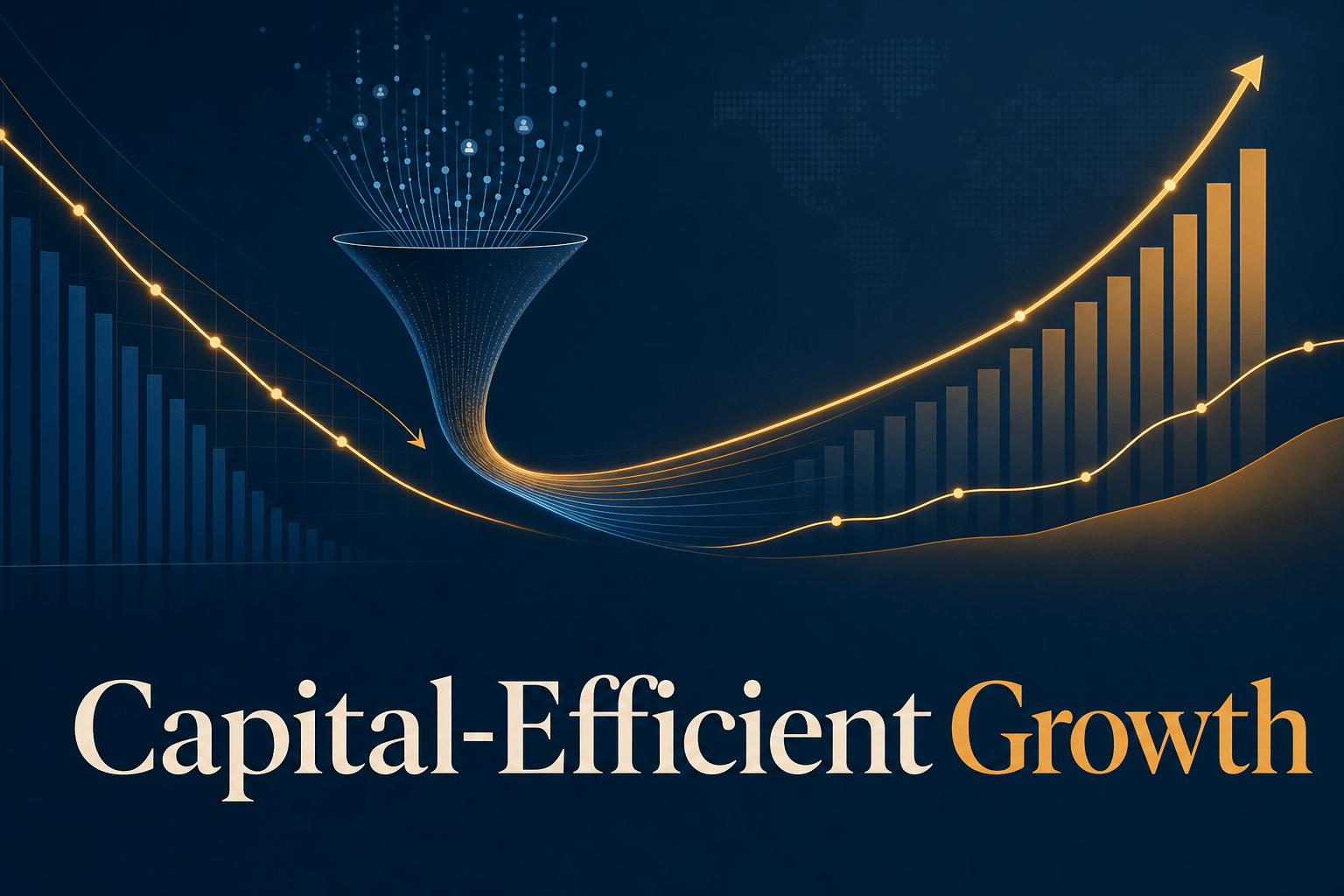
Bottom line: Capital-efficient growth means increasing revenue while lowering the cost to acquire each customer, so growth expands margin and EBITDA instead of consuming cash. In a portfolio company, the instinct when acquisition gets expensive is to cut the marketing budget, which cuts revenue with it. The real move is to cut the cost of acquisition without cutting the acquisition: fix what each channel actually returns, shift rented demand toward owned demand, and focus spend on the customers worth acquiring. Done right, the same growth costs less and drops more to EBITDA, which is exactly what the return now depends on.
Key Facts at a Glance
- In 2026, the return math favors efficiency: with cheap debt and multiple expansion largely gone, revenue growth drove about 71% of the value created in 2024 exits, and margin expansion has become increasingly critical alongside it (Bain & Company, 2026; Chronograph).
- The median B2B SaaS company now spends about $2.00 in sales and marketing to acquire $1.00 of new-customer ARR, up 14% year over year, with the bottom quartile near $2.82 (Benchmarkit, 2025 SaaS Performance Metrics).
- Median CAC payback sits around 16 months on full-year 2025 actuals; top-quartile companies recover acquisition cost in 6 months or fewer, and that gap decides how much capital can be recycled back into growth (Aleph and Benchmarkit, 2026 SaaS and AI Performance Benchmarks).
- Paid-channel inflation is structural: Google Ads costs are up roughly 164% and LinkedIn Ads about 89% since 2019, so simply buying more traffic gets more expensive every year (Data-Mania, 2026).
- The highest-performing profile pairs efficient acquisition with strong retention: companies with high net revenue retention and low CAC payback average roughly 71% growth and a 47 Rule-of-40 score, versus single-digit Rule-of-40 scores for the inverse (2025 SaaS Benchmarks, High Alpha).
- PE-backed software companies already run leaner than VC-backed peers on go-to-market, spending about 33% of revenue on sales and marketing versus 47%, so the lever is efficiency and reallocation, not simply more budget (SaaS Capital, 2025).
- Only about 11% to 30% of SaaS companies meet the Rule of 40, and hitting it carries a meaningful valuation premium, which makes capital-efficient growth an exit-multiple story, not just a margin story (Data-Mania, 2026).
This guide draws on Peter Geisheker’s 20-plus years of B2B marketing experience as founder and CEO of The Geisheker Group, Inc., a fractional CMO agency serving B2B, B2B SaaS, PE/VC-backed, and law firm clients. Peter has personally managed more than $50 million in annual advertising spend, and the centerpiece of this playbook is a result he has delivered: a 77% reduction in paid acquisition cost while revenue grew, alongside documented 6X inbound lead growth. The perspective here is an operator’s, focused on the acquisition math that actually moves margin and enterprise value inside a portfolio company, informed by 2026 value-creation research from Bain, McKinsey, and current go-to-market benchmarks.
Table of Contents
- What Is Capital-Efficient Growth, and Why Does It Matter Now?
- Why Has Customer Acquisition Gotten So Expensive?
- Why Cutting the Marketing Budget Is the Wrong Move
- How Do You Cut CAC Without Cutting Revenue? The Playbook
- What Does It Look Like as a Before and After?
- How Does This Translate to EBITDA and Enterprise Value?
- How Do You Measure Capital-Efficient Growth?
- Frequently Asked Questions
What Is Capital-Efficient Growth, and Why Does It Matter Now?
Capital-efficient growth is revenue growth that costs less to produce over time, measured by a falling cost to acquire a customer, a shorter payback on that cost, and more new revenue generated per dollar of sales and marketing spend. It is the opposite of the growth-at-all-costs model that dominated the cheap-capital era, when burning two or three dollars to generate a dollar of new revenue was tolerated because the next funding round would cover it.
That era is over, and private equity feels the shift more sharply than anyone. With leverage and multiple expansion no longer doing the heavy lifting, the return now comes from growing the top line, and growing it in a way that expands margin rather than consuming it. Revenue growth drove roughly 71% of the value created in 2024 exits, and margin expansion alongside that growth has become increasingly critical (Bain & Company, 2026; Chronograph). A portfolio company that grows by spending ever more to acquire each customer is not creating value; it is renting a growth rate. Capital-efficient growth is how you own it.
Explore Fractional CMO Services →
Why Has Customer Acquisition Gotten So Expensive?
The cost to acquire a customer has risen structurally, not cyclically, and it is worth understanding why before trying to fix it. Paid media keeps getting more expensive: Google Ads costs are up roughly 164% and LinkedIn Ads about 89% since 2019 (Data-Mania, 2026). That inflation flows straight into unit economics. The median B2B SaaS company now spends about $2.00 in sales and marketing to acquire $1.00 of new-customer ARR, a 14% jump year over year, and the worst quartile spends $2.82 (Benchmarkit, 2025). Payback periods reflect the same pressure: the median company takes around 16 months to recover acquisition cost, while the top quartile does it in 6 months or fewer (Aleph and Benchmarkit, 2026).
The gap between those two numbers is the whole game. A company recovering CAC in 6 months can recycle that capital into the next cohort more than twice as fast as one taking 16 months, which compounds into a dramatically different growth rate at the same spend. So when a portfolio company’s growth stalls, the problem is usually not that it needs more budget. It is that its acquisition is inefficient, and more budget poured into an inefficient engine just loses money faster.
Why Cutting the Marketing Budget Is the Wrong Move
When margins are under pressure, the reflex is to cut marketing spend, because it is one of the largest and most visible discretionary line items. In a company whose growth depends on acquisition, that reflex is a mistake. Marketing spend and revenue are linked; cut the spend across the board and you cut the pipeline, then the revenue, a quarter or two later. You improve margin briefly and damage the growth engine that the entire value-creation plan depends on.
The distinction that matters is between cutting the budget and cutting the cost of acquisition. Cutting the budget reduces both spend and revenue. Cutting the cost of acquisition, lowering what you pay to bring in each customer, reduces spend while holding or growing revenue. The first shrinks the company; the second is the actual value-creation lever. Getting there is not about spending less; it is about spending better, and it is where an operator earns their keep.
How Do You Cut CAC Without Cutting Revenue? The Playbook
The mechanics of reducing acquisition cost while protecting revenue come down to a handful of moves, run in roughly this order.
Fix attribution first. You cannot optimize what you cannot measure, and most companies track a single blended CAC that hides where the money is actually wasted. Get to CAC by channel and by customer cohort. The blend is where inefficiency goes to hide.
Cut or fix the worst channels, then reallocate. Once CAC is broken out by channel, the spread is usually enormous; acquisition cost can vary by more than 15 times between the cheapest and most expensive channels. Kill or repair the channels returning the least, and move that budget to the ones that convert efficiently. This alone can drop blended CAC sharply without reducing total spend or losing volume.
Shift rented demand toward owned demand. Paid media is rented pipeline: it stops the day the budget stops, and it keeps getting more expensive. Owned demand, brand, organic search, referral, and an engaged audience, costs more to build but compounds and does not inflate every year. Rebalancing the mix toward owned demand structurally lowers CAC over the hold period.
Focus the value proposition on the accounts worth winning. Bain found that roughly 60% of companies have not focused their value proposition on their most critical target accounts (Bain & Company). A sharper focus on the best-fit customers raises conversion and lowers CAC at the same time, because you stop paying to chase accounts that were never going to buy or stay.
Improve conversion instead of buying more traffic. Lifting the conversion rate on the traffic you already pay for, through better positioning, message-match, offers, and landing pages, is almost always cheaper than buying more traffic. A company doubling conversion halves its effective CAC without spending another dollar on media.
Pair acquisition with retention and expansion. Acquisition efficiency is meaningless if the bucket leaks, and expansion revenue is far cheaper to generate than new-logo revenue. The data is unambiguous: companies pairing high net revenue retention with low CAC payback average roughly 71% growth and a 47 Rule-of-40 score, versus single digits for the inverse (High Alpha, 2025). Fixing retention is often the highest-return acquisition move available.
Run together, these are how a demand engine gets cheaper while it keeps producing. This is the operator work behind the 77% reduction in paid acquisition cost referenced above: not a budget cut, but a systematic rebuild of where the money went and what it returned.


Get a portfolio growth plan from two senior CMOs
30 minutes with both of us. No hard sell. Written plan in 3 business days.
What Does It Look Like as a Before and After?
The shift from growth-at-all-costs to capital-efficient growth is visible in how a company runs its acquisition:
| Dimension | Growth-at-all-costs (before) | Capital-efficient growth (after) |
|---|---|---|
| Primary metric | Leads and top-line growth | CAC payback, new ARR per dollar of spend, EBITDA contribution |
| How CAC is viewed | One blended average | Broken out by channel and cohort |
| Demand mix | Mostly rented (paid) | Rebalanced toward owned demand |
| Spend logic | More budget equals more growth | Reallocate budget to efficient channels |
| Effect on margin | Growth consumes cash | Growth expands margin |
| Value-creation impact | Top line only | EBITDA and exit multiple |
Nothing in the “after” column requires spending less in total. It requires spending with a different objective: the lowest cost per acquired customer at the volume the plan needs, rather than the most volume at any cost.
How Does This Translate to EBITDA and Enterprise Value?
This is the part that matters to a deal partner. Every dollar taken out of acquisition cost, without losing the customer, is a dollar that drops to EBITDA. Because portfolio companies are valued on a multiple of EBITDA, that saved dollar is worth its multiple in enterprise value at exit. A meaningful reduction in CAC across a company doing real volume is not a marketing win; it is margin expansion achieved with negative incremental capital, one of the most attractive forms of value creation there is.
It also compounds into the exit story. Only about 11% to 30% of software companies meet the Rule of 40, and the ones that do command a valuation premium (Data-Mania, 2026). A company that has moved from renting growth to producing it efficiently reads very differently in diligence: its growth is durable, its margins are improving, and its demand engine does not require ever-increasing capital to run. That is a company a buyer pays more for, and it is the same durable, measurable demand engine that a marketing due diligence assessment is designed to find, or find missing.
How Do You Measure Capital-Efficient Growth?
Measure it the way the market and your future buyer will. CAC payback period is the clearest single signal of go-to-market efficiency; under 12 months is strong, and the top quartile is at 6 (Aleph and Benchmarkit, 2026). The new-customer CAC ratio tells you how many dollars of sales and marketing it takes to generate a dollar of new ARR; the goal is to move it below the roughly $2.00 median toward $1.00 or better (Benchmarkit, 2025). Net revenue retention shows whether the customers you acquire actually stay and grow. And the Rule of 40, growth rate plus profit margin, is the summary metric investors use to judge whether growth and efficiency are in balance. Report those, and marketing stops being a cost the CFO questions and becomes a lever the deal partner tracks. That reframing sits at the center of the broader fractional CMO model for private equity value creation.
Frequently Asked Questions
What is capital-efficient growth?
Capital-efficient growth is revenue growth that costs progressively less to produce, shown by a falling cost to acquire a customer, a shorter payback on that cost, and more new revenue generated per dollar of sales and marketing spend. It replaces the growth-at-all-costs model with growth that expands margin instead of consuming cash.
How do you reduce CAC without cutting revenue?
By cutting the cost of acquisition rather than the acquisition itself: fix attribution so you can see CAC by channel, reallocate budget from inefficient channels to efficient ones, shift from rented paid demand toward owned demand, focus the value proposition on best-fit accounts, improve conversion on existing traffic, and pair acquisition with retention and expansion. These lower the cost per customer while holding or growing volume.
Why not just cut the marketing budget to improve margin?
Because in a company whose growth depends on acquisition, marketing spend and revenue are linked. Cutting the budget across the board cuts the pipeline and then the revenue a quarter or two later. It improves margin briefly while damaging the growth engine the value-creation plan depends on. The goal is to cut the cost of acquisition, not the acquisition.
How does reducing CAC increase enterprise value?
Every dollar removed from acquisition cost without losing the customer drops to EBITDA, and because portfolio companies are valued on an EBITDA multiple, that dollar is worth its multiple in enterprise value at exit. Efficient growth also strengthens the Rule of 40 and the durability of the demand engine, both of which support a higher exit multiple.
What are the key metrics for capital-efficient growth?
CAC payback period (target under 12 months), the new-customer CAC ratio (move it toward $1.00 of spend per $1.00 of new ARR), net revenue retention, and the Rule of 40. Read together, they distinguish durable efficiency from a one-time cost cut.
Is this only relevant for SaaS portfolio companies?
The benchmarks are clearest in B2B SaaS, but the principle applies to any portfolio company that acquires customers through marketing and sales. Any business paying to generate demand has a cost of acquisition that can be measured, segmented, and reduced without shrinking the top line.
Putting the Playbook to Work
The logic of capital-efficient growth is straightforward; the execution is not. It takes an operator to pull real CAC-by-channel history, separate rented demand from owned, reallocate spend without dropping volume, and rebuild the acquisition engine so it produces the same growth at a lower cost, then report the result in EBITDA and Rule-of-40 terms the deal team already uses.
That is fractional CMO work. If your fund has that demand-generation depth in house, you may not need outside help. If your situation is the common one, strong deal and operations teams without someone who has personally cut CAC at scale while growing revenue, a short conversation will tell us whether we can help turn a portfolio company’s growth from a cash drain into a margin story.
About Peter Geisheker
Peter Geisheker is a fractional CMO and founder and CEO of The Geisheker Group, Inc., serving B2B, B2B SaaS, and PE/VC-backed companies. He has managed more than $50 million in annual advertising spend and specializes in capital-efficient demand generation, with documented results including a 77% reduction in paid acquisition cost while revenue grew and 6X inbound lead growth. With 20-plus years of experience translating marketing into revenue, margin, and enterprise value, Peter provides senior marketing leadership to portfolio companies and their sponsors without the cost of a full-time executive hire.
Ready to turn growth into a margin story in your portfolio? Schedule a free consultation with Peter Geisheker. Connect with Peter on LinkedIn.
References and Sources
- Bain & Company, “Global Private Equity Report 2026”: revenue growth drove about 71% of value created in 2024 exits; the shift from financial engineering to operational value creation. https://www.bain.com/insights/topics/global-private-equity-report/
- Chronograph, “Bain 2025 Private Equity Report: Key Takeaways”: margin expansion alongside revenue growth increasingly critical to returns. https://www.chronograph.pe/top-takeaways-from-bains-2025-private-equity-report/
- Benchmarkit, “2025 SaaS Performance Metrics Benchmarks”: the new-customer CAC ratio rose to about $2.00 of sales and marketing per $1.00 of new ARR (up 14% year over year), with the fourth quartile near $2.82. https://www.benchmarkit.ai/2025benchmarks
- Aleph and Benchmarkit, “2026 SaaS and AI Performance Benchmarks”: median B2B SaaS CAC payback around 16 months on full-year 2025 actuals; top quartile at 6 months or fewer; the payback gap determines how much capital can be recycled into growth. https://www.getaleph.com/answers/cac-payback-period-saas-2026
- Data-Mania, “B2B SaaS Benchmarks 2026”: Google Ads costs up roughly 164% and LinkedIn Ads about 89% since 2019; only 11% to 30% of companies meet the Rule of 40, which carries a valuation premium. https://www.data-mania.com/blog/b2b-saas-benchmarks-2026-annual-report/
- High Alpha, “2025 SaaS Benchmarks Report”: companies pairing high net revenue retention with low CAC payback average about 71% growth and a 47 Rule-of-40 score, versus single digits for the inverse. https://www.highalpha.com/saas-benchmarks
- SaaS Capital, “2025 Spending Benchmarks”: PE-backed software companies spend about 33% of revenue on sales and marketing versus 47% for VC-backed, indicating efficiency and reallocation as the lever. https://www.saas-capital.com/
- Bain & Company, “How Commercial Excellence Jump-Starts Growth in Private Equity”: roughly 60% of companies have not focused their value proposition on their most critical target accounts. https://www.bain.com/insights/how-commercial-excellence-jump-starts-growth-in-private-equity/
- McKinsey & Company, “Pricing: The Next Frontier of Value Creation in Private Equity”: commercial productivity, including pricing and marketing efficiency, as an underused margin lever. https://www.mckinsey.com/capabilities/growth-marketing-and-sales/our-insights/pricing-the-next-frontier-of-value-creation-in-private-equity
- McKinsey & Company, “Global Private Markets Report 2026: Private Equity”: the shift toward operational value creation and revenue quality over financial engineering. https://www.mckinsey.com/industries/private-capital/our-insights/global-private-markets-report/private-equity
- Benchmarkit / Growth Unhinged, “What’s Going On in SaaS: 2025 SaaS Benchmarks”: CAC payback and net revenue retention as the two strongest predictors of durable, profitable growth. https://www.growthunhinged.com/p/2025-saas-benchmarks-report
- SaaS Mag, “SaaS Capital Efficiency Metrics: 2026 Benchmarks Guide”: the market’s recalibration around sustainable unit economics, burn multiples, and CAC payback under 15 months as the efficient-growth profile. https://www.saasmag.com/saas-capital-efficiency-metrics/
Free Written Growth Plan
Running marketing across a portfolio company?
Get a free written growth plan from two senior CMOs who have helped companies grow into acquisitions. See exactly how we would drive value before you commit.
No hard sell on the call. Your plan arrives within 3 business days. See a sample plan