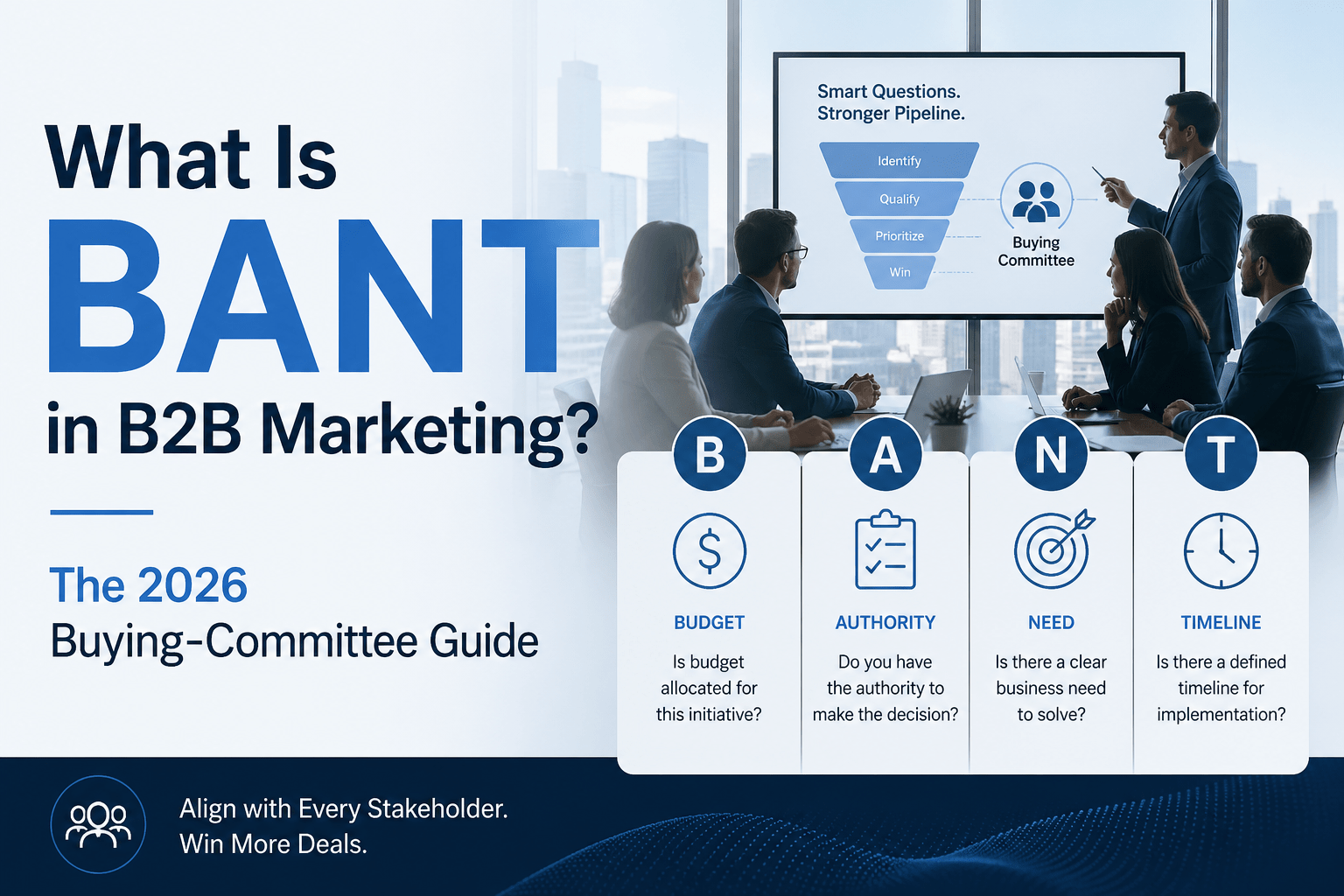
BANT is a four-part lead qualification framework: Budget, Authority, Need, and Timeline. It still works in 2026 as a fast first filter for smaller, simpler deals. It breaks on committee purchases because it assumes one person holds Authority. Gartner says buying groups now run five to 16 people, so Authority must become a map of roles, not one yes.
Key facts
- BANT stands for Budget, Authority, Need, and Timeline. It is commonly attributed to IBM, though published accounts disagree on the decade: Mailchimp says the 1950s, Outreach says the 1960s, and Salesforce dates it to the 1950s without naming IBM.
- B2B buying groups range from five to 16 people across as many as four functions, according to a Gartner sales survey.
- In the same Gartner survey of 632 B2B buyers, 74% of buyer teams showed unhealthy conflict during the decision, and groups that reached consensus were 2.5 times more likely to report a high-quality deal.
- BANT qualifies buying readiness. MEDDIC qualifies how a complex deal will actually get decided. Most teams selling into committees need both, at different stages.
Why most B2B companies misuse BANT
Many B2B companies still run BANT as a four-question checklist on the first discovery call. That worked when one manager could sign. It does not work when a purchase needs finance, IT, security, legal, and the line-of-business owner to agree.
The result is predictable. Sales chases leads that “passed” BANT but never had a real path to close. Forecasts slip. Marketing and sales argue about lead quality. The framework itself is not the problem. The way most companies apply it is.
This guide covers what BANT is, how each criterion works today, where it breaks, how it compares to MEDDIC, CHAMP, and SPICED, and when to use it.


Try two senior CMOs before you hire them
30 minutes with both of us. No hard sell. Written plan in 3 business days.
What does BANT stand for, and where did it come from?
BANT stands for Budget, Authority, Need, and Timeline. It is one of the oldest sales qualification frameworks still in common use.
The usual story is that IBM created it to help its sales force decide which prospects to pursue. That attribution is repeated widely, but I could not find a primary IBM source for it, and the secondary sources disagree on the decade. Mailchimp writes that “the BANT sales framework was first used at IBM in the 1950s.” Outreach says it was “developed by IBM in the 1960s.” Salesforce says only that it was “first developed in the 1950s.” The safe statement is this: BANT is commonly credited to IBM and has been in use for more than half a century.
The acronym reduces qualification to four questions:
- Budget: Can this company pay for what we sell?
- Authority: Are we talking to people who can approve the purchase?
- Need: Do they have a real problem we solve?
- Timeline: When do they need to act?
When the answer to all four is yes, the lead is worth active sales time. When one or more is no, the lead goes back to marketing nurture or is disqualified.
BANT spread because it is fast, repeatable, and easy to train. A new rep can run a BANT pass in a few minutes. That speed is why it is still everywhere, and also why it fails when applied to deals it was never designed to qualify.
Why BANT still matters in 2026
BANT still matters because most B2B sales teams have more leads than good leads. A rep’s time is the scarcest resource in the revenue function. Every week spent on a prospect with no budget and no deadline is a week taken from a real opportunity.
Used at the top of the funnel, BANT works as triage. It sorts inbound and outbound leads quickly so reps spend their time where a purchase can actually happen. It also gives marketing and sales a shared, simple vocabulary for what a qualified lead looks like.
What BANT does not do is manage a complex deal. The companies that get value from it treat it as a fast filter, not as the whole qualification system.
How each BANT criterion works in modern B2B
Each criterion means something different today than it did when one buyer signed the purchase order. Marketing can capture some of these signals before the first call (through forms, content engagement, and intent data), which shortens discovery.
Budget: confirmed funds and an approval path, not a number on a wishlist
Budget asks whether the prospect can pay. In modern B2B this rarely means a fixed line item. It means knowing whether funds exist, who controls them, and what approval cycle releases them.
The common mistake is asking “What is your budget?” on the first call. Experienced buyers either do not know yet or will not say. A better approach is to anchor on a typical investment range for companies like theirs and listen for confirmation or pushback. Then ask who signs off and what that approval process looks like.
Authority: map the decision, do not name one person
Authority asks who can make the buying decision. This is where traditional BANT breaks, because no single person makes a complex B2B purchase anymore. Gartner reports buying groups of five to 16 people across as many as four functions.
The modern Authority question is not “Are you the decision-maker?” Almost everyone says yes. The better question is “Who else needs to be involved, and what does each of them need to see?” At a minimum, know the economic buyer, the technical evaluator, the legal or security reviewer, and the internal champion.
Need: quantified pain, not curiosity
Need asks whether the prospect has a real business problem you solve. The modern test is whether that pain is quantified and prioritized. A prospect who calls your product “nice to have” rarely closes. A prospect who can put a dollar figure on the problem, and say what it costs to wait, has something to take to their CFO.
Marketing assets such as ROI calculators, cost-of-inaction worksheets, and diagnostic checklists help surface quantified Need before the sales conversation begins.
Timeline: a compelling event, not a vague quarter
Timeline asks when the purchase will happen. The strongest answer is a compelling event tied to a date: a contract expiration, a regulatory deadline, an executive mandate, or a fiscal-year close.
“Maybe this quarter” is not a timeline. “Our current vendor contract ends March 31 and our CFO wants a replacement in place by then” is a timeline. If no compelling event exists, treat the lead as nurture, not as an active opportunity.
The biggest weakness of traditional BANT
The biggest weakness of traditional BANT is that it assumes one decision-maker and a linear buying process. Neither describes most B2B purchases today. Gartner found that 74% of B2B buyer teams show unhealthy conflict during the buying decision. A single “yes” on a discovery call says nothing about whether the rest of the group agrees.
When a rep passes a deal through BANT after talking to one champion, they have qualified that conversation, not the buying decision. The rep moves forward with:
- Budget confirmed by a manager who has not taken the request to finance
- Authority confirmed by a champion who has not mapped procurement
- Need confirmed by an end user who has not built the business case
- A timeline that ignores legal and security review
The framework is not wrong. It is incomplete for the deals that matter most. The fix is not to throw BANT out. The fix is to keep it as the first filter and rebuild the Authority criterion for committee buying.
How to adapt BANT for a buying committee
Here is how I recommend adapting BANT for deals with several stakeholders. It keeps BANT’s speed and fixes the Authority gap. Mapping the full committee is its own discipline, which I cover in buying committee cartography. The short version for BANT:
- Let marketing capture Budget, Need, and Timeline signals early. Company size and funding data, content engagement, form answers, and compelling-event triggers in nurture emails can all arrive before the first sales call. Authority waits for sales.
- Turn Authority into a list of roles with names. Instead of a yes or no, the rep records the economic buyer, technical evaluator, security or legal reviewer, champion, and procurement contact. Blank roles are gaps to close, not details to skip.
- Quantify the cost of inaction. Need moves from “we have a problem” to “this problem costs us a specific amount per quarter.” Without that number, your champion cannot win agreement from the rest of the group.
- Anchor Timeline to a dated event. If there is no compelling event, the deal goes back to nurture.
- Re-qualify as the deal moves. Committees change. New stakeholders appear, budgets freeze, leaders leave. Re-check all four criteria at each stage change instead of treating BANT as a one-time gate.
This turns BANT from a one-time SDR checklist into a qualification standard both teams use. The written agreement between marketing and sales on what counts as a qualified lead belongs in your SQL definition, which I cover in how to define a sales qualified lead.
How BANT compares to MEDDIC, CHAMP, and SPICED
BANT is the fastest qualification framework. MEDDIC is the most thorough. CHAMP and SPICED sit between them and suit consultative, discovery-led sales. The right choice depends on deal size, sales cycle length, and how many people are involved, not on personal preference.
| Framework | What the letters stand for | What it measures | Best fit | Main weakness |
|---|---|---|---|---|
| BANT | Budget, Authority, Need, Timeline | Buying readiness | High-volume triage; smaller deals with few stakeholders and short cycles | Treats Authority as one person; shallow on complex deals |
| CHAMP | Challenges, Authority, Money, Prioritization | Pain-led fit | Consultative mid-market sales where the problem matters more than the budget line | Still light on how the decision gets made |
| SPICED | Situation, Pain, Impact, Critical Event, Decision | The buyer’s context and urgency | Discovery-led SaaS sales, including recurring-revenue expansion | Takes more discovery time than BANT |
| MEDDIC / MEDDPICC | Metrics, Economic Buyer, Decision Criteria, Decision Process, Identify Pain, Champion (plus Paper Process and Competition) | How the full deal will be decided | Large, long, multi-stakeholder enterprise deals | Too heavy to run on every inbound lead |
The pattern is simple. BANT screens. MEDDIC manages the deal. Strong B2B revenue teams use BANT at the top of the funnel for speed and MEDDIC or MEDDPICC once a real opportunity exists. Running MEDDIC on every inbound lead wastes SDR time. Running BANT alone on a large enterprise deal loses the deal.
When B2B teams should use BANT
Use BANT when:
- Inbound lead volume is more than your SDRs can work, and triage speed matters more than depth
- Deals are smaller and sales cycles are short
- The product is well defined, the category is mature, and buyers already budget for it
- Marketing forms can capture Need and Timeline before the sales call
Avoid BANT, or layer it with another framework, when:
- Deals are large and involve multi-stakeholder evaluation
- The category is new and prospects have not set aside budget yet
- The sales motion is consultative and discovery-led
- Procurement, security, and legal review are part of the close
The clearest test: if your typical deal involves more than a handful of people, BANT alone is not enough. Use it as the inbound filter, then move qualified opportunities to MEDDIC (for enterprise) or CHAMP or SPICED (for consultative mid-market). Installing this kind of layered qualification is part of the revenue-system work we do as fractional CMOs.
Frequently asked questions
Does BANT still work when a buying committee makes the decision?
Partly. Budget, Need, and Timeline still work as early filters. Authority does not, because no single person can approve a committee purchase. Replace the Authority yes-or-no with a named list of the roles involved, and add MEDDIC or a similar framework once the deal is real.
Who created the BANT framework?
BANT is commonly credited to IBM. Published sources disagree on when: Mailchimp says the 1950s and Outreach says the 1960s. I could not find a primary IBM document confirming either, so treat the IBM origin as widely reported rather than proven.
What is the difference between BANT and MEDDIC?
BANT is a four-part framework that checks buying readiness quickly. MEDDIC (Metrics, Economic Buyer, Decision Criteria, Decision Process, Identify Pain, Champion) examines how a complex deal will be decided and who will decide it. Most teams use BANT for initial qualification and MEDDIC for deal management.
What questions do you ask in BANT?
Ask open questions that bring out evidence. Budget: “What has been set aside for this, and who approves it?” Authority: “Who else is involved, and what does each person need to see?” Need: “What problem are you solving, and what does it cost you each quarter?” Timeline: “What event is driving this, and by what date?”
Is BANT outdated?
No, but using it as a one-call checklist is. The original framework assumed one decision-maker and a straight-line process. It works in 2026 when marketing captures Budget, Need, and Timeline signals early and sales treats Authority as mapping the group rather than confirming one person.
Should marketing or sales own BANT?
Both. Marketing captures early signals through forms, content engagement, and enrichment data. Sales confirms Authority and completes qualification in discovery. It fails when one team writes the criteria alone, so agree on the definitions together and record them in shared CRM fields.
Where to take BANT next
BANT is not the full answer to B2B qualification. It is the foundation. The teams getting results use it as a fast filter, layer MEDDIC or SPICED on top for deal management, treat Authority as committee mapping rather than a single yes, and require evidence before any deal advances a stage.
If your team runs BANT but still misses pipeline targets, the framework is rarely the cause. It is usually how the framework has been adapted, or not, to the way your buyers actually decide. If you want a second set of eyes on your qualification process, Michael Pecora and I offer a free 30-minute growth plan session on Google Meet. You get a written growth plan within 3 business days, with no hard sell. We take 10 companies a month. Book your session here.
Free Written Growth Plan
Wondering if a fractional CMO is right for you?
Try us before you hire us. Book a free 30-minute working session with both of us and get a written growth plan you can use whether or not you hire us.
Get My Free Growth Plan →No hard sell on the call. Your plan arrives within 3 business days. See a sample plan