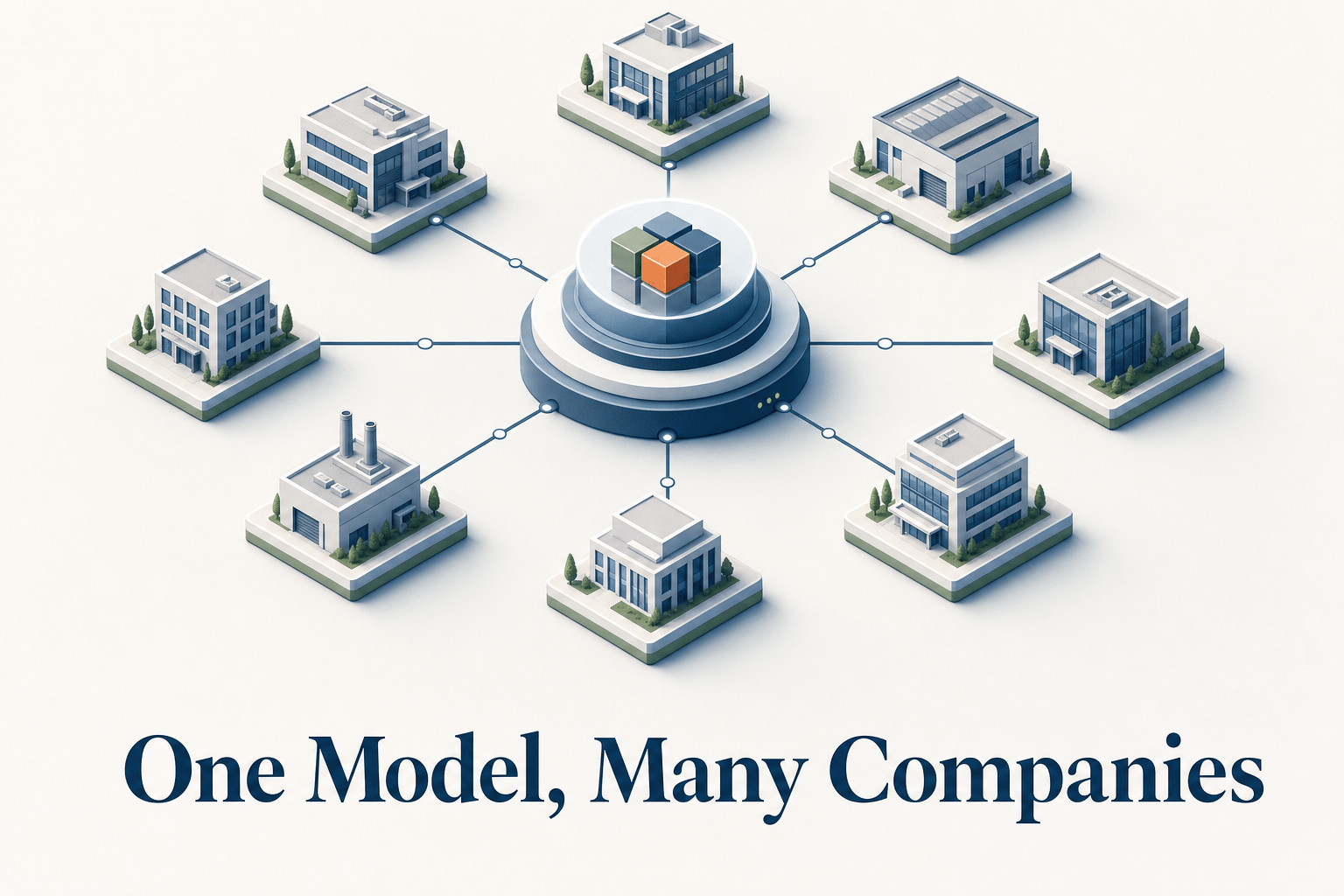
Bottom line: Standardizing marketing across a portfolio means running one repeatable demand-generation operating model, common tooling, common metrics, and a shared playbook, across several portfolio companies, instead of letting each one reinvent its marketing with its own agencies, dashboards, and definitions. For a single company, going it alone is fine. Across a portfolio, and especially in a buy-and-build where every add-on arrives with its own bespoke setup, it is wasteful and slow. The real portfolio-level unlock of the fractional model is deploying one senior operator and one playbook across many companies, converting scattered marketing cost lines into a standardized growth engine the fund controls and can benchmark.
Key Facts at a Glance
- Add-on acquisitions were roughly 40% of buyout deal value in 2024, and with record dry powder, firms are aggressively pursuing buy-and-build to scale platforms, so most portfolios are adding companies, not just holding them (McKinsey & Company, 2026; E78 Partners, 2025).
- Leading funds now drive portfolio-wide performance through standardized playbooks, quarterly value reviews, cross-company benchmarking, and dynamic resource reallocation (Simon-Kucher, 2025 Value Creation Study).
- When a portfolio standardizes on common planning, marketing, and sales tooling, it produces comparable metrics across companies, so a specialist can benchmark and improve each team one by one (Citrin Cooperman, 2026).
- Without a standardized operating model, each acquisition introduces bespoke processes, disconnected reporting, and manual workarounds that compound over time (Pemeco Consulting, 2026).
- Operating partners increasingly must orchestrate transformation across dozens of portfolio companies, and talent in commercial excellence is specifically scarce, which makes a shared operator model attractive (Catalant, 2025).
- Standardization delivers measurable results: one healthcare network that adopted a common operating model saw a 27% productivity increase and a 24% improvement in access, and the model became a blueprint for future acquisitions (PE Professional, 2024).
- Revenue growth drove about 71% of the value created in 2024 exits, so a standardized demand engine that lifts revenue across the whole portfolio compounds the fund’s primary return driver (Bain & Company, 2026).
This guide draws on Peter Geisheker’s 20-plus years of B2B marketing experience as founder and CEO of The Geisheker Group, Inc., a fractional CMO agency serving B2B, B2B SaaS, PE/VC-backed, and law firm clients. Peter has personally managed more than $50 million in annual advertising spend and has run acquisition programs at scale, including a paid program operating at $1 million per week, which is what it takes to build one operating model disciplined enough to run across many companies rather than one. The perspective here is an operator’s: how to turn a portfolio’s scattered marketing into a single, benchmarkable growth engine, informed by 2026 private-equity value-creation research from Bain, McKinsey, and others.
Table of Contents
- What Does It Mean to Standardize Marketing Across a Portfolio?
- Why Does Every Company Usually Run Its Own Marketing?
- Why Does That Break Down in a Buy-and-Build?
- What Does a Standardized Marketing Operating Model Look Like?
- What Are the Benefits of One Model Across Many Companies?
- Why Is a Fractional CMO the Right Way to Deliver It?
- How Do You Avoid Over-Standardizing?
- Frequently Asked Questions
What Does It Mean to Standardize Marketing Across a Portfolio?
Standardizing marketing across a portfolio means running one operating model for demand generation across several portfolio companies: a common playbook for how growth is built, a common tooling stack, common metric definitions, shared best practices, and a templated way to onboard each new acquisition. It does not mean every company runs identical campaigns or speaks in one voice. It means the machine underneath, how pipeline is generated, measured, and improved, is consistent enough that performance is comparable across companies and a single operator can run it at scale.
This is the same move funds already make with finance and systems. Leading operators standardize the operating model, centralize shared services, and onboard new acquisitions using predefined templates rather than custom builds (Pemeco Consulting, 2026). Marketing is simply the workstream where this discipline is least often applied, even though it drives the revenue growth the return now depends on.
Explore Fractional CMO Services →
Why Does Every Company Usually Run Its Own Marketing?
By default, each portfolio company arrives with its own marketing setup: its own agencies, its own analytics, its own tools, and its own definitions of a lead, an opportunity, and a customer. Nobody chose that fragmentation; it accumulated. Each company built what it needed when it was independent, and after acquisition those choices persist because unwinding them feels like a low priority next to cash and operations.
For a fund holding a handful of unrelated companies, some of that independence is fine, and forcing uniformity for its own sake wastes effort. But the cost of fragmentation is real and usually invisible: the fund cannot compare marketing performance across companies because nobody measures the same things the same way, best practices discovered at one company never reach the others, every company pays retail for its own agencies and tools, and the operating partner has no leverage because there is no shared model to apply. What looks like local autonomy is often just uncoordinated spending that no one can benchmark.
Why Does That Break Down in a Buy-and-Build?
The fragmentation that is merely wasteful in a hold-and-improve portfolio becomes actively expensive in a buy-and-build. Add-ons were roughly 40% of buyout deal value in 2024, and with record dry powder funds are aggressively rolling up fragmented industries like technology, healthcare, and professional services (McKinsey, 2026; E78 Partners, 2025). Every one of those add-ons arrives with its own marketing stack, its own agencies, and its own way of counting.
Without a standardized operating model, each acquisition introduces bespoke processes and disconnected reporting that compound over time (Pemeco, 2026). By the fifth add-on, the platform is running five different marketing setups that cannot be compared, five sets of agency relationships, and five dashboards that do not reconcile. The synergy the deal thesis assumed, one efficient growth engine across the combined company, never materializes, because there is no shared engine, only five bolted-together ones. A standardized model turns each add-on from a bespoke rebuild into a fast, templated onboarding, which is where the buy-and-build actually captures its marketing synergy.
What Does a Standardized Marketing Operating Model Look Like?
A standardized marketing operating model has a handful of components, and the discipline is in keeping them consistent across companies while leaving room for each company’s market.
One playbook. A documented, repeatable way to build demand: how the demand engine is assessed, how channels are chosen and tested, how conversion is improved, how owned demand is built. The same method travels to every company.
Common tooling and data. A shared core stack for CRM, analytics, and attribution, so the numbers mean the same thing everywhere. When a portfolio standardizes on common tooling, it produces comparable metrics across companies, which is what lets a specialist benchmark and lift each team (Citrin Cooperman, 2026).
Common metric definitions. One definition of a lead, a qualified opportunity, CAC, and pipeline, so a dashboard from one company can be read against another without translation. This is the unglamorous foundation that makes everything else possible.
Cross-company benchmarking and reviews. With comparable data, the fund can benchmark companies against each other, spot the outliers, and reallocate effort to where it moves the needle, exactly the standardized-playbook, quarterly-review, dynamic-reallocation model leading funds now run (Simon-Kucher, 2025).
Shared best practices. What works at one company gets codified and carried to the others, so a win is captured once and reused many times instead of being trapped where it was discovered.
Templated add-on onboarding. A predefined way to bring each new acquisition onto the model quickly, so the platform does not reinvent marketing with every deal.


Get a portfolio growth plan from two senior CMOs
30 minutes with both of us. No hard sell. Written plan in 3 business days.
What Are the Benefits of One Model Across Many Companies?
The contrast between the fragmented default and a standardized model is stark once it is laid out:
| Dimension | Every company on its own | One standardized operating model |
|---|---|---|
| Tooling | Different stack at each company | Common core stack; data that reconciles |
| Metrics | Defined differently everywhere | One definition; benchmarkable across the portfolio |
| Agencies and vendors | Each company hires its own at retail | Shared operator and playbook; portfolio vendor leverage |
| Add-on onboarding | Reinvented from scratch each time | Templated and fast |
| Fund visibility | Apples compared to oranges | Real-time cross-company benchmarking |
| Best practices | Trapped in the company that found them | Codified and reused across the portfolio |
| Operator leverage | None; every company is bespoke | One operator runs the model across many companies |
The through-line is leverage. A standardized model lets one senior operator and one playbook improve many companies at once, lets the fund see and compare marketing performance for the first time, and lets each add-on inherit a working engine instead of building one. That is how marketing stops being a scattered cost across the portfolio and becomes a controllable, benchmarkable value-creation lever.
Why Is a Fractional CMO the Right Way to Deliver It?
Standardizing marketing across a portfolio requires a senior operator, but not a full-time one at every company, and not one per company at all. Operating partners are increasingly asked to orchestrate transformation across dozens of portfolio companies, and commercial-excellence talent is specifically scarce (Catalant, 2025). A fractional CMO for portfolio companies is built for exactly this shape of problem: one experienced operator who carries the same playbook into several companies, sets up the common model, benchmarks across them, and improves each without the fund hiring a full-time CMO for every logo.
This is the portfolio-level expression of the broader fractional CMO model for private equity value creation. At the single-company level, the fractional model is capital-efficient senior leadership. At the portfolio level, it is leverage: one model, one operator, many companies, which is also much of how private equity firms use fractional CMOs as they scale.
How Do You Avoid Over-Standardizing?
Standardization has a failure mode, and it is worth naming honestly. The goal is to standardize the operating model, the tooling, the metrics, and the method, not the message. Each portfolio company serves a different market with a different buyer, a different value proposition, and a different competitive position. Forcing a single brand voice, a single campaign, or a single positioning across heterogeneous businesses destroys the very thing that makes each one work.
The discipline is to hold the line on the machine while leaving the market-facing work local. Common CRM, common definitions, common playbook, and cross-company benchmarking: yes. Identical messaging and a homogenized brand: no. A good operator knows the difference, and it is the difference between a portfolio that compounds shared learning and one that flattens every company into a template. Standardize the engine; localize the story.
Frequently Asked Questions
What does it mean to standardize marketing across a portfolio?
It means running one operating model for demand generation across several portfolio companies: a shared playbook, common tooling and analytics, common metric definitions, shared best practices, and templated onboarding for new acquisitions. The machine that generates and measures pipeline is consistent, so performance is comparable and one operator can run it at scale. It does not mean identical campaigns or a single brand voice.
Why standardize marketing instead of letting each company run its own?
Because fragmentation is costly and usually invisible: the fund cannot benchmark marketing across companies, best practices never travel, every company pays retail for its own agencies and tools, and the operating partner has no leverage. Standardizing creates comparability, economies of scale, and a model one operator can apply across many companies.
Why does this matter most in a buy-and-build?
Because add-ons are roughly 40% of buyout deal value, and each one arrives with its own bespoke marketing setup. Without a standardized model, every add-on is a rebuild and the platform ends up running several incompatible marketing operations. A standardized model turns each add-on into a fast, templated onboarding, which is where the buy-and-build captures its marketing synergy.
What are the components of a standardized marketing operating model?
One documented playbook, a common tooling and data stack, common metric definitions, cross-company benchmarking and reviews, shared best practices, and templated add-on onboarding. Together they make marketing performance comparable across companies and let a single operator improve many at once.
Does standardizing marketing mean every company runs the same campaigns?
No, and doing so would be a mistake. Each company serves a different market and buyer, so the message, positioning, and campaigns stay local. What gets standardized is the engine underneath: tooling, metrics, method, and benchmarking. Standardize the engine; localize the story.
Who should run a standardized portfolio marketing model?
A senior operator deployed across companies, not a full-time CMO at each. A fractional CMO is well suited to it: one experienced operator sets up the common model, benchmarks across the portfolio, and improves each company, giving the fund senior marketing leverage without a full-time hire per company.
Building One Growth Engine Across the Portfolio
The logic is clear: a portfolio running one standardized marketing model can benchmark, share what works, onboard add-ons fast, and improve many companies with one operator. The hard part is building the model with enough discipline to be consistent and enough judgment to leave each company’s market alone, then running it across the portfolio.
That is fractional CMO work at the portfolio level. If your fund already has a shared marketing operating model and the operator to run it, you may not need outside help. If your situation is the common one, a portfolio of companies each running its own bespoke marketing with no way to compare them, a short conversation will tell us whether we can help turn that into one benchmarkable growth engine.
About Peter Geisheker
Peter Geisheker is a fractional CMO and founder and CEO of The Geisheker Group, Inc., serving B2B, B2B SaaS, and PE/VC-backed companies. He has managed more than $50 million in annual advertising spend, including a paid program running at $1 million per week, and specializes in building repeatable, measurable demand-generation systems disciplined enough to run across many companies. With 20-plus years of experience translating marketing into revenue and enterprise value, Peter provides senior marketing leadership to portfolio companies and their sponsors without the cost of a full-time executive hire.
Ready to turn a fragmented portfolio into one benchmarkable growth engine? Schedule a free consultation with Peter Geisheker. Connect with Peter on LinkedIn.
References and Sources
- McKinsey & Company, “Global Private Markets Report 2026: Private Equity”: add-on acquisitions as roughly 40% of buyout deal value in 2024; the shift toward operational, portfolio-wide value creation. https://www.mckinsey.com/industries/private-capital/our-insights/global-private-markets-report/private-equity
- E78 Partners, “Scaling for Impact: A PE Guide to Add-On Integration and Value Creation” (2025): record dry powder driving aggressive buy-and-build in fragmented industries; integration, not the transaction, determines whether synergy is realized. https://e78partners.com/blog/scaling-for-impact-a-pe-guide-to-add-on-integration-value-creation/
- Simon-Kucher, “2025 Industrial and Business Services Value Creation Study”: portfolio-wide performance through standardized playbooks, quarterly value reviews, cross-company benchmarking, and dynamic resource reallocation. https://www.simon-kucher.com/en/insights/private-equity-study-2025
- Citrin Cooperman, “The New Value Creation Playbook” (2026): a portfolio standardized on common planning, marketing, and sales tooling produces comparable metrics across companies, enabling specialists to improve each team. https://www.citrincooperman.com/In-Focus-Resource-Center/The-New-Value-Creation-Playbook
- Pemeco Consulting, “ERP Strategy for Middle Market Private Equity” (2026): standardize the operating model and centralize shared services; without it, each acquisition introduces bespoke processes and disconnected reporting that compound. https://pemeco.com/erp-strategy-for-middle-market-private-equity-a-value-creation-playbook/
- Catalant, “Private Equity Operating Partners Playbook” (2025): operating partners must orchestrate transformation across dozens of portfolio companies amid talent scarcity in commercial excellence. https://catalant.com/reports/private-equity-operating-partners-playbook/
- PE Professional, “The Evolving Playbook: Expert-Led Operational Enhancements in Private Equity” (2024): a healthcare network adopting a common operating model realized a 27% productivity increase, 10% capacity improvement, and 24% access improvement, with the model becoming a blueprint for future acquisitions. https://peprofessional.com/2024/11/the-evolving-playbook-expert-led-operational-enhancements-in-private-equity/
- Bain & Company, “Global Private Equity Report 2026”: revenue growth drove about 71% of value created in 2024 exits; operational value creation as the dominant return driver. https://www.bain.com/insights/topics/global-private-equity-report/
- KPMG, “Value Creation in Private Equity” (2025): centralizing data across the portfolio and sharing best practices lets value-creation teams uncover opportunities and deliver operational alpha at scale. https://assets.kpmg.com/content/dam/kpmgsites/xx/pdf/2025/10/value-creation-in-private-equity.pdf
- Bain & Company, “How Commercial Excellence Jump-Starts Growth in Private Equity”: commercial excellence as a primary organic growth lever across portfolio companies. https://www.bain.com/insights/how-commercial-excellence-jump-starts-growth-in-private-equity/
- Accenture, “The Evolving Private Equity Playbook: Unlocking Operational Value”: setting up portfolio companies for repeatable value creation through add-ons and standardized operations maturity. https://www.accenture.com/us-en/insights/strategy/evolving-private-equity-playbook
- McKinsey & Company, “Bridging Private Equity’s Value Creation Gap” (2024): operational value creation, run across the portfolio, as the new source of returns. https://www.mckinsey.com/industries/private-capital/our-insights/bridging-private-equitys-value-creation-gap
Free Written Growth Plan
Running marketing across a portfolio company?
Get a free written growth plan from two senior CMOs who have helped companies grow into acquisitions. See exactly how we would drive value before you commit.
No hard sell on the call. Your plan arrives within 3 business days. See a sample plan