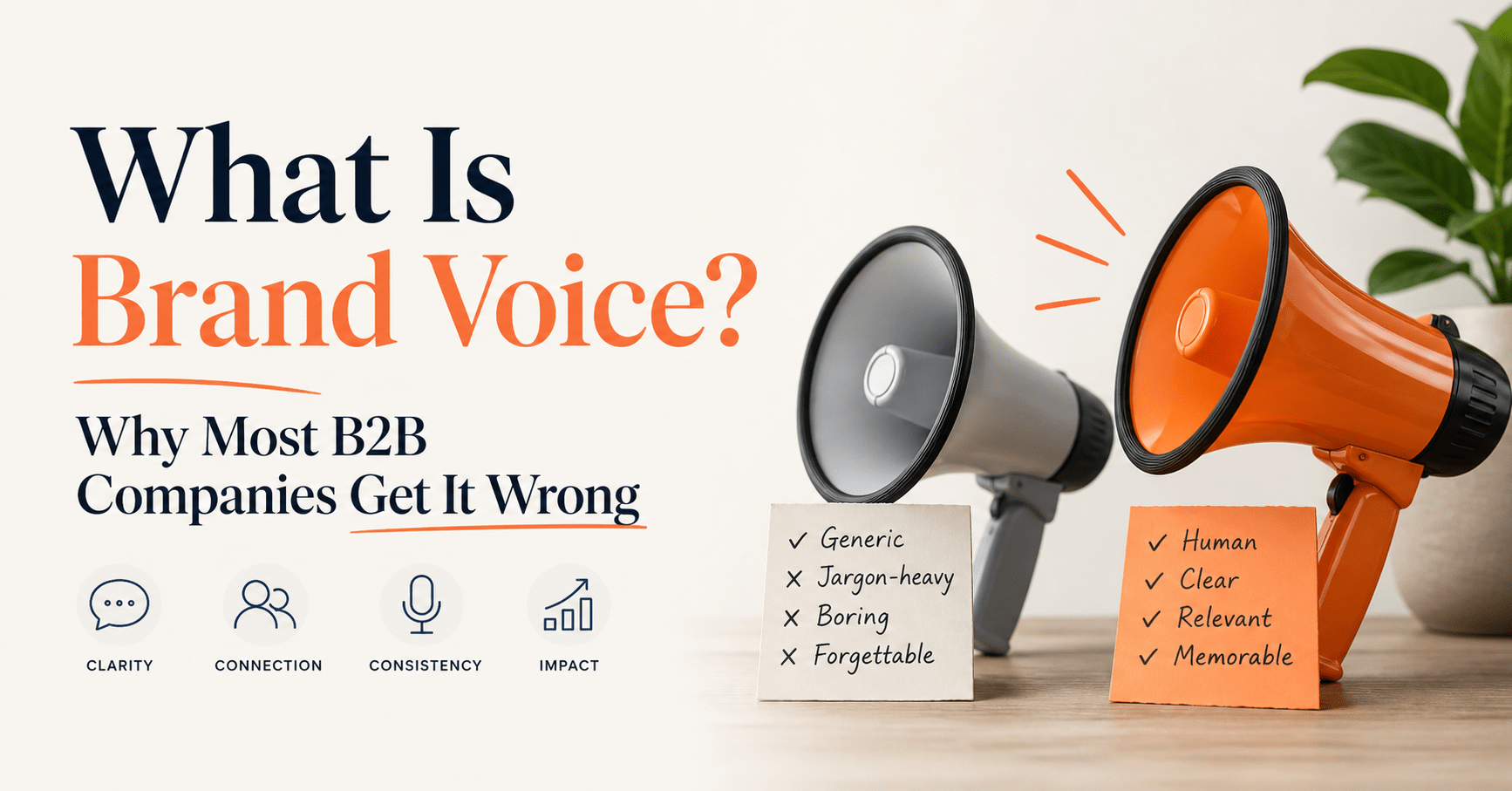
Brand voice is the consistent personality a company expresses through every word it publishes; the tone, point of view, humor, and rhythm that make readers recognize your content even with the logo removed. Most B2B companies confuse brand voice with sounding “professional,” producing forgettable copy that reads like a legal disclaimer. The strongest brands sound like a smart, opinionated, often funny human, because emotional resonance, not corporate polish, is what builds preference.
Key Facts at a Glance
- B2B brands that build strong emotional connections with buyers are roughly twice as likely to be chosen over competitors, according to research by Google and CEB (CEB / Google, From Promotion to Emotion).
- The personal value of a B2B solution has approximately 2x the impact on the purchasing decision as the business value (CEB / Google research summarized by OpenView).
- Across nine B2B brands studied in the Google/CEB research, seven had emotional connections with more than 50% of customers, exceeding most B2C brands measured by Motista (Financesonline summary of CEB / Google study).
- In B2B, emotional advertising drives significantly more long-term brand growth than rational advertising, per the LinkedIn B2B Institute research with Les Binet and Peter Field (LinkedIn B2B Institute, The 5 Principles of Growth).
- Only 52% of organizations have a clearly defined value proposition that truly differentiates them from competitors (HubSpot 2026 State of Marketing summary, KLIQ Interactive).
- 33% of consumers say a distinct personality is the main reason a brand stands out from others (Asana, What Is a Brand Voice?).
- 86% of consumers say authenticity is important when deciding which brands they like and support (Asana, What Is a Brand Voice?).
I have spent more than two decades writing, editing, and rebuilding B2B marketing copy as a Fractional CMO, and the single most consistent failure I see is this: companies obsess over their “brand voice,” then publish content that reads like a legal disclaimer crossed with bookshelf assembly instructions. The brand voice they think they are projecting is “trusted authority.” The brand voice that actually lands on the reader is “we are dull and forgettable.” That is the opposite of what brand voice is supposed to do.
If you are a CEO, a head of marketing, or an investor-backed B2B operator wondering why your content is not building preference, the answer is almost never that you need more content. It is that the content you have sounds like everybody else’s content. In this article, I will define brand voice clearly, explain why so many B2B teams get it backwards, walk through what the world’s most successful brands actually sound like, and share a 5-check diagnostic I use with Fractional CMO clients called the brand voice reality check.
In this article:
- What brand voice actually is, and what it is not
- Why marketers confuse “professional” with “boring”
- The real cost of a forgettable B2B brand voice
- What the world’s most successful brands actually sound like
- Brand voice vs. brand tone: the distinction that matters
- The brand voice reality check: a 5-check diagnostic
- How to build a brand voice that does not put readers to sleep
- When playfulness is right for B2B, and when it is not
- A side-by-side comparison of generic vs. distinctive brand voice
- FAQs on brand voice for B2B and B2B SaaS companies
What Is Brand Voice, Really?
Brand voice is your company’s distinctive, consistent personality expressed in language. It is the combination of word choice, sentence rhythm, point of view, attitude, humor, and willingness to take a position that, taken together, sounds unmistakably like you. As Asana defines it, brand voice is “the distinct way your brand communicates and presents itself,” and unlike tone, it does not change with context. Brand voice = Brand Personality.
Notice the word “personality.” Brand voice is not a checklist of approved adjectives in a style guide. It is a personality that a real human reader can feel after two or three sentences. If your audience cannot tell whether the post they are reading came from your company, your top competitor, or a generic SaaS startup with a Series A round, you do not have a brand voice. You have category writing.
Why Do Marketers Confuse “Professional” With “Boring”?
Because most B2B marketers were trained to believe that business writing has to sound like business writing. The result is a kind of corporate monotone that nobody set out to write, but everybody ends up producing.
The pattern goes like this. A founder or CEO hires a marketing team. The team builds a brand voice document with four to five adjectives: “professional, trustworthy, expert, innovative, customer-focused.” Every other B2B company in the same vertical has the exact same four to five adjectives. Copy is then drafted to match that vocabulary, sent through a legal review that strips out anything specific or interesting, scrubbed by a committee that softens every claim, and finally published as a 700-word blog post that no one will ever forward to a colleague. The voice is not “professional.” The voice is, “We’re afraid to stand out and be unique.”
The deeper problem is a confusion between formality and authority. Plenty of high-authority sources, including Harvard Business Review, publish content with crisp opinions, dry humor, and unusual sentence structure. They are professional and interesting at the same time. The two are not in conflict; in fact, distinctiveness is part of how authority gets established.
The Real-World Cost of a Forgettable B2B Brand Voice
The cost of generic brand voice is not aesthetic; it is financial, and the data is unambiguous. The 2013 Google and CEB Marketing Leadership Council study, From Promotion to Emotion, surveyed roughly 3,000 B2B purchasers and found that B2B buyers are significantly more emotionally connected to their suppliers than B2C consumers are to consumer brands. Across the nine B2B brands studied, seven had emotional connections with more than 50% of customers, a level most B2C brands never reach.
That emotional connection translates into preference, willingness to pay a premium, and shorter sales cycles. Brands that create strong emotional connections with B2B buyers are roughly twice as likely to be chosen over competitors. The follow-up research from the LinkedIn B2B Institute with Les Binet and Peter Field reinforced this finding: in B2B, emotional advertising drives significantly more long-term growth than rational advertising, even though the average B2B campaign skews almost entirely rational.
If your content has no personality, you forfeit the emotional channel. You compete only on features, price, and ROI calculations, which is the most expensive way to win a B2B deal. Worse, in a market where buyers consult 62 or more touchpoints before signing a deal, a forgettable brand voice means each touchpoint earns zero compounding effect. You pay for every impression, and none of them stick.
What Do the World’s Most Successful Brands Actually Sound Like?
Friendly. Opinionated. Frequently funny. Rarely formal. The brands consistently cited as brand voice exemplars in marketing literature are not the ones that sound like white papers; they are the ones that sound like a smart, slightly weird friend explaining something they care about.
Look at how Mailchimp describes its own voice: “Our humor is dry. Our sense of humor is straight-faced, subtle, and a touch eccentric. We’re weird but not inappropriate, smart but not snobbish. We prefer winking to shouting.” That is a B2B SaaS company describing how it talks to small business owners about email automation, which is, on paper, not an inherently entertaining subject. They made it interesting through voice.
Slack writes its own product copy with the goal of sounding like, in their words, “a friendly, intelligent coworker”. Oatly built a billion-dollar oat-milk business in part on packaging copy that says things like “If this side of the carton bores you, please read no further.” Liquid Death sells canned water with horror-film branding and built a unicorn valuation. None of these brands sound “professional” in the dull-by-default sense. They all sound like specific, recognizable humans, and they all command pricing power that their generic-sounding competitors cannot. They have personality.
The lesson is not that every B2B brand should crack jokes. The lesson is that the most successful brands trust their audience enough to be specific, to have a point of view, and to risk being a little distinctive instead of broadly inoffensive. Stop being so safe and dull. You cannot bore people into buying your product or service. Be fun. Be playful. Have charisma.
Brand Voice vs. Brand Tone: What Is the Difference?
Brand voice is your personality; brand tone is how that personality adjusts to the situation. Voice stays constant. Tone changes based on context.
A useful analogy: you have one personality, but you talk differently to your spouse over dinner than you do to a client in a quarterly review. Same person, different tones. Brand tone shifts depending on context and what is suitable for the message, medium, or situation, while brand voice remains consistent.
This distinction matters because most companies get it backwards. They write a brand voice document that is so generic (“professional, friendly, helpful”) it cannot meaningfully distinguish them from a competitor, and then they obsess over tone variations across channels that should not need variation at all. The fix is to invest the work in voice, then let tone flex naturally. A confident voice produces an appropriately serious tone in a security white paper and an appropriately wry tone in a launch email, without anyone needing to consult a 40-page guide.
The Brand Voice Reality Check: A 5-Check Diagnostic
Most B2B brand voice documents look impressive and produce nothing. To find out whether yours actually exists in the writing, run a sample of your published content through this 5-check diagnostic called the brand voice reality check.
If a piece fails three or more checks, you do not have a brand voice. You have a hedged, committee-approved monotone that no reader will remember.
Check 1: The Logo Test. Take a paragraph of your content. Strip out the company name and logo. Hand it to a customer who already knows you. Can they identify it as yours from the writing alone? If no, your content is generic.
Check 2: The Stranger Test. Place a paragraph of your copy alongside paragraphs from your two closest competitors, all unbranded. Can a stranger reliably tell which is which? If no, you have category writing, not brand voice.
Check 3: The Subtraction Test. Delete every instance of “leading,” “innovative,” “best-in-class,” “trusted,” “world-class,” “synergistic,” and “transformative.” Read what remains. If the copy collapses, your “voice” was made of marketing adjectives, not personality.
Check 4: The Position Test. Does the content take a position that someone could reasonably disagree with? Brands without opinions sound like Wikipedia. Wikipedia is great for facts; it is not how preference is built.
Check 5: The Risk Test. Did the final draft contain at least one sentence that an internal reviewer might have suggested cutting because “it is a little much”? If not, the personality has been review-process bleached out of the copy.
A piece that passes all five checks does not need to be funny, edgy, or unconventional. It needs to be specific, opinionated, and recognizably human. That is a high bar, but it is also the actual bar that the brands you admire are clearing every day.
Want more qualified pipeline? Get a free growth plan 30 minutes with both of us. No hard sell. Written plan in 3 business days.

How Do You Build a Brand Voice That Is Not Boring?
Start with the most uncomfortable step: define a personality, not a vocabulary. Adjectives like “professional” and “trustworthy” are table stakes, not voice. The exercise that produces a real voice is closer to character casting. If your brand walked into a room of your ideal customer profile (ICP), what would they sound like? Are they the dryly funny industry veteran who has seen this movie before? The blunt operator who refuses to dress up bad news? The relentlessly curious newcomer with a contrarian thesis? Pick one. Pick a real one. If your brand were a character from a movie, who would that character be?
Then write to that personality. Read your draft out loud, ideally to someone who is not a marketer. If they would not say it that way, do not publish it that way. Cut the hedging verbs (“may,” “might,” “could potentially”) that quietly drain personality from B2B writing. Use specific examples instead of generic claims. When you have an opinion, state it as an opinion.
The single highest-leverage practice I have seen is putting a writer or editor with strong taste in the final review. Not for grammar, but for voice. The reason most B2B copy sounds bland is that nobody on the approval chain is paid to defend the voice; they are paid to remove risk. Differentiation happens in the moments where brands show up, and those moments are decided by the editor with the courage to leave the interesting sentence in.
When Should a B2B Company Sound More Playful, and When Should It Not?
Playfulness is a tool, not a default. The question is not “should our brand sound playful?” but “what is the right personality for our audience and category?” A cybersecurity firm selling to compliance officers in regulated industries probably should not crack jokes about ransomware. A B2B SaaS company selling collaboration software to design teams almost certainly should.
Two practical guides. First, match the personality of your buyer, not the personality of your category. The category may be “enterprise legal tech,” but the buyer is a general counsel who is also a human being who reads novels and likes a well-turned sentence. Second, calibrate playfulness to risk. In high-stakes content (security disclosures, financial reports, incident communications), tone tightens; voice does not change. The same brand that writes wry launch emails should write clear, direct, low-humor incident notices. Voice is about who you are; tone is about reading the room.
Generic vs. Distinctive Brand Voice: A Side-by-Side Comparison
The simplest way to see what is wrong with most B2B brand voice is to compare it directly with what a distinctive brand voice looks like. The table below summarizes what I look for during the content audit phase of a Fractional CMO engagement.
| Dimension | Generic B2B Brand Voice | Distinctive Brand Voice |
|---|---|---|
| Recognizability | Could belong to any of 50 competitors | Recognizable in three sentences without a logo |
| Voice descriptors | “Professional, trustworthy, expert” | “Bluntly honest, dryly funny, opinionated” |
| Sentence rhythm | Uniform, polished, hedged | Variable lengths, occasional surprises |
| Use of opinion | Avoids saying anything controversial | Holds clear positions and defends them |
| Use of humor | None, by default | Used sparingly when it serves the message |
| Specificity | Generic claims and category language | Concrete examples, named situations, real numbers |
| Reader’s reaction | Polite interest, then forgotten | Forwarded to a colleague |
| Effect on preference | Functional satisfaction | Emotional connection and pricing power |
| Effect on long-term growth | Modest; competes mainly on features | Strong; compounds via brand memory and word of mouth |
A second useful lens is Jennifer Aaker’s classic brand personality framework from the Journal of Marketing Research, which identifies five personality dimensions brands tend to occupy: Sincerity, Excitement, Competence, Sophistication, and Ruggedness. Most B2B companies default to Competence (“reliable, intelligent, successful, leader”) because it feels safest. The result is that every B2B SaaS landing page sounds like every other B2B SaaS landing page. The companies that grow fastest in crowded categories are usually the ones that stack a primary Competence positioning with a secondary dimension (Sincerity, Excitement, or Sophistication) to create personality contrast.
Frequently Asked Questions
What is meant by brand voice?
Brand voice is the consistent personality a company expresses through its written and spoken communications. It encompasses word choice, attitude, point of view, humor, and rhythm, and it does not change based on platform or audience. A strong brand voice makes your content recognizable as yours, even when the logo is removed. Generic word lists like “professional and trustworthy” are not brand voice; they are table-stakes traits that every competitor in your category also claims.
What are the four elements of brand voice?
The four core elements typically cited are character (the personality your brand expresses), tone (the emotional inflection that adapts to context), language (the specific word choices and vocabulary that signal your brand), and purpose (why your brand says what it says). Sprout Social and other industry resources frame these slightly differently, but the underlying idea is the same: voice is more than vocabulary, and effective brand voice ties character, tone, language, and purpose together into a recognizable identity.
What is an example of a strong brand voice?
Mailchimp is the most cited example in marketing literature. Their style guide describes their voice as “clear, genuine, and with a bit of dry humor,” and the writing follows through. They use plain English, active voice, and unexpected turns of phrase that make potentially boring topics like email configuration feel approachable. Other strong B2B examples include Slack, Atlassian, and Intercom, each of which sounds like a specific, identifiable person rather than a corporate committee.
What is the difference between brand voice and brand tone?
Brand voice is your personality; brand tone is how that personality adjusts to context. Your voice does not change. Your tone shifts depending on the message, medium, or situation. A B2B SaaS company might use the same confident, dryly funny voice across its launch emails and its incident communications, but the tone of the launch email will be celebratory while the tone of the incident notice will be clear, direct, and low on humor.
Why is brand voice important for B2B companies specifically?
Because B2B buyers make emotional decisions disguised as rational ones. The 2013 Google/CEB study From Promotion to Emotion found that B2B buyers are significantly more emotionally connected to their vendors than B2C consumers are to consumer brands, and that emotional connection translates into preference and willingness to pay a premium. A distinctive brand voice is one of the most reliable ways to build that emotional connection, especially in crowded B2B SaaS categories where features converge.
What are the five brand voice personality dimensions?
The most widely-cited framework is Jennifer Aaker’s 1997 Dimensions of Brand Personality, published in the Journal of Marketing Research. The five dimensions are Sincerity (down-to-earth, honest, wholesome), Excitement (daring, spirited, imaginative), Competence (reliable, intelligent, successful), Sophistication (upper-class, charming), and Ruggedness (outdoorsy, tough). Most B2B brands cluster heavily in Competence, which is why they all sound alike. Mixing in a secondary dimension is one of the cleanest ways to create voice differentiation.
Can a B2B brand voice be playful and still be taken seriously?
Yes, and the data argues that playful brand voices are often taken more seriously because they signal confidence. Mailchimp, Atlassian, and HubSpot all use measured humor and conversational rhythm in their content while serving Fortune 500 customers. Playfulness undermines authority only when it feels forced or obscures the message. Playfulness that emerges naturally from a confident point of view tends to enhance authority, not reduce it.
How do you fix a boring brand voice?
Start by auditing what you publish. Run sample content through the brand voice reality check described above. Identify which checks the content fails most often. From there, the practical fixes are usually: cut hedging verbs, replace generic adjectives with concrete examples, take clear positions on contested questions, and put one editor with strong taste in the final review chain whose job is to defend voice rather than remove risk. For most B2B teams, the bottleneck is not writing talent; it is the review process, which systematically strips voice out of every draft.
Conclusion
Brand voice is one of the most misunderstood ideas in B2B marketing. Most companies treat it as a synonym for “sounding professional,” then publish content that is technically correct, factually dense, and completely forgettable. The data on B2B emotional connection from Google/CEB and the LinkedIn B2B Institute makes the cost of that approach clear: brands that build emotional resonance through distinctive voice are roughly twice as likely to be chosen, command premium pricing, and grow faster long-term than brands that compete on rational messaging alone.
Real brand voice is a personality, not a vocabulary. It is built by character casting, defended in the editorial review process, and tested through diagnostics like the brand voice reality check. The best B2B brands sound like specific, opinionated, often funny humans because that is what makes content memorable and what makes buyers choose one vendor over another in a crowded category.
If your content is not building preference, the fix is rarely more content. It is content with a real voice.
If you would like an outside read on whether your B2B brand voice is helping or hurting your growth, schedule a free consultation, and we can review a sample of your content together.
About Peter Geisheker
Peter Geisheker is the Founder and CEO of The Geisheker Group, Inc., a Fractional CMO and B2B marketing advisory serving CEOs and investor-backed companies. He specializes in scalable, capital-efficient revenue systems across B2B SaaS, B2B services, and performance-driven environments, with AI embedded across all engagements. His work includes programs delivering 6X inbound lead growth, 100% YoY SaaS revenue growth for three consecutive years, and a 77% reduction in paid acquisition spend while growing revenue.
Ready to explore how a Fractional CMO can sharpen your brand voice and accelerate your growth? Schedule a free consultation with Peter.
References and Sources
- Aaker, Jennifer L. (1997). Dimensions of Brand Personality. Journal of Marketing Research, 34(3), 347-356. Stanford Graduate School of Business. https://www.gsb.stanford.edu/faculty-research/working-papers/dimensions-brand-personality
- CEB Marketing Leadership Council and Google, From Promotion to Emotion: Connecting B2B Customers to Brands. https://www.thinkwithgoogle.com/marketing-strategies/promotion-to-emotion-b2b/
- LinkedIn B2B Institute, with Les Binet and Peter Field, The 5 Principles of Growth in B2B Marketing. https://business.linkedin.com/marketing-solutions/b2b-institute/marketing-as-growth
- Marketing Week, Three rules for more effective B2B marketing, citing the LinkedIn B2B Institute / Binet & Field research. https://www.marketingweek.com/three-rules-more-effective-b2b-marketing/
- Mailchimp Content Style Guide, Voice and Tone. https://styleguide.mailchimp.com/voice-and-tone/
- Slack API Documentation, Choosing the right voice and tone for your app. https://api.slack.com/start/designing/voice-tone
- Asana, What Is a Brand Voice? Plus, 7 Tips to Develop One. https://asana.com/resources/brand-voice
- Sprout Social, Brand Voice: What It Is, Why It Matters + Examples. https://sproutsocial.com/insights/brand-voice/
- KLIQ Interactive, Ultimate B2B Marketing Reports & Benchmarks 2025–2026, summarizing HubSpot’s State of Marketing data. https://kliqinteractive.com/insights/b2b-reports-benchmarks-and-statistics-2025-2026/
- Content Marketing Institute and MarketingProfs, B2B Content and Marketing Trends: Insights for 2026. https://contentmarketinginstitute.com/b2b-research/b2b-content-marketing-trends-research
- Brandingmag, Emotional Connection in B2B Communication: A Missing Ingredient? https://www.brandingmag.com/fredrik-ternstrom/emotional-connection-in-b2b-communication-a-missing-ingredient/
- OpenView Partners, The Real Power of Emotional Connections in B2B Marketing. https://openviewpartners.com/blog/emotion-in-b2b-marketing/
Free Written Growth Plan
Want more qualified pipeline?
Give us 30 minutes with your toughest marketing problem. You get a written plan with your three best growth opportunities and the first steps your team can take.
No hard sell on the call. Your plan arrives within 3 business days. See a sample plan