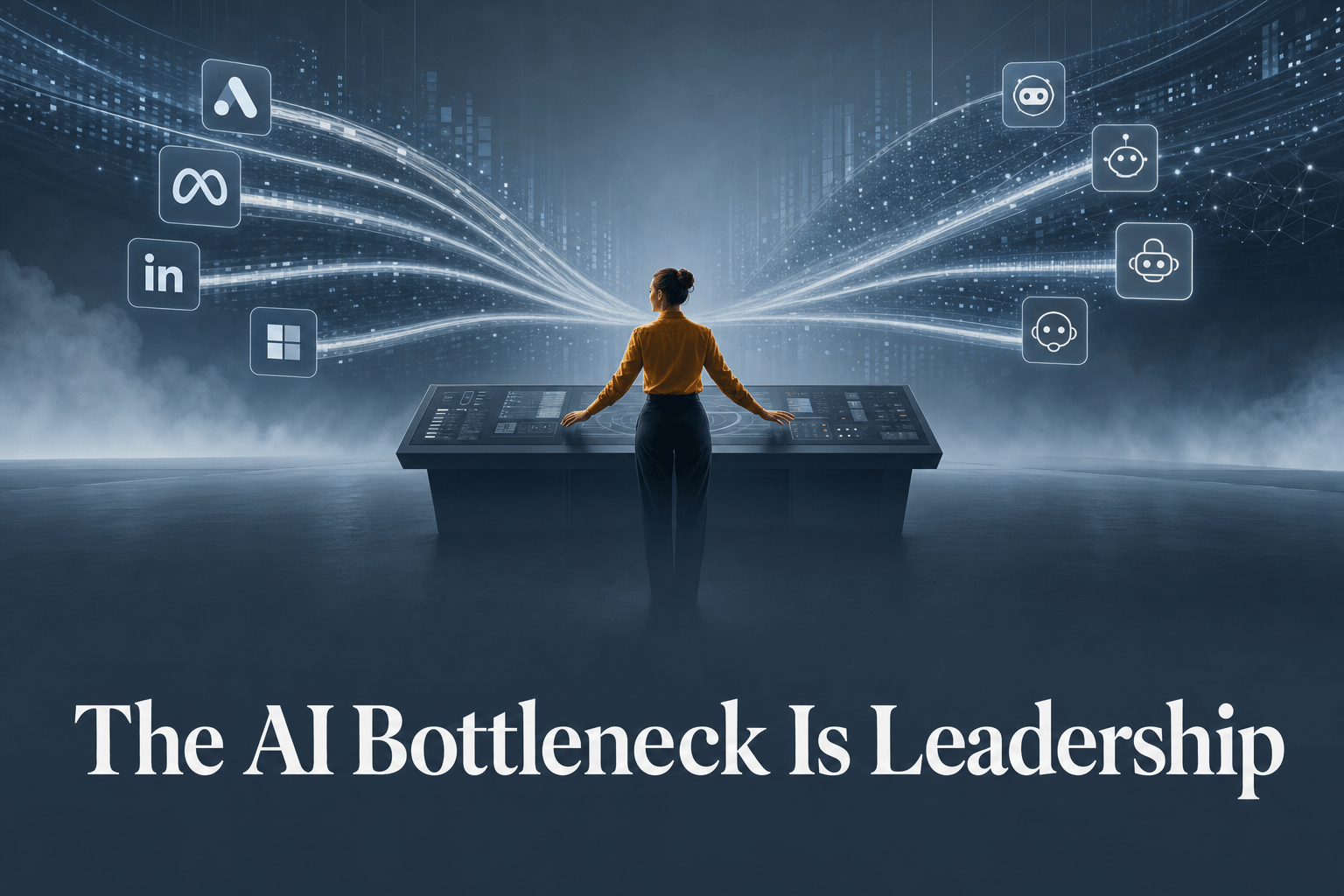
Bottom line: The constraint on AI in marketing is not the software; it is the person directing it. Heading into 2027, the scarce capability is a marketing leader who can tell a good AI output from a convincing bad one, knows what to feed the ad platforms, and knows when a result is real rather than noise. An AI-era marketing leader is a senior operator who directs people, platforms, and AI agents as one system and owns the growth number, not a specialist who has bolted AI tools onto a digital-era playbook. Companies keep buying tools to fix what is actually a leadership-judgment gap, and in 2026 the data shows that gap plainly.
Key Facts at a Glance
- Only 15% of CEOs believe their marketing leaders are AI-savvy in 2026, per Gartner.
- By 2027, a lack of AI literacy is projected to become one of the top three reasons large-enterprise CMOs are replaced, per Gartner.
- 65% of CMOs agree AI will dramatically change their role within two years, yet 20% believe no change is needed to their own skill set and another 48% expect only minor changes, per Gartner.
- Only 30% of CMOs operate at the intersection of creative instinct, data-led growth, and operational command; the other 70% are stuck in a single lane, per Salesforce (2026).
- 51% of CMOs say their CEO holds unrealistic expectations for AI, often demanding results before the team has built the skills to deliver them, per Salesforce (2026).
- Labor’s share of the marketing budget rose from 21.9% to 24.5% in 2026 even as AI adoption climbed, because AI value depends on the people directing it, per the Gartner 2026 CMO Spend Survey.
- Marketing organizations put 15.3% of budget into AI in 2026, but only 30% report being ready to scale it, per the Gartner 2026 CMO Spend Survey.
This analysis draws on Peter Geisheker’s 20-plus years of B2B marketing experience as founder of The Geisheker Group, Inc., a fractional CMO agency serving B2B, B2B SaaS, PE/VC-backed, and law firm clients. Documented client outcomes include 6X inbound lead growth, 100% year-over-year SaaS revenue growth for three consecutive years, a 77% reduction in paid acquisition cost while revenue grew, and programs scaled to $1 million per week in managed ad spend. The perspective here is an operator’s, informed by 2026 marketing-leadership research from Gartner, Salesforce, and Prophet: what actually constrains AI in a marketing function, and what a company should do about it.
On this page
- Why is the real bottleneck the marketing leader, not the AI?
- Why do capable leaders talk themselves out of the skill?
- What does an AI-era marketing leader actually have to be able to do?
- Did AI make marketing judgment more valuable, or less?
- What does this mean for how you staff marketing?
- Frequently asked questions
Need marketing leadership and expert strategy to grow your company?
The Geisheker Group provides senior, embedded marketing leadership for B2B, B2B SaaS, and PE-backed companies. You get an operator who has run the systems, not a strategy deck handed off at the door.
Explore fractional CMO services →Or see how a specialized fractional CMO agency runs an engagement.
Why is the real bottleneck the marketing leader, not the AI?
Walk into enough marketing organizations and a pattern shows up fast. The company has bought the tools. There is a customer data platform, an AI content engine, an attribution model, and a stack of agentic point solutions on annual contracts. Leadership assumes the hard part is done, because the hard part looked like a purchasing decision. Six months later the pipeline has not moved, and everyone blames the technology.
The technology is almost never the problem. The problem is that the person meant to direct it cannot yet tell a good output from a convincing bad one, and in 2026 the people who sign the checks have started to notice. Gartner found that only 15% of CEOs believe their marketing leaders are AI-savvy this year. That is not a statement about the tools; it is a statement about the person at the top of the function. Gartner goes further, projecting that by 2027 a lack of AI literacy will be one of the top three reasons large-enterprise CMOs lose their jobs.
Ask an operator who has actually run these systems where the gap sits, and the answer is not about software access. Peter Geisheker, founder of The Geisheker Group, puts it plainly: “If you are not an expert in the thing you are asking AI to do, you have no idea whether what came back is gold or garbage. A junior marketer and I use the identical model and get wildly different results, because I know which of the fifty outputs to keep.”
That sentence is the whole argument. The tool is a commodity; access to it is universal. The scarce input is the judgment to direct it, and judgment does not arrive with the software license. This is the same shift that reshaped how AI changed the B2B buying process: the machine got radically more capable, and the human’s job moved from doing the work to knowing which work was worth trusting.
Why do capable leaders talk themselves out of the skill?
The denial is not stupidity; it is a set of understandable errors, and naming them is more useful than mocking them.
Put the leader’s own view next to the CEO’s. Gartner found that while 65% of CMOs agree AI will dramatically change their role within two years, 20% believe no change is needed to their personal skill set, and another 48% expect only minor changes. So a clear majority of marketing leaders acknowledge a transformation is coming and simultaneously conclude it will not require much of them.
Gartner traces that dissonance to three habits. Leaders treat AI as an efficiency tool rather than a strategic growth driver, so they scope it as a cost-cutting project instead of a capability. They delegate AI ownership to IT, the department that has always managed platforms, which quietly removes marketing leadership from the decisions that matter most. And they apply digital-era thinking to an AI-era problem, assuming that because they survived the last technology wave they will coast through this one.
There is a fourth reason that is less comfortable to say out loud. Leaning fully into AI can automate parts of a leader’s own role, so the person best positioned to drive the change carries a quiet incentive to move slowly. That incentive is human, and it is expensive.
Proof, not promises.
Documented client outcomes from The Geisheker Group include 6X inbound lead growth, a 77% reduction in customer acquisition cost while revenue grew, and programs scaled to $1 million per week in managed ad spend.
What does an AI-era marketing leader actually have to be able to do?
The skill that matters now is not “knows the tools.” Plenty of leaders can name the stack. The skill is the ability to direct people, platforms, and AI agents as one operating system, while still holding the judgment about what the brand should say and to whom.
Salesforce put a number on how rare that combination is. In its 2026 research on marketing leaders, only 30% of CMOs were operating at the intersection of creative instinct, data-led growth, and operational command. The other 70% were stuck in a single lane: roughly a quarter in pure storytelling, a quarter in pure measurement, and a fifth in isolated technical experimentation. Directing the whole system is a different job than running any one part of it well, and most leaders are still running one part well.
It gets harder from there. Salesforce also found that 51% of CMOs say their CEO holds unrealistic expectations for AI, pushing for AI-led results before the team has built the skills to deliver them. So the capable leader is not just rare; the rare ones are operating under a boss who wants the payoff on a timeline that does not exist. The Association of National Advertisers frames the underlying truth well in its 2026 Marketing Capabilities Framework: AI is transforming how the work gets done, not the core capabilities that drive growth. The judgment was always the job. AI just raised the stakes on getting it right.
Did AI make marketing judgment more valuable, or less?
The reflex is to assume that as machines take over more of the work, the humans directing them become less valuable. The opposite is happening.
AI has made scale and speed close to free. What it has not made free is judgment: knowing what to say, to whom, and why it matters, and knowing which of a hundred machine-generated options is the right one. Prophet’s 2026 read on the shift is blunt; AI handles scale and speed, and authentic brand judgment becomes the scarce asset. The spending data agrees. In the Gartner 2026 CMO Spend Survey, labor’s share of the marketing budget rose, from 21.9% to 24.5%, even as AI adoption climbed, because leaders are learning that AI value depends on the people who direct it, not the software line item.
The clearest way to see why judgment is the constraint is to watch what happens when it is missing. The ad platforms already optimize with AI whether or not a marketer touches a single tool; targeting, bidding, and creative rotation are algorithmic now, and they do exactly what they are told. Peter Geisheker describes the failure mode this produces: “When you optimize for cheap MQLs, you are not just filling the funnel with junk. You are teaching the algorithm. You tell Meta and Google to optimize for the form fill, and their AI gets very good at finding people who fill out forms and never buy. You are training the most powerful targeting systems on earth to hunt down your worst leads.”
Nothing in that failure is a tooling failure. The platform performed perfectly against the objective it was given. The gap was upstream, in the judgment about what to measure and what to feed the system, which is exactly why the question of whether marketing attribution is still reliable in the dark-funnel era sits so close to the center of this. When anyone can generate fifty variants in an hour, output stops being the differentiator. The scarce skill becomes knowing what is worth testing, what to measure, and when a result is real rather than noise.
What does this mean for how you staff marketing?
Here is the structural implication, and it is the part most “AI transformation” conversations skip. If the constraint is a specific, scarce, and slowly developed capability sitting in one person, then the real question a CEO or operating partner faces is not which AI platform to buy. It is this: who is directing this, have they actually run an AI-enabled marketing system before, and if they have not, how fast can I close that gap?
There are only three honest answers to a person-shaped constraint. Develop the leader you have, which is right when there is time and raw ability but takes quarters you may not have. Hire a new full-time leader, which is right when the role is permanent and you can survive a long search and a longer ramp. Or bring in someone who has already run the system, for a defined stretch, to build the engine and set the direction while your team develops around it. Which one fits depends on your timeline, your stage, and how much runway you have before the gap shows up in the numbers.
For private-equity-backed companies the math is sharpest, because the hold clock is running and a stalled marketing function is lost enterprise value, which is why a growing number of sponsors now reach for a fractional CMO for PE portfolio companies rather than absorb a six-to-nine-month search. What does not work, in any stage, is treating a leadership constraint as a technology purchase and wondering two quarters later why the tools did not fix it.
The companies that pull ahead in the next two years will not be the ones with the most AI. They will be the ones who understood, earlier than their competitors, that the bottleneck was a person, and staffed it like one.
Frequently asked questions
What is an AI-era marketing leader?
An AI-era marketing leader is a senior operator who directs people, platforms, and AI agents as one system and owns the growth number, rather than a specialist who has added AI tools to a digital-era playbook. The defining skill is judgment: knowing what to feed the platforms, which AI outputs to keep, and when a result is real rather than noise.
Why do most AI marketing initiatives stall?
Most stall because the constraint is treated as a technology problem when it is a leadership-judgment problem. The platforms already optimize with AI; if the person directing them feeds the wrong objective or cannot tell a good output from a bad one, more tooling only scales the error. Gartner reports only 15% of CEOs believe their marketing leaders are AI-savvy in 2026, which points the problem at direction, not software.
What new skills do marketing leaders need in 2026?
The genuinely new skills are directing AI agents as if they were team members and staying visible when AI systems make the first brand recommendation. The rest of the durable skill set is unchanged: strategic judgment, knowing what is worth testing, and reading whether a result is signal or noise. The Association of National Advertisers’ 2026 framework makes the same point: AI changed how the work gets done, not the core capabilities that drive growth.
How do I know if my marketing leader can actually direct AI?
Ask them to walk you through a time they caught the ad platform optimizing toward the wrong outcome, and what they changed. A leader who can only discuss which tools they use, rather than what they told those tools to optimize toward and how they verified the result, is describing tool access, not judgment. Judgment shows up in the decisions upstream of the software.
Should I hire a full-time CMO or a fractional one for an AI transformation?
It depends on timeline and stage. A full-time hire fits a permanent role when you can absorb a long search and ramp; developing your current leader fits when there is time and raw ability. Bringing in an operator who has already run AI-enabled marketing systems fits when the gap is showing up in the numbers now and you cannot wait two or three quarters for a hire to prove out.
Implementing AI-Era Marketing Leadership in Your Company
Most executives grasp this argument quickly once they read it; the harder problem is installing the judgment across a function that has not built it before, while the ad platforms keep optimizing toward whatever objective they were last handed.
That installation work is fractional CMO work. It means auditing what the platforms have actually been told to optimize toward, setting the measurement so the machine learns from real revenue rather than junk conversions, and building the operating cadence that lets a team tell a real result from noise, then handing that system to the people who will run it.
It is not the right move for everyone. If you have a strong senior marketing leader already directing the system well, you do not need outside help, and an honest operator will tell you so. If you are not sure whether the gap is a leadership gap or something else, that is worth thirty minutes to find out before you spend another quarter training the algorithm to find the wrong buyers.
References and Sources
- Gartner, CMO AI-readiness research, 2026 (CEO confidence in marketing leaders’ AI capability; AI literacy as a top-three driver of CMO replacement by 2027; CMO personal-skills dissonance). Reported by Marketing Dive: https://www.marketingdive.com/news/gartner-cmos-want-ai-transformation-but-few-are-upgrading-their-skills/812450/
- Gartner, 2026 CMO Spend Survey (labor’s share of the marketing budget; 15.3% AI allocation; 30% ready to scale): https://www.gartner.com/en/newsroom/press-releases/2026-05-11-gartner-2026-cmo-spend-survey
- Salesforce, chief marketing officer research on AI agents, 2026 (share of CMOs operating at the creative, data, and operational intersection; the CEO expectation gap): https://www.salesforce.com/uk/news/stories/cmo-research-ai-agents/
- Prophet, 2026 CMO guidance (AI handles scale and speed while brand judgment becomes the scarce asset): https://www.prophet.com/
- Association of National Advertisers, 2026 Marketing Capabilities Framework (AI transforms how the work gets done, not the core capabilities that drive growth): https://www.ana.net/miccontent/show/id/rr-2026-07-marketing-capabilities-framework
- Gartner, 2026 Marketing Symposium findings on media spend and AI readiness: https://www.gartner.com/en/newsroom/press-releases/2026-06-08-gartner-marketing-survey
- Spencer Stuart, CMO Tenure 2026 (career trajectory and the expanding CMO remit): https://www.spencerstuart.com/research-and-insight/cmo-tenure-2026
- The Geisheker Group, how AI changed the B2B buying process: https://www.geisheker.com/how-ai-changed-b2b-buying-process/
- The Geisheker Group, is marketing attribution dead in the dark-funnel era: https://www.geisheker.com/is-marketing-attribution-dead-dark-funnel-dark-social/
- The Geisheker Group, fractional CMO for portfolio companies: https://www.geisheker.com/fractional-cmo-for-portfolio-companies/
- The Geisheker Group, fractional CMO agency: https://www.geisheker.com/fractional-cmo-agency/
- Salesforce newsroom, A-shaped CMO research summary, 2026: https://www.salesforce.com/uk/news/stories/cmo-research-ai-agents/
Peter Geisheker is founder of The Geisheker Group, Inc., a fractional CMO agency serving B2B, B2B SaaS, PE/VC-backed, and law firm clients. He has more than 20 years of B2B marketing experience and has personally managed over $50 million in annual advertising spend. Connect on LinkedIn: https://www.linkedin.com/in/geisheker/