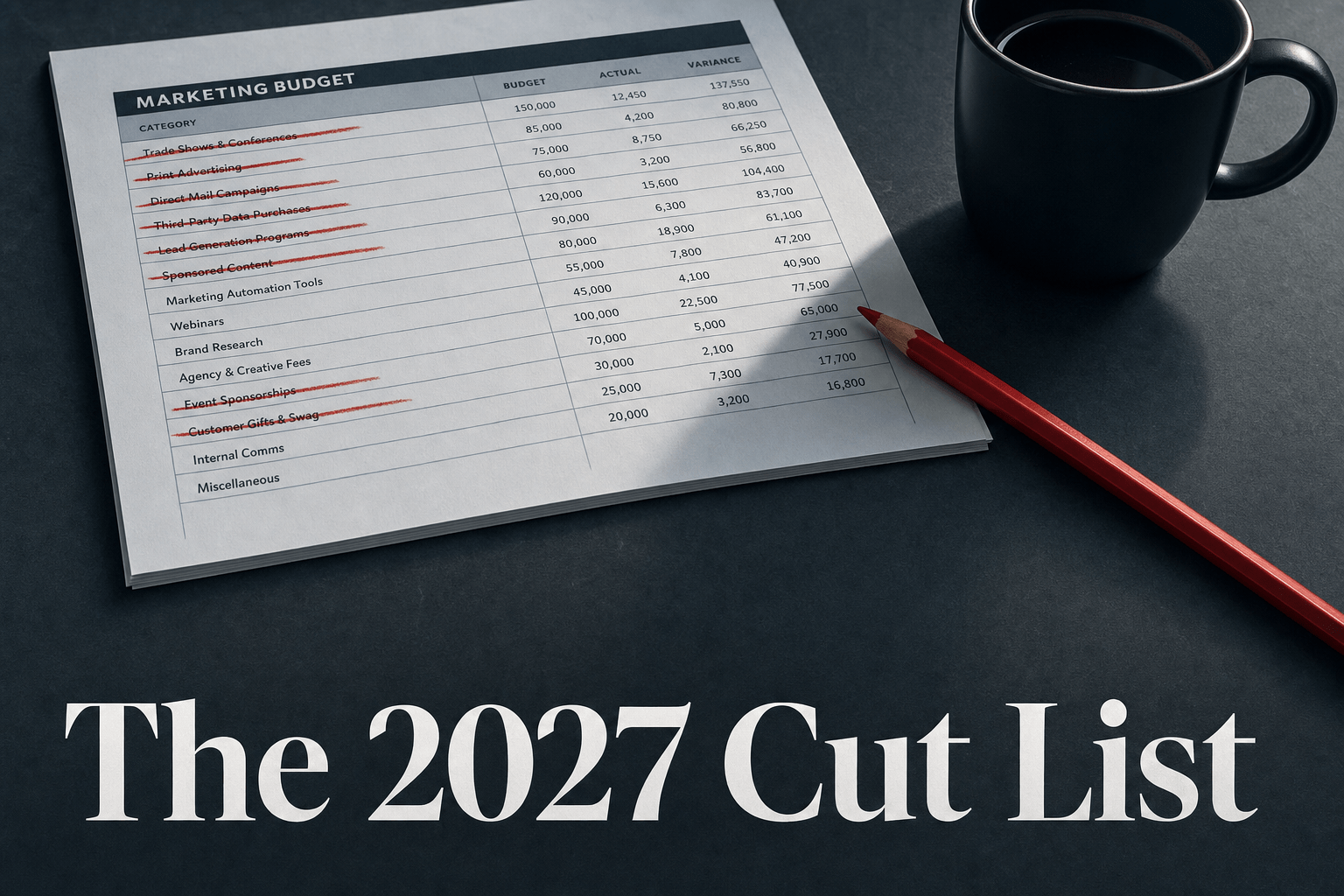
Short answer: cut the line items that consume spend without changing pipeline, and cut them before the allocation meeting, not after it. A marketing budget cut list is a ranked inventory of the spend that produces activity instead of revenue, typically built during planning rather than during a mid-year panic, with every item tied to the specific measurement failure that let the waste hide. In 2027 the cut list matters more than the ask, because 91% of marketing decision-makers expect a bigger budget next year, per Forrester’s 2027 Budget Planning Guides, and a bigger budget poured into an unmeasured system buys more of what already was not working.
Peter Geisheker, founder of The Geisheker Group, Inc., puts the most expensive line item this way:
“When you optimize for cheap MQLs, you are not just filling the funnel with junk. You are teaching the algorithm. You tell Meta and Google to optimize for the form fill, and their AI gets very good at finding people who fill out forms and never buy. You are training the most powerful targeting system ever built to go get you the wrong people, and it will do it, efficiently, at scale, for as long as you keep paying.”
That is why a cut list is not an austerity exercise. Some marketing waste is passive; it simply fails to return. The waste described above is active, because it compounds inside the ad platforms and gets better at being wrong every month you fund it.
Key Facts at a Glance
- 91% of marketers expect budget increases over the next 12 months, and up to 25% of all leaders expect growth of 10% or more, per Forrester’s 2027 Budget Planning Guides (July 2026, based on a global survey of more than 2,600 business and technology decision-makers).
- Only 30% of CMOs report mature or fully developed AI readiness, while CMOs allocate an average of 15.3% of marketing budgets to AI, per the Gartner 2026 CMO Spend Survey (May 2026, n=401 CMOs).
- 84% of companies are trapped in a brand “doom loop,” where underfunded measurement produces unclear impact, which produces C-suite skepticism, which produces tighter budgets, per Gartner (February 2026, n=426 senior marketing leaders).
- Only 19% of marketing leaders work from a single integrated AI platform, and 76% spend three or more hours a week editing or fact-checking AI output, per Optimizely’s 2026 Global Data Study (June 2026, n=2,003 marketing leaders, conducted by Savanta).
- Labor’s share of marketing budgets rose from 21.9% to 24.5% between 2025 and 2026, per Gartner’s June 2026 marketing survey, which contradicts the assumption that AI adoption reduces personnel cost.
- 82% of B2B software buyers sourced recommendations from AI chatbots in the past 24 months, and 83% shortlist three or fewer products, per G2’s 2026 Buyer Behavior Report (July 2026, n=1,000+ buyers).
- CMOs spend roughly 68% of their time managing the present versus 32% preparing for the future, and 53.1% of companies prioritize expense cuts over revenue growth when profits underperform, per The CMO Survey, 35th edition (January 2026, n=308 U.S. marketing leaders).
Who Wrote This
This guide draws on Peter Geisheker’s 20-plus years of B2B marketing experience as founder of The Geisheker Group, Inc., a fractional CMO agency serving B2B, B2B SaaS, PE/VC-backed, and law firm clients. Peter Geisheker has managed more than $50 million in annual advertising spend across his career, including programs deploying up to $1 million per week. Documented client outcomes include 6X inbound lead growth, 100% year-over-year SaaS revenue growth for three consecutive years, and a 77% reduction in paid acquisition cost while growing revenue. The recommendations below reflect budget and planning work inside B2B, SaaS, and private-equity-backed companies, informed by 2026 benchmark research from Forrester, Gartner, The CMO Survey, the American Marketing Association, and G2.
Contents
- Why does a bigger 2027 budget make weak marketing worse?
- What does the 2027 budget data actually say?
- What belongs on the 2027 marketing budget cut list?
- Where should the money you cut actually go?
- How do you defend a cut list to your CEO and CFO?
- Frequently asked questions about 2027 marketing budget planning
- Implementing a budget cut list in your company
- References and sources
Why does a bigger 2027 budget make weak marketing worse?
Budget season in 2026 has an unusual shape. After two years of defensive planning, the money is coming back. Forrester’s 2027 Budget Planning Guides, published in July 2026, found that more than 80% of business and technology leaders expect budget increases in the next 12 months, with marketers the most optimistic group at 91%. Forrester’s own framing of that finding is the part most planning articles skip: spending more is no longer enough.
Here is the mechanical reason that warning is correct. Modern paid media is not a distribution system you point at an audience. It is a learning system you train with conversion data. Targeting, bidding, and creative rotation are algorithmic, and the algorithm optimizes toward whatever event you tell it to value. Increase the budget on a system trained toward a junk conversion event and you do not get more good leads; you get a better-funded machine finding more people who look exactly like the people who never bought.
This is the difference between a marketing budget that is too small and a marketing budget that is misdirected. A small budget underperforms quietly. A misdirected budget underperforms while producing an impressive dashboard, which is worse, because nobody escalates a metric that is going up.
Gartner’s February 2026 research put a number on where that ends. Among 426 senior marketing leaders surveyed, 84% of companies were caught in what Gartner calls a brand “doom loop”: measurement is underfunded, so impact is unclear, so the C-suite grows skeptical, so budgets tighten, so measurement stays underfunded. Companies in the loop were half as likely to exceed their growth targets as companies that evaluate brand value effectively. Gartner further predicts that by 2027, more than 40% of CMOs who push for larger brand budgets will lose influence with the C-suite, precisely because they cannot demonstrate return.
A cut list is the antidote, and it works for a reason that has nothing to do with thrift. Cutting forces you to say out loud what each line item is supposed to produce. Most budgets have never survived that question.
Fractional CMO Services
Need marketing leadership and expert strategy to grow your company?
The Geisheker Group installs senior marketing leadership on a fractional basis for B2B, B2B SaaS, and private-equity-backed companies; strategy, paid media, measurement, and pipeline, owned end to end.
Explore Fractional CMO Services
Or learn how a fractional CMO agency differs from hiring a full-time CMO.
What does the 2027 budget data actually say?
Four independent 2026 datasets point at the same conclusion, which is that the marketing money problem is now an allocation problem rather than a size problem.
Budgets are not actually starved. The Gartner 2026 CMO Spend Survey, conducted January through March 2026 among 401 CMOs and marketing leaders, found marketing budgets at 7.8% of company revenue, up slightly from 7.7% in 2025. The CMO Survey’s 35th edition, fielded in January 2026 among 308 U.S. marketing leaders, put marketing at 9.64% of overall company budgets and 8.96% of company revenues. Meanwhile 56% of the Gartner respondents said they lacked adequate budget to deliver their 2026 strategy. Both things are true at once, which is the tell: the shortfall is being created downstream of the allocation.
AI spend is running ahead of AI readiness. Gartner found CMOs allocating 15.3% of marketing budgets to AI while only 30% reported mature or fully developed AI readiness capabilities, and 70% acknowledged that internal marketing processes lack the maturity to implement and scale AI. In a separate Gartner survey of 402 CMOs, marketing leaders projected AI-driven automation of marketing work rising from 16% in 2026 to 36% by 2028. Optimizely’s June 2026 study of 2,003 marketing leaders found the friction underneath those projections: only 19% work from a single integrated AI platform, 76% spend three or more hours a week editing or fact-checking AI output, and just 4% say AI saves time at every stage of the process.
AI is not reducing headcount cost. Gartner’s June 2026 survey found labor’s share of total marketing budgets rising from 21.9% in 2025 to 24.5% in 2026. The American Marketing Association’s 2026 State of Marketing Careers Report, based on 1,412 practitioners surveyed in December 2025 and January 2026 plus a job-posting analysis, found the share of marketing job postings mentioning AI doubled during 2025 while total marketing postings remained 27% below pre-pandemic levels. Execution roles are what shrank: SEO specialist postings fell 15% and content marketer postings fell 11%, the two steepest declines in the study.
Buyers moved before budgets did. G2’s 2026 Buyer Behavior Report, released in July 2026 and based on more than 1,000 B2B software buyers plus 50-plus interviews with sales and marketing leaders, found that 82% of buyers had sourced software recommendations from AI chatbots in the previous 24 months, and that 83% now shortlist three or fewer products. Finance involvement in software decisions jumped from 31% to 46% year over year. The buyer’s research phase compressed and the evaluation phase lengthened, which changes what a marketing dollar is even being asked to do. Peter Geisheker has written previously on how AI changed the B2B buying process, and the budget consequence is straightforward: spend aimed at winning a click is aimed at a step of the journey that is quietly disappearing.
What senior marketing leadership actually produces
- 6X inbound lead growth
- 77% reduction in paid acquisition cost while growing revenue
- $1 million per week in managed ad spend, deployed and measured


Not sure what is working? Get a free written plan
30 minutes with both of us. No hard sell. Written plan in 3 business days.
What belongs on the 2027 marketing budget cut list?
Six candidates, in the order a fractional CMO would work through them on a first engagement. The order matters, because the first three cuts usually fund the reallocation described in the next section without asking the CFO for anything.
1. The conversion event that trains the platforms toward the wrong buyer
This is the cut with the largest and least visible return, and it is not a line item so much as a setting. If your Meta and Google campaigns are optimizing toward a raw form fill, a content download, or a newsletter signup, you are paying the platforms to become expert at finding people who perform that action and nothing else. The spend is not merely wasted; it is invested in the wrong direction, and the learning persists.
The fix is to send the platforms a conversion event that occurs further down the funnel, closer to the point where money changes hands: a qualified call booked, a sales-accepted opportunity, a demo that was actually attended. Understanding the distinction between MQL and SQL as a B2B marketing KPI is the prerequisite, because you cannot feed the algorithm an event your funnel does not define.
What to cut: not the channel, the objective. Then cut whatever budget was justified solely by the volume that objective produced.
2. Duplicate AI tooling and the disconnected pilot portfolio
Forrester’s 2027 guidance names duplicate technology tools, integration complexity, disconnected AI pilots, and fragmented tech stacks as explicit cut candidates. The Optimizely data explains why they persist: with only 19% of marketing leaders operating from a single integrated platform, most teams have accumulated overlapping point solutions, each purchased to solve one workflow, each now requiring its own review and reconciliation. That is where the three-plus hours a week of editing and fact-checking goes.
Audit every AI and martech subscription against a single question: which decision does this tool change? A tool that produces output somebody else has to check is not a productivity gain, it is a task transfer. Gartner’s finding that 70% of CMOs say internal processes lack the maturity to scale AI is the same problem stated from the top: the constraint is process, and buying another tool does not buy process.
What to cut: every subscription whose output requires more review time than the manual alternative, and every pilot with no owner and no decision attached.
3. Content volume produced for a click that no longer arrives
The AMA data showing SEO specialist postings down 15% and content marketer postings down 11% is not a story about AI writing the content. It is a story about the click economics underneath the content changing. With 82% of B2B software buyers sourcing recommendations from AI chatbots and 83% shortlisting three or fewer products, the traffic-to-lead path that justified high-volume publishing has narrowed sharply.
This is not an argument to stop publishing. It is an argument to stop paying for volume. Content that gets summarized inside an AI answer produces an impression and no visit. Content carrying something the model cannot get anywhere else gets quoted and attributed, which puts a name in front of the buyer. The budget implication: fewer pieces, each carrying something proprietary, beats a quota. Companies still funding a monthly article count should read why most B2B SaaS lead gen programs fail before renewing that line.
What to cut: the volume target. Keep the budget, redirect it toward fewer, more differentiated pieces.
4. Broad-match paid search without a real negative keyword list
Peter Geisheker’s operating rule on this is specific:
“I average over a hundred negative keywords in a Google Ads campaign. ‘Free’ and ‘cheap’ are always on the list. That is what lets you bid on broader, higher-volume terms without paying for garbage clicks from people who were never going to buy.”
The negative list is not hygiene, it is the mechanism that makes broad targeting affordable. Without it, broad match is a subsidy paid to people who were never in the market. Most accounts that arrive at a new fractional CMO engagement have fewer than twenty negatives, and the search terms report usually explains a double-digit share of the spend within about fifteen minutes.
What to cut: the wasted share of existing search spend, identified from the search terms report, not the search budget itself.
5. Low-friction forms that manufacture unqualified pipeline
This one is counterintuitive enough that it usually starts an argument:
“We were taught that more questions on a form means fewer leads. That is true, and it is the point. The friction you are stripping out is the thing doing the qualifying. Five real SQLs beat a hundred junk MQLs, because your closers can actually do something with five.”
Every unqualified lead carries a cost that never appears in the marketing budget, because it is paid in sales time. It also feeds directly back into cut number one, since those form fills are the events training the ad platforms. The two problems are the same problem, and both resolve at the point where marketing and sales agree what a qualified lead is. Companies that have not had that conversation should start with sales and marketing alignment before touching the budget at all.
What to cut: the volume goal, and any program whose only defense is the lead count it produces.
6. The cut most companies are already making, and why it is the wrong one
Gartner’s June 2026 survey found that awareness and conversion now account for 62.6% of total media spend, an increase of more than 10 percentage points since 2024, while spending on customer loyalty and retention declined 29% over the same period to less than 15% of total media budgets.
That is the category cutting the cheapest revenue it has. Retention and expansion spend is defensible on a shorter payback than almost any acquisition program, which makes it the easiest thing to protect in front of a CFO and the hardest to rebuild once the team is gone. It is being cut anyway, because it is the line item with the least internal advocacy. The CMO Survey’s finding that 53.1% of companies prioritize expense cuts over revenue growth when profits underperform is the same instinct visible at the company level.
What to cut: nothing here. Put it on the list so the cut is a decision rather than a default.
Where should the money you cut actually go?
Three destinations, ranked by how fast they change the numbers.
Measurement, first and unglamorously. Gartner’s doom loop is a measurement problem wearing a budget costume, and 84% of companies are in it. Conversion tracking that misfires does not produce a slightly wrong cost per lead; it produces a fictional one, and it feeds that fiction to the ad platforms, which learn from it. Fixing attribution is the only line item on this list that improves every other line item at once. Peter Geisheker has argued the broader case in is marketing attribution dead, and the short version is that imperfect measurement you understand beats precise measurement you have not validated.
Senior judgment over execution capacity. The AMA data shows senior roles holding steady while execution roles decline, and Gartner’s finding that labor’s share of budget rose to 24.5% while AI adoption accelerated says the same thing from the spend side. AI has made execution cheap and made the person deciding which output to keep more valuable, not less. For companies at the stage where a full-time chief marketing officer is not yet justified, a fractional CMO agency covers that judgment layer at a fraction of the loaded cost, and for private-equity-backed businesses the same logic drives the growing use of a fractional CMO for PE portfolio companies during the hold period.
Process maturity before more AI licenses. Gartner found that 70% of CMOs say internal marketing processes lack the maturity to implement and scale AI, and that organizations with mature AI capabilities allocate a higher share of budget to AI (21.3%) than the average (15.3%). Read in the right order, that is not an argument to spend more on AI. It is an argument that the mature organizations earned the right to. For B2B SaaS teams specifically, a SaaS fractional CMO will usually sequence the process work ahead of the tooling for exactly this reason.
How do you defend a cut list to your CEO and CFO?
Three things make the conversation go differently.
Bring the cut list before the ask. Gartner found that only 32% of executives say their CMO makes compelling business strategy recommendations based on data, and only 34% say the CMO effectively identifies high-impact marketing initiatives. A leader who opens with what they are killing, and why, is answering the question those executives are actually asking. A leader who opens with a request for more is confirming the skepticism.
Name the payback window before you are asked for it. The CMO Survey found CMOs spending roughly 68% of their time managing the present versus 32% preparing for the future, which is a fair description of what quarterly reporting does to a marketing plan. In a business with a long sales cycle, the work you fund in Q1 shows up in Q3, and the only way to survive the gap is to have described it in advance. This matters more for interim and fractional leaders than for permanent ones, because the engagement is often shorter than the sales cycle.
Accept that the person cutting may not collect. Spencer Stuart’s CMO Tenure 2026 study, published in January 2026, put average S&P 500 CMO tenure at 4.1 years against 5.0 years for the C-suite overall, with about 31% of S&P 500 companies operating without an enterprise CMO at all. Structural short tenure creates a real incentive to protect the metric that looks good this quarter rather than the pipeline that pays out next year. Naming that incentive out loud, in the room, is usually what gets a cut list approved.
Frequently asked questions about 2027 marketing budget planning
How much should a B2B company budget for marketing in 2027?
Benchmarks cluster in a narrow band. The Gartner 2026 CMO Spend Survey put marketing budgets at 7.8% of company revenue among 401 mostly enterprise CMOs, while The CMO Survey’s 35th edition put marketing at 8.96% of company revenues and 9.64% of overall company budgets among 308 U.S. marketing leaders. Use these as sanity checks rather than targets. The more useful question in 2027 is what share of the existing budget is currently producing activity rather than pipeline, since 56% of the Gartner respondents reported inadequate budget while sitting at or above benchmark spend.
What is the difference between cutting marketing spend and reallocating it?
A cut removes money from the marketing budget. A reallocation moves money between line items and leaves the total unchanged. Most of the six items above are reallocations rather than cuts, which is what makes the exercise defensible to a CMO who does not want to hand budget back. The exceptions are duplicate tooling and disconnected AI pilots, where the correct answer usually is a genuine reduction.
When should I build the 2027 cut list?
Before the allocation conversation, not after. A line item defended once in a planning meeting is much harder to remove in March, and Forrester’s finding that 91% of marketers expect an increase means the 2027 conversation is likely to be about where new money goes rather than whether old money is working. The cut list is what forces the second question onto the agenda.
Should I cut marketing content production now that AI answers most queries?
Cut the volume target, not the budget. With 82% of B2B software buyers sourcing recommendations from AI chatbots per G2’s 2026 Buyer Behavior Report, content that merely restates what a model already knows produces impressions and no visits. Content carrying proprietary data, first-person operating experience, or original analysis still earns citation and attribution. Fewer, more differentiated pieces is the correct adjustment.
How do I know if my conversion tracking is causing the problem?
Compare the number of conversions your ad platforms report against the number of qualified opportunities your CRM shows for the same period and source. If the two numbers cannot be reconciled within a reasonable margin, your cost per lead and your customer acquisition cost are both fiction, and the ad platforms have been learning from that fiction for as long as it has been running.
Is a fractional CMO cheaper than the budget waste they find?
Frequently, though it is not a universal claim and no honest advisor should make it one. The relevant comparison is not fractional cost against full-time cost, it is the engagement cost against the share of current spend that is producing activity instead of revenue. In accounts where the conversion objective is set wrong and the negative keyword list is thin, that share is routinely large enough to fund the engagement several times over. In accounts that are already clean, it is not, and a good advisor will say so in the first month.
What should a PE-backed portfolio company cut first?
The same first item, for a sharper reason. Portfolio companies are usually measured on a hold-period clock, which makes an ad platform trained toward the wrong buyer more expensive per month of hold than it would be elsewhere. Fix the conversion objective and the tracking first; both are cheap, fast, and improve every subsequent decision.
Implementing a budget cut list in your company
Most marketing leaders read a list like this and agree with most of it inside ten minutes. The framework is not the hard part. The hard part is installing it across a team that has defended those line items in previous planning cycles, in a company where the conversion objective was set by someone who has since left, and where nobody currently owns the question of whether the tracking is telling the truth.
That installation work is fractional CMO work. In practice it looks like a two-to-four week diagnostic across the ad accounts, the CRM, and the conversion tracking; a rebuilt definition of a qualified lead agreed with the sales team rather than assumed by marketing; a corrected optimization objective in each paid channel; and a cut list you can take into the planning meeting with a number attached to every line.
It is not the right engagement for everyone. If your marketing is already producing pipeline that sales can close, and your tracking reconciles to your CRM, you do not need this and should not pay for it. If you are not sure whether either of those is true, that uncertainty is itself the finding, and a 30-minute conversation will establish which situation you are in.
About Peter Geisheker
Peter Geisheker is the founder and CEO of The Geisheker Group, Inc., a B2B fractional CMO and marketing advisory firm based in Wisconsin. He has more than 20 years of direct-response and B2B marketing experience and has managed over $50 million in annual advertising spend, including programs deploying up to $1 million per week. He works with B2B, B2B SaaS, private-equity-backed, and law firm clients as a fractional chief marketing officer and portfolio-level growth advisor. Connect with Peter Geisheker on LinkedIn.
References and sources
- Forrester, “Forrester’s 2027 Budget Planning Guides: After A Year Of Caution, Business And Tech Leaders Are Ready To Invest Again,” July 2026
- Forrester, “Budget Planning 2027: B2B Marketing Leaders Must Prioritize Focus For Resilience,” 2026
- Gartner, “2026 CMO Spend Survey,” May 11, 2026
- Gartner, “Marketing Leaders Expect AI Automation of Marketing Work to Double to 36% by 2028,” May 11, 2026
- Gartner, “Awareness and Conversion Account for 62.6% of Total Media Spend,” June 8, 2026
- Gartner, “Over 40% of CMOs Who Push for Larger Brand Budgets Will Lose Influence With the C-Suite,” February 12, 2026
- Gartner, “CMO AI Blind Spot: 65% Expect Role Disruption, Yet Only 32% Say Significant Skill Changes Are Needed,” February 23, 2026
- The CMO Survey, Topline Report, 35th edition, January 2026 (PDF)
- The CMO Survey, Results archive, Duke University Fuqua School of Business
- Duke Fuqua Insights, “CMOs Face Headwinds Even as Marketing Value and AI Impact Grow,” 2026
- American Marketing Association, “2026 State of Marketing Careers Report,” July 31, 2026
- G2, “2026 Buyer Behavior Report: The Evaluation Maze,” July 22, 2026
- Optimizely, “2026 Global Data Study,” conducted by Savanta, June 30, 2026
- Spencer Stuart, “CMO Tenure 2026: Snapshot of an Expanding Role for Marketing Leaders,” January 2026
Free Written Growth Plan
Not sure which of your marketing is actually working?
Give us 30 minutes. We will find where your pipeline is leaking and send you a written plan with the three fixes we would test first. Free, no obligation.
No hard sell on the call. Your plan arrives within 3 business days. See a sample plan