The American Marketing Association’s 2026 careers research lands on a single, uncomfortable sentence: companies are hiring less execution, not less judgment. AI is absorbing the doing, the routine production and reporting that used to fill a marketing team, while demand for the people who decide what to do holds steady. A marketing team built for 2026 is therefore not a smaller version of a 2021 team; it is a different shape. This is what that shape looks like, and the one role that gets more valuable the better AI gets.
This analysis draws on Peter Geisheker’s 20-plus years in B2B marketing as founder and CEO of The Geisheker Group, Inc., a fractional CMO agency serving B2B, B2B SaaS, and PE-backed companies. He has managed more than $50 million in advertising spend and embeds AI as operating leverage across every client engagement. The staffing conclusions here come from running and rebuilding marketing teams through exactly the transition the AMA is now measuring.
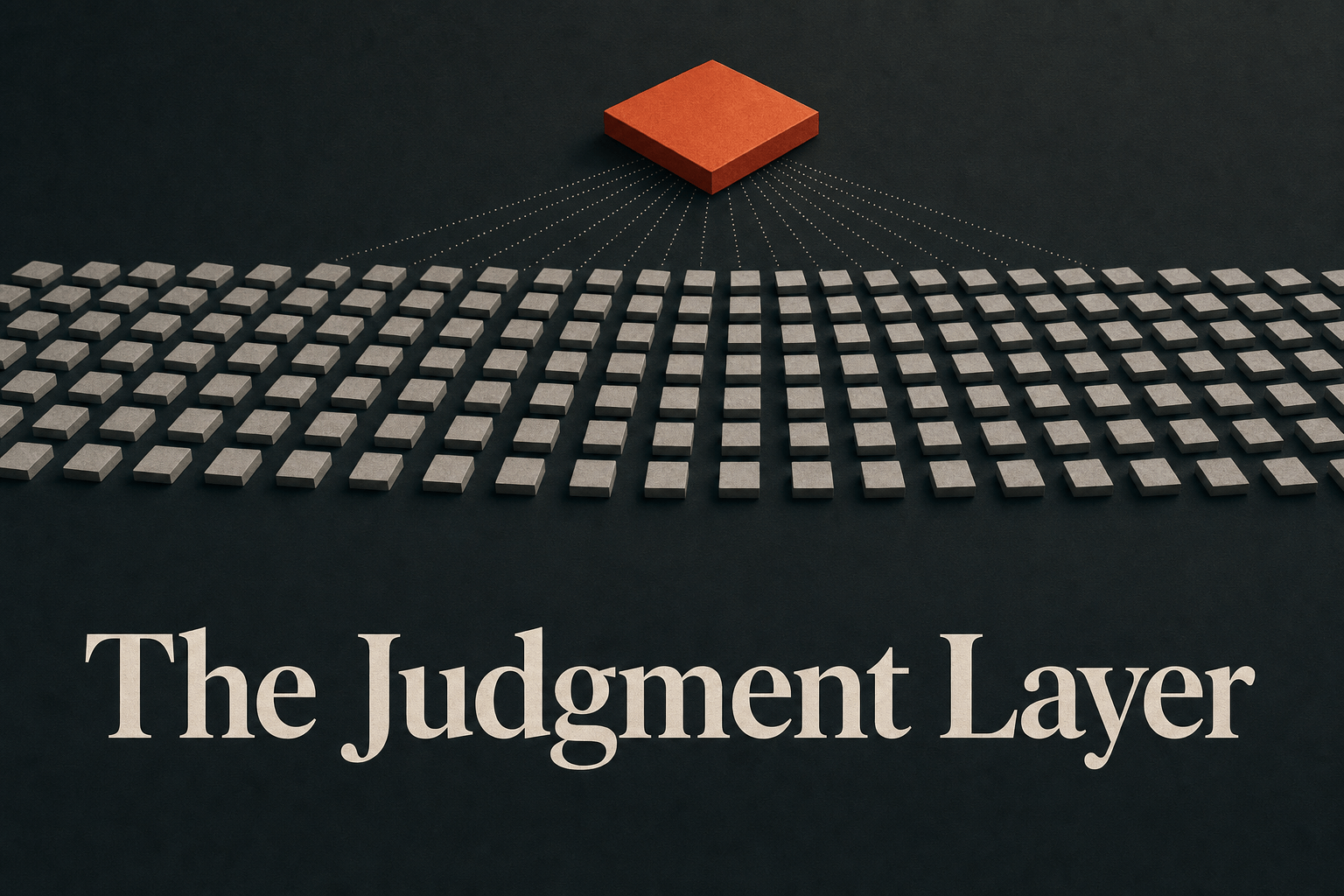
Marketing execution is the production layer AI now handles cheaply: drafting, formatting, routine reporting, generating fifty variants of a thing. Marketing judgment is deciding what is worth making, what to measure, and which of those fifty outputs to keep. The 2026 shift is that the first is being commoditized and the second is becoming the whole job.
Key Facts at a Glance
- The AMA’s 2026 State of Marketing Careers Report, based on a survey of 1,412 marketing practitioners conducted December 2025 through January 2026, frames the shift plainly: companies are hiring less execution, not less judgment.
- The share of marketing job postings mentioning AI nearly doubled across 2025, rising from 8% in January to 15% in December.
- Total US marketing job postings fell more than 8% in 2025, and marketing employment sits roughly 27% below its March 2020 level.
- Gartner reports marketing leaders expect AI-driven automation of marketing work to more than double, from 16% in 2026 to 36% by 2028.
- Demand for senior leadership and strategic roles has held steady even as execution-layer hiring contracts.
- The Duke Fuqua CMO Survey reports marketing headcount growth dropped by roughly half year over year, with training investment at just 3.8% of budget.
- The most-cited capability shortfall in 2026 is not a missing skill; it is a lack of resources: people, time, and budget.
Contents
- What did the AMA’s 2026 careers report actually find?
- Why is AI automating execution but not judgment?
- What does hiring less execution look like on an org chart?
- Can a junior marketer with AI replace a senior one?
- So what should you actually hire for in 2026?
- Where does a fractional CMO fit in this?
- Implementing this in your company
- Frequently asked questions
Need marketing leadership and expert strategy to grow your company?
The Geisheker Group is a fractional CMO agency for B2B, B2B SaaS, and PE-backed companies. We install the strategy, the measurement, and the acquisition system, then we hold ourselves to the number.
What did the AMA’s 2026 careers report actually find?
In August 2026 the American Marketing Association published its 2026 State of Marketing Careers Report, its own research into how AI is reshaping marketing jobs, skills, and team structure. The headline finding is not that marketing is shrinking. It is that marketing is splitting.
The AMA’s own summary of the shift is worth quoting exactly: “Companies are not hiring less judgment. They are hiring less execution.” The data underneath it is blunt. The share of marketing job postings mentioning AI nearly doubled over 2025, from 8% in January to 15% by December. Over the same stretch total marketing postings fell more than 8%, and US marketing employment remains roughly 27% below where it stood in March 2020. Yet demand for senior, strategic, decision-making roles held steady. The jobs disappearing are concentrated in the execution layer, the roles that produce and report rather than decide.
The report’s AI Disruption Map sorts marketing tasks by how much human involvement they still require. Routine reporting, data collection, and campaign monitoring sit at the low end; these are the tasks AI absorbs first and most completely. Strategy, interpretation, and the judgment calls that direct the work sit at the high end, largely untouched.
There is a second finding that should bother anyone staffing a team. The report notes that marketers rated human skills like critical thinking, collaboration, and adaptability as less important in 2026 than they did in 2025, precisely the capabilities the AMA’s own analysis places furthest from automation.
The profession is quietly demoting the skills that are hardest to automate, at the exact moment the automatable work is being automated out from under it.
Why is AI automating execution but not judgment?
Because the two are different activities, and only one of them is production.
Execution is generating options: the draft, the variant, the report, the fifty versions of a headline. AI is extraordinary at this and getting better fast. Gartner found marketing leaders expect AI-driven automation of marketing work to more than double, from 16% in 2026 to 36% by 2028. Generating options got cheap. Choosing correctly did not.
Judgment is selection. It is knowing which of the fifty outputs is worth shipping, what is worth testing, what to measure, and when a result is real rather than noise. A model will hand you fifty options with total confidence and no idea which one wins. The person who can tell the difference is the person you are actually paying for, and that skill does not come from a tool. It comes from having been wrong enough times to recognize the pattern.
What does hiring less execution look like on an org chart?
The old marketing org was a pyramid: a wide base of execution seats, junior producers, coordinators, analysts running manual reports, and a thin layer of strategy at the top. AI inverts it. The base becomes software. The value concentrates in the judgment layer.
You can already see the new shape forming. Jasper’s 2026 research found that 65% of marketing teams now have designated AI roles, most of them oriented around AI operations, workflows, and strategy rather than hand production. Those are not execution seats with an AI label; they are direction seats. Meanwhile the Duke Fuqua CMO Survey reports that marketing headcount growth has dropped by roughly half year over year, and training investment sits at just 3.8% of budget. Teams are getting leaner at the bottom, not the top, and they are not re-skilling fast enough to keep up with the machines they are buying.
The practical translation: fewer seats defined by output, more seats defined by decision rights. If a role’s whole job is to produce a thing AI now produces, that role is on the wrong side of the AMA’s disruption map.
Twenty years of B2B revenue growth, with the receipts.
6X inbound lead growth. A 77% reduction in paid acquisition cost while revenue grew. Programs scaled to $1 million per week. If your marketing produces activity but not pipeline, that is a fixable problem.


Try two senior CMOs before you hire them
30 minutes with both of us. You keep the written plan.
Can a junior marketer with AI replace a senior one?
This is the assumption buried inside every plan to cut senior headcount and hand the tools to someone cheaper: junior plus AI equals senior. It does not, and the reason is structural rather than snobbish.
If you are not an expert in the thing you are asking AI to do, you have no idea whether what came back is gold or garbage. A junior marketer and I use the identical model and get wildly different results, because I know which of the fifty outputs to keep.
That is the whole game in two sentences. The model is the same for everyone. The judgment sitting in front of it is not. A junior marketer using the exact tool a 20-year operator uses will produce something fluent, structured, and confidently wrong, because selecting from the distribution requires knowing what a losing version looks like, and that knowledge was bought with losses.
To be fair about where junior talent plus AI genuinely works: production volume, first drafts, formatting, and repetitive assembly. It works there well, and a great deal of that work should be handed to it. Where it fails, specifically, is judgment and interpretation. Which maps exactly onto the AMA’s finding. The execution that junior seats used to do is precisely what automates. The judgment that senior seats do is precisely what does not.
So what should you actually hire for in 2026?
Hire for reps, not resume. The variable that predicts whether someone can tell gold from garbage is not their title or their years; it is how many real decisions they have personally owned and been graded on. A marketer who has personally run hundreds of tests and watched most of them lose is worth more than a decorated veteran who has only ever approved other people’s decks.
So the hiring math changes. Fewer seats, more senior, better paid, each one carrying AI leverage, will beat a large junior team producing volume nobody is qualified to judge. The scarce hire is the person who can direct the system and read the output, not the person who can operate the tool. This is also why the churn at the top does not contradict the trend: Spencer Stuart’s 2026 data puts average S&P 500 CMO tenure at 4.1 years, the role is expanding and turning over fast, but the through-line is that the judgment layer is exactly where companies cannot afford a vacancy.
Where does a fractional CMO fit in this?
Read the AMA finding one more time, as a staffing instruction rather than a trend: buy less execution, keep the judgment. That sentence is, almost word for word, the structural case for a fractional model.
When execution is software and the scarce input is direction, you need the direction more than you need the headcount to carry it. A fractional CMO agency installs the judgment layer without the full-time execution overhead attached to it: someone senior decides what gets made, what gets measured, and which outputs are worth keeping, and a lean team plus AI carries the production underneath. For a company that cannot justify a full-time CMO salary but badly needs the judgment a CMO provides, the AMA’s data is the business case written for you.
The honest caveat, because it matters: fractional is not automatically that. The title has no barrier to entry and the quality range is enormous, so the model only delivers when the person actually has the reps to tell gold from garbage. Buying a fractional CMO who cannot do that is buying the same commoditized layer you were trying to escape, just at a senior price. The value is in the judgment, not the arrangement. If you are weighing the structural trade-offs, we cover them directly in our breakdown of the bad marketing hire, fractional versus full-time, and in how to hire a fractional CMO.
When execution is the cheap part, the expensive mistake is hiring for output. Hire for the judgment that decides which output is worth keeping.
Implementing this in your company
The move is not to buy more tools. It is to look at your org chart and mark every seat whose whole job is producing something AI now produces. Those are the seats the AMA data says will not survive the decade as they are currently defined. Then stop reflexively backfilling execution when someone leaves, and redirect that budget toward the judgment layer: senior direction, plus AI leverage underneath it, wired to a number your CFO recognizes.
That is uncomfortable, because it means rebuilding what your team is for, not just adding software on top of the old shape. Most B2B marketing teams are still staffed as though execution is the scarce resource. It stopped being scarce in 2025.
If your marketing produces activity but not pipeline, or you are trying to work out which roles to keep, cut, or redefine as AI absorbs the production layer, that is a strategy problem worth a conversation. If the honest answer is that you need one senior operator directing the system rather than three more producers, I will tell you that.
About Peter Geisheker
Peter Geisheker is a fractional CMO and the founder and CEO of The Geisheker Group, Inc., serving B2B, B2B SaaS, and PE/VC-backed companies. He has managed more than $50 million in advertising spend and specializes in building capital-efficient, measurable demand generation systems directed by senior judgment and executed with AI leverage. He also advises private equity portfolio companies on marketing as a value-creation lever. Connect with him on LinkedIn.
Frequently asked questions
Is AI going to replace marketing jobs?
It is replacing marketing tasks, not whole roles evenly. The 2026 AMA data shows AI absorbing execution work, routine production, reporting, and campaign monitoring, while demand for senior, strategic, judgment roles holds steady. The exposure is concentrated in the execution layer.
Which marketing roles are most at risk from AI?
Roles whose primary output is production AI can now generate: routine content assembly, manual reporting, data collection, and campaign monitoring. Roles built around interpretation, strategy, and deciding what to make and measure are the least exposed.
How should I structure a marketing team in 2026?
Invert the old pyramid. Let AI plus a lean team carry execution, and concentrate your budget in the judgment layer, the people who decide what gets made, what gets measured, and which outputs are worth keeping. Hire fewer, more senior seats with AI leverage rather than a large junior production team.
Do I still need junior marketers if I have AI?
For production volume, first drafts, formatting, and repetitive assembly, junior talent plus AI works well. What it cannot do is substitute for senior judgment and interpretation, which is exactly the skill selecting good output from bad requires.
What marketing skills matter most now?
Selection and interpretation: knowing which output is worth shipping, what is worth testing, what to measure, and when a result is real rather than noise. These are the capabilities AI does not provide and, per the AMA, the ones the profession is underrating at exactly the wrong moment.
Is a fractional CMO worth it when AI can do so much?
The more AI does the execution, the more valuable the judgment layer becomes, and a fractional CMO is a way to buy that judgment without full-time overhead. The value depends entirely on the operator having real reps; a fractional CMO who cannot tell good output from bad is not worth the senior price.
References and Sources
- American Marketing Association. “2026 State of Marketing Careers Report.” Original AMA research on how AI is reshaping marketing careers, skills, and team structure; survey of 1,412 practitioners conducted December 2025 through January 2026. https://www.ama.org/
- American Marketing Association / Agility PR Newswire. “American Marketing Association Releases New Report: The AMA State of Marketing Careers Report.” Announcement and summary of the 2026 report, August 2026. https://agilitypr.news/American-Marketing-Association-Releases–1006011
- MarTech. “Here are the marketing skills AI is making more valuable.” Coverage of the AMA 2026 State of Marketing Careers Report, including the AI job-posting share, employment figures, and the execution-versus-judgment framing. https://martech.org/here-are-the-marketing-skills-ai-is-making-more-valuable/
- Gartner. “Gartner Survey Reveals Marketing Leaders Expect AI Automation of Marketing Work to Double to 36% by 2028.” Survey of 402 CMOs, May 2026. https://www.gartner.com/en/newsroom/press-releases/2026-05-11-gartner-survey-reveals-marketing-leaders-expect-ai-automation-of-marketing-work-to-double-to-36-percent-by-2028
- Spencer Stuart. “CMO Tenure 2026: Snapshot of an Expanding Role for Marketing Leaders.” Annual analysis of S&P 500 CMO tenure and role scope, January 2026. https://www.spencerstuart.com/research-and-insight/cmo-tenure-2026-snapshot-of-an-expanding-role-for-marketing-leaders
- Duke University’s Fuqua School of Business. “CMOs Face Headwinds Even as Marketing Value and AI Impact Grow.” The CMO Survey, 35th edition, fielded January 2026; source of the headcount-growth and training-investment figures. https://www.fuqua.duke.edu/duke-fuqua-insights/CMOs-Face-Headwinds-Even-as-Marketing-Value-and-AI-impact-grow
- The CMO Survey. Longest-running study of marketing leaders, directed by Professor Christine Moorman, co-sponsored by Deloitte and the American Marketing Association. https://cmosurvey.org/
- Jasper. “The State of AI in Marketing 2026.” Source of the finding that 65% of marketing teams now have designated AI roles. https://www.jasper.ai/state-of-ai-marketing-2026
- Lippincott. “CMO Outlook 2026.” Global study of 500-plus marketing leaders on the forces reshaping marketing leadership. https://www.lippincott.com/cmo-outlook-2026/
- PwC and the ANA. “2026 Growth Strategy for Chief Marketing Officers.” Research on how leading marketers use AI to elevate marketing’s role in enterprise growth. https://www.pwc.com/us/en/leadership-center/cmo.html
- Canva. “The State of Marketing and AI Report 2026.” Finding that AI use has become near-universal inside marketing teams. https://www.canva.com/newsroom/news/marketing-ai-report-2026/
- First-party operator experience. Selection-versus-production observations and the “gold or garbage” judgment claim are drawn from Peter Geisheker’s own campaign work across 20-plus years and more than $50 million in managed advertising spend, The Geisheker Group, Inc.
Free Written Growth Plan
Wondering if a fractional CMO is right for you?
Try us before you hire us. Book a free 30-minute working session with both of us and get a written growth plan you can use whether or not you hire us.
For B2B companies with $5M to $50M in revenue. Limited to 10 plans a month. See a sample plan