By Peter Geisheker, Fractional CMO | The Geisheker Group, Inc. | March 10, 2026
What Is a B2B Marketing Strategy Framework?
A B2B marketing strategy framework is a structured system that connects market positioning, demand generation, sales alignment, and revenue measurement into a single operating model. According to research cited by SiriusDecisions (now part of Forrester), companies with tightly aligned marketing and sales operations achieve 24% faster revenue growth and 27% faster profit growth over a three-year period (Forrester Research). Without this framework, marketing becomes a series of disconnected tactics that consume budget and produce little measurable growth.
Why Most B2B Marketing Strategies Fail Before They Start
Here is a hard truth most consultants will not tell you: the majority of B2B marketing programs fail not because of poor execution, but because of poor strategy.
CEOs invest in campaigns, hire agencies, and launch content initiatives, yet pipeline stays thin and sales teams complain that marketing is generating the wrong leads.
The four most common failure patterns are entirely predictable.
- Lack of clear positioning, so messaging becomes generic and forgettable
- Marketing pursues tactics without a strategy connecting them, chasing channels instead of ideal customers
- Sales and marketing operate in silos, blaming each other when pipeline goals are missed (learn how to fix sales and marketing alignment)
- CEOs measure the wrong things: website traffic and social followers instead of pipeline and revenue
According to Forrester’s 2024 State of Business Buying report, 86% of B2B purchases stall during the buying process, and 81% of buyers express dissatisfaction with their chosen providers, strong evidence that most B2B go-to-market strategies are structurally broken (Forrester, The State of Business Buying 2024).
This article presents the B2B marketing strategy framework that addresses each failure point in sequence. It is the same framework I use as a Fractional CMO when working with small and mid-size B2B companies that are serious about building a marketing engine that drives measurable revenue.
What Marketing Should Actually Do for Your Business
Before building a B2B marketing strategy framework, CEOs need to agree on what marketing is actually responsible for. This sounds obvious, but disagreement here is one of the most common sources of dysfunction between CEOs and their marketing teams.
Marketing has four core functions in a B2B business.
- Create demand by making your ideal customers aware that a problem exists and that your company offers a credible solution
- Build trust by educating buyers, demonstrating expertise, and reducing the perceived risk of choosing you
- Accelerate pipeline by nurturing prospects through the buying process faster than they would move on their own
- Support sales conversion by equipping your sales team with the right content, tools, and insights to close deals
What marketing is not responsible for, by itself, is closing revenue. That is a shared outcome between marketing and sales.
When CEOs hold marketing accountable only for closed deals (without giving them pipeline visibility or sales alignment) they are setting marketing up to fail.
Fractional CMO Insight: “One of the first things I do when engaging with a new B2B client is establish a shared, written definition of what marketing owns and what it does not. Without that agreement at the CEO level, no strategy framework will succeed.” – Peter Geisheker
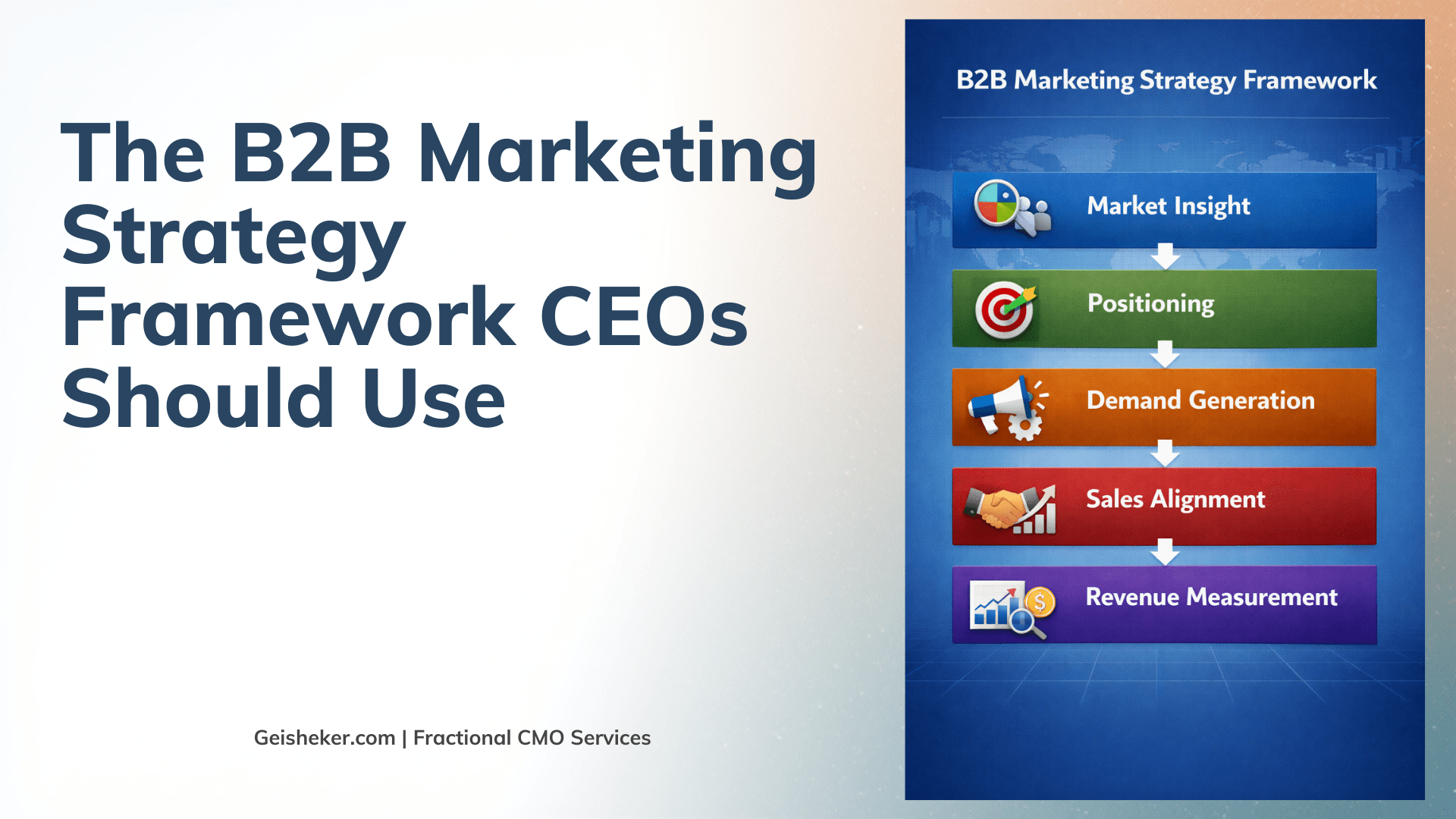
The Core B2B Marketing Strategy Framework: Five Integrated Layers
A sound B2B marketing strategy framework is not a single tactic or channel. It is a layered system where each component builds on the one before it.
The five layers are:
- Market Insight, Understanding your customers, competitors, and market position
- Positioning, Defining what makes you different and why it matters
- Demand Generation, Building the engine that creates pipeline
- Sales Alignment, Connecting marketing output to sales outcomes
- Revenue Measurement, Tracking what matters and optimizing over time
When all five layers work together, marketing generates consistent, compounding pipeline growth. The following sections examine each layer in depth.
Layer 1: Market Insight, Know Your Customer Before You Market to Them
Defining Your Ideal Customer Profile (ICP)
The first and most critical element of any B2B marketing strategy framework is a precisely defined Ideal Customer Profile (ICP).
Your ICP is not a demographic description. It is a detailed profile of the company types most likely to buy from you, succeed with your solution, and grow over time as a customer.
A strong B2B ICP includes:
- Company size by revenue and headcount
- Industry vertical and sub-vertical
- Technology stack or operational environment
- Common buying triggers, growth events, compliance changes, competitive pressure
- The specific pain points your product or service resolves
Gartner defines the ICP as “the firmographic, environmental, and behavioral attributes of accounts that are expected to become a company’s most valuable customers” (Gartner, The Framework for Ideal Customer Profile Development). Their research on high-growth companies shows that ICP is not a marketing exercise. It is a foundational, organization-wide strategic decision.
Companies implementing a well-defined ICP see 68% higher account win rates, 45% larger deal sizes, and 36% higher customer retention rates, according to data aggregated across multiple B2B performance studies (Wandify, The Ultimate Guide to Creating a Data-Driven ICP).
Identifying the Economic Buyer
In B2B, marketing must reach the economic buyer. The person who controls the budget and makes or significantly influences the final purchasing decision.
Depending on company size and category, this could be the CEO, CFO, CTO, VP of Operations, or a procurement committee. According to Forrester’s 2024 State of Business Buying report, 89% of B2B purchases involve two or more departments, with an average of 13 people inside the organization involved in the buying decision (Forrester, The State of Business Buying 2024).
A common mistake in B2B marketing is marketing exclusively to end users of your product, practitioners or managers, while neglecting executive-level decision makers.
For contracts above $25,000, the economic buyer is almost always involved in the final decision. If your marketing does not speak to their concerns around ROI, risk, and strategic advantage, you will struggle to close deals even when practitioners love your solution.
ICP Checklist for B2B Companies: Company size (revenue range and headcount) | Industry or vertical | Technology environment | Buying triggers | Decision-making structure | Revenue potential per account | Customer success profile
Layer 2: Positioning, The Cornerstone of Your B2B Marketing Strategy Framework
Defining the Problem You Solve
B2B market positioning begins not with your product, but with the problem your customer is experiencing. This distinction is critical.
When companies lead with features and capabilities, they sound like every other vendor in the market. When they lead with a clear, vivid articulation of the problem they solve, they immediately connect with buyers who are actively experiencing that pain.
Ask your marketing team to answer this question in one sentence, without mentioning your product: What painful, costly, or risky problem does our ideal customer face that we uniquely help them solve? If they cannot answer clearly and specifically, your positioning work is not done.
Competitive Market Positioning
Effective competitive positioning requires understanding three dimensions of your market.
First, what category do you compete in, and is that the right category? Second, where are your competitors weakest, and can you own that gap credibly? Third, what specific claims can you make that competitors cannot or do not make?
Category positioning is particularly powerful for B2B companies. Rather than competing as the fourth-best option in an established category, companies that successfully create or own a sub-category can be the leader in it. This approach, described by Al Ries and Jack Trout in Positioning: The Battle for Your Mind, is especially effective in crowded B2B software and services markets.
Creating a Unique Value Proposition
Your Unique Value Proposition (UVP) is the single most important sentence in your B2B marketing strategy. It should answer three questions simultaneously: Why is your company different? Why should the market care? Why should they act now?
A strong B2B UVP is specific, credible, and outcome-focused. Compare these two examples:
- Weak: “We help companies grow their marketing.”
- Strong: “We help mid-size B2B SaaS companies cut customer acquisition costs by 30-40% in the first six months by replacing broad campaigns with account-targeted demand programs.”
The first creates nothing. The second creates urgency, specificity, and interest.
Executive-Level Messaging
At the executive level, B2B messaging should never lead with features. CEOs, CFOs, and other economic buyers think in terms of ROI, risk reduction, competitive advantage, and strategic outcomes.
Every piece of executive-facing content should answer one of these questions:
- How does this improve our financial performance?
- How does this reduce risk or uncertainty?
- How does this give us an edge over competitors?
- How does this align with our strategic priorities?
Forrester’s 2024 State of Business Buying data shows that industry, technology, and domain expertise are among the top reasons B2B buyers select a provider, and that buyers specifically want vendors to “understand their specific needs and context” (Forrester, State of Business Buying 2024 Blog).
If your executive messaging leads with product capabilities rather than business context, you are losing deals to vendors who speak the executive’s language.
Layer 3: The Demand Generation Engine
With a clear ICP and strong positioning in place, you are ready to build a demand generation engine.
Demand generation is not the same as lead generation. Lead generation captures contact information from people who show interest. Demand generation creates that interest in the first place, making your ideal customers aware of the problem you solve and establishing your authority as the best solution.
Content as a Demand Generation Engine
In B2B marketing, content is not optional. It is the primary mechanism through which companies build authority, educate buyers, and generate organic demand at scale.
According to the Content Marketing Institute’s 2024 B2B Content Marketing Benchmarks research, 73% of B2B marketers use content marketing as a core part of their overall strategy, and those with a documented content strategy are significantly more likely to achieve strong ROI than those operating without one (Content Marketing Institute, B2B Content Marketing Benchmarks 2024).
Content that drives demand at the executive level includes:
- Original research and data-driven reports
- Strategic perspective pieces that challenge conventional thinking
- Frameworks and models that help buyers solve problems
- Case studies demonstrating measurable business outcomes
The Authority Platform Approach
One of the most powerful demand generation strategies in B2B is an authority platform approach: a systematic approach to publishing expert content that attracts your ideal customers through search, thought leadership, and earned media, rather than interrupting them with advertising.
The authority platform model works on three levels:
- Top of funnel: Broad educational content attracts executives in early-stage problem awareness
- Middle of funnel: Specific framework content engages buyers evaluating options
- Bottom of funnel: Proof content (case studies, ROI data, testimonials) helps buyers justify a decision
When all three levels consistently produce content, the platform generates compounding inbound demand over time.
This is the model I implement for my Fractional CMO services business, The Geisheker Group, and for my B2B clients. It typically takes 6 to 12 months to reach full velocity, but once operational it becomes a durable competitive advantage that compounds rather than depreciates like paid media spend. – Peter Geisheker
If you would like to discuss whether this model is right for your business, schedule a free strategy consultation here.
Thought Leadership as a Demand Driver
Thought leadership is a specific type of content that positions your company and leadership as the foremost authority on a category of problem type. Unlike general educational content, thought leadership takes a point of view. It makes predictions, challenges assumptions, presents original frameworks, and demonstrates expertise that only comes from deep experience.
Effective B2B thought leadership formats include:
- Original articles and white papers published on owned and earned channels
- Podcast appearances and hosting
- Keynote speaking and webinar presentations
- Participation in industry publications and analyst briefings
Channel Strategy for B2B Marketing
The right channel strategy depends on your ICP, your average contract value, and your available budget.
| Contract Value (ACV) | Recommended Channels |
|---|---|
| Below $10,000 | SEO content, email automation, paid search |
| $10,000 – $50,000 | LinkedIn, content marketing, ABM-lite, webinars |
| $50,000 – $150,000 | Full ABM, executive events, strategic partnerships |
| $150,000+ | Enterprise ABM, field marketing, executive relationship programs |
For most B2B companies with average contract values above $20,000, the highest-ROI channels are SEO-driven B2B content marketing, LinkedIn organic and paid, targeted outbound email to ICP accounts, and webinars.
Account-Based Marketing (ABM)
Account-Based Marketing (ABM) is a strategy in which marketing and sales target a defined list of specific high-value accounts with personalized campaigns rather than marketing broadly to a wide audience.
ABM is most effective when:
- Average contract values exceed $50,000
- Sales cycles are long and complex (3+ months)
- You have a defined list of named target accounts
- Winning a single deal justifies significant marketing investment
For companies below these thresholds, a broad demand generation program combined with strong inbound content typically produces better pipeline economics than a full ABM motion.


Get a free written growth plan from two senior CMOs
30 minutes with both of us. No hard sell. Written plan in 3 business days.
Choosing the Right Marketing Leadership for Your B2B Strategy
A well-designed B2B marketing strategy framework requires experienced strategic leadership to execute effectively. Before investing in a full demand generation program, CEOs need to assess whether they have the right leadership in place.
| Full-Time CMO | Marketing Agency | Fractional CMO | |
|---|---|---|---|
| Annual Cost | $200,000 – $400,000+ | $120,000 – $300,000 | $120,000+ (from $10,000 per month) |
| Strategic Leadership | Yes | Limited | Yes |
| Time to Start | 3 – 6 months | 2 – 4 weeks | 1 – 2 weeks |
| Flexibility | Low | Medium | High |
| B2B Specialization | Varies | Varies | Targeted |
| Accountability | High | Low – Medium | High |
For small and mid-size B2B companies with annual revenues between $5 million and $75 million, a Fractional Chief Marketing Officer typically delivers the optimal combination of strategic expertise, cost efficiency, and flexibility, at 60 to 70% lower cost than hiring a full-time Chief Marketing Officer, with no long-term commitment and no benefits overhead.
Layer 4: Sales and Marketing Alignment, The Key to Pipeline Growth
The Sales and Marketing Alignment Model
Sales and marketing misalignment is one of the most expensive problems in B2B. Research from SiriusDecisions (now part of Forrester) shows that B2B companies with tightly aligned sales and marketing operations achieve 24% faster three-year revenue growth and 27% faster three-year profit growth (Forrester Research, B2B Sales).
Additionally, companies with strong sales and marketing alignment see 36% higher customer retention rates and 38% higher sales win rates (ZoomInfo, Sales and Marketing Alignment Statistics).
True alignment requires three things.
- Shared pipeline goals: Both teams should be accountable to the same revenue number, not separate vanity metrics
- Messaging alignment: Sales should use the same core value propositions and objection responses that marketing communicates in content and campaigns
- Feedback loops: Sales should regularly report which content is helping close deals and which objections are most common, so marketing can adapt accordingly
Despite the evidence, only 35% of marketers say their sales and marketing teams are strongly aligned, according to HubSpot’s 2024 State of Marketing report (HubSpot, State of Marketing 2024).
The B2B Revenue Funnel
A clearly defined revenue funnel gives sales and marketing a common operating model. Without it, pipeline conversations become confusing and accountability breaks down.
| Stage | Goal | Key Activities |
|---|---|---|
| Awareness | Get found | SEO, thought leadership, LinkedIn, paid media |
| Interest | Build trust | Educational content, email nurture, retargeting |
| Consideration | Demonstrate value | Case studies, demos, comparisons, webinars |
| Opportunity | Accelerate close | Sales enablement, proposals, executive alignment |
| Revenue | Win and expand | Onboarding, upsell, referral programs |
Pipeline Generation vs. Lead Generation
One of the most important distinctions in modern B2B marketing is the difference between lead generation and pipeline generation.
Lead generation focuses on capturing contact information, typically measured in MQL volume. Pipeline generation focuses on creating genuine buying intent within your ICP accounts, measured in sales-accepted opportunities and pipeline value.
Many B2B companies over-invest in lead generation tactics that produce high volumes of low-quality contacts, while under-investing in demand creation that produces fewer but far more valuable pipeline opportunities. A strong B2B marketing strategy framework optimizes for pipeline contribution, not lead volume.
According to HubSpot’s 2024 State of Marketing data, only 35% of marketers say their sales and marketing teams share a single source of truth for data, a core prerequisite for effective pipeline accountability (HubSpot, State of Marketing 2024).
Marketing and Sales Handoff
The transition from marketing to sales is where deals are won or lost at the operational level.
A clean handoff requires:
- Agreed-upon lead qualification criteria defining what constitutes an MQL and SQL
- CRM workflows that ensure timely follow-up and accurate pipeline attribution
- A shared Service Level Agreement (SLA) specifying how quickly sales will follow up on marketing-sourced leads
Without this structure, marketing-sourced leads go cold, neither team trusts the other’s output, and the CEO is left wondering why marketing spend is not translating to revenue.
Layer 5: Revenue Measurement, Tracking What Actually Matters
Marketing Metrics CEOs Should Track
The metrics CEOs track shape what marketing prioritizes. If you measure vanity metrics, your marketing team will optimize for vanity metrics.
The four marketing metrics every CEO should review monthly are:
- Pipeline generated by marketing, in dollar value of qualified opportunities
- Customer Acquisition Cost (CAC), total marketing spend divided by new customers acquired
- Marketing payback period, how many months to recover marketing investment per customer
- Marketing’s contribution to closed-won revenue, as a percentage of total bookings
Secondary metrics that inform strategic decisions include organic search traffic growth, content engagement by ICP persona, webinar and event attendance by target account, and sales cycle length for marketing-sourced versus non-marketing-sourced deals.
Data, Attribution, and Marketing ROI
Attribution (understanding which marketing activities contributed to a closed deal) is one of the most complex topics in B2B marketing. For most mid-size B2B companies, a multi-touch attribution model that gives partial credit to all marketing touchpoints in a buyer’s journey provides the most useful signal for budget allocation decisions.
The key principle is to tie marketing investment to pipeline outcomes, not to individual tactic performance. A blog post may have low direct attribution but play a critical role in building trust during a three-month buying cycle. Good attribution modeling captures this contribution.
Marketing Technology Stack
The right marketing technology stack enables measurement, automation, and personalization at scale. For most B2B companies, the core stack includes:
- A CRM (Salesforce or HubSpot) for pipeline tracking and contact management
- A marketing automation platform for email nurture and campaign execution
- An SEO and content analytics tool such as Semrush or Ahrefs
- A paid media management tool for LinkedIn or Google campaigns
The most common mistake is investing in technology before strategy. Technology amplifies whatever strategic approach you are already executing. If your strategy is weak, more technology makes your weak strategy faster and more expensive. Build strategy first, then select the tools that support it.
Budget Allocation for a B2B Marketing Strategy Framework
How you allocate your marketing budget reflects your strategic priorities. The following allocation model serves as a practical starting point for mid-size B2B companies with established product-market fit.
| Category | Recommended Allocation | What It Funds |
|---|---|---|
| Demand Generation | 40% | SEO, paid media, webinars, email campaigns |
| Brand and Authority | 30% | Thought leadership, PR, content marketing |
| Experimentation | 20% | New channels, A/B testing, partnerships |
| Retention and Expansion | 10% | Customer marketing, referral programs |
Budget allocations should shift based on company stage. Early-stage companies should weight experimentation more heavily, 30 to 40%, testing channels and messaging before committing to a full demand generation engine. Growth-stage companies should shift weight toward proven demand generation channels. Market-leadership-stage companies should increase brand and authority investment to protect their position.
The B2B Marketing Growth Flywheel
When all five layers of the B2B Marketing Strategy Framework are operating effectively, they create a growth flywheel: a self-reinforcing cycle where marketing investment compounds over time rather than decaying.
Authority Content
      ↓
Trust Building
      ↓
Demand Generation
      ↓
Pipeline Growth
      ↓
Sales Conversion
      ↓
Revenue → Funds More Content
      ↓
(Cycle repeats with compounding returns)
The flywheel works as follows. Authority content attracts ideal customers through organic search and thought leadership. Trust built through expert content converts prospects to leads and leads to opportunities. A strong demand generation engine creates consistent pipeline. Sales alignment ensures that pipeline converts to revenue efficiently. Revenue funds more marketing investment, which generates more authority content, and the cycle accelerates.
The critical insight is that this flywheel takes time to reach full velocity, typically 9 to 18 months for mid-size B2B companies. But once it is turning, it becomes exponentially more efficient. Companies that invest early in building this flywheel consistently outcompete those that rely on short-term campaigns and paid media spikes.
When B2B Companies Need a Fractional CMO
A well-designed B2B marketing strategy framework requires experienced strategic leadership to build, execute, and continuously optimize. Most small and mid-size B2B companies face a dilemma: they need senior marketing leadership but cannot yet justify the cost of a full-time CMO.
This is precisely where a Fractional CMO creates strategic value. A Fractional CMO is a senior marketing executive who works with companies on a part-time basis, providing C-level strategic thinking and execution leadership at a fraction of a full-time executive’s cost.
Three situations indicate that a B2B company needs a Fractional CMO rather than a full-time hire or agency:
- The company has a marketing budget but no clear strategy connecting that budget to revenue
- The company is scaling and needs senior marketing leadership without a full-time cost commitment
- The CEO is currently driving all marketing decisions but lacks the bandwidth or expertise to build a scalable engine
If any of these describe your situation, a Fractional CMO services engagement is likely your highest-leverage marketing investment.
Ready to explore whether a Fractional CMO is right for your business? Schedule a free, no-obligation strategy consultation with Peter Geisheker. There is no sales pitch, just a strategic conversation about your marketing goals and current challenges.
How CEOs Should Evaluate Their B2B Marketing Strategy
Before investing further in marketing, every CEO should be able to answer yes to each of these diagnostic questions. If you cannot, your B2B marketing strategy framework has a gap that is likely costing you pipeline and revenue.
- Do we have a documented Ideal Customer Profile that sales and marketing both agree on?
- Can our marketing team articulate our competitive positioning in one clear sentence?
- Do we have a documented content strategy tied to the buyer’s journey?
- Are marketing and sales operating from the same pipeline goal and lead qualification criteria?
- Can we measure marketing’s direct contribution to pipeline and closed revenue?
- Do we have a marketing technology stack that supports measurement and automation?
- Are we investing in long-term demand generation, not just short-term lead generation?
If you answered no to three or more of these questions, your marketing program is operating without a strategic foundation. Every dollar you invest in tactics without this foundation produces a fraction of the return it would with the right strategy in place.
Not sure where your strategy stands? Schedule a complimentary B2B marketing audit with Peter Geisheker to identify your highest-priority gaps.
Frequently Asked Questions: B2B Marketing Strategy Framework
What is a B2B marketing strategy framework?
A B2B marketing strategy framework is a structured system that connects market research, positioning, demand generation, sales alignment, and revenue measurement into an integrated operating model. It gives marketing teams and executives a shared blueprint for deciding what to prioritize, where to invest, and how to measure success. Companies operating with a documented strategy are substantially more likely to achieve strong marketing ROI than those without one, according to multiple industry studies.
How is strategy different from tactics in B2B marketing?
Strategy defines the direction, priorities, and goals of your marketing program. Tactics are the specific actions taken to execute that strategy. For example, deciding to target CFOs in the manufacturing sector with content focused on operational risk is strategy. Publishing a LinkedIn article on operational risk for manufacturers is a tactic. Tactics without strategy produce activity without outcomes, and that is the most common cause of B2B marketing failure.
How long does it take to see results from a B2B marketing strategy framework?
Most B2B companies should expect 6 to 12 months before a new marketing strategy framework produces meaningful pipeline results. This reflects the reality of B2B buying cycles, which average 3 to 6 months for mid-market deals, as well as the time required to build authority through content and establish brand recognition in a target market. Paid media programs can accelerate early results, but organic demand generation programs take longer to reach full velocity and then compound over time.
What is an Ideal Customer Profile and why does it matter for B2B marketing?
An Ideal Customer Profile (ICP) is a detailed description of the company types most likely to buy from you, succeed with your solution, and grow as long-term customers. It matters because it defines who you market to, which channels you use, and what messages you emphasize. According to Gartner, the ICP should capture the “firmographic, environmental, and behavioral attributes” of your most valuable target accounts (Gartner, The Framework for Ideal Customer Profile Development). Without a clear ICP, marketing targets too broad an audience to generate efficient pipeline.
How should a CEO measure marketing performance?
CEOs should track four primary marketing metrics: pipeline generated by marketing in dollar value, Customer Acquisition Cost (CAC), marketing payback period in months, and marketing’s contribution to closed-won revenue as a percentage of total bookings. Avoid over-weighting vanity metrics like website traffic and social media followers. They do not directly correlate with revenue performance and can mask serious strategic problems. Learn more about B2B marketing measurement frameworks at The Geisheker Group.
What is Account-Based Marketing and when should B2B companies use it?
Account-Based Marketing (ABM) is a strategy in which marketing and sales target a defined list of specific high-value accounts with personalized campaigns rather than marketing broadly. ABM is most effective for B2B companies with average contract values above $50,000, complex enterprise sales cycles, and a defined list of named target accounts where winning a single deal justifies significant marketing investment. For companies with lower contract values or broader markets, a demand generation approach typically produces better pipeline economics.
What does a Fractional CMO do for a B2B company?
A Fractional CMO provides senior-level marketing strategy and execution leadership on a part-time basis. Typical responsibilities include developing or refining the marketing strategy framework, building and managing the demand generation engine, aligning marketing with sales on pipeline goals and qualification criteria, overseeing the marketing team and vendor relationships, and reporting marketing performance directly to the CEO. A Fractional CMO typically costs 60 to 70% less than a full-time CMO while delivering equivalent strategic value, making it the most cost-efficient model for B2B companies between $5M and $75M in annual revenue. Explore Fractional CMO services at The Geisheker Group.
How does content marketing fit into a B2B marketing strategy?
Content marketing is the primary mechanism for building authority, educating buyers, and generating organic demand in B2B. High-quality educational content targeted to your ICP drives search traffic, builds trust with decision makers, supports the buying process, and creates assets your sales team can use in conversations. According to the Content Marketing Institute, 73% of B2B marketers use content marketing as a core part of their overall strategy, and those with a documented approach see measurably better results (Content Marketing Institute, B2B Content Marketing Benchmarks 2024).
Building Your B2B Marketing Strategy Framework: Next Steps
The B2B marketing strategy framework presented in this article is not a theoretical model. It is a practical operating system for building a marketing engine that generates consistent pipeline and compounds over time.
When all five layers are in place and working together, marketing becomes one of your most durable competitive advantages, rather than a variable cost producing inconsistent results.
The sequence matters. Start with market insight and define your ICP before investing in any demand generation program. Develop clear positioning before creating content. Align sales and marketing before measuring pipeline attribution. Build the measurement infrastructure before scaling budget. Each layer creates the foundation for the next.
The companies that win in B2B markets over the next decade will be those that invest now in strategic marketing capabilities, not just tactical marketing activities.
If you are ready to build a B2B marketing strategy framework that drives measurable revenue growth, schedule a complimentary strategy consultation with Peter Geisheker. There is no obligation and no sales pitch, just a focused conversation about your business, your marketing goals, and where the highest-leverage opportunities are.
About Peter Geisheker
Peter Geisheker is a Fractional CMO and founder of The Geisheker Group, Inc., specializing in B2B and B2B SaaS marketing strategy. With over 20 years of experience helping small and mid-size B2B companies build marketing engines that generate measurable pipeline and revenue, Peter provides senior-level marketing expertise without the full-time executive cost.
Ready to explore how a Fractional CMO can accelerate your B2B growth? Schedule a free consultation with Peter Geisheker.
References and Sources
This article cites research and data from the following authoritative sources:
- Forrester Research, The State of Business Buying, 2024, B2B purchasing stall rates and buyer dissatisfaction data. https://www.forrester.com/press-newsroom/forrester-the-state-of-business-buying-2024/
- Forrester Research (via SiriusDecisions), Sales and Marketing Alignment Research, 24% faster revenue growth and 27% faster profit growth from aligned teams. https://www.forrester.com/research/b2b-sales/
- Forrester Research, State of Business Buying 2024 Blog, Buyer selection criteria; industry and domain expertise as top purchase drivers. https://www.forrester.com/blogs/state-of-business-buying-2024/
- Gartner, The Framework for Ideal Customer Profile Development, Definition and strategic application of ICP in high-growth B2B companies. https://www.gartner.com/en/articles/the-framework-for-ideal-customer-profile-development
- HubSpot, State of Marketing 2024, Sales and marketing alignment rates; single source of truth data. https://www.hubspot.com/state-of-marketing
- Content Marketing Institute, B2B Content Marketing Benchmarks, Budgets, and Trends: Outlook for 2024, Content marketing adoption and documented strategy effectiveness data. https://contentmarketinginstitute.com/b2b-research/b2b-content-marketing-benchmarks-budgets-and-trends-outlook-for-2024-research
- ZoomInfo, 20 Sales and Marketing Alignment Statistics, 36% higher customer retention and 38% higher win rates from aligned teams. https://pipeline.zoominfo.com/sales/sales-and-marketing-alignment-statistics
- Wandify, The Ultimate Guide to Creating a Data-Driven ICP, 68% higher account win rates, 45% larger deal sizes, 36% higher retention from well-defined ICPs. https://wandify.io/blog/sales/the-ultimate-guide-to-creating-a-data-driven-ideal-customer-profile-icp-for-sales-success/
- Al Ries and Jack Trout, Positioning: The Battle for Your Mind, Foundational framework for competitive category positioning. (McGraw-Hill, 2001)
Free Written Growth Plan
Want this thinking applied to your business?
Book a free 30-minute working session with two senior CMOs. You leave with a written growth plan you can use whether or not you hire us.
Get My Free Growth Plan →No hard sell on the call. Your plan arrives within 3 business days. See a sample plan