By Peter Geisheker, Fractional CMO | The Geisheker Group, Inc. | Updated March 13, 2026
⚡ Quick Answer, What Is the Most Effective Way to Generate B2B Leads?
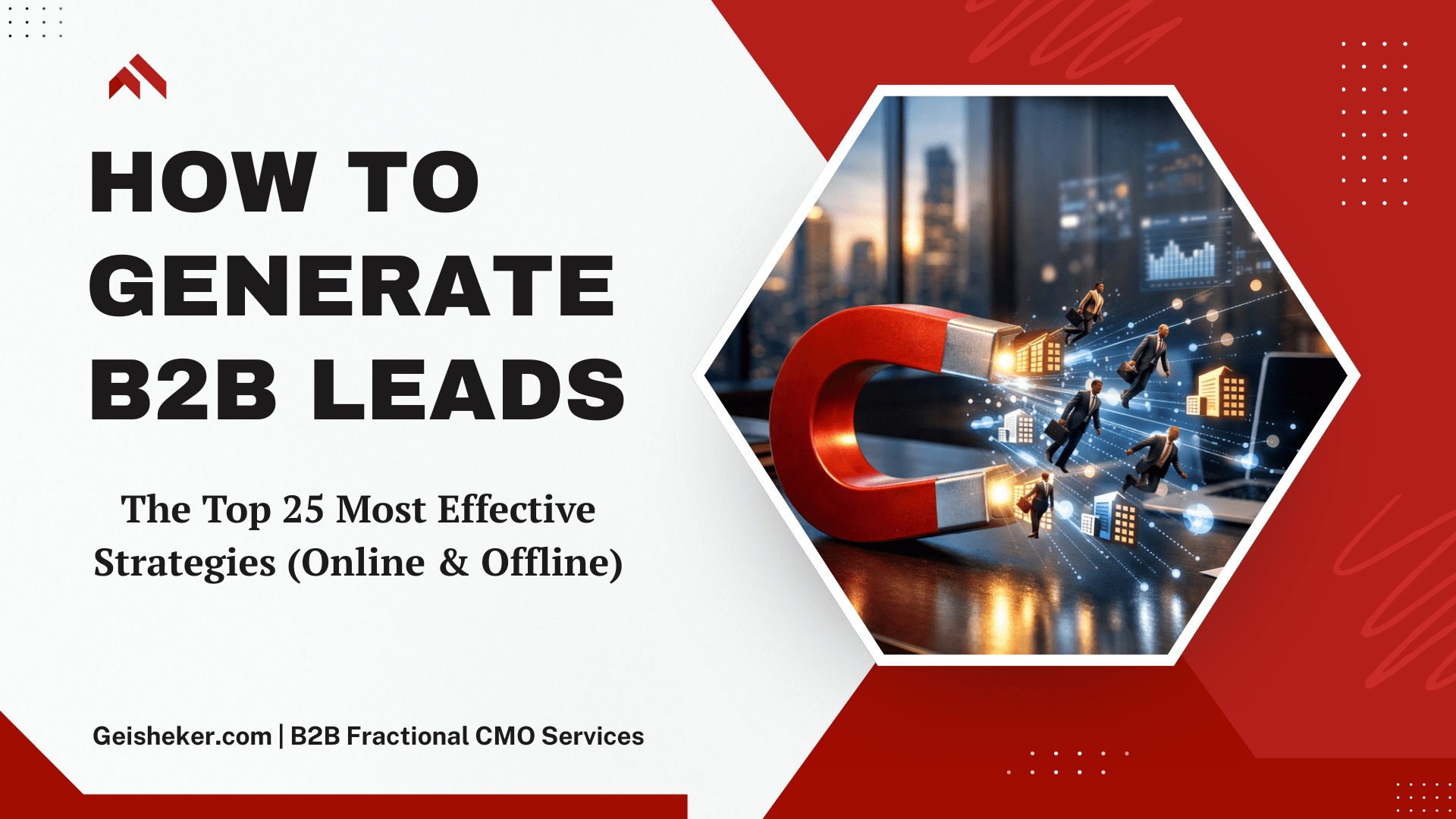
The most effective B2B lead generation strategy combines SEO-driven content marketing, LinkedIn outreach, targeted email nurture, and Account-Based Marketing (ABM). According to HubSpot research, 61% of marketers say generating leads is their #1 growth challenge. Companies using a deliberate multi-channel program generate up to 3x more qualified pipeline than those relying on a single tactic. No one channel wins alone, the strongest B2B programs layer five to seven complementary channels simultaneously.
Why B2B Lead Generation Is the Most Important System You Can Build
If your pipeline runs dry, revenue stops, no matter how great your product or service is. Yet 61% of B2B marketers say generating high-quality leads remains their single biggest challenge, a finding that has remained stubbornly consistent across multiple HubSpot State of Marketing reports.
What has changed is the sheer scale of options available, and the sophistication required to use them well. Today’s B2B buyer completes roughly 70% of the purchase journey before ever speaking to a salesperson, according to 6sense’s B2B Buyer Experience Research. By the time a prospect reaches out, they have already formed opinions, shortlisted vendors, and, in many cases, made a preliminary decision.
That reality transforms B2B lead generation from an interruption sport into an education sport. The companies winning at pipeline today are the ones that show up with authority, relevance, and value, well before a prospect is ready to buy.
This guide delivers exactly that edge. You will find 25 fully developed B2B lead generation strategies (online, offline, and ABM-specific) each backed by verifiable data with clickable sources. Whether you are generating your first 50 leads per month or trying to scale to 500, these are the tactics that top-performing B2B companies use right now.
Is your pipeline inconsistent or underperforming? Schedule a free consultation with Peter Geisheker to diagnose exactly where your lead generation is breaking down, and how to fix it.
Before You Choose Tactics: Define Your Ideal Customer Profile (ICP)
No lead generation strategy works without precision targeting. Before selecting a single channel, you need a clearly documented Ideal Customer Profile, a detailed portrait of the companies and decision-makers most likely to buy, stay, and grow with you.
Your ICP should define: industry verticals, company size (employee count and revenue), geographic markets, technology stack, common pain points, buying triggers, and the specific roles that participate in purchase decisions (economic buyer, technical evaluator, end user, executive sponsor).
The more specific your ICP, the more efficiently every tactic below will perform. A spray-and-pray approach to LinkedIn outreach, paid search, or ABM wastes budget and demoralizes your sales team. A precisely targeted program creates momentum.
For more on building your go-to-market foundation, see our guide to B2B marketing strategy for small and mid-size companies.
Understanding B2B Lead Types
Not all leads are equal. These distinctions determine how you qualify, route, and nurture each contact:
- Marketing Qualified Lead (MQL): A prospect who has engaged with your content or campaigns (downloaded a guide, attended a webinar, or repeatedly visited your site) but is not yet ready for a sales conversation. Needs nurturing.
- Sales Qualified Lead (SQL): A prospect who has demonstrated buying intent through high-value actions: requesting a demo, submitting a contact form, requesting a pricing guide, or responding positively to direct outreach. Route to sales immediately.
- Product Qualified Lead (PQL): Relevant for SaaS companies. A user who has experienced product value through a free trial or freemium plan and is a strong conversion candidate.
Every tactic in this guide is designed to fill your pipeline with SQLs and well-nurtured MQLs, not raw contacts who will never convert.
The B2B Lead Generation Statistics You Need to Know in 2026
| Metric | Data Point | Source |
|---|---|---|
| Marketers who say lead gen is their #1 priority | 61% | HubSpot State of Marketing |
| B2B buyers who complete most research before contacting sales | ~70% | 6sense B2B Buyer Experience Research |
| B2B sales interactions occurring via digital channels by 2025 | 80% | Gartner Future of Sales |
| Social sellers who generate more opportunities than peers | +45% | LinkedIn Social Selling |
| Social sellers more likely to reach quota | +51% | LinkedIn Social Selling |
| Marketers who say webinars generate highest-quality top-of-funnel leads | 53% | Demand Gen Report / HubSpot |
| Average revenue increase from ABM implementation | 208% | ITSMA ABM Benchmarking Study |
| ABM marketers who say it outperforms all other marketing investments | 87% | IDG / Foundry |
| Companies using AI for lead scoring: conversion rate lift | +35% | Reach Marketing, 2025 |
| US B2B trade show market size (2024) | $15.78B | Statista |
How to Generate B2B Leads: The 25 Most Effective Strategies
PART 1: Online / Digital B2B Lead Generation Strategies (Tactics 1–15)
01. SEO-Optimized Long-Form Content Marketing
Content marketing is the highest long-term ROI investment in B2B lead generation. 85% of B2B marketers use content as their primary lead generation tool, and with good reason, a single well-optimized article can generate qualified traffic and leads for years with zero ongoing ad spend.
The key is depth and specificity. Google rewards comprehensive, authoritative content. A generic 800-word post on “B2B marketing” will not rank against established publishers. A 5,000-word pillar article on a specific buyer pain point (e.g., The Complete B2B SEO Guide for 2026: How Enterprise Companies Build Lasting Search Authority) (structured with clear H2/H3 headings, backed by data, and optimized for a high-intent keyword) will attract decision-makers who are actively researching solutions.
Read our guide: B2B Content Marketing Strategy Guide.
Importantly, companies that maintain an active blog generate 67% more leads than those without one, according to HubSpot’s analysis of 1,400 customers’ inbound marketing activity.
Best practices for B2B content that generates leads:
- Target buyer-intent keywords:
[solution] for [industry],how to [solve problem],best [tool] for B2B - Include gated assets within articles (white papers, ROI calculators, benchmarking reports) to capture leads mid-read
- Use internal links to connect related content and guide readers deeper into your funnel
- Publish a mix of pillar pages (comprehensive topic coverage) and cluster pages (sub-topic specificity)
- Update content annually with fresh data and new sections to maintain search rankings
💡 The Content Cluster Strategy: Build one “pillar page” that comprehensively covers a broad topic (e.g., The Ultimate B2B Marketing Guide for 2026: Strategies & Tactics), then create 8–12 “cluster pages” targeting specific sub-topics. Each cluster links back to the pillar. This architecture dramatically improves domain authority and search visibility across your entire topic area, and gives Google clear topical signals about your expertise.
02. LinkedIn Organic + Social Selling
LinkedIn is the single most important social platform for B2B lead generation. 79% of B2B marketers report it as their most effective platform for high-quality leads. The data on individual sales performance is even more compelling: according to LinkedIn’s own Social Selling research, sales professionals with a high Social Selling Index generate 45% more sales opportunities than peers with a lower score, and are 51% more likely to reach quota.
The mechanism is social selling, building relationships before making a request. This requires:
- Optimizing your profile as a landing page, not a resume. Your headline should describe the problem you solve, not just your job title.
- Publishing original thought leadership content 3–5 times per week (text posts, carousels, articles, and short video)
- Engaging meaningfully with your ideal customer’s posts before sending connection requests, like, comment, and reply with genuine substance
- Sending personalized, research-based connection messages that reference something specific about their role, their company, or their content
- Using LinkedIn Creator Mode and LinkedIn Newsletter to build an owned audience of decision-makers over time
03. LinkedIn Sales Navigator + Targeted Outreach
LinkedIn Sales Navigator is the most powerful prospecting tool available for B2B sales teams. It enables precise filtering by company size, industry, seniority, job title, geography, recent activity, and whether a prospect has changed jobs recently, allowing you to build hyper-targeted lists of exactly the decision-makers you need.
A proven outreach sequence using Sales Navigator:
- View the prospect’s profile (this triggers a notification they will see)
- Engage with 1–2 of their recent posts with a thoughtful comment
- Send a personalized connection request that references something specific from their profile or content
- After connecting, send a short message referencing a relevant business challenge, no pitch
- Follow up once after 5–7 business days if no response; then move on and re-engage in 30–60 days
The average B2B lead requires 6–8 touchpoints before a sales meeting is booked. Patience without persistence-to-the-point-of-spam is the formula.
One of the most common (and costly) mistakes B2B sales teams make is abandoning a prospect after a single email and one voicemail. Research consistently shows that the average B2B lead requires 6–8 touchpoints before a meeting is booked. Yet most reps give up long before that threshold.
A disciplined follow-up cadence of at least 10 touchpoints (distributed across email, voicemail, LinkedIn messages, phone calls, and yes, physical direct mail) is not aggressive outreach. It is the minimum required to break through in a crowded inbox environment where your prospect is simultaneously being pursued by dozens of competitors. The companies that build a structured, multi-channel follow-up system consistently outperform those that leave conversion to chance.
04. Email Marketing & Drip Nurture Campaigns
Email remains the #1 B2B lead generation channel by volume. 73% of B2B buyers say email is their preferred channel for hearing from vendors, according to Sopro’s State of Prospecting research. The mistake most B2B companies make is blasting promotional emails to cold or unengmented lists. That approach destroys deliverability and produces near-zero results.
The model that works is segmented, behavioral email nurturing:
- Segment your list by industry, company size, funnel stage, and engagement behavior
- Trigger emails based on behavior: downloaded a guide → send a follow-up case study; visited your pricing page → send a comparison guide or ROI calculator
- Use a 3:1 value-to-pitch ratio: three educational or insight-driven emails for every one that asks for a meeting or demo
- Keep emails short: under 200 words typically performs best for outbound and warm nurture sequences
- Test subject lines relentlessly: open rate is the first conversion you need to win, everything else is downstream of it
📊 Email Benchmark: Nurtured leads produce 47% larger purchases than non-nurtured leads, according to Annuitas research cited in multiple 2025 B2B marketing studies. The compounding effect of consistent nurture, not the dramatic single-email blast, is what fills your pipeline.
05. Paid Search (Google Ads & Bing Ads)
Pay-per-click advertising on Google and Bing puts your solution in front of buyers who are actively searching for it right now. For B2B companies with clear buying-intent keywords (e.g., B2B CRM software, enterprise HR platform, fractional CMO services), paid search delivers some of the highest-intent leads available.
The challenge: average cost-per-lead in B2B paid search ranges from $200 to $500, according to Gartner data cited across multiple 2025 industry analyses. That makes targeting precision non-negotiable.
Best practices:
- Build tightly themed ad groups, one product or solution per group, not broad catch-alls
- Use negative keywords aggressively to exclude irrelevant searches and wasted spend
- Test competitor keywords, bidding on competing brand names can capture high-intent switchers
- Send paid traffic to dedicated landing pages with a single, clear CTA, never to your homepage
- Implement remarketing to re-engage visitors who did not convert on the first visit
- Use sitelink, callout, and review extensions to improve both click quality and conversion relevance
06. LinkedIn Paid Advertising
LinkedIn advertising offers targeting capabilities no other platform can match for B2B. You can reach by job title, company name, industry, seniority level, company size, and even specific LinkedIn Groups, meaning your ad appears in front of exactly the decision-makers who matter to your business.
Most effective LinkedIn ad formats for B2B lead generation:
- Lead Gen Forms: The highest-converting format. The form pre-populates with the user’s LinkedIn data, eliminating typing friction. Use for gating white papers, webinar registrations, and consultation requests. 90% of B2B marketers using LinkedIn Lead Gen Forms report lower cost-per-lead.
- Sponsored Content (Single Image & Carousel): Best for awareness and driving traffic to high-value content. Use carousel format to tell a story or highlight multiple benefits across swipe-able cards.
- Conversation Ads: Message-based ads delivered directly to prospect inboxes. Use sparingly with highly personalized, segmented copy.
- Retargeting Ads: Re-engage website visitors, video viewers, or lead form openers with tailored follow-up messaging at a different funnel stage.
LinkedIn leads (particularly those captured through LinkedIn Lead Gen Forms) require a different follow-up approach than inbound leads from your website. Because the form pre-populates with a user’s LinkedIn profile data, prospects occasionally complete a form with minimal friction and little conscious intent, which can make initial contact more challenging. Some will not immediately recall submitting the form at all.
The practical implication: LinkedIn leads demand persistent, multi-channel follow-up. A minimum of 20 structured touchpoints across phone, email, LinkedIn messages, and voicemail is appropriate before drawing any conclusions about a lead’s interest level. This is not excessive. It reflects the reality of reaching a busy decision-maker who may have engaged with your content in passing rather than at a moment of active buying intent.
If a LinkedIn lead remains unresponsive after 20 documented contact attempts, do not discard the contact. Transition them into your long-term email nurture program. Buying timelines shift, budgets open, and priorities change, a prospect who is unreachable today may be actively evaluating solutions in six months.
One additional best practice that significantly impacts conversion rates: speed of follow-up. When a LinkedIn lead comes in, the goal should be to make first contact within five minutes of form submission. Research from Harvard Business Review found that companies that contacted leads within one hour were seven times more likely to qualify the prospect than those who waited even 60 minutes, and the advantage compounds the longer follow-up is delayed.
A prospect who has just engaged with your content is at peak awareness and interest at the moment of submission. Every minute that passes reduces that receptivity. Automated CRM alerts, dedicated SDR coverage during business hours, and clearly documented lead response protocols are the infrastructure that makes five-minute follow-up consistently achievable, rather than an aspirational goal that depends on someone happening to check their notifications.
07. Webinars & Virtual Events
Webinars are among the most powerful top-of-funnel lead generation tools in B2B marketing. 53% of marketers say webinars generate the most high-quality leads of any top-of-funnel format, according to Demand Gen Report data cited in HubSpot. They accomplish three things simultaneously: educate your audience, position your team as authoritative experts, and capture qualified contacts who voluntarily invested their time in your content.
A high-performance webinar lead generation program includes:
- Monthly or bi-weekly webinars on topics your ICP is actively researching, not product demos disguised as thought leadership
- Co-hosted webinars with complementary vendors to access each other’s audiences simultaneously
- On-demand recordings that continue generating leads indefinitely after the live event ends
- Post-webinar email sequences segmented by engagement level (live attendees vs. registered-only)
- SDR follow-up within 24 hours for high-engagement attendees who stayed for the full session and asked questions
08. Website Conversion Optimization
Your website is either your best lead generation asset or your biggest pipeline leak. An average B2B buyer conducts 12 online searches before engaging with a vendor’s website. If your site is slow, confusing, or missing conversion prompts, you lose leads every hour of every day.
Critical website conversion elements:
- Page speed: A 1-second delay in page load time can reduce conversions by up to 7%
- Clear above-the-fold CTAs on every key page: Schedule a Consultation, Download the Guide, Request a Demo
- Live chat and chatbots: Companies using AI chatbots for prospect qualification report 42% more leads generated, according to Drift research
- Social proof: Customer case studies, logos, testimonials, and third-party review ratings on service and solution pages
- Exit-intent popups with content offers for visitors about to leave high-value pages
- Optimized lead capture forms: 3–5 fields maximum, every additional field measurably reduces form submission rates
The same five-minute follow-up principle applies to every inbound lead, regardless of the source. Whether a prospect completes a contact form on your website, registers for a webinar, or downloads a piece of gated content, speed of response is one of the highest-leverage variables in your entire sales process, and one of the most consistently underestimated.
The data is unambiguous on this point. According to Harvard Business Review, companies that follow up with inbound leads within one hour are seven times more likely to qualify the prospect than those who wait longer. Sales teams that allow leads to sit uncontacted for hours (or worse, days) are surrendering pipeline that their competitors will be happy to capture.
Build the infrastructure that makes rapid response the default, not the exception: real-time CRM lead alerts, clearly assigned SDR ownership by lead source, and documented response time standards that are measured and held accountable. In B2B sales, the representative who responds first with a relevant, personalized message wins a disproportionate share of the opportunities.
09. Content Gating & Lead Magnets
A lead magnet is a high-value piece of content offered in exchange for contact information. Done well, gated content is one of the most scalable lead generation systems in B2B marketing. Done poorly, it fills your CRM with low-intent contacts who download things for research and never buy.
The highest-converting B2B lead magnets:
- Original research reports. Buyers will share their email for data nobody else has
- ROI calculators and interactive tools. The value exchange is personalized, quantified output they receive instantly
- Industry benchmarking studies, comparison data is inherently compelling to decision-makers
- Step-by-step implementation guides and templates, save your prospect real working hours
- Competitor comparison guides, attract high-intent researchers who are actively evaluating options
The key insight: gate assets that deliver tangible business value, not generic PDF listicles. A prospect will share their work email to access a benchmarking report. They will not do it for a blog post reformatted as a download.
10. Retargeting & Programmatic Display Advertising
Most B2B website visitors will not convert on their first visit. Retargeting campaigns re-engage those visitors with relevant ads as they browse the broader web, keeping your brand present throughout their multi-week or multi-month research process.
Effective B2B retargeting approaches:
- Segment retargeting audiences by page visited: pricing page visitors receive a demo offer; blog readers receive a content upgrade or next-step guide
- Intent-based programmatic platforms (6sense, Demandbase, Bombora) serve ads to companies showing in-market buying signals, even companies whose contacts have never visited your site
- Cross-channel retargeting: pixel your site, then run LinkedIn retargeting ads to the same visitors at their professional identity
- Behavior-triggered retargeting: re-engage webinar attendees, email openers, and video viewers with next-step offers appropriate to their demonstrated interest level
11. Video Marketing & YouTube
Video is the fastest-growing B2B content format. 69% of marketers invested in video content in 2024, and short-form video delivers the highest ROI of any content format according to HubSpot’s State of Marketing report. For B2B companies, video simultaneously serves awareness, education, and conversion functions.
High-impact B2B video formats:
- Explainer videos: 60–90 second animations or screen recordings that live on your homepage, solution pages, and LinkedIn posts
- Customer success / case study videos: Nothing converts a late-stage prospect faster than watching a peer describe a specific, measurable result achieved with your solution
- Thought leadership interview videos: Weekly conversations with your team or industry experts, distributed on YouTube and LinkedIn, these compound into a body of authority over time
- Product demo videos: For SaaS and technology companies, a detailed walkthrough video reduces sales cycle length by enabling self-qualification before the first sales call
12. Podcast Guesting & Branded Podcasts
Podcasts have become a serious B2B lead generation channel. The authority transfer that occurs when a respected host introduces you to their audience is not replicable through paid advertising. It is earned trust at scale.
Two approaches with distinct ROI profiles:
- Podcast guesting: Research the top 20–30 podcasts your ICP listens to. Pitch yourself as a guest with a specific, compelling angle tied to a current challenge your audience faces. Include a dedicated landing page URL in the show notes with a lead magnet tailored to that audience segment.
- Branded podcast: Launch your own weekly or bi-weekly show. This builds long-term brand equity, creates a library of repurposable content, and attracts sponsors and strategic partners as the show grows.
53% of marketers say podcasts are a top content format for lead generation. Early mover advantage in your niche is still available in most B2B verticals.
13. AI-Powered Lead Scoring & Predictive Intent Data
Artificial intelligence has transformed B2B lead generation from a volume game into a precision game. Companies using AI for lead scoring report a 35% lift in conversion rates (Reach Marketing, 2025). And according to Gartner, sellers who use AI tools are 3.7x more likely to meet their quotas than those relying on traditional approaches.
The most impactful AI-driven lead generation applications:
- Intent data platforms (Bombora, 6sense, TechTarget Priority Engine): Monitor which companies are actively researching your solution category across the web, before they ever contact you. This is arguably the single highest-leverage capability in modern B2B lead generation.
- AI lead scoring (HubSpot AI, Salesforce Einstein): Analyze hundreds of behavioral signals in real time to score every lead, letting your sales team focus exclusively on highest-potential contacts
- Predictive list building: AI tools analyze your best existing customers and surface companies with matching firmographic and behavioral profiles
- Personalization at scale: Generate contextually relevant email copy and ad creative for each account segment automatically, reducing manual effort while increasing message relevance


Want more qualified pipeline? Get a free growth plan
30 minutes with both of us. No hard sell. Written plan in 3 business days.
14. Partner & Co-Marketing Programs
Your best leads often come from businesses that already serve your ideal customer. Co-marketing partnerships with complementary vendors let you tap into established trust relationships without spending on cold acquisition.
Effective B2B co-marketing formats:
- Joint webinars: Both companies promote to their lists; both capture all registrant leads
- Co-authored research reports or white papers distributed through both companies’ channels
- Formal referral agreements with documented lead-sharing or revenue-sharing terms
- Partner portal programs for resellers, consultants, and system integrators who recommend your solution to clients
- Technology integration partnerships: Listing in major platform app marketplaces (HubSpot, Salesforce, Slack) can generate consistent inbound partner-referred leads with no ongoing sales effort
15. Community Building & Online Forums
72% of B2B buyers hire consultants or analysts to help with purchasing decisions, according to 6sense’s 2024 B2B Buyer Experience Report, which reveals how much weight is placed on trusted peer and community input. Building a community around your customers and prospects creates an owned channel that generates leads through trust and peer recommendation rather than interruption.
Community-driven lead generation approaches:
- Launch a free Slack or Circle community for your ICP centered on a topic of shared professional interest, not your product
- Actively participate in existing communities on Reddit, LinkedIn Groups, and industry Slack channels: answer questions, share insights, never drop unsolicited links
- Answer relevant Quora questions in your industry with expert, in-depth responses that organically drive traffic to your site
- Sponsor or host local user groups and industry meetups through your community platform
PART 2: Offline B2B Lead Generation Strategies (Tactics 16–20)
16. Industry Trade Shows & Conferences
Reports of the trade show’s death were premature. 65% of companies rate in-person events as their most effective lead generation tactic, according to MarketingProfs. And the market data backs that up: the US B2B trade show market reached $15.78 billion in 2024, surpassing pre-pandemic levels, with growth forecast to $17.3 billion by 2028.
The reason is simple: decision-makers attend conferences specifically to evaluate solutions. A 30-minute conversation at a trade show can accomplish what 15 cold emails cannot.
Maximizing trade show lead generation:
- Pre-schedule 10–15 meetings with target accounts before the event using LinkedIn outreach and direct email
- Use QR codes at your booth to capture leads instantly and trigger automated nurture sequences on the spot
- Create a booth offer with genuine business value, not branded merchandise, but a free audit, benchmarking consultation, or exclusive research report
- Enter all leads into your CRM within 24 hours and follow up within 48 hours while the conversation is fresh in both parties’ minds
- Pursue speaking slots or panel discussions to reach the entire room rather than only booth visitors
17. Executive Roundtables & Hosted Dinners
Executive roundtables and intimate hosted dinners are among the highest-converting offline B2B lead generation tactics available. By bringing together 8–12 senior decision-makers from your target accounts for a curated peer discussion, with no sales pitch, you create an environment of trust and intellectual exchange that accelerates relationships by weeks or months.
The format works because it delivers genuine value to attendees (peer learning, candid dialogue, strategic networking) while giving your team face time with multiple senior prospects in a single event.
Best practices:
- Theme the dinner around a pressing business challenge, not your product category
- Invite a respected industry analyst or well-known practitioner as a facilitator to elevate the credibility
- Keep the group small enough for genuine round-table dialogue, 8–12 attendees maximum
- Follow up individually within 48 hours with a personalized note referencing something specific from their comments during the event
18. Intelligence-Powered Cold Calling
Cold calling is used by 37% of B2B businesses and remains viable when combined with modern intelligence tools. Pure cold calling, dialing a list with zero research, converts at under 1% and burns out your sales team. Intelligence-powered calling is a fundamentally different activity.
The modern approach:
- Use intent data to call companies already actively researching your category. You are no longer interrupting their day, you are timing your outreach to their active buying cycle
- Invest 5 minutes of research before each call: review their LinkedIn profile, check their company news feed, understand their current role and likely responsibilities
- Lead the conversation with a relevant insight or question about their business situation, not a product pitch
- Combine calling with email, LinkedIn, and short personalized video messages in a coordinated multi-touch cadence
19. High-Impact Direct Mail
Direct mail to B2B decision-makers has experienced a genuine renaissance. In an era when a typical executive receives 100+ emails per day, a well-designed physical package stands out in a way no digital message can replicate. Precision targeting and creative execution are what separate direct mail that drives meetings from direct mail that drives recycling.
High-impact B2B direct mail approaches:
- Dimensional / “lumpy” mail: A custom package (gift box, relevant physical item, handwritten note) sent to 20–50 hyper-targeted accounts as part of an outreach sequence, physical presence creates psychological reciprocity
- Printed research reports or guides mailed to named decision-makers at target accounts with a personalized cover letter
- Gift-with-meeting programs: A curated gift sent to a prospect who accepts a 20-minute discovery call (services like Sendoso and Alyce automate this at scale)
- Post-event follow-up mailers: A physical thank-you note or relevant resource sent within 48 hours of meeting a prospect at a conference reinforces the relationship while competitors send generic LinkedIn messages
20. Strategic Networking & Association Involvement
In high-trust B2B categories (professional services, consulting, enterprise software, financial services) the best leads come from personal relationships built consistently over time. Strategic networking, executed with a genuine give-first mentality, generates referrals and warm introductions that convert at 10–20x the rate of cold outreach.
Networking that generates leads:
- Join 2–3 industry associations where your ideal customer is an active, dues-paying member, then participate visibly (committees, speaking opportunities, event volunteering)
- Schedule one breakfast, lunch, or coffee per week with a peer, partner, or former client, relationships compound over time in ways that paid channels cannot replicate
- Build a formal referral partner network with complementary service providers who serve the same clients but do not compete
- Sponsor or present at local and regional business events attended by your ICP
PART 3: Account-Based Marketing (ABM), The Highest-ROI B2B Lead Strategy
Before covering individual ABM tactics, let us establish why ABM deserves its own section.
ABM is not merely a tactic. It is a strategic framework that fundamentally realigns how your sales and marketing teams operate together. Companies implementing ABM strategies report a 208% increase in marketing-generated revenue (ITSMA). And 87% of B2B marketers say ABM outperforms every other marketing investment (IDG/Foundry, 2024).
ABM inverts the traditional lead generation model. Instead of casting a wide net and hoping the right accounts show up, ABM starts with your ideal accounts, typically 50 to 500 named companies, and orchestrates highly personalized outreach across every channel simultaneously.
📊 ABM By the Numbers:
- 208%, Average revenue increase from ABM implementation (ITSMA)
- 87%, Marketers who say ABM outperforms all other investments (IDG/Foundry)
- 76%, Marketers who report higher ROI with ABM vs. other strategies (ITSMA)
- 28%, Faster average sales cycles for ABM accounts (Marketing LTB, 2025)
- 5–9x, Average ROI for high-maturity ABM programs (Marketing LTB, 2025)
21. ABM Tier 1: One-to-One Account Programs
Tier 1 ABM (1:1 ABM) dedicates significant marketing and sales resources to a small number of named accounts, typically your top 10–25 highest-value targets. Each account receives fully customized content, dedicated outreach sequences, and tailored messaging built specifically around their documented business challenges.
Tier 1 ABM components:
- Dedicated landing pages and microsites personalized to the target company, using their logo, industry language, and specific use cases relevant to their business
- Custom research reports or business assessments created specifically for that account
- Executive-to-executive outreach from your CEO or senior leadership team
- Personalized direct mail packages tied to the account’s current strategic initiatives or pain points
- Custom LinkedIn ad campaigns targeting the buying committee at the specific company by job title
Tier 1 ABM works best for enterprise deals with average contract values above $100,000 and sales cycles of 6–18 months.
22. ABM Tier 2: One-to-Few Industry Segmentation
Tier 2 ABM scales personalization across clusters of 10–50 accounts that share defining characteristics, same industry vertical, same company size band, same technology stack, or same regulatory environment. Instead of fully bespoke content per account, you create industry-specific content that speaks directly to the shared challenges of each segment.
Tier 2 execution:
- Develop industry-specific case studies, landing pages, and nurture sequences for your top 3–5 verticals
- Build email sequences that address each target company by name while using segment-level messaging and industry-specific examples
- Run LinkedIn ad campaigns targeting each industry segment with tailored creative and copy that references their industry’s specific language and challenges
- Host vertical-specific webinars and virtual roundtables (e.g., B2B SaaS Marketing Leaders Forum or Manufacturing Operations Summit)
Tier 2 ABM is the sweet spot for most B2B companies with average contract values of $25,000–$100,000.
23. ABM Tier 3: Programmatic ABM at Scale
Tier 3 ABM uses technology to deliver personalized experiences to hundreds or thousands of named accounts simultaneously, combining intent data, programmatic advertising, and automated email personalization at scale.
Tier 3 technology stack:
- Intent data platform (Bombora, 6sense, TechTarget Priority Engine): Identifies which named accounts are actively researching your solution category right now, before they ever contact you
- ABM advertising platform (Demandbase, Terminus, RollWorks): Serves targeted display and LinkedIn ads to specific companies based on IP targeting, firmographic matching, and intent signals
- CRM + marketing automation (HubSpot, Salesforce + Pardot/Marketo): Personalizes email sequences at the account level using dynamic content fields
- Sales engagement platform (Outreach, Salesloft): Coordinates multi-touch outreach sequences across email, phone, and LinkedIn for accounts showing highest intent signals
| ABM Tier | Target Account Volume | Best For | ACV Sweet Spot |
|---|---|---|---|
| Tier 1: 1:1 | 5–25 accounts | Enterprise deals, strategic partnerships | $100K+ ACV |
| Tier 2: 1:Few | 50–200 accounts | Mid-market, shared vertical or use case | $25K–$100K ACV |
| Tier 3: 1:Many | 500+ accounts | SMB to mid-market at scale, broad named account coverage | Under $25K ACV |
24. ABM Sales & Marketing Alignment
ABM fails without genuine sales and marketing alignment. 93% of marketers say tight alignment between sales and marketing is critical for ABM success (G2, 2024). Yet only 36% of companies executing ABM consider their teams to be tightly aligned (RollWorks, 2024).
The gap between those two numbers explains why most ABM programs underperform their potential.
The sales and marketing alignment approach for ABM:
- Joint account selection: Sales and marketing build the target account list together using shared criteria, not separate wishlist spreadsheets
- Shared account dashboards: Both teams access identical real-time data: account engagement scores, content consumed, ad impressions, SDR touchpoints, in a single CRM view
- Weekly ABM pipeline review: A 30-minute standing meeting where both teams review account progression, content performance, and next-step plays
- Documented MQL definition: Define in writing exactly what constitutes a qualified lead, shared standards eliminate the #1 source of sales-marketing friction
- Shared revenue accountability: Marketing is measured not just on leads generated, but on pipeline created and revenue influenced, a metric that matters to the CEO
25. Customer Referral & Advocacy Programs
Your happiest customers are your most powerful lead generation asset, and most B2B companies dramatically underutilize them. Referral leads convert at approximately 26% compared to 1–3% for cold outbound. They arrive with built-in trust, shorter sales cycles, and consistently larger average deal sizes.
Building a systematic B2B referral program:
- Identify your top 10–15% of customers by NPS score, revenue contribution, and strategic fit. These are your potential advocates
- Create a formal referral program with meaningful incentives: service credits, early feature access, charitable donations in the advocate’s name
- Make referral frictionless: provide shareable one-page summaries, templated LinkedIn posts, and email scripts advocates can use to introduce you to their network
- Feature customers in case studies, webinars, and conference speaking slots, advocates are dramatically more likely to refer when they have been celebrated publicly
- Ask at the right moment: immediately after a customer achieves a meaningful, measurable result with your solution is the optimal window
The Lead Engine Approach
Effective B2B lead generation is a system, not a series of disconnected campaigns. The companies that consistently win at pipeline treat it as an engineered engine with deliberate inputs, measurable conversion rates at each stage, and continuous optimization loops.
Here is how to build yours in four phases:
| Phase | Priority Tactics | Expected Time to First Leads |
|---|---|---|
| Foundation (Months 1–2) | ICP definition, website conversion optimization, content/SEO infrastructure, email list building | 3–6 months (SEO); immediate (email) |
| Activation (Months 2–4) | LinkedIn organic + Sales Navigator outreach, paid search, webinar launch, email nurture sequences | 2–8 weeks |
| Acceleration (Months 4–6) | ABM program launch (Tier 2 or 3), intent data activation, partner co-marketing, retargeting campaigns | 6–12 weeks |
| Scale (Month 6+) | Full ABM maturity (Tier 1), referral program, trade show strategy, predictive AI lead scoring, content cluster expansion | Ongoing compounding returns |
The compounding effect: Each channel you activate well makes every other channel more effective. A prospect who discovers you through an organic blog post, then sees your LinkedIn content, then receives a personalized email is dramatically more likely to convert than a prospect touched by only one channel. The average B2B lead requires 6–8 touchpoints before a meeting is booked, build your program to be present across all of them.
How to Measure B2B Lead Generation Performance
Vanity metrics (impressions, page views, social followers) do not pay salaries. The metrics that matter are tied directly to pipeline and revenue:
- Cost Per Lead (CPL): Total spend divided by qualified leads generated. B2B CPL averages $200–$500 in paid search. Track by channel to understand where you are efficient.
- MQL-to-SQL Conversion Rate: Industry benchmark is approximately 13:1 (HubSpot, 2024). If you are consistently worse than this, examine lead qualification criteria and channel quality.
- SQL-to-Closed-Won Rate: Track by channel and campaign to identify which lead sources produce the highest-quality pipeline, then invest more in those.
- Pipeline Contribution by Channel: What percentage of your total pipeline originated from each channel? This is the most important strategic resource allocation metric.
- Sales Cycle Length by Channel: Referral leads and ABM-sourced leads consistently show shorter cycles. Use this data to set realistic forecasts.
- Lead Velocity Rate (LVR): Month-over-month growth rate of qualified leads entering your pipeline. The single best leading indicator of future revenue, if LVR is positive and consistent, revenue growth follows.
Frequently Asked Questions About B2B Lead Generation
What is the fastest way to generate B2B leads?
The fastest channels for immediate B2B leads are paid search (Google Ads), LinkedIn Sales Navigator outreach, and targeted cold email. These can produce results within days to weeks. ABM direct outreach to warm, intent-signaling accounts can also accelerate response times significantly. Note that “fast” and “high quality” are not synonymous, fast channels often produce lower-intent leads that require substantial nurturing before they are sales-ready. A sustainable approach layers both fast and compounding channels simultaneously.
How much does B2B lead generation cost?
Costs vary widely by channel and industry. Average cost per lead in paid search is $200–$500 (Gartner data, 2024). LinkedIn advertising CPL typically ranges from $75–$200. SEO and content marketing have high upfront production costs but near-zero marginal cost per lead once content is ranking and driving traffic. Email marketing delivers a median ROI of approximately 42:1. ABM programs for mid-market companies typically require $180,000–$600,000 annually. Overall, B2B companies allocate 36% of their total marketing budget to lead generation activities.
What is Account-Based Marketing (ABM) and why does it matter for B2B lead generation?
ABM is a strategic framework that concentrates sales and marketing resources on a specific set of high-value target accounts, treating each account as its own market with personalized outreach, content, and advertising orchestrated across all channels simultaneously. It matters because it dramatically improves efficiency: 87% of marketers say ABM outperforms every other marketing investment (IDG/Foundry, 2024), and companies implementing ABM report a 208% increase in marketing-generated revenue (ITSMA). ABM is most powerful for companies with complex sales cycles, high average contract values ($25,000+), and well-defined ideal customer profiles. Schedule a free consultation with Peter Geisheker to discuss whether and how to build an ABM program for your business.
How many B2B leads should a company generate per month?
There is no universal benchmark. It depends on your average deal size, sales cycle length, and close rate. Work backward from your revenue goal using this formula: if you need $1M in new revenue, your average deal is $50,000, and your close rate is 25%, you need 80 qualified pipeline opportunities per year, approximately 7 per month. The average B2B organization generates approximately 1,877 leads per month, with roughly 80% qualifying as MQLs (HubSpot, 2024). But volume without quality is noise. Focus on improving close rates and deal size alongside volume.
Is cold calling still effective for B2B lead generation in 2025–2026?
Cold calling remains viable for 37% of B2B businesses that use it, particularly when powered by modern intelligence tools. Pure cold calling from a generic list converts at under 1% and is difficult to scale. Intent-based calling (contacting companies that are actively researching your category right now based on intent data signals) converts at meaningfully higher rates. The key differentiator is combining calling with a coordinated multi-touch cadence that includes email, LinkedIn engagement, and short personalized video messages rather than relying on phone alone.
How long does it take to see results from B2B content marketing and SEO?
Content and SEO are long-term, compounding investments. Expect 3–6 months before new content begins to rank meaningfully in search results, and 6–12 months before significant organic traffic and lead volume becomes consistent. The trade-off is durability: once a piece of content ranks in the top 5 for a relevant keyword, it generates leads indefinitely with no ongoing ad spend required. Companies that invest consistently in content over 18–24 months typically see exponential growth in organic pipeline, making SEO-driven content one of the highest lifetime-ROI lead generation channels available.
What tools are most commonly used for B2B lead generation?
The most widely used tools include: LinkedIn Sales Navigator (prospecting and outreach), HubSpot or Salesforce (CRM and marketing automation), 6sense or Bombora (intent data and account intelligence), ZoomInfo or Apollo.io (contact data enrichment), Outreach or Salesloft (sales engagement and cadence management), Google Analytics + Search Console (SEO and traffic analytics), Demandbase or RollWorks (ABM advertising), and Drift or Intercom (conversational marketing and real-time lead qualification).
How do I generate B2B leads with a limited marketing budget?
Start with zero-cost or very low-cost channels: LinkedIn organic social selling requires only consistent time and a clear ICP. Content marketing requires a writing investment but zero ad spend. Cold email to a well-researched, targeted list is extremely cost-efficient when you have a clear value proposition. Community participation (LinkedIn Groups, Slack communities, Quora) is free. Customer referral programs cost nothing except the incentive you offer. Focus on two channels, execute them with genuine depth for 90 days, measure what produces qualified conversations, and reinvest in what works before adding new channels.
Conclusion: Build a Lead Generation Engine, Not a Campaign
The B2B companies that consistently outgrow their competitors treat lead generation as a system, not a series of one-off campaigns. They know their ICP precisely. They are present across multiple channels simultaneously. They measure what matters to revenue, not vanity. And they continuously optimize based on data rather than instinct.
The 25 strategies in this guide are not designed to be deployed all at once. The most effective approach is to select the three to five tactics that best match your current stage, budget, and buyer behavior (execute them with genuine depth and consistency) and expand deliberately as you gather performance data.
If you are uncertain where to start, the following three-channel foundation works for most B2B companies regardless of size or industry:
- SEO-optimized content marketing (builds compounding pipeline over 6–18 months)
- LinkedIn Sales Navigator outreach (generates immediate qualified conversations)
- Structured email nurture program (converts the leads both channels generate)
For companies ready to move into ABM, the data is compelling: organizations with mature ABM programs outperform competitors by up to 55% in revenue growth (Marketing LTB, 2025). The earlier you build that capability, the more competitive distance you create from peers who are still relying on high-volume, low-precision lead generation.
Ready to build a B2B lead generation engine that actually works?
Peter Geisheker is a Fractional CMO who helps B2B and B2B SaaS companies build predictable pipeline through strategic marketing. If your lead generation is inconsistent, your channels are underperforming, or you are ready to launch an ABM program, Peter can help, without the cost of a full-time CMO. To compare your options first, see how to hire a fractional CMO, how fractional CMOs charge, and the best fractional CMO companies.
About Peter Geisheker
Peter Geisheker is a Fractional CMO and founder of The Geisheker Group, Inc., specializing in B2B and B2B SaaS marketing strategy. With extensive experience helping small and mid-size companies build predictable lead generation systems, develop go-to-market strategies, and launch ABM programs, Peter provides senior-level marketing expertise and execution without the full-time executive cost.
The Geisheker Group serves B2B companies that need a strategic marketing leader to build and lead their marketing function, generate consistent pipeline, and accelerate revenue growth on a flexible, fractional basis.
Ready to accelerate your B2B marketing? Schedule a free consultation | Learn about Fractional CMO services
References and Sources
All statistics in this article are cited from verifiable, primary or authoritative secondary sources. Every reference includes a clickable URL.
- HubSpot, “Marketing Statistics, Trends & Data” (2025–2026): https://www.hubspot.com/marketing-statistics
- HubSpot, “22 Stats That Make a Case for Webinars” / Webinar Statistics (citing Demand Gen Report): https://blog.hubspot.com/marketing/webinar-stats
- HubSpot, “Lead Generation Tips From 1,400 Websites” (blog data study): https://www.hubspot.com/lead-generation-tips
- HubSpot, “26 Best Lead Generation Tools” (citing 61% challenge stat): https://blog.hubspot.com/marketing/lead-generation-tools
- 6sense, “B2B Buyer Experience Research: When Do B2B Buyers Reach Out to Sales?” (2024): https://6sense.com/blog/dont-call-us-well-call-you-what-research-says-about-when-b2b-buyers-reach-out-to-sellers/
- LinkedIn Sales Solutions, “Social Selling: What It Is and Why It Matters” (45% more opportunities, 51% more likely to reach quota): https://business.linkedin.com/sales-solutions/social-selling
- Gartner, “The B2B Buying Journey / Future of Sales” (80% digital interactions, 17% of buying time with suppliers): https://www.gartner.com/en/sales/insights/b2b-buying-journey
- ITSMA, “ABM Benchmarking Study” (208% revenue increase, 76% higher ROI): https://www.itsma.com/research/abm-benchmarking-study/
- IDG / Foundry, “ABM Research” (87% say ABM outperforms other investments): https://foundryco.com/research/
- G2, “Account-Based Marketing Statistics” (93% say alignment is critical): https://learn.g2.com/account-based-marketing-statistics
- RollWorks, ABM Alignment Research (36% consider teams tightly aligned): https://revnew.com/blog/account-based-marketing-stats
- Marketing LTB, “Account-Based Marketing Statistics” (2025): https://marketingltb.com/blog/statistics/account-based-marketing-statistics/
- Sopro, “State of Prospecting / Lead Generation Statistics” (73% prefer email): https://sopro.io/resources/blog/lead-generation-statistics/
- Reach Marketing, “B2B Lead Generation Statistics and Trends” (2025): https://reachmarketing.com/blog/b2b-lead-generation-statistics-and-trends-for-january-2025/
- PepperInsight, “The Ultimate 2025 Guide to B2B Lead Generation”: https://pepperinsight.com/blog/the-ultimate-2025-guide-to-b2b-lead-generation-strategies-statistics-and-tools-to-double-your-pipeline-rowiq4
- Landbase, “35 B2B Sales Statistics” (referral conversion rates, social selling data): https://www.landbase.com/blog/b2b-sales-statistics
- Statista, B2B Trade Show Market Size / Video Marketing Investment Data (2024): https://www.statista.com
- MarketingProfs, “B2B Marketing Benchmarks” (65% rate in-person events as most effective): https://www.marketingprofs.com/research
- UnboundB2B, “35 Proven Strategies for B2B Sales Lead Generation” (12 searches before vendor contact): https://www.unboundb2b.com/blog/generate-b2b-sales-leads/
- Exploding Topics, “B2B Lead Generation Statistics” (85% use content as primary tool): https://explodingtopics.com/blog/b2b-lead-generation-statistics
- Remotereps, “B2B Lead Generation Strategies” (citing Gartner CPL data, Annuitas nurture stat): https://remotereps.com/services/sales-outsourcing/b2b-lead-generation-strategies
- Passivesecrets, “50+ B2B Lead Generation Statistics” (36% of budget on lead gen): https://passivesecrets.com/b2b-lead-generation-statistics/
- 6sense / gotoclient, “B2B Buyer Experience Report” (72% hire consultants/analysts): https://gotoclient.com/en/blog/https-gotoclient-com-en-blog-https-gotoclient-com-en-blog-most-relevant-statistics-that-everyone-involved-with-b2b-should-know-about/
- DesignRush, “Lead Generation Statistics” (90% of LinkedIn Lead Gen Form users report lower CPL): https://www.designrush.com/agency/digital-marketing/lead-generation/trends/lead-generation-statistics
- Mandalasystem, “80 Lead Generation Statistics for Marketers” (1,877 avg leads/month, 80% MQL): https://blog.mandalasystem.com/en/lead-generation-statistics
Free Written Growth Plan
Want more qualified pipeline?
Give us 30 minutes with your toughest marketing problem. You get a written plan with your three best growth opportunities and the first steps your team can take.
Get My Free Growth Plan →No hard sell on the call. Your plan arrives within 3 business days. See a sample plan