Why B2B Lead Attribution Is Structurally Different from B2C
Before building a model, you need to understand why you can’t just borrow your B2C attribution framework and call it done. The structural differences are significant.
B2B deals rarely involve a single buyer. Today’s B2B buying committee averages 8–13 decision-makers, each consuming content and interacting with your brand through different channels. A VP of Marketing might read your blog post in February. The CFO might download a pricing guide in April. The CEO might attend your webinar in May. Standard single-touch attribution will credit only one of those interactions, and whichever it credits, you’ll misread what’s actually moving the deal.
B2B sales cycles are also dramatically longer. An enterprise SaaS deal might involve 30–60 touchpoints spanning 6–18 months. Standard 30-day attribution windows, which are the default in most analytics platforms, miss critical early-stage awareness interactions entirely. The channel that planted the seed gets no credit because it happened too long ago. (Source: ZoomInfo Pipeline)
And then there’s what practitioners call the “dark funnel”. The research activity that happens completely outside your tracked channels. Research from 6sense’s 2025 B2B Marketing Attribution Benchmark found that 84% of B2B buyers already have a preferred vendor in mind before they ever talk to sales, meaning a massive portion of the decision-making happens in channels you probably aren’t measuring.
The 6 B2B Attribution Models You Need to Know
Before you can build your model, you need to understand the six primary attribution frameworks and when each one is most useful. Most B2B teams will eventually use a combination of two or three of these, not just one.
| Model | How Credit Is Assigned | Best For | Watch Out For |
|---|---|---|---|
| First-Touch | 100% to the first interaction | Understanding awareness channels | Ignores all nurturing activity |
| Last-Touch | 100% to the final pre-conversion touchpoint | Understanding closing channels | Ignores top-of-funnel activity |
| Linear | Equal credit to all touchpoints | Full-funnel visibility | Treats all touches as equally important |
| Time-Decay | More credit to recent interactions | Long-cycle deals where recent activity matters most | Under-credits early awareness |
| U-Shaped | 40% first touch, 40% lead creation, 20% middle | Awareness + conversion milestones | Misses opportunity creation stage |
| W-Shaped | 30% first touch, 30% lead creation, 30% opportunity creation, 10% middle | B2B with defined pipeline stages | Requires clean CRM stage tracking |
For most B2B companies, the W-shaped model is the strongest starting point because it acknowledges the three moments that actually matter in a B2B deal: when someone first encounters your brand, when they become a qualified lead, and when they enter active evaluation. (Source: Cometly)
How to Create a B2B Lead Attribution Model: The Revenue Signal Attribution Approach
Here is the step-by-step framework I use when building attribution systems for B2B clients. It is a structured, six-step process that moves you from data chaos to a working attribution model.
Step 1: Define Your Conversion Events (All of Them)
Most companies only track the bottom of the funnel, a demo request or a closed deal. That’s not enough for a B2B attribution model to be useful. You need to define conversion events at each stage:
- Stage 1, Awareness Conversion: First content engagement (blog, LinkedIn, video view)
- Stage 2, Interest Conversion: Form fill, email subscription, content download, chatbot conversation
- Stage 3, MQL Conversion: Prospect crosses a behavioral threshold (e.g., visited pricing page + downloaded two resources)
- Stage 4, SQL Conversion: Sales team confirms active interest and budget fit
- Stage 5, Opportunity Creation: A deal is formally entered in CRM
- Stage 6, Closed-Won Revenue: Contract signed
Each of these is a signal. Your attribution model’s job is to trace which marketing activities influenced the journey from Stage 1 to Stage 6. If you’re only measuring Stage 6, you’re flying blind on everything upstream.
Step 2: Implement Consistent UTM Tracking
UTM parameters are the technical foundation of any B2B attribution system. Every paid link, email campaign, social post, partner referral, and outbound sequence should carry UTM tags with four fields:
utm_source, the platform (Google, LinkedIn, newsletter, partner)utm_medium, the channel type (cpc, email, organic-social, referral)utm_campaign, the specific campaign name (q2-abm-manufacturing, demo-nurture-series)utm_content. The specific asset (blog-post-title, video-variant-a)
Here is a free tool you can use to build your UTM tracking links.
For B2B SaaS companies, you should also implement conversion API or server-side tracking to supplement browser-based tracking. As third-party cookies disappear, server-side tracking maintains accuracy where browser pixels fail. (Source: The Digital Bloom B2B PPC Report)
Step 3: Make Your CRM Your Attribution Spine
Your CRM is not just a sales tool, in a properly built B2B attribution model, it is the single source of attribution truth. For each contact and company record, your CRM should capture and preserve:
- Original Lead Source, the first tracked channel (never overwrite this field)
- Most Recent Lead Source, updated with each new touchpoint
- Lead Source Detail, the specific campaign, content asset, or referral
- Funnel Stage History, a timestamped log of every stage transition
- Associated Account Record, linking individual contacts to a company account
Attribution in B2B must happen at the account level, not just the contact level. (Source: Improvado) If a VP of Marketing filled out your demo form, but it was the CEO reading three of your articles that initiated the conversation internally, your model should capture both signals under the same account.
Step 4: Clean and Unify Your Data Before Building Your Model
Before running attribution analysis, complete these data hygiene steps:
- Resolve duplicate contacts, merge duplicate records so touchpoints aren’t split across phantom contacts
- Standardize lead source field values, eliminate variant spellings and unnamed sources
- Apply consistent timestamps, ensure all touchpoint dates are accurate and in the same timezone
- Tag legacy records, segment historical contacts without source data separately, rather than letting them corrupt your model
- Validate form-to-CRM field mapping, confirm every form submission correctly populates the lead source fields you’ve configured
As Integrate notes in their attribution research, clean, structured data gives your model the foundation it needs, missing or incorrect lead fields break attribution chains.
Step 5: Choose Your Attribution Model and Configure Reporting
For companies under $5M revenue or fewer than three active marketing channels: Start with U-shaped attribution. It’s straightforward to implement in most CRMs, acknowledges both awareness and conversion, and surfaces insights without requiring complex data pipelines.
For companies with $5M–$30M revenue and defined pipeline stages: Implement W-shaped attribution. Configure your CRM to tag the three milestone events (first touch, lead creation, opportunity creation) and build dashboards that show pipeline influence by channel at each stage.
For B2B SaaS companies with 12+ months of conversion data: Evaluate data-driven attribution through platforms like Google Analytics 4 or dedicated attribution tools.
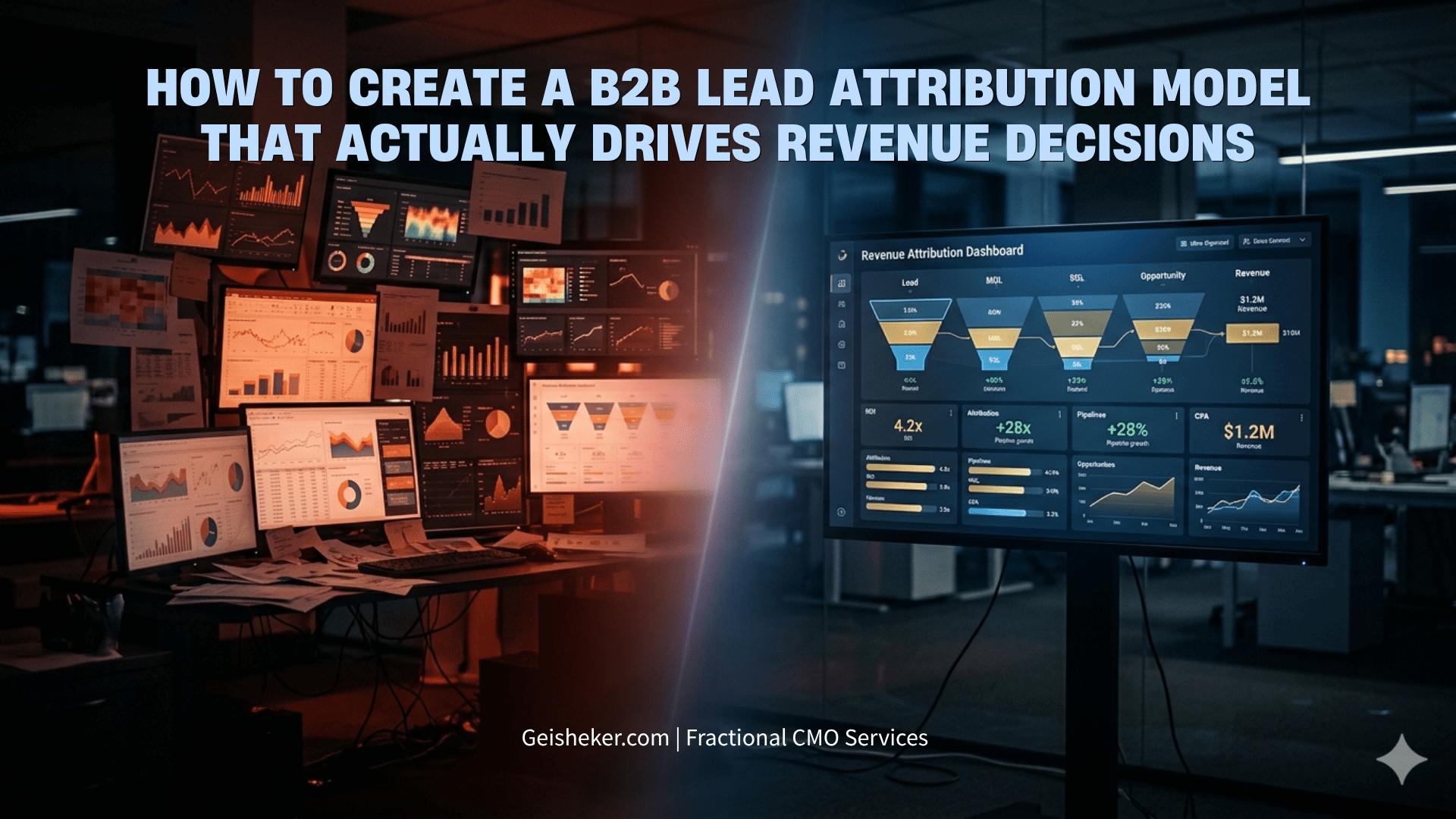
Regardless of model, build two reporting views: a channel-level attribution dashboard (which channels deserve more budget?) and a campaign-level attribution dashboard (which specific campaigns within a channel are working?).
Step 6: Add Self-Reported Attribution for the Dark Funnel
No technical tracking system captures everything. Add a “How did you first hear about us?” question to every demo request form, discovery call intake, and onboarding questionnaire. Make it an open text field, not a dropdown. You’ll get richer, more honest answers. Then log those answers in your CRM alongside your technically-tracked attribution data.
The combination of technical attribution (UTMs, CRM tracking, conversion events) and self-reported attribution gives you the most complete picture of what’s actually driving your pipeline.
Not sure what is working? Get a free written plan 30 minutes with both of us. No hard sell. Written plan in 3 business days.

How to Create a B2B Lead Attribution Model for B2B SaaS Specifically
B2B SaaS companies face unique attribution challenges worth addressing separately.
First, the buyer journey in B2B SaaS often includes multiple product-level touchpoints (free trial signups, feature walkthroughs, in-app engagements) that exist between the marketing funnel and the sales funnel. These product signals must be integrated into your attribution model, or you’ll misattribute conversions that were actually influenced heavily by the product experience, not a marketing campaign.
Second, enterprise B2B SaaS buyer journeys frequently span 6–12 months, which means you need custom attribution windows far exceeding the 30-day default in most platforms. Configure your analytics to look back at least 90–180 days for MQL attribution, and up to 365 days for opportunity and closed-won attribution.
Common B2B Attribution Mistakes That Distort Your Data
Relying solely on last-click attribution. Last-click attribution credits the final interaction before conversion (often a branded search, a direct visit, or a sales follow-up email) and entirely ignores the content interactions that created the purchase intent. Leadfeeder’s attribution research shows last-click attribution systematically undervalues top-of-funnel content significantly.
Tracking at the contact level instead of the account level. In B2B, you sell to companies. When three people from the same company touch different content across three months, those interactions should be aggregated to the account record.
Letting your CRM lead source field get overwritten. Many CRM configurations default to updating the lead source field every time a contact re-engages. This destroys the original source data you need for first-touch analysis. Lock the original lead source field and create a separate “most recent source” field for ongoing tracking.
Connecting Attribution to Budget Decisions: The CMO-Level Move
The question attribution should answer is not just “which channels get credit?” but “which channels produce the highest return per dollar invested?” Build a Revenue Attribution Efficiency Score for each channel:
- Take the total closed revenue influenced by Channel X (from your attribution model)
- Divide by total spend on Channel X
- The result is your revenue multiple, for every $1 spent, how many dollars of attributed closed revenue did the channel influence?
A channel with a 4.0x score influenced $4 in revenue for every $1 spent. A channel at 1.2x is barely breaking even. This comparison gives you a defensible, data-driven basis for reallocation decisions, and it’s exactly the kind of conversation that earns marketing a seat at the strategic table.
This is precisely where a Fractional CMO for B2B companies brings significant value, building the attribution infrastructure, training the team to use it, and translating the data into strategic decisions that would otherwise get lost in the noise of day-to-day execution.
Ready to build an attribution model that connects your marketing spend to revenue? Schedule a free consultation with Peter Geisheker at The Geisheker Group to discuss your B2B marketing measurement strategy.
Frequently Asked Questions About B2B Lead Attribution Models
What is the best attribution model for B2B?
For most B2B companies, W-shaped multi-touch attribution is the strongest model because it acknowledges three critical milestones (first awareness, lead creation, and opportunity creation) without requiring advanced data science capabilities. However, the “best” model depends on your sales cycle length, data maturity, and number of active channels. Early-stage companies often start with U-shaped attribution and graduate to W-shaped as their pipeline data matures.
How long does it take to build a B2B attribution model?
A functional B2B attribution model can be configured in 4–8 weeks if your CRM and marketing automation platform are already in place. The largest time investment is in data hygiene, standardizing lead source values, resolving duplicate contacts, and verifying UTM tracking consistency. Organizations with fragmented tech stacks or poor historical data quality should budget 3–4 months for a fully reliable model.
What tools do I need for B2B lead attribution?
The core toolkit includes a CRM (HubSpot, Salesforce, or equivalent), a marketing automation platform, Google Analytics 4 for web touchpoint tracking, and UTM parameters on all outbound links. For more complex needs, dedicated attribution platforms such as Bizible (Marketo Measure), Triple Whale, or Rockerbox provide more granular multi-touch tracking and cross-channel reporting.
How do I attribute leads that came from word-of-mouth or referrals?
Referral and word-of-mouth attribution requires a combination of technical tracking (referral source UTM parameters) and self-reported attribution (asking prospects directly how they heard about you on intake forms and discovery calls). Create a “Referral” source category in your CRM and actively log self-reported referral data. Over time, this reveals your true referral network, which is often far more influential than technical tracking data alone suggests.
What is the difference between contact-level and account-level attribution?
Contact-level attribution tracks individual people’s interactions with your marketing. Account-level attribution aggregates all individual interactions under a single company record, giving you a unified view of how an entire buying committee engaged with your brand. In B2B, account-level attribution is far more useful because revenue decisions are made at the organization level, not the individual level.
How do I handle attribution for long B2B sales cycles (6–18 months)?
For long-cycle deals, extend attribution lookback windows well beyond platform defaults. In Google Analytics 4, configure conversion windows of at least 90 days for MQLs and 365 days for closed-won attribution. In your CRM, preserve the original lead source field from the first tracked interaction regardless of how much time has passed. Supplement with self-reported attribution, prospects in long-cycle deals often remember where they first encountered you, even if that touchpoint isn’t visible in your dashboard data.
Should B2B SaaS companies use different attribution models?
B2B SaaS companies should prioritize multi-touch attribution with extended lookback windows and integrate product-level engagement signals (trial starts, feature adoption, in-app interactions) into their attribution model alongside traditional marketing touchpoints. Most B2B SaaS attribution models also need to track the product-led growth (PLG) motion separately from the sales-led motion to accurately credit the channels and content that drive each type of conversion.
How do I know if my attribution model is working?
A functioning attribution model produces data that sales and marketing teams both trust and use. Practical validation tests: Does your attribution data align roughly with what your sales team hears from prospects about how they found you? When you increase spend on a channel, does your attribution model show corresponding pipeline growth? Are marketing and sales using the same data to discuss channel performance? If attribution data is being ignored in planning meetings, the model likely needs refinement.
How a Fractional CMO Helps You Build and Operationalize Attribution
One of the most common gaps in B2B companies is not a lack of data, it’s a lack of attribution architecture. The data exists in five different systems, nobody has connected them, and the team is making budget calls based on gut feel because nobody has the bandwidth to build the infrastructure.
A Fractional CMO for B2B growth brings the strategic and technical expertise to build your attribution system, train your team to use it, and translate attribution data into actionable budget and campaign decisions. This is the kind of project that typically takes an experienced CMO 60–90 days to implement, and the return is improved budget efficiency, better sales and marketing alignment, and a clear picture of what’s actually driving your revenue.
Ready to explore how a Fractional CMO can accelerate your growth? Schedule a free consultation with Peter Geisheker at The Geisheker Group.
Conclusion: Attribution Is a Strategic Advantage, Not a Reporting Exercise
When B2B clients invest in attribution for the first time, the transformation is consistent: within two to three months of having a functioning model, marketing conversations shift from “here’s what we did” to “here’s what drove revenue and here’s where we’re investing next.” That shift changes how the organization perceives marketing, from a cost center to a revenue driver.
The steps outlined in this guide (defining conversion events, implementing UTM tracking, configuring your CRM as your attribution spine, cleaning your data, choosing the right model, and layering in self-reported attribution) give you a complete blueprint for building a B2B lead attribution model that actually informs decisions.
If you’re ready to move from attribution theory to attribution execution, or want a senior-level marketing strategist to assess your current attribution gaps and build a roadmap, schedule a free consultation with Peter Geisheker at The Geisheker Group.
Free Written Growth Plan
Not sure which of your marketing is actually working?
Give us 30 minutes. We will find where your pipeline is leaking and send you a written plan with the three fixes we would test first. Free, no obligation.
No hard sell on the call. Your plan arrives within 3 business days. See a sample plan