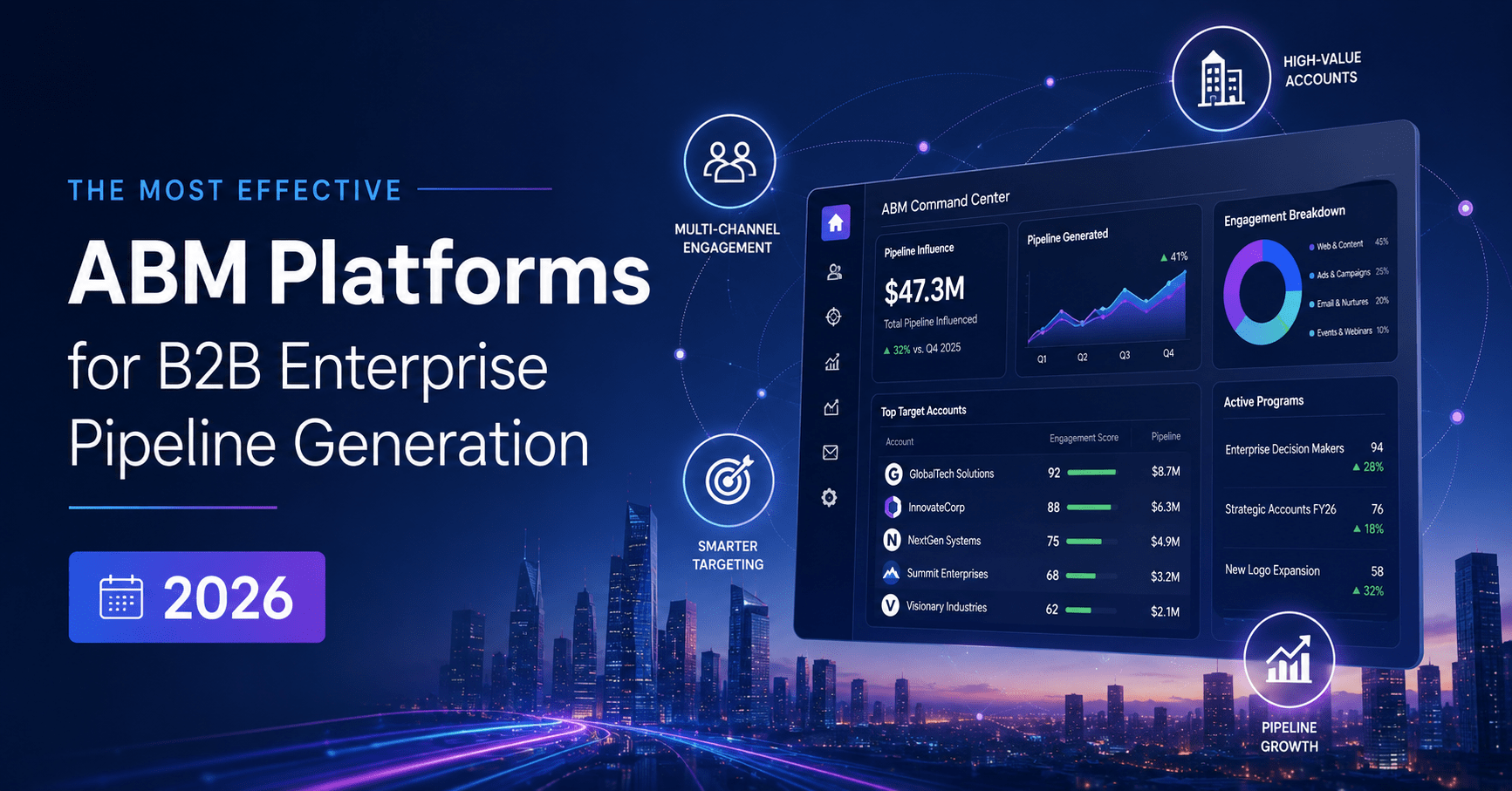
The Most Effective ABM Platforms for B2B Enterprise Pipeline Generation in 2026
The most effective ABM platforms for B2B enterprise pipeline generation in 2026 are 6sense, Demandbase, and ZoomInfo Marketing — the three vendors named Leaders in the November 2025 Gartner Magic Quadrant for Account-Based Marketing Platforms. Each excels at a different layer of the pipeline engine: 6sense for predictive intent scoring, Demandbase for unified ABM advertising and orchestration, and ZoomInfo for the contact-data foundation that every other layer runs on top of.
Key Facts at a Glance
- 6sense, Demandbase, and ZoomInfo were named Leaders in the 2025 Gartner Magic Quadrant for Account-Based Marketing Platforms, published November 6, 2025; 6sense received the highest score for Ability to Execute, Demandbase the highest for Completeness of Vision, and ZoomInfo was the only Customers’ Choice (Source: Gartner via Demandbase, 2025).
- Account-based marketing increases pipeline conversion rates by 14% and lifts MQL-to-sales-accepted-lead conversion by 25%, per Gartner research cited in early 2026 industry analyses (Source: Gartner via TheCMO, February 2026).
- 87% of B2B marketers report ABM delivers higher ROI than other marketing approaches (Source: ITSMA Momentum, cited 2026).
- Median enterprise ABM contracts run $58,617 per year for 6sense and $65,981 per year for Demandbase, based on hundreds of Vendr-tracked transactions (Source: Vendr-cited buyer data, 2026).
- Organizations with mature ABM frameworks see a 22.33% median Marketing Qualified Account (MQA) conversion rate, compared to 14.19% for less mature programs, based on a Demandbase Labs analysis of 1,452 tenants and 38 million marketing activities (Source: Demandbase Labs B2B GTM Report, March 2026).
- The typical B2B buying decision now involves 13 internal stakeholders plus 9 external influencers, per Forrester’s State of Business Buying 2026 report (Source: Forrester, January 2026).
- Fewer than 20% of ABM programs deliver measurable pipeline impact within their first year, according to Forrester research — the failure mode is almost always execution, not platform choice (Source: Forrester, cited 2026).
This guide draws on Peter Geisheker’s 20-plus years of B2B marketing experience as founder of The Geisheker Group, Inc., a fractional CMO agency serving B2B SaaS, B2B services, PE/VC-backed portfolio companies, and law firm clients. Documented career outcomes include 6X inbound lead growth, 100% YoY SaaS revenue growth for three consecutive years, 77% reduction in paid acquisition spend while growing revenue, and $1 million per week in managed ad spend for law firm lead generation. Recent and current B2B/SaaS client work includes SightCall, Beonic, and PegEx. AI is embedded across all client engagements as a core component of how the work gets done. The platform recommendations and operating-model guidance in this article reflect direct experience evaluating, implementing, and operating ABM tooling for B2B and B2B SaaS companies between $5M and $75M in revenue, informed by the November 2025 Gartner Magic Quadrant, the January 2026 Forrester Wave, and Demandbase Labs’ 2026 benchmark study.
If your enterprise B2B revenue team is evaluating account-based marketing platforms in 2026, the question is rarely whether to invest. With 76% of enterprise B2B organizations now running formal ABM programs and 49.7% planning to increase ABM budgets this year, ABM is the operating standard for pipeline generation against high-value accounts. The harder question is which platform actually drives measurable pipeline against the specific buying motion, deal size, and team maturity inside your business.
This guide ranks the most effective ABM platforms for B2B enterprise pipeline generation against a CMO-grade decision framework: analyst recognition, real pricing, integration depth, intent quality, orchestration breadth, and time-to-value. It draws on the November 2025 Gartner Magic Quadrant, the January 2026 Forrester Wave for Revenue Marketing Platforms, Demandbase Labs’ 2026 benchmark study covering 1,452 tenants, and verified buyer-side pricing data. Where the platforms diverge most is at the enterprise tier — and that is where pipeline generation either compounds or collapses.
In this article:
- The 2026 ABM platform landscape and what “most effective” really means
- The top ABM platforms for B2B enterprise pipeline generation
- Side-by-side comparison: pricing, fit, and analyst position
- How to choose: a decision framework keyed to ARR and deal size
- Implementation reality and time-to-pipeline expectations
- When an ABM platform is the wrong investment
- ROI benchmarks and pipeline impact data
- Frequently asked questions
What Defines an Effective ABM Platform for Enterprise Pipeline Generation in 2026?
An ABM platform is a software system that unifies first-party signals, third-party intent data, and multi-channel orchestration into a single account-level operating system, typically used by B2B revenue teams targeting 50 to 5,000 named accounts, with the key characteristic of measuring pipeline impact at the account level rather than the individual lead level.
Gartner formally defines ABM platforms as software enabling B2B marketing and sales teams to run ABM programs at scale, including account selection, planning, engagement, and reporting (Source: Gartner Magic Quadrant for ABM Platforms, 2025).
For enterprise pipeline generation specifically, the platform must address three jobs: identify in-market accounts before they raise their hand, surround the entire buying committee with personalized engagement, and report pipeline impact at the account level rather than the lead level. The Demandbase Labs 2026 study of 1,452 tenants found that organizations operating mature ABM frameworks achieve a 22.33% median MQA conversion rate against 14.19% for less mature programs, with win rates climbing 48.5% higher when teams engage 3 to 4 buying groups per product (Source: Demandbase Labs, March 2026).
That data point reframes the platform conversation. In Peter Geisheker’s experience installing ABM systems for B2B SaaS and PE-backed portfolio companies, the right tool is the one that compresses the distance between “we know an account is in-market” and “we have multi-threaded engagement across the buying committee,” because that compression is where enterprise pipeline actually gets generated.
Why Are 6sense, Demandbase, and ZoomInfo the Top ABM Platforms in 2026?
6sense, Demandbase, and ZoomInfo are the top ABM platforms in 2026 because all three were named Leaders in the November 2025 Gartner Magic Quadrant for Account-Based Marketing Platforms — the most recent and authoritative third-party evaluation of the category. The Gartner Leaders quadrant placement reflects both Ability to Execute and Completeness of Vision, scored against criteria including account discovery, intent data, multi-channel orchestration, and account-level measurement.
The convergence is striking. The January 2026 Forrester Wave for Revenue Marketing Platforms also named Demandbase and 6sense as Leaders, with Demandbase taking the highest Strategy score for “AI-driven, outcomes-based pipeline generation” and 6sense recognized for Intelligent Workflows that unify data, intent signals, and orchestration in an adaptive AI canvas (Source: Forrester Wave for Revenue Marketing Platforms, cited January 2026). When two analyst houses applying different methodologies arrive at the same top tier, the platform fundamentals are durable — not a marketing artifact.
ZoomInfo’s distinction is the data layer beneath the orchestration. Gartner named ZoomInfo the only ABM vendor recognized as Customers’ Choice in its 2025 Voice of the Customer report, reflecting the strength of its B2B contact and company database — the foundation every ABM motion ultimately depends on for committee mapping and outreach (Source: Gartner Voice of the Customer, 2025, via Autobound).
Which ABM Platform Is Best for Predictive Intent and Buying-Stage Scoring?
6sense is the strongest ABM platform for predictive intent and buying-stage scoring. Its Revenue AI engine uses machine learning to assign accounts to buying stages — Awareness, Consideration, Decision, Purchase — based on layered behavioral signals from its proprietary publisher network combined with third-party intent sources including Bombora and G2.
6sense reports nearly 85% accuracy in predicting which accounts will convert based on layered behavioral analysis, and predictive scoring continues to be its most-cited differentiator in customer reviews. In the November 2025 Gartner Magic Quadrant, 6sense was positioned highest for Ability to Execute and received the highest scores for Multi-Channel Journey Orchestration and Sales Alerts and Insights — the two capabilities most directly tied to pipeline generation (Source: Gartner Magic Quadrant 2025, via 6sense).
Pricing is the trade-off. Median 6sense contracts run $58,617 per year based on Vendr transaction data, with mid-market deployments typically starting around $60,000 to $100,000 annually and full enterprise deployments commonly reaching $120,000 to $200,000 or more (Source: Vendr-cited data via Salesmotion, April 2026). The free tier is available, but it does not include the predictive AI layer that defines the platform.
Which ABM Platform Is Best for Unified Advertising and Orchestration?
Demandbase is the strongest ABM platform for unified advertising and orchestration. Its native Demand-Side Platform (DSP) is the only B2B-purpose-built DSP among the major ABM platforms, allowing programmatic display, retargeting, native, and Connected TV advertising to run directly inside the platform against named target accounts.
Demandbase received the highest Strategy score in the January 2026 Forrester Wave, with Forrester citing its vision to replace legacy signals with AI-driven, outcomes-based pipeline generation. In the 2025 Gartner Magic Quadrant, Demandbase ranked first in three Use Cases evaluated: New Account Acquisition, Account Retention, and Account Expansion (Source: Gartner Critical Capabilities for ABM Platforms, November 2025, via Demandbase). Demandbase’s first-party intent dataset captures over 2 trillion signals per month, the largest in the category.
Median Demandbase contracts run $65,981 per year per Vendr, with mid-market deals typically starting around $50,000 to $80,000 annually and full enterprise deployments reaching $100,000 to $200,000 or more, depending on module mix (Source: Salesmotion ABM pricing comparison, April 2026). Companies running CTV alongside display advertising on the platform see 46% more domains visited and 54% more clicks from named accounts than display-only programs, per Demandbase customer data — material lift directly tied to the unified ad architecture.
Which ABM Platform Is Best for Contact Data and Committee Mapping?
ZoomInfo Marketing is the strongest ABM platform for contact data and buying committee mapping. With verified data on over 300 million contacts and 100 million companies, ZoomInfo provides the contact-level foundation that committee multi-threading depends on — every email, direct dial, and title needed to engage the 13 internal stakeholders and 9 external influencers Forrester identifies in a typical 2026 enterprise buying decision.
ZoomInfo was named a Leader in the November 2025 Gartner Magic Quadrant for the first time and was the only vendor recognized as Customers’ Choice in the 2025 Gartner Voice of the Customer report — a distinction reflecting consistent customer reviews of data quality and platform reliability (Source: Gartner via Autobound, 2026). ZoomInfo Marketing extends the data layer with intent signals, website visitor identification, and native display and social advertising, though many enterprise teams use ZoomInfo as the data foundation under a more orchestration-focused platform like 6sense or Demandbase rather than as the system of record.
ZoomInfo pricing typically starts around $15,000 per year for mid-market plans, climbing into the $50,000 to $150,000+ range for full intent and ABM module deployments — generally below 6sense or Demandbase for equivalent coverage, but the trade-off is a lighter orchestration layer (Source: Salesmotion 6sense alternatives analysis, 2026).
Are There Strong Mid-Market Alternatives Worth Considering?
Yes — RollWorks, Madison Logic, and HubSpot’s Marketing Hub Enterprise ABM tools are credible mid-market alternatives that deliver meaningful pipeline impact without the six-figure commitment of the enterprise Leaders. Each addresses a specific use case where the full Demandbase or 6sense suite is overkill.
RollWorks, backed by NextRoll, is widely considered the entry-point enterprise ABM platform, particularly strong for digital advertising and audience management. It pairs account scoring with intent data and a native advertising network, and is frequently 30 to 40 percent cheaper than Demandbase or Terminus at comparable scale (Source: Abmatic ABM Pricing Comparison 2026). Madison Logic was named the sole Visionary in the November 2025 Gartner Magic Quadrant, recognized for Buying Group Identification, ML Intent Dashboard, and ABM Audio Advertising via streaming channels — innovations that extend reach beyond the standard display-and-LinkedIn ABM stack.
HubSpot’s ABM tools are bundled into Marketing Hub Enterprise at $3,600 per month with no incremental ABM-specific cost. For mid-market B2B teams already running on HubSpot CRM and marketing automation, this can deliver enough ABM functionality — target account dashboards, buying role tracking, account-level reporting — without the integration overhead of bolting a dedicated platform on top.
How Do the Top ABM Platforms for Enterprise Pipeline Generation Compare?
The table below summarizes the most effective ABM platforms for B2B enterprise pipeline generation across analyst position, pricing posture, and primary strength. Median pricing reflects Vendr-tracked transaction data and practitioner-reported contract values; actual pricing varies materially by module mix, account volume, and seat count.
| Platform | 2025 Gartner Position | Forrester Wave Q1 2026 | Median Annual Contract | Best For |
|---|---|---|---|---|
| 6sense | Leader (highest Ability to Execute) | Leader | $58,617 | Predictive intent and buying-stage scoring at scale |
| Demandbase | Leader (highest Completeness of Vision) | Leader (highest Strategy) | $65,981 | Unified ABM advertising, orchestration, and CTV |
| ZoomInfo Marketing | Leader (Customers’ Choice) | Not evaluated | $15K–$50K+ | Contact data foundation, committee mapping, enrichment |
| Madison Logic | Visionary | Not evaluated | $40K–$90K | Buying Group ID, ABM audio advertising, content syndication |
| RollWorks | Niche / Mid-Market | Not evaluated | $12K–$50K | Mid-market ABM advertising, account scoring |
| HubSpot ABM (Enterprise) | Not in MQ | Not evaluated | $43,200 (bundled) | Existing HubSpot customers, mid-market under $25M ARR |
The pricing column is the part that surprises most B2B leaders the first time. Enterprise ABM platforms are bespoke-priced and contract-heavy, with multi-year commitments standard. The honest comparison is not list price; it is cost-per-pipeline-dollar against a 24-month horizon — and that calculation requires the operating discipline most companies do not yet have when they sign. For B2B SaaS leaders weighing platform options against engagement readiness, the decision logic Peter Geisheker uses inside fractional CMO engagements is to match platform tier to the operating maturity already in place, not to aspirational positioning.
How Should B2B Companies Choose Among ABM Platforms by Company Size and Deal Size?
Platform fit by ARR and average contract value is the cleanest decision framework for choosing among ABM platforms. The category bifurcates around a clear threshold: under $25,000 average contract value, a full ABM platform rarely earns its keep; above $100,000 ACV, the enterprise Leaders typically pay for themselves within 24 months.
The mid-market band between $10 million and $50 million ARR is where the platform decision is most contested. RollWorks or Madison Logic typically delivers strong outcomes at one-third to one-half the cost of 6sense or Demandbase, particularly when the primary motion is account-targeted advertising rather than full multi-channel orchestration. Above $50 million ARR with enterprise-grade deal sizes, 6sense or Demandbase becomes the default — the breadth of intent data, the orchestration capabilities, and the AI-driven account scoring all start producing meaningful incremental pipeline at that scale.
For B2B SaaS companies specifically, Peter Geisheker recommends the platform choice track to revenue stage. SaaS Hero’s March 2026 analysis recommends HubSpot for under $10M ARR, RollWorks or Madison Logic for $10M to $50M ARR, and 6sense or Demandbase for $50M and above with AI intent data and enterprise feature sets (Source: SaaS Hero, March 2026). The recommendation aligns with what plays out in practice — platform sophistication should match operating maturity, not aspirational positioning. For deeper coverage of how to evaluate the operator behind these decisions, see the find a fractional CMO guide.


Want more qualified pipeline? Get a free growth plan
30 minutes with both of us. You keep the written plan.
What Is the Realistic Time-to-Pipeline for ABM Platforms?
ABM platforms produce early engagement signals within 30 to 60 days but require 3 to 6 months for meaningful pipeline impact and 6 to 18 months for revenue attribution to compound. The variance is driven primarily by enterprise sales cycle length and platform implementation complexity, not by platform choice.
Implementation timelines themselves vary significantly. 6sense and Demandbase typically require 8 to 16 weeks of implementation work with $15,000 to $50,000 in consulting fees; RollWorks and lighter mid-market platforms run 4 to 6 weeks at $5,000 to $15,000 (Source: Abmatic ABM Platform Pricing Comparison 2026). G2 data shows median time to ROI of approximately 11 months for sales intelligence platforms in this category — a useful planning anchor.
The leading indicators to track in months 1 through 6 are not pipeline dollars. Track committee coverage (mapped contacts with verified data per target account), account engagement progression across the buying journey, and multi-threading depth (the count of engaged stakeholders per active opportunity). Programs that focus on these leading indicators in the first two quarters consistently outperform programs that pressure marketing for pipeline reporting before the data infrastructure can support it. For a deeper view of how to operationalize that, see the 2026 ABM Operating System guide.
When Should a B2B Company NOT Buy an Enterprise ABM Platform?
Most B2B companies should NOT buy an enterprise ABM platform under the following conditions: average contract value below $25,000, target account list under 5,000 companies, ABM budget under $50,000 per year, no dedicated marketing operations or revenue operations resource, or no committed sales-side adoption of the named target account list.
The honest math is uncomfortable. A median 6sense contract at $58,617 per year requires roughly $588,000 in incremental pipeline at a 10% marketing-sourced rate to break even on platform cost alone, before accounting for implementation services, internal headcount, and ad spend layered on top. For mid-market B2B with sub-$25K ACVs, that pipeline math rarely closes. Forrester data suggests fewer than 20% of ABM programs deliver measurable pipeline impact within their first year — and the dominant failure mode is platform-without-program: tooling purchased before the operating model, sales SLA, and committee mapping are in place (Source: Forrester via MarketBetter, 2026).
In those situations, three lower-cost moves outperform a platform purchase. First, invest in verified contact data (ZoomInfo lighter tiers, Apollo, Cognism) for committee mapping at the contact level. Second, run account-targeted campaigns through LinkedIn Campaign Manager directly using uploaded lists. Third, implement a written sales-marketing SLA that turns the named target account list into a committed pipeline target. Done well, this stack runs at $15,000 to $30,000 per year and delivers 70% of the pipeline impact a $60,000 platform would — but only if the operating discipline is genuine. For more on the operating layer that turns ABM tooling into pipeline, see the framework on sales and marketing alignment.
What Is the Pipeline ROI of the Most Effective ABM Platforms?
Mature ABM programs running on top-tier platforms generate 2.6 times more pipeline per marketing dollar than broad-reach demand generation, with 41% higher win rates and 33% larger average deal sizes once an account converts, per ABM Leadership Alliance and Demandbase 2026 data. The published industry-wide ABM ROI for B2B enterprise in 2026 averages 145% (a 2.45x return), with top-tier programs delivering returns in the 7.5x to 9.0x range (Source: The ABM Agency, 2026 ROI analysis).
Three platform-driven mechanisms produce that ROI. Predictive intent data compresses the gap between in-market signal and SDR action — 6sense’s stage-based scoring lets sales reps engage accounts in active buying cycles 60 to 90 days earlier than non-ABM cohorts. Account-targeted programmatic and LinkedIn advertising delivers 5.6 times the click-through rate of the same creative on broader B2B audiences, per Digital Applied 2026 panel data (Source: Digital Applied ABM Statistics 2026). And committee multi-threading lifts win rates 2 to 3 times when teams engage 4 or more stakeholders versus single-threaded outreach.
The variance in published ROI numbers is real and worth understanding. Top-quartile programs achieve 2.6x to 9x returns; bottom-quartile programs achieve negative ROI on the platform investment alone. The differentiator is execution discipline, not platform brand. In Peter Geisheker’s installations across B2B SaaS engagements, a $60,000 platform run with rigorous tier discipline, a written sales SLA, and committee multi-threading discipline outperforms a $200,000 platform run as ABM theater — every time.
What Drives Pipeline Variance Across ABM Platform Investments?
Pipeline variance across ABM platform investments is driven by tier discipline, sales-marketing alignment, and signal-to-action mapping — not by platform selection. The Demandbase Labs analysis of 1,452 tenants found that organizations connecting CRM, marketing automation, predictive scoring, and ads earned materially higher MQA conversion and pipeline progression than companies running each in isolation, regardless of which specific platform was used (Source: Demandbase Labs B2B GTM Report, March 2026).
Three operating disciplines determine whether the platform investment pays off. Tier architecture concentrates the highest treatment intensity on a small set of tier-1 accounts (typically 5 to 25 per dedicated team) rather than spreading the same intensity across the full target account list — a failure pattern that collapses tier-1 economics into mediocre tier-2 outcomes. Sales-marketing alignment requires a shared target account list committed by both teams, a written SLA defining engaged-account criteria and response times, and a weekly cadence to review account engagement together. Industry research shows companies with aligned sales and marketing teams see 24% faster revenue growth and top performers achieve 81% higher ABM ROI, yet only 36% of companies running ABM consider their teams tightly aligned (Source: WebFX, 40+ ABM Stats 2026, via Geisheker Group ABM Operating System).
Signal-to-action mapping is the third discipline. Every signal type the platform surfaces — a G2 product-page visit, a competitor comparison search, a hiring signal in marketing leadership — needs a documented play attached. Without that mapping, intent data becomes dashboard decoration rather than pipeline acceleration. The platforms surface the signal; the operating system turns it into pipeline.
Frequently Asked Questions
What is the most effective ABM platform for B2B enterprise pipeline generation?
The most effective ABM platforms for B2B enterprise pipeline generation in 2026 are 6sense, Demandbase, and ZoomInfo Marketing, all named Leaders in the November 2025 Gartner Magic Quadrant for Account-Based Marketing Platforms. The right choice depends on the dominant motion: 6sense for predictive intent scoring, Demandbase for unified ABM advertising, and ZoomInfo for the data foundation under both. For mid-market B2B between $10M and $50M ARR, RollWorks and Madison Logic deliver strong outcomes at meaningfully lower cost.
How much do ABM platforms cost in 2026?
Enterprise ABM platforms cost between $50,000 and $300,000+ per year depending on platform, modules, account volume, and seat count. Median 6sense contracts run $58,617 annually and median Demandbase contracts run $65,981 annually based on Vendr-tracked transactions. Mid-market platforms like RollWorks typically start at $12,000 to $50,000 per year. HubSpot Marketing Hub Enterprise bundles ABM tools at $3,600 per month for existing HubSpot customers, with no incremental ABM cost (Source: Salesmotion ABM Pricing 2026).
What is the difference between 6sense and Demandbase?
6sense and Demandbase are the two leading enterprise ABM platforms with overlapping capabilities but different architectural strengths. 6sense is predictive AI-first, with the strongest buying-stage scoring and intent prediction in the category. Demandbase is unified-platform-first, with the only native B2B Demand-Side Platform among the major ABM vendors and the deepest integration of advertising, intent, and account intelligence. 6sense ranks highest for Ability to Execute in the 2025 Gartner Magic Quadrant; Demandbase ranks highest for Completeness of Vision (Source: Gartner Magic Quadrant 2025, via 6sense and Demandbase).
Do you need an ABM platform if you already have HubSpot or Salesforce?
You may not need a dedicated ABM platform if you have HubSpot Marketing Hub Enterprise, particularly if your average contract value is under $50,000 and your target account list is under 1,000 companies. HubSpot’s bundled ABM tools cover target account dashboards, buying role tracking, and account-level reporting at no incremental cost for existing customers. Salesforce by itself is a CRM, not an ABM platform — it requires either an ABM platform layered on top or significant custom configuration to support multi-channel account-based execution. The decision should be driven by the deal-size and orchestration-complexity threshold above, not by what you already own.
How long does it take to see pipeline results from an ABM platform?
ABM platforms produce early engagement signals within 30 to 60 days, meaningful pipeline impact within 3 to 6 months, and revenue attribution within 6 to 18 months — variance driven primarily by enterprise sales cycle length. G2 data shows a median time to ROI of approximately 11 months for sales intelligence platforms in this category. Implementation timelines run 8 to 16 weeks for Demandbase and 6sense; 4 to 6 weeks for RollWorks and lighter mid-market platforms. The leading indicators to track in months 1 through 6 are committee coverage, account engagement progression, and multi-threading depth — not pipeline dollars.
What is the ROI of ABM platforms?
Mature ABM programs generate 2.6x more pipeline per marketing dollar than broad-reach demand generation, with 41% higher win rates and 33% larger average deal sizes once an account converts, per ABM Leadership Alliance and Demandbase 2026 data. Industry-average ABM ROI in 2026 is 145% (a 2.45x return), with top-tier programs delivering 7.5x to 9.0x returns. 87% of B2B marketers report ABM delivers higher ROI than other marketing approaches, per ITSMA Momentum research (Source: ITSMA Momentum, cited 2026).
What features matter most when evaluating ABM platforms for enterprise pipeline generation?
The five capabilities that matter most for enterprise pipeline generation are: account-level intent data quality (proprietary depth plus third-party signal coverage), multi-channel orchestration (display, LinkedIn, CTV, email, sales engagement), buying-committee identification and coverage tracking, native or tightly integrated advertising activation, and pipeline-attributed reporting at the account level rather than the lead level. Gartner’s 2025 Critical Capabilities for ABM Platforms report evaluates seven capabilities; these five drive the highest pipeline correlation in practice.
When should a B2B company avoid investing in an ABM platform?
B2B companies should avoid an enterprise ABM platform purchase when their average contract value is under $25,000, their target account list is under 5,000 accounts, their ABM budget is under $50,000 per year, they lack a dedicated marketing operations or RevOps resource, or their sales team has not committed to the named target account list. In those conditions, the operating gap between platform capability and program execution will collapse the pipeline math. A lighter stack of verified contact data plus account-uploaded LinkedIn campaigns plus a written sales-marketing SLA typically delivers 70% of the pipeline impact at 25% of the cost.
How does ABM platform selection differ for B2B SaaS versus B2B services?
B2B SaaS companies should weight predictive intent capabilities and product-led signal integration more heavily, since trial-to-paid conversion is the dominant pipeline mechanism. 6sense and Demandbase both excel here. B2B services companies should weight committee-mapping and multi-threading capabilities more heavily, since long sales cycles with 13+ stakeholders define the buying motion — making ZoomInfo’s contact data depth and Demandbase’s orchestration breadth particularly valuable. For both, the question to answer first is whether the operating model is in place to use any platform effectively.
Installing ABM Platform Investments That Actually Generate Pipeline
Most B2B marketing teams can read this guide, compare the platforms, and form a defensible opinion on which vendor fits their stage and budget. The harder problem is what happens next: installing the platform across an organization that has not run ABM at scale before, connecting it to the existing pipeline machinery, getting sales committed to the named target account list, and building the measurement systems that translate platform output into board-grade reporting. That installation is where 80% of ABM platform investments stall, and it is consistently the gap between the 22.33% MQA conversion rate of mature programs and the 14.19% rate of less mature ones documented in Demandbase Labs’ 2026 study.
That installation work is fractional CMO work. Specifically, a fractional CMO agency engagement to install an ABM platform investment typically involves auditing current marketing maturity and platform readiness, defining tier-1 versus tier-2 versus tier-3 account architecture, building the buying committee cartography process and contact data foundation, writing the sales-marketing operating compact (target account list, SLA, weekly cadence), mapping signals to documented plays, and standing up account-level attribution reporting that ties platform spend to influenced pipeline. The work runs 6 to 12 months for first-time installations and produces a platform that earns its keep rather than producing ABM theater.
Honest disqualification: if your company already has an experienced VP of Marketing who has installed ABM at scale before, you may not need outside help — the operating discipline will likely be in place to deploy any of the platforms above effectively. If your situation is one of the common patterns where a smart marketing team has not yet done this specific installation work, that gap is what a fractional CMO consultant is for. A 30-minute call will tell us whether your situation fits this kind of engagement.
Conclusion
The most effective ABM platforms for B2B enterprise pipeline generation in 2026 are 6sense, Demandbase, and ZoomInfo — three Leaders that earned analyst recognition because they each solve a different layer of the pipeline engine well. But platform recognition is not the same as pipeline outcomes. The Demandbase Labs analysis of 1,452 tenants is unambiguous: ABM maturity (tier discipline, sales-marketing alignment, signal-to-action mapping) is what separates 22.33% MQA conversion from 14.19%, and that maturity gap is operational, not technological.
For B2B CMOs and revenue leaders evaluating ABM platforms in 2026, the right framing is straightforward. Match the platform tier to the deal-size and team-maturity tier. Buy 6sense or Demandbase when ACVs and ARR justify the six-figure commitment, and the operating model is ready to use them. Buy RollWorks, Madison Logic, or HubSpot’s bundled ABM when the deal-size economics or team maturity calls for it. Avoid the platform investment entirely when neither the math nor the operating model supports it — and invest in the operating system instead.
About Peter Geisheker
Peter Geisheker is the Founder and CEO of The Geisheker Group, Inc., a fractional CMO agency serving B2B SaaS, B2B services, PE/VC-backed, and law firm clients. He specializes in scalable, capital-efficient revenue systems across B2B SaaS, B2B services, and performance-driven environments, with AI embedded across all engagements. Documented client outcomes include 6X inbound lead growth, 100% YoY SaaS revenue growth for three consecutive years, 77% reduction in paid acquisition spend while growing revenue, and $1 million per week in managed ad spend for law firm lead generation. Recent and current B2B/SaaS client work includes SightCall, Beonic, and PegEx.
Ready to explore how a Fractional CMO can install ABM platform investments that actually generate pipeline? Schedule a free consultation with Peter.
References and Sources
1. Gartner, Magic Quadrant for Account-Based Marketing Platforms, Jenifer Silverstein, Ray Pun, Upasna Chandna, Chris Chandler, November 6, 2025. https://www.gartner.com/en/documents/7152730
2. Gartner, Critical Capabilities for Account-Based Marketing Platforms, Jenifer Silverstein, Chris Chandler, Ray Pun, Upasna Chandna, November 10, 2025, via Demandbase. https://www.demandbase.com/resources/report/2025-gartner-abm-magic-quadrant/
3. Gartner Peer Insights, Voice of the Customer: Account-Based Marketing Platforms, 2025. https://www.gartner.com/reviews/market/account-based-marketing-platforms
4. Forrester, State of Business Buying, 2026, January 2026. https://www.forrester.com/press-newsroom/state-of-business-buying-2026/
5. Forrester, The Forrester Wave: Revenue Marketing Platforms, Q1 2026, January 2026, summarized via Autobound. https://www.autobound.ai/blog/best-ai-powered-abm-tools
6. ITSMA Momentum research, cited via TheCMO, Account-Based Marketing Statistics, February 2026. https://www.thecmo.com/marketing-strategy/account-based-marketing-statistics/
7. Demandbase Labs, The State of ABM in 2026: What 1,452 Companies Taught Us About Pipeline Growth, March 2026. https://www.demandbase.com/resources/labs/state-of-abm-2026-benchmark-report/
8. Salesmotion, How Much Do ABM Platforms Cost? 2026 Pricing Comparison, April 2026. https://salesmotion.io/blog/abm-platform-cost
9. Salesmotion, 6sense Pricing Review 2026: Plans, Costs, and What Enterprise ABM Really Costs, 2026. https://salesmotion.io/blog/6sense-pricing
10. Prospeo, 6sense vs Demandbase: Honest ABM Comparison (2026), 2026 — citing Vendr median contract data. https://prospeo.io/s/6sense-vs-demandbase
11. SaaS Hero, Best ABM Platforms for B2B SaaS: Top 10 Tools in 2026, March 12, 2026. https://www.saashero.net/strategy/best-abm-platforms-b2b-saas/
12. Abmatic AI, ABM Platform Pricing Comparison 2026, 2026. https://abmatic.ai/blog/abm-platform-pricing-comparison-2026
13. Digital Applied, ABM Statistics 2026: 150 Account-Based Data Points, 2026. https://www.digitalapplied.com/blog/abm-account-based-marketing-statistics-2026
14. Digital Applied, Demand Generation Statistics 2026: Pipeline Data, April 2026. https://www.digitalapplied.com/blog/demand-generation-statistics-2026-pipeline-data
15. 6sense, Named a Leader in the 2025 Gartner Magic Quadrant for ABM Platforms, November 2025. https://6sense.com/gartner-abm-magic-quadrant/
16. The ABM Agency, Which ABM Agencies Deliver the Highest ROI in 2026?, November 2025. https://abmagency.com/which-abm-agencies-deliver-the-highest-roi-in-2026/
17. AdRoll, 17 ABM Stats That Will Make You Rethink Your 2026 B2B Marketing Strategy, December 2025. https://www.adroll.com/blog/17-abm-stats-rethink-your-2026-b2b-marketing-strategy
18. Forrester, Account-Based Marketing (ABM) Archives, 2026, citing Forrester Demand, ABM, and Customer Marketing Survey. https://www.forrester.com/blogs/category/account-based-marketing-abm/
19. MarketBetter, The 2026 ABM Playbook: How to Build a Full-Funnel Account-Based Engine, 2026 — citing Forrester program-failure data. https://www.marketbetter.ai/blog/abm-playbook-full-funnel-account-based-engine-2026/
20. Salesmotion, Top 6sense Alternatives in 2026, 2026. https://salesmotion.io/6sense-alternatives
Free Written Growth Plan
Want more qualified pipeline?
Give us 30 minutes with your toughest marketing problem. You get a written plan with your three best growth opportunities and the first steps your team can take.
Get My Free Growth Plan →For B2B companies with $5M to $50M in revenue. Limited to 10 plans a month. See a sample plan