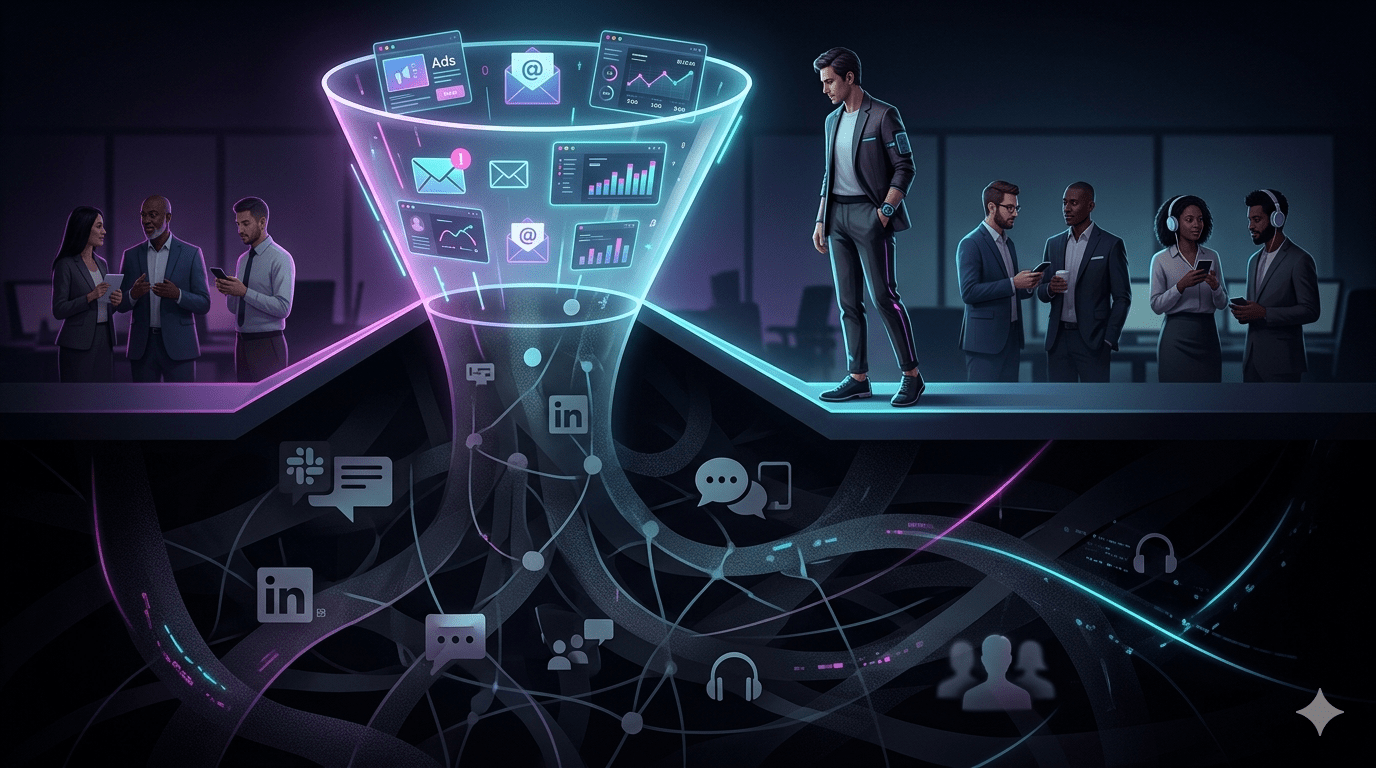
The dark funnel is all the research, conversations, and content B2B buyers consume outside the channels your analytics can track. It is made up of seven channels: private messaging, peer communities, review sites, podcasts, AI answer engines, industry publications and analysts, and live events. Buyers form their shortlist there, long before they fill out your form.
Key facts
- 92% of B2B buyers start the purchase process with at least one vendor in mind, and 41% already have a single preferred vendor before formal evaluation begins, according to Forrester’s 2024 Buyers’ Journey Survey as reported by Digital Commerce 360.
- Buyers choose from one of the four vendors on their Day One shortlist 95% of the time, per the 6sense 2025 B2B Buyer Experience Report (6sense is an intent data vendor).
- In that same 6sense report, the point of first contact with a seller moved from about 69% of the journey in 2024 to 61% in 2025, and buyers initiated 79% of those first engagements.
- 45% of B2B buyers said they used GenAI during a recent purchase, primarily to gather information on vendors and products, according to a Gartner survey of 645 B2B buyers.
- The typical B2B buying decision involves 13 internal stakeholders and nine external influencers, per Forrester’s 2026 Buyer Insights release.
What the Dark Funnel Is
Most B2B marketing teams measure what they can see: website traffic, form fills, ad clicks, and email opens. The deals they win or lose are often decided somewhere else.
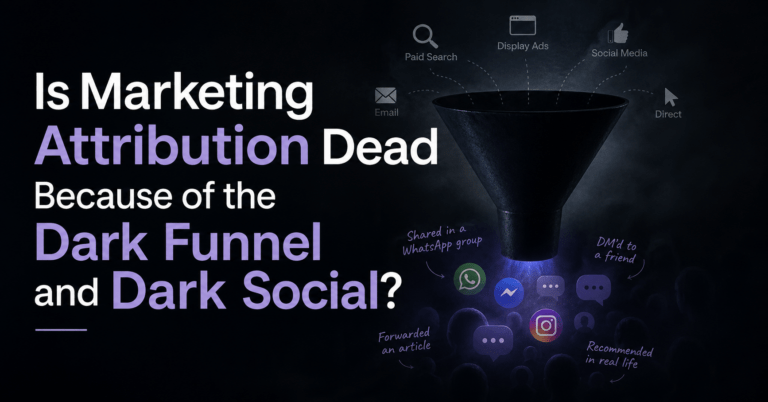
The dark funnel is that somewhere else. It covers every place a buyer learns about you, or about your competitors, where no pixel, UTM tag, or CRM field records it. A CFO asks a peer at a dinner which vendor they use. An engineer posts a question in a private Slack group. A VP of Operations asks ChatGPT to compare three options. A buyer reads your G2 reviews six times. None of it shows up in your reports.
When that buyer finally reaches out, your CRM records them as a new, first-time contact. In reality, they have already done most of their homework, and they have usually already picked a favorite.


Try two senior CMOs before you hire them
30 minutes with both of us. No hard sell. Written plan in 3 business days.
Why the Dark Funnel Matters More Now
The dark funnel is not new. Buyers have always asked friends and colleagues for advice. What has changed is how much of the decision now happens there, and how many new places it can happen.
Three shifts are driving it.
AI assistants became a research tool. Buyers now ask ChatGPT, Perplexity, Gemini, and Claude to explain a category, list vendors, and compare options. Gartner found 45% of B2B buyers used GenAI during a recent purchase, mainly to gather information on vendors and products. The 6sense 2025 report found 94% of buyers are using LLMs during their purchasing process. Those conversations leave no trace in your analytics.
Private communities grew. Invite-only Slack groups, Discord servers, peer advisory groups, and industry associations are where buyers ask each other blunt questions. Forrester notes that buyers “tap colleagues, communities, peers, and, increasingly, AI tools long before they ever talk to a provider” (Forrester, Three Realities About B2B Buying Networks).
Buying groups got bigger. Forrester’s 2025 Buyers’ Journey Survey found an average of 13 people inside the buyer’s organization and nine from outside involved in a purchase decision, and 73% of purchases involve three or more departments (Forrester). Each of those people researches on their own, in their own channels.
The result is simple. By the time a buyer raises a hand, preference has usually formed. Forrester found 92% of buyers start with at least one vendor in mind (Digital Commerce 360). If your marketing only switches on when someone clicks an ad or fills out a form, you are arriving after the shortlist is set.
In my experience working with B2B companies, the marketing teams that struggle most with pipeline predictability share a common blind spot: they’ve built their entire strategy around what they can measure, not where their buyers actually make decisions. (Peter Geisheker)
The 7 Channels That Make Up the Dark Funnel
These channels share one trait. Your standard analytics cannot tag them. Here is what happens in each one and how to be present there.
| Channel | What happens there | How to be present |
|---|---|---|
| Private messaging (Slack, Teams, email forwards, DMs) | Buyers forward your content to colleagues and debate options in internal threads | Publish content worth forwarding: short, specific, and useful to a CFO or CTO who did not ask for it |
| Peer communities and forums | Buyers ask “has anyone used this vendor?” in Slack groups, Discord, Reddit, LinkedIn groups, and associations | Have senior people participate as members who answer questions, not as sellers |
| Review platforms (G2, TrustRadius, Capterra) | Buyers read reviews and comparisons repeatedly, often without ever visiting your site | Ask happy customers for reviews on a steady schedule and respond to every review, good or bad |
| Podcasts and audio | Buyers hear your CEO or a customer explain a problem during a commute | Put your leaders on shows your buyers already listen to, with a clear point of view |
| AI answer engines (ChatGPT, Perplexity, Gemini, Claude) | Buyers ask AI to define the category, list vendors, and compare them | Publish clear, factual answers to the questions buyers ask, and earn mentions on third-party sites AI draws from |
| Industry publications and analysts | Buyers trust trade press and analysts more than vendor marketing | Pitch bylined articles, brief relevant analysts, and give journalists real data |
| Live events, webinars, and conferences | Hallway conversations and peer recommendations between sessions | Speak, sponsor selectively, and send people who can hold a real conversation |
1. Private Messaging and Internal Conversations
When a procurement lead forwards your article to a colleague in Slack, or a VP of Engineering shares your product page in a Teams thread, the visit shows up in your analytics as “direct.” There is no referral source and no credit.
How to show up: You cannot join these conversations, so your content has to travel on its own. Write pieces a champion would want to forward to their boss: a one-page cost comparison, a plain answer to a common objection, a short case story with numbers. Make every page make sense to someone who lands on it cold, with no prior context.
2. Peer Communities and Online Forums
Private Slack communities, industry Discord servers, LinkedIn groups, Reddit threads, and trade associations are where buyers ask each other, “Has anyone worked with this vendor? Are they worth it?” These conversations carry weight because they happen outside vendor influence.
How to show up: Pick two or three communities where your buyers actually spend time. Have a senior person, not an intern, join as a genuine member. Answer questions with no link and no pitch. Over months, that person becomes the name others tag when your topic comes up. Communities spot a sales play quickly, so the rule is: help first, mention your company only when asked.
3. Review Platforms and Third-Party Comparison Sites
G2, TrustRadius, Capterra, and similar sites are dark funnel channels because buyers research there continuously, often with no contact with you. A buyer might read your profile many times before reaching out, and your CRM will still call them a first-time contact.
How to show up: Treat reviews as an ongoing program, not a one-time push. Ask customers for a review at natural high points: after a successful launch, after a renewal, after a support win. Reply to every review, including the critical ones, in a calm and specific way. Keep your profile, pricing approach, and category tags current so you appear in the right comparisons.
4. Podcasts and Audio Content
There is no pixel on a podcast. When a prospect hears your CEO explain a problem on an industry show, that influence is real, and it often comes up later in discovery calls as the reason the buyer first heard of you.
How to show up: Target the shows your buyers already listen to, even if the audience is small. A focused niche show beats a large general one. Send your leaders with a clear, specific point of view and a few stories, not a product tour. Customers who appear as guests and talk about the problem you solved are even more persuasive.
5. AI Answer Engines
This is the newest dark funnel channel and the one most B2B companies are not yet addressing. When a buyer asks ChatGPT or Perplexity, “What are the best options for [your category] for a mid-market company?”, the answer is built from published content, reviews, and third-party sources. If your company is well represented in those sources, you can appear. If not, you are missing from the answer.
The influence chain often looks like this: a colleague mentions you in Slack, the buyer asks an AI tool about you, the AI describes you favorably, and the buyer searches your name on Google. Your reports credit branded search. The AI and the colleague get nothing.
How to show up:
- List the 20 to 30 questions your buyers ask before they buy, in the words they would use.
- Publish one clear page per question that answers it directly in the first few sentences, with facts and sources.
- Get your company described accurately on third-party sites AI tools draw on: review platforms, trade publications, analyst pages, and partner directories.
- Ask the AI tools those same questions every month and note which companies appear and which sources they cite. Close the gaps you find.
Gartner also found that 69% of B2B buyers prefer to validate AI-generated insights with sales reps (Gartner). So the AI answer gets you on the list, and your team still has to confirm it in the conversation.
6. Industry Publications and Analyst Reports
Buyers trust journalists and analysts more than vendor marketing. A mention in a respected trade publication, an analyst’s inclusion in a category report, or a bylined article in an industry newsletter carries more weight than any email campaign. These sources also feed the AI answer engines in channel 5.
How to show up: Offer editors bylined articles that teach something, not product announcements. Brief the analysts who cover your category, even if you are small. Share original data from your own customer base when you can. Journalists cover numbers they cannot get anywhere else.
7. Live Events, Webinars, and Conferences
Conversations at conferences, in hallways between sessions, and in post-webinar chats are untrackable by definition. They are also where some of the strongest peer recommendations happen.
How to show up: Choose fewer events and go deeper. Speak where you can, because a good talk gets repeated afterward. Send people who can hold a real business conversation. Host small dinners or roundtables for buyers in your category, where the value is the peer conversation, not your pitch.
Dark Funnel vs. Dark Social: What’s the Difference?
The two terms get used interchangeably, but they cover different ground.
Dark social is one part of the dark funnel. It refers to content shared through private digital channels (direct messages, email forwards, private group chats) where the referral source is stripped and the visit shows up in analytics as “direct traffic.”
The dark funnel is the broader idea. It includes dark social, plus everything else that shapes buyer preference outside your marketing stack: offline word of mouth, review site research, podcast listening, AI assistant queries, conference conversations, and analyst opinions. Some of it is digital, some semi-private, some fully offline.
Put simply: all dark social is dark funnel, but most of the dark funnel is not dark social.
Where to Start: Pick Two or Three Channels
You do not need to be present in all seven channels at once. Most B2B companies with limited budgets do better by going deep in a few.
- Ask your recent customers. Review your last 20 closed-won deals with your sales team. Where did the buyer first hear of you? Which peers, communities, review sites, or AI tools did they mention?
- Find the pattern. Two or three channels usually come up again and again in a given market.
- Commit to those channels for at least two quarters. Presence builds slowly. A community member who shows up for three weeks and disappears earns nothing.
- Assign a senior owner to each one. Dark funnel presence depends on credibility, and credibility comes from people who know the subject.
- Shift some budget. Move a portion of spend from bottom-of-funnel tactics like retargeting toward the channels where preference forms.
How you then measure the effect of that presence (self-reported attribution, branded search trends, and the rest) is a separate question, which I cover in Is Marketing Attribution Dead Because of the Dark Funnel and Dark Social?
Frequently Asked Questions
What channels make up the dark funnel in B2B?
The seven main channels are private messaging and internal chat (Slack, Teams, email forwards), peer communities and forums, review platforms such as G2 and TrustRadius, podcasts and audio, AI answer engines such as ChatGPT and Perplexity, industry publications and analyst reports, and live events and conferences. Each shapes buyer preference without producing a trackable signal in standard analytics.
How much of the B2B buying journey happens before buyers contact a vendor?
The often-quoted “70 to 80%” figure is hard to trace to a single current primary source. The 6sense 2025 B2B Buyer Experience Report found that first contact with sellers happens at about 61% of the journey, down from about 69% in 2024. Either way, most of the research and shortlisting happens before a seller is involved.
Are AI assistants part of the dark funnel?
Yes, and they are the fastest-changing part of it. When a buyer asks an AI tool for vendor recommendations in your category, the answer comes from published content, reviews, and third-party sources, and you see no visit or click. Gartner found 45% of B2B buyers used GenAI in a recent purchase, mainly to gather vendor and product information.
Is the dark funnel the same as dark social?
No. Dark social is the slice of the dark funnel where content is shared through private digital channels and shows up as “direct” traffic. The dark funnel also includes offline word of mouth, review sites, podcasts, AI answers, analyst opinions, and conference conversations.
Can a small B2B company compete in the dark funnel?
Yes, often better than a large one. Peer communities, niche podcasts, and review sites reward expertise and consistency more than budget. A small company with one or two respected senior voices and a steady review program can show up more often in these channels than a larger competitor that spends only on paid media.
Does a dark funnel strategy replace demand generation?
No. Demand generation captures intent that already exists. Dark funnel presence shapes preference before that intent is declared. Buyers usually pick from their Day One shortlist, so companies that invest only in capturing demand are competing for buyers who have already made most of their decision.
Show Up Before the Shortlist Is Set
The dark funnel is not a problem you solve once. It is a permanent part of how B2B companies buy. The companies that win are not the ones with the most advanced tracking. They are the ones buyers already know, trust, and hear about from peers, review sites, and AI answers before any formal evaluation begins.
If you want help deciding which two or three dark funnel channels matter most for your buyers, book a free 30-minute growth plan session with Michael Pecora and me on Google Meet. You will get a written growth plan within 3 business days, with no hard sell. We take on 10 companies a month. Book your session here.
Free Written Growth Plan
Wondering if a fractional CMO is right for you?
Try us before you hire us. Book a free 30-minute working session with both of us and get a written growth plan you can use whether or not you hire us.
Get My Free Growth Plan →No hard sell on the call. Your plan arrives within 3 business days. See a sample plan
Sources
- Digital Commerce 360, Forrester: B2B buyers choose vendors before the buying process begins
- Forrester, Three Realities About B2B Buying Networks
- Business Wire, Forrester’s 2026 Buyer Insights: GenAI Is Upending B2B Buying
- 6sense, 2025 B2B Buyer Experience Report
- Gartner, Gartner Survey Finds 69% of B2B Buyers Turn to Sales Reps to Validate AI-Generated Insights