Why do most B2B SaaS lead gen programs fail?
Most B2B SaaS lead gen programs fail because they optimize for lead volume instead of pipeline quality. Industry data shows only 13% of MQLs convert to sales-qualified leads on average, meaning 87 out of every 100 “qualified” leads produce zero revenue. The core problem is structural, not tactical.
Your pipeline dashboard looks healthy. Leads are coming in. MQL numbers are climbing. But revenue forecasts stay flat, sales reps quietly stop working marketing-sourced leads, and the CEO starts asking uncomfortable questions.
Sound familiar? You are not alone, and the problem is almost certainly not what you think.
Most B2B SaaS companies I work with as a Fractional CMO have a lead generation problem hiding inside what looks like a lead generation success. The volume is there. The quality is not.
This article breaks down the six structural reasons B2B SaaS lead gen programs fail, with real data, and gives you a clear framework to find and fix the leak in your specific funnel.
The B2B SaaS Lead Gen Reality Check
Before diagnosing failure, let us establish what success actually looks like, because most companies are measuring the wrong things.
According to 2025 benchmark data compiled from FirstPageSage and PoweredBySearch, the average B2B SaaS funnel converts 2.3% of website visitors into leads, 31% of leads into MQLs, and only 13% of MQLs into sales-qualified leads. That creates an end-to-end lead-to-customer conversion rate of roughly 2–3%.
To put that bluntly: if your team is generating 500 MQLs per month, statistically only about 65 of them will ever become sales opportunities. And of those, maybe 20 will close.
That is the industry average. But here is what makes it worse: most B2B SaaS companies do not know where their funnel is breaking down. According to research published by MarketingSherpa, 61% of B2B marketers send all leads directly to sales, yet only 27% of those leads are actually qualified.
You are flooding sales with noise and wondering why they ignore your leads.
The fix starts with understanding the six structural failure modes that cause this.
Failure #1: Optimizing for Lead Volume Instead of Pipeline Quality
This is the root cause of nearly every dysfunctional B2B SaaS lead gen program.
When your marketing team is measured on MQL count and cost per lead, every decision trends in the wrong direction. You write broader content to capture more traffic. You lower form friction to increase submissions. You loosen ICP criteria to hit your numbers. And every one of those moves degrades lead quality.
The result is a pipeline that looks productive on paper and performs terribly in practice. Research from Squaristic shows that industry averages for demand generation programs sit at 2–3% lead-to-pipeline conversion, while well-structured campaigns with tight ICP alignment achieve 8–15%.
That is a 5–7x performance gap between volume-optimized and quality-optimized programs.
The fix: Redefine your primary marketing KPI. Stop measuring MQL volume. Start measuring pipeline contribution. The dollar value of opportunities marketing generates that make it to SQL stage. This one metric change shifts every downstream decision toward quality.
How B2B SaaS Lead Gen Programs Fail at the MQL-to-SQL Stage
The MQL-to-SQL transition is where most B2B SaaS lead gen programs fail catastrophically, and it is largely invisible until you look at the right data.
The 2025 B2B SaaS funnel benchmark data shows the MQL-to-SQL conversion rate averages 15–21% across the industry, with the steepest losses occurring at exactly this handoff point. A 5-point improvement in this single stage can lift total revenue by up to 18%.
So why does it fail so consistently?
Because marketing and sales have fundamentally different definitions of “qualified.” Marketing calls a lead qualified when it matches demographic criteria and engages with content. Sales calls a lead qualified when the person has budget, authority, and an active need, right now. These are not the same standard, and without a written, agreed-upon definition called a Service Level Agreement (SLA), every handoff is a negotiation.
Failure #2: No Shared ICP Definition Between Marketing and Sales
Your Ideal Customer Profile (ICP) is not just a firmographic filter. It is a deal qualification framework. And if marketing and sales are not working from the same version of it, your pipeline will break at the handoff every time.
This is one of the most common structural failures I diagnose in B2B SaaS marketing audits. Marketing targets industry and company size. Sales qualifies on buying stage, budget authority, and pain severity. They are scoring leads against entirely different rubrics.
Research confirms that sales and marketing misalignment around ICP definitions directly reduces conversion rates at every funnel stage.
The data on what alignment is worth is striking. Companies with aligned sales and marketing generate 208% more revenue from marketing, and they become 67% better at closing deals when those teams operate in sync (Source: MarketingProfs, as cited in HubSpot’s Sales & Marketing Statistics).
The fix: Hold a joint ICP session with sales and marketing leadership. Define your ideal buyer in terms of observable behavioral signals, not just company attributes. Document it. Make it the shared definition that governs both lead scoring and sales qualification. Revisit it quarterly.
Failure #3: Content That Attracts Learners, Not Buyers
Your blog is generating traffic. Your lead magnets are filling your database. But the people downloading your eBooks and reading your top-of-funnel content are researchers, not buyers, and treating them like buyers is bleeding your pipeline dry.
Research shows that 67% of B2B marketers focus most of their content effort on top-of-funnel (TOFU) awareness content, while completely underinvesting in the middle and bottom of the funnel where buyers actually make decisions.
The B2B SaaS buyer journey has three distinct stages with very different content needs:
- Awareness: The buyer is researching the problem, not solutions. They want education, frameworks, and diagnosis.
- Consideration: The buyer is comparing vendors. They want case studies, comparison guides, ROI frameworks, and demos.
- Decision: The buyer is justifying a purchase internally. They want pricing transparency, security documentation, implementation timelines, and social proof.
When 67% of your content lives in the awareness stage, you are attracting people who are not yet close to buying, and then treating their download of your “Ultimate Guide” as a buying signal.
The fix: Audit your content inventory by funnel stage. Map content to buyer journey stage explicitly. Build a deliberate mid-funnel content system, ROI calculators, competitor comparison pages, case studies with measurable outcomes, and implementation guides. These attract buyers who are already solution-aware, and they convert at dramatically higher rates.
According to 2025 benchmark data, SEO-generated leads outperform paid leads in MQL-to-SQL conversion at a rate of 51% vs. 26%, largely because organic search attracts solution-aware buyers with higher purchase intent. (Source: FirstPageSage / PoweredBySearch)
Failure #4: Single-Channel Dependency
Many B2B SaaS companies build their entire lead gen program around one channel, usually LinkedIn ads or Google PPC, and then wonder why growth stalls or collapses when that channel’s performance shifts.
Single-channel dependency creates compounding fragility: algorithm changes, rising CPCs, audience fatigue, or increased competition can cripple pipeline overnight.
The deeper problem is that different buyer personas (and different stages of the same buyer’s journey) require different channels. A VP of Sales evaluating your CRM integration does not behave the same way at every stage of consideration. They might find you through organic search during research, engage with you on LinkedIn during evaluation, and respond to a targeted email when they are ready to schedule a demo.
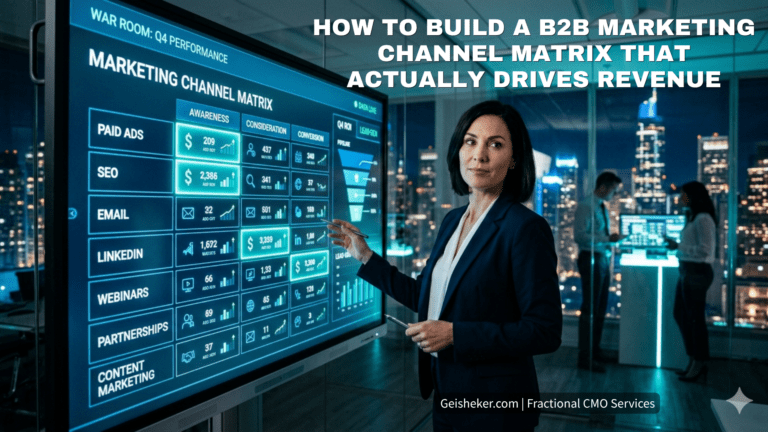
The fix: Build a marketing channel matrix. Map each buyer persona to the channels where they actively research at each stage of their journey. Then build a coordinated, multi-touch lead gen system where channels reinforce each other. This is not about being everywhere. It is about being present at the right moments in the right way.
If you need help designing this system with the right resource allocation, a Fractional CMO engagement can build the full channel architecture without the cost of a full-time hire.
Failure #5: Treating Lead Nurturing as an Email Blast Calendar
Most B2B SaaS companies have a nurture sequence. Almost none of them have a nurture system.
The difference is significant. A nurture sequence is a linear series of emails sent on a time-based schedule, regardless of buyer behavior. A nurture system is a dynamic, behavior-triggered workflow that responds to what the buyer actually does, the pages they visit, the content they download, the emails they open or ignore.
Modern B2B buyers complete roughly 57% of their research before talking to a sales rep. That means they are deep into your content ecosystem (forming opinions, comparing vendors, developing objections) long before they raise their hand.
A static email sequence that sends the same three messages to every lead at the same intervals is not nurturing. It is broadcasting. And it produces predictable results: low engagement, low conversion, and high unsubscribe rates.
VERY IMPORTANT: There is also a timing problem. Companies that follow up with leads within the first hour see a 53% conversion rate, compared to just 17% for follow-ups after 24 hours. That is a 3x difference based purely on speed! To improve that even more, make it a rule at your company that all leads must be contacted within 5 minutes of them completing your contact form or request a demo form. SPEED = SALES.
The fix: Rebuild your nurture infrastructure around behavioral signals. Trigger sequences based on page visits, content engagement, and intent signals, not just time elapsed since form fill. Establish a defined lead response SLA between marketing and sales: high-intent leads get a same-day response, every time.
Want more qualified pipeline? Get a free growth plan 30 minutes with both of us. No hard sell. Written plan in 3 business days.

Failure #6: No Attribution Model, So No One Knows What Is Working
If you cannot reliably trace closed revenue back to the marketing activities that generated it, you cannot optimize your program. And most B2B SaaS companies cannot.
A staggering 68% of B2B organizations have not identified their full sales funnel. They track top-of-funnel metrics. Some track MQLs. Very few have closed-loop attribution connecting specific marketing touchpoints to specific closed deals.
Without attribution, you are making budget decisions based on vanity metrics. You cut the channel that looks expensive but generates your best-converting leads. You scale the channel that looks efficient but feeds your worst-converting accounts. And your cost per acquisition climbs quietly while your pipeline quality erodes.
Research shows that untracked lead attribution gaps result in 34% of qualified leads getting lost between departments due to poor tracking systems, and that regular process audits can reduce this loss by up to 40%.
The fix: Implement a multi-touch attribution model. At minimum, track first-touch (which channel created awareness), last-touch (which channel drove the conversion), and pipeline attribution (which touchpoints influenced the deal). Tie this to your CRM with closed-loop reporting so marketing can see actual revenue generated by campaign. This is foundational, without it, optimization is guesswork.
The Revenue Leak Diagnostic: A Practical Framework for B2B SaaS Teams
One of the frameworks I use with Fractional CMO clients at The Geisheker Group is a revenue leak diagnostic. The concept is simple: if revenue is underperforming, the leak is somewhere in the funnel. The goal is to find it, measure it, and fix it systematically, rather than randomly testing tactics.
Here is how to run it:
- Map your conversion rates at every funnel stage. Visitor-to-lead. Lead-to-MQL. MQL-to-SQL. SQL-to-opportunity. Opportunity-to-close. Compare each rate to 2025 benchmarks for B2B SaaS: visitor-to-lead (2.3%), lead-to-MQL (31%), MQL-to-SQL (15–21%), SQL-to-opportunity (30–59%), opportunity-to-close (22–30%).
- Identify your widest gap. Where are you most underperforming relative to benchmarks? That is your leak. The biggest drop-off in most B2B SaaS companies occurs at MQL-to-SQL, usually because of the ICP misalignment failure described above.
- Diagnose the root cause. Is the problem lead quality (wrong people entering the funnel)? Timing (too slow to follow up)? Content (wrong messages at the wrong stage)? Channel (attracting low-intent traffic)? Attribution (you have no idea what is actually working)?
- Build a 90-day fix plan. Pick the one constraint with the highest revenue impact. Fix it with a specific, measurable change. Measure results after 60 days. Then address the next constraint.
What a Fixed B2B SaaS Lead Gen System Actually Looks Like
A high-performing B2B SaaS lead gen program has five characteristics that distinguish it from a failing one:
- ICP precision: Every campaign targets accounts and personas that your sales team has confirmed they can close. Marketing and sales use the same definition.
- Funnel-stage content: Content is mapped to buyer journey stage, with clear mid-funnel and decision-stage assets that accelerate deals, not just build awareness.
- Behavioral nurture: Sequences are triggered by buyer actions, not calendar intervals. High-intent signals trigger immediate sales outreach.
- Multi-channel coordination: Channels are selected based on where ideal buyers actually spend time during research and evaluation, and they reinforce each other across the buyer journey.
- Closed-loop attribution: Marketing knows which activities generate pipeline and closed revenue. Budget decisions are driven by contribution to revenue, not volume metrics.
This is not a radical transformation. It is a structural rebuild, and most B2B SaaS companies can implement it over a focused 90-to-120-day sprint.
When to Bring in a Fractional CMO to Fix Your Lead Gen Program
Not every B2B SaaS company has the internal bandwidth or senior expertise to run this kind of structural audit and rebuild. If your marketing team is strong on execution but lacks senior-level strategic leadership (someone who has designed and fixed B2B SaaS lead gen systems before) that is exactly the gap a Fractional CMO fills.
A Fractional CMO can embed with your team part-time at a fraction of the $300K+ cost of a full-time CMO. They bring the pattern recognition from working across multiple B2B SaaS companies, which means they can diagnose your specific leak faster and fix it with higher confidence than someone building the framework from scratch.
If your pipeline is underperforming and you are not sure where the leak is, I offer a free consultation to walk through your current funnel and identify the most likely failure modes.
Schedule a free consultation with Peter Geisheker to discuss your B2B SaaS lead gen program.
Frequently Asked Questions: B2B SaaS Lead Gen Programs
Why do B2B SaaS lead gen programs fail even when they generate high lead volume?
High lead volume is not the same as high-quality pipeline. Most B2B SaaS lead gen programs fail because they optimize for MQL count, which creates pressure to generate volume at the expense of quality. When marketing passes unqualified leads to sales, reps lose trust in marketing, stop working those leads, and the pipeline stalls. The root cause is almost always structural: wrong success metrics, misaligned ICP definitions, or content that attracts researchers instead of buyers.
What is a realistic MQL-to-SQL conversion rate for B2B SaaS?
According to 2025 benchmark data, the industry average MQL-to-SQL conversion rate for B2B SaaS is 15–21%. Top-performing companies using behavioral scoring models achieve 39–40%. If your rate is below 15%, your ICP definition, lead scoring criteria, or handoff process is likely the primary problem. Learn more from the 2026 MQL-to-SQL benchmarks from Data-Mania.
What is the biggest funnel stage failure in B2B SaaS lead gen?
Across the industry, the MQL-to-SQL stage produces the steepest conversion drop-off. The average lead-to-customer conversion rate is 2–5%, with the biggest loss occurring at MQL-to-SQL. Fixing this single stage by 5 percentage points can lift total revenue by up to 18%.
How does sales and marketing misalignment affect B2B SaaS lead gen?
The financial impact is substantial. Companies with aligned sales and marketing generate 208% more revenue from marketing and are 67% better at closing deals. Misalignment typically shows up as disagreements about lead quality, low follow-up rates on marketing-sourced leads, and rising cost per acquisition. A shared ICP definition and a formal SLA between marketing and sales are the primary fixes.
How quickly should B2B SaaS companies respond to inbound leads?
Speed-to-lead has a dramatic impact on conversion rates. Following up within the first hour produces a 53% conversion rate, compared to just 17% when follow-up occurs after 24 hours, a more than 3x performance difference based purely on response time. For high-intent signals like demo requests or pricing page visits, same-day outreach should be a hard SLA. To make that conversion rate even higher, contact all incoming leads within 5 minutes of them completing your contact form or request a demo form.
What content types perform best for B2B SaaS lead generation?
High-intent, solution-aware content consistently outperforms broad awareness content for pipeline generation. SEO-driven content produces MQL-to-SQL conversion rates of 51%, nearly double the 26% rate for paid advertising. The highest-performing content types include ROI calculators, competitor comparison guides, product-specific case studies with measurable outcomes, and decision-stage implementation guides.
What is a revenue leak diagnostic and how does it work?
A revenue leak diagnostic is a systematic framework for identifying where in your funnel conversion rates are underperforming relative to benchmarks, and diagnosing the structural root cause. It involves mapping conversion rates at every stage, comparing them to industry benchmarks, identifying the widest gap, diagnosing the root cause, and building a 90-day fix plan focused on the highest-revenue-impact constraint first. This is a core methodology used in Fractional CMO engagements at The Geisheker Group.
How does a Fractional CMO help fix a broken B2B SaaS lead gen program?
A Fractional CMO brings senior-level strategic expertise at a fraction of the cost of a full-time marketing executive. They conduct a structured funnel audit, identify the primary failure mode, and lead the rebuild across ICP alignment, content strategy, channel architecture, nurture infrastructure, and attribution. The typical engagement runs 6–12 months, part-time, at 60–70% less cost than a full-time CMO hire. Schedule a free consultation to discuss your specific situation.
Conclusion
Most B2B SaaS lead gen programs do not fail because of bad tactics. They fail because of bad structure, wrong metrics, misaligned teams, content that serves the wrong buyer stage, and no visibility into what is actually driving revenue.
The six structural failures covered in this article (volume optimization over quality, ICP misalignment, TOFU content overinvestment, single-channel dependency, static nurture sequences, and broken attribution) are all fixable. And fixing even one of them typically produces a measurable improvement in pipeline quality within 60–90 days.
But you cannot fix what you cannot see. Start with the revenue leak diagnostic. Map your conversion rates. Find your widest gap. Diagnose the structural root cause. Then fix it with intention, not just with more activity.
If you want a senior marketing strategist to walk through your funnel with you and tell you exactly where the leak is, I am happy to do that in a free 30-minute consultation. No hard sell, just a direct, data-driven conversation.
Schedule your free consultation with Peter Geisheker here.
About Peter Geisheker
Peter Geisheker is a Fractional CMO and founder of The Geisheker Group, Inc., specializing in B2B and B2B SaaS marketing strategy. With over 25 years of experience helping companies achieve measurable revenue growth (including 6x inbound lead increases, 400%+ sales volume gains, and 100% year-over-year SaaS revenue growth for three consecutive years) Peter provides senior-level marketing expertise without the full-time executive cost.
Ready to find and fix the leak in your B2B SaaS lead gen program? Schedule a free consultation with Peter Geisheker to get a direct, data-driven assessment.
References and Sources
- Squaristic, “Why Most B2B Lead Generation Strategies Fail” (2025): Industry averages for lead-to-pipeline conversion rates and ABM performance benchmarks. https://squaristic.com/b2b-lead-generation-strategies-fail-how-to-fix/
- Whistle.ltd, “10 Reasons Traditional Lead Generation Is Failing B2B SaaS Companies” (October 2025): B2B SaaS buyer research behavior, including the 57% research-before-sales-contact statistic. https://whistle.ltd/lead-generation/traditional-lead-generation-failing-b2b-saas/
- My-Outreach.com, “Why Your SaaS Lead Generation Strategies Aren’t Working” (January 2026). https://www.my-outreach.com/blog/saas-lead-generation-strategies
- TheDigitalBloom, “2025 B2B SaaS Funnel Benchmarks & Pipeline Audit Framework” (October 2025). https://thedigitalbloom.com/learn/pipeline-performance-benchmarks-2025/
- SerpSculpt, “B2B Sales Conversion Rate by Industry 2025” (November 2025). https://serpsculpt.com/reports/b2b-sales-conversion-rate-by-industry/
- Understory Agency, “MQL to SQL Conversion Rates: B2B SaaS Benchmarks” (2025). https://www.understoryagency.com/blog/mql-to-sql-conversion-rate-benchmarks
- Data-Mania, “MQL to SQL Conversion Rate Benchmarks 2026” (March 2026). https://www.data-mania.com/blog/mql-to-sql-conversion-rate-benchmarks-2025/
- MarketJoy, “B2B Sales Pipeline Conversion Rates” (September 2025). https://marketjoy.com/b2b-sales-pipeline-conversion-rates-marketjoy-data/
- HubSpot Sales & Marketing Statistics (via MarketingSherpa): 61% of B2B marketers send all leads to sales; only 27% are qualified. https://cdn2.hubspot.net/hubfs/1941744/TBIG_Conferences/110_Sales_and_Marketing_statistics.pdf
- SPOTIO, “140+ Sales Statistics 2026 Update.” https://spotio.com/blog/sales-statistics/
Free Written Growth Plan
Want more qualified pipeline?
Give us 30 minutes with your toughest marketing problem. You get a written plan with your three best growth opportunities and the first steps your team can take.
No hard sell on the call. Your plan arrives within 3 business days. See a sample plan