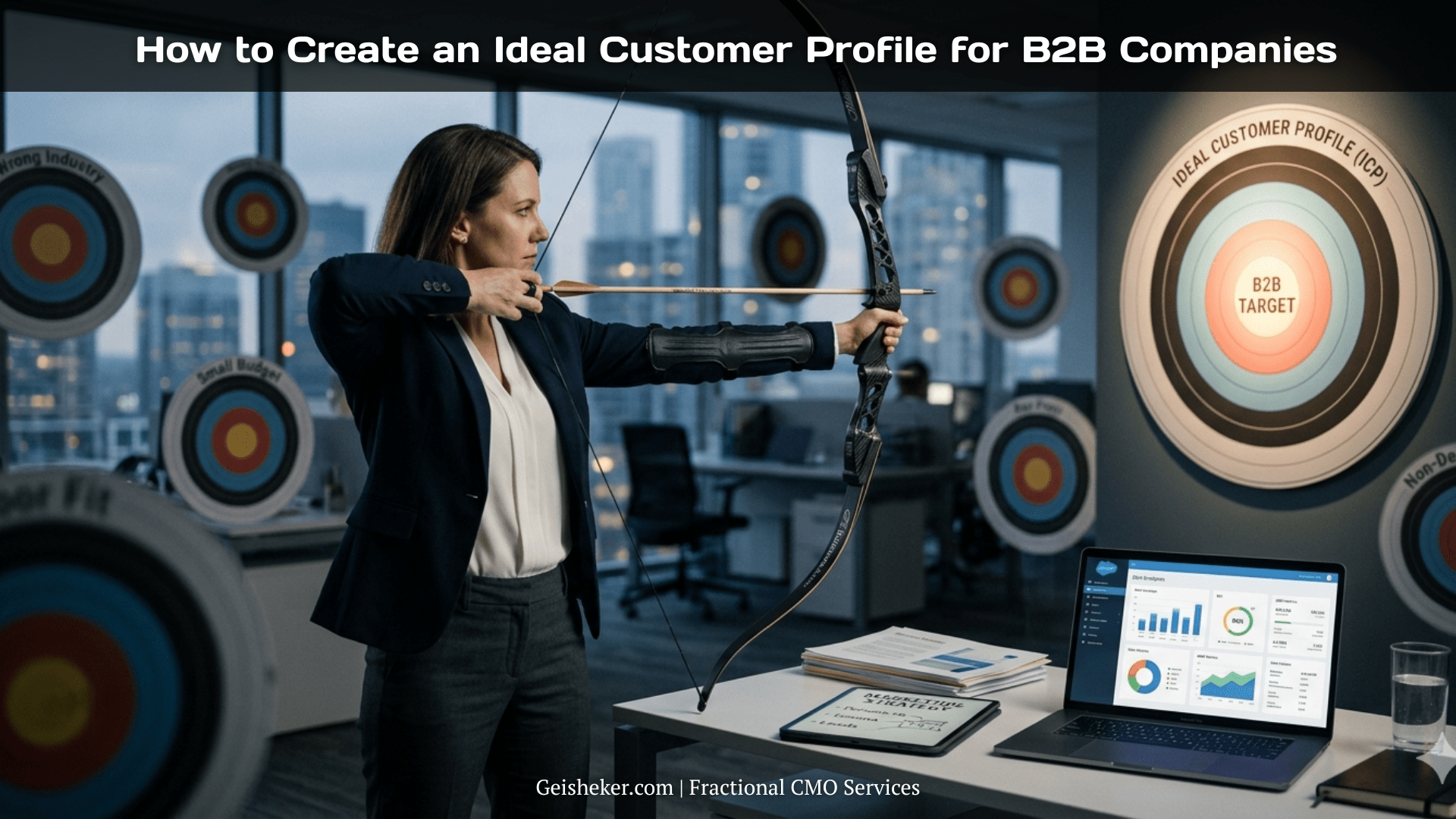
B2B companies are often targeting the wrong prospects, and spending real money to do it.
Without a well-defined ideal customer profile (ICP), your marketing dollars get spread across companies that will never buy from you, your sales team wastes time on unqualified leads, and your revenue growth stalls. If you have ever wondered why your pipeline is full but your close rate is disappointing, a weak or missing ICP is often the reason.
This guide walks you through exactly how to create an ideal customer profile for your B2B company, using a structured, data-driven process that Peter Geisheker and The Geisheker Group use with clients every day. You will learn what an ICP actually is, why it matters for B2B growth, and the six-step process for building one that aligns your marketing, sales, and customer success teams around the customers most likely to drive your revenue.
What Is an Ideal Customer Profile?
An ideal customer profile (ICP) is a data-driven description of the type of company that would benefit most from your product or service and provide the highest value to your business in return. For B2B companies, the ICP defines the organizational attributes (industry, company size, revenue, geography, technology stack, and pain points) of your best-fit accounts. Companies with a well-defined ICP achieve up to 68% higher account win rates than those without one. (SalesHive, citing WebFX ABM research)
Why Every B2B Company Needs an Ideal Customer Profile
Too many B2B companies build their marketing strategy around a vague sense of who their customer is. They describe their target market as something like “mid-sized technology companies” or “B2B SaaS companies with 50–500 employees” and call it a day. That is not an ICP. That is a demographic guess that will cost you in wasted ad spend, missed quota, and misaligned teams.
The business case for a precise ideal customer profile is compelling. Organizations with aligned sales and marketing functions, alignment that starts with a shared ICP, achieve 36% higher customer retention rates and 38% higher sales win rates, according to MarketingProfs research widely cited across the B2B industry (ZoomInfo, Revenue Memo). Companies with strong alignment also achieve 20% annual revenue growth, while those with poor alignment experience a 4% revenue decline, a 24-percentage-point gap that traces back, in large part, to not knowing who you are actually selling to (Revenue Memo).
The cost of misalignment is not abstract. Misalignment between sales and marketing (driven largely by disagreement over what constitutes an ideal prospect) costs B2B companies an estimated $1 trillion in lost revenue annually (Revenue Memo). Getting your ICP right is not a marketing exercise. It is a revenue decision.
The good news is that building an ICP does not have to take months or require expensive consultants. With the right process, even a small B2B team can develop a working ICP in a matter of weeks and start targeting smarter immediately.
Key ICP Impact Statistics
- Organizations with a strong ICP achieve up to 68% higher account win rates (SalesHive)
- Aligned sales and marketing teams see 38% higher win rates and 36% better customer retention (ZoomInfo)
- Companies with strong alignment achieve 20% annual revenue growth vs. a 4% decline for misaligned teams (Revenue Memo)
- Sales and marketing misalignment costs B2B companies an estimated $1 trillion annually (Revenue Memo)
ICP vs. Buyer Persona: Understanding the Difference
Before you start building your ICP, it helps to understand what it is not.
An ideal customer profile defines the type of company you are targeting, the account. It describes organizational characteristics: industry, company size, annual revenue, geography, technology stack, growth stage, and strategic pain points. It answers the question, “Which companies should we be targeting?”
A buyer persona defines the individual people within those companies. The humans who research, evaluate, and ultimately make purchasing decisions. A persona includes job title, seniority, decision-making authority, professional goals, personal motivations, and communication preferences.
Both are essential. But you have to build the ICP first. As Gartner explains in their B2B ideal customer profile guide, the ICP gives your sales teams a broad picture of the enterprise they should target, while buyer personas zoom in on all individuals involved in the purchase (Gartner Digital Markets). Trying to build personas without a defined ICP is like casting characters before you know what movie you are making.
ICP vs. Buyer Persona at a Glance
| Dimension | Ideal Customer Profile (ICP) | Buyer Persona |
|---|---|---|
| Focus | The company (account level) | The individual (person level) |
| Key attributes | Industry, revenue, employee count, tech stack, geography | Job title, goals, pain points, motivations, communication style |
| Primary question | Which companies should we target? | How do we engage the people within those companies? |
| Built by | Marketing, Sales, Customer Success together | Marketing, informed by Sales |
| Build order | Build first | Build second, after ICP is defined |
| Primary use | Account list building, ABM, lead scoring | Messaging, content strategy, sales conversations |
The Six-Step ICP Development Process
After working with dozens of B2B and B2B SaaS companies on marketing strategy and ICP development, I have refined this process into six steps that consistently produce actionable, data-grounded ideal customer profiles.
Step 1: Identify Your Best Current Customers
Start with your existing customer data. Your best customers are not necessarily your largest customers or your earliest customers. They are the ones who get the most value from your solution, require the least support to keep, renew consistently, and are most likely to refer others.
Pull your customer list and rank them using three criteria:
- Revenue and lifetime value (LTV), who generates the most recurring revenue?
- Retention, who stays longest without requiring heavy intervention?
- Satisfaction, who gives you the best feedback, provides testimonials, and advocates for your brand?
Cross-reference those rankings with your CRM data. Look for patterns in company size, industry, geography, and deal structure. Your goal is to identify your top 10–20 best customers by these combined criteria. This group becomes the raw data for your ICP.
One important nuance: do not blend customers from different market segments into a single analysis. As the FullFunnel team notes in their B2B ICP guide, the most common ICP mistake is mixing data from different customer segments, which produces a broad, generic profile that fits no one well (FullFunnel.io). Analyze each segment separately.
Not sure how to structure this analysis or lacking strong CRM data to work from? Schedule a free consultation with Peter Geisheker to discuss your specific situation.
Step 2: Collect Firmographic, Technographic, and Behavioral Data
Once you have your best-customer list, you need to systematically document the characteristics they share. There are three categories of data to gather:
Firmographic data covers the organizational basics: company size by employee count, annual revenue, industry and sub-industry, geographic location, business model, funding status, and company age or growth stage. This is often the starting point for most ICPs, and it is necessary, but not sufficient on its own.
Technographic data covers the technology stack your ideal customers use. Which CRM do they rely on? Which marketing automation platform? Which project management or data tools? For many B2B solutions, there is a strong correlation between the tools a company uses and their readiness to adopt a complementary solution. Clearbit’s B2B ICP guide identifies technographics as a critical dimension for pinpointing which businesses are the perfect fit (Clearbit).
Behavioral and intent data is the third layer: How did they find you? How long was their sales cycle? What content did they consume before buying? What trigger events preceded their decision to buy? Gartner recommends combining quantitative CRM data (including annual contract value (ACV) and customer lifetime value (CLTV)) with qualitative input from sales, customer success, and direct customer interviews to get the full picture (Gartner Digital Markets).
Build a spreadsheet or use your CRM to document all three data types for each of your best customers. The patterns will start to surface quickly.
Step 3: Conduct Customer Interviews
Data tells you what your best customers look like. Customer interviews tell you why they chose you, and that distinction is what separates a useful ICP from a generic one.
Identify five to ten customers from your best-customer list and request 20–30 minute conversations. Focus your questions on three areas:
The problem landscape: What was happening in their business before they found your solution? What were the specific challenges, inefficiencies, or costs they were experiencing? How urgent was the need?
The decision process: Who was involved in the buying decision? What alternatives did they consider? What made them choose you over competitors? What would have prevented them from buying?
The outcome experience: What specific results have they achieved? How has your solution changed their day-to-day operations or business performance? What do they tell colleagues about your product?
The language customers use to describe their own problems is gold for your marketing and sales teams. When your messaging reflects the exact words your ideal customers use to describe their challenges, it resonates in a way that generic positioning never can.
Step 4: Define Pain Points, Trigger Events, and Disqualifiers
Your ICP is not just about who your ideal customer is. It is also about when they are ready to buy and what rules them out.
Trigger events are situations or circumstances that make a company more likely to need your solution now. These might include: a leadership change (new CMO, new CEO), a funding round, a competitor entering their market, a regulatory change, or a specific growth milestone. Identifying common trigger events among your best customers helps your sales team prioritize prospects who are in an active buying window.
Pain points are the specific operational, financial, or strategic challenges your ideal customers are trying to solve. Be as specific as possible. “Marketing inefficiency” is not a pain point. “Spending 40% of the marketing budget on unqualified leads because the sales and marketing teams define a good prospect differently” is a pain point.
Disqualifiers are equally important. What types of companies consistently do not succeed with your solution, or have characteristics that make them hard to serve profitably? Defining negative ICP criteria prevents your sales team from pursuing accounts that will churn, demand excessive support, or never reach a buying decision.
A note on data quality: B2B contact data decays between 22.5% and 70.3% annually, meaning ICP-driven account and contact lists quickly become unreliable without ongoing enrichment and validation (SalesHive, citing Landbase data quality research). Build a regular data maintenance process into your ICP program from the start.
Step 5: Build and Validate Your ICP Profile
Now synthesize everything you have gathered into a clear, documented ICP. A complete B2B ideal customer profile should include:
- Industry and sub-industry classification
- Company size range (employees and revenue)
- Geographic scope
- Technology stack and relevant integrations
- Growth stage or funding status
- Organizational structure and buying committee composition
- Core pain points (ranked by frequency and urgency)
- Common trigger events that precede a purchase
- Disqualifying characteristics
- A brief narrative profile synopsis that ties all of this together
A profile synopsis might look like this: “Our ideal customer is a B2B SaaS company in the finance or healthcare vertical, with 100–500 employees and $10M–$75M in annual recurring revenue, headquartered in North America. They are past the startup phase and struggling to scale their marketing function, typically with a small in-house team and no senior marketing leadership. The key decision-makers are the CEO and CFO, who are focused on efficient pipeline growth and need a strategic partner, not just a tactical vendor.”
Once you have a draft, validate it. Share the ICP with your sales team, customer success team, and key stakeholders. Ask them to pressure-test it against their daily experience. As the team at Primer notes, an ICP that only marketing buys into is not really an ICP. It is a marketing brief (Sayprimer). Your ICP needs cross-functional alignment to drive real results.


Want more qualified pipeline? Get a free growth plan
30 minutes with both of us. No hard sell. Written plan in 3 business days.
Step 6: Activate, Measure, and Refine
An ICP is not a document you create and archive. It is a living framework that should actively govern how you allocate marketing budget, score leads, structure your content strategy, and prioritize sales outreach.
Put your ICP to work in these concrete ways:
Filter your CRM and build targeted prospect lists. Every inbound and outbound lead should be evaluated against ICP criteria before your sales team invests significant time in them.
Align your content strategy to ICP characteristics. If your ideal customer is a CFO at a mid-market SaaS company, your content should speak directly to CFO priorities (cash efficiency, scalable growth, and predictable revenue) not generic marketing advice.
Improve lead scoring in your marketing automation platform. Accounts that match your ICP firmographics and are showing buying intent signals should get higher scores and faster follow-up.
Review and update the ICP at least annually, or whenever you launch a new product, enter a new market, or notice a shift in which customer segments are performing best. As Dreamdata recommends, your ICP should evolve as your business matures, not sit static in a shared drive (Dreamdata).
How a Fractional CMO Accelerates Your ICP Development
For small and mid-size B2B companies, one of the most common challenges with ICP development is simply bandwidth and strategic expertise. Building a rigorous ICP requires cross-functional alignment, structured research, data analysis, and the experience to know what good looks like. Most small marketing teams do not have all of those capabilities in-house.
This is where a Fractional CMO creates significant leverage. A Fractional CMO brings senior-level marketing strategy, including ICP development, at a fraction of the cost of a full-time CMO hire. Rather than starting from scratch, a Fractional CMO brings a proven process, cross-industry pattern recognition, and the ability to drive alignment across your sales, marketing, and customer success teams from day one.
In my work with B2B and B2B SaaS companies at The Geisheker Group, ICP development is one of the first strategic priorities I address with new clients. Getting clarity on the ideal customer unlocks everything else, messaging, channel strategy, content planning, lead scoring, and sales enablement all become significantly more effective once the target is precisely defined.
If you are building or rebuilding your ICP and want a structured framework and senior marketing leadership to guide the process, reach out to discuss how a Fractional CMO engagement could accelerate your results.
Common Ideal Customer Profile Mistakes to Avoid
Even well-intentioned ICP development processes produce weak results when certain mistakes go uncorrected.
Blending customer segments is the most common error. If you serve two distinct customer types (say, early-stage startups and established mid-market companies) mixing their data into a single ICP produces a blurry profile that describes neither segment accurately. Build separate ICPs for each meaningful segment, then prioritize.
Over-relying on intuition rather than data is another frequent pitfall. Many founders and sales leaders have strong intuitions about their ideal customer, and those intuitions are worth capturing. But they need to be validated against actual customer data. The gap between who leadership thinks the ideal customer is and who actually generates the most revenue and retention is often surprising.
Building the ICP in isolation is a third mistake. Marketing often leads the ICP process, but input from sales and customer success is essential. Sales teams know which prospects actually close and which ones stall. Customer success teams know which accounts churn and which ones expand. As Primer research notes, focusing solely on marketing or sales data when building an ICP leads to leads that do not close or closed deals that do not succeed (Sayprimer).
Treating the ICP as a one-time project rather than an ongoing process consistently limits its value. Market conditions change, your product evolves, and new customer segments emerge. A stale ICP is worse than a rough one. It creates false confidence while misdirecting resources.
ICP and Account-Based Marketing: A Natural Fit
Once your B2B ideal customer profile is defined, account-based marketing (ABM) becomes significantly more effective and efficient. ABM strategy depends on identifying a precise set of high-value target accounts, which is exactly what a well-built ICP enables.
Research consistently shows that ABM produces strong returns when paired with an accurate ICP. According to the 2020 ABM Benchmark Study conducted by the ABM Leadership Alliance and ITSMA, 76% of B2B marketers reported higher ROI from ABM than from any other marketing strategy (Demand Gen Report). That performance depends on starting with a well-defined target account list, which starts with your ICP.
With a precise ICP in place, your marketing team can build lookalike audience segments on LinkedIn and Google, create content specifically designed for ICP-matching accounts, and deliver personalized outreach that speaks directly to the challenges your ideal customers face. The result is a more efficient pipeline with higher conversion rates at every stage.
Frequently Asked Questions About Creating an Ideal Customer Profile
What is an ideal customer profile in B2B marketing?
An ideal customer profile (ICP) in B2B marketing is a data-driven description of the type of company that would benefit most from your product or service and deliver the highest value to your business. It defines organizational attributes (industry, company size, revenue, geography, technology stack, and pain points) that characterize your best-fit accounts. According to Gartner, the ICP gives your sales teams a broad, enterprise-level picture of who to target, which is distinct from buyer personas that describe the individuals within those companies (Gartner Digital Markets).
How is an ICP different from a buyer persona?
An ICP defines the type of company you are targeting, the account level. A buyer persona defines the individuals within those companies who are involved in the buying process. You build the ICP first, then develop personas for the key decision-makers and influencers within your ideal customer companies. The ICP tells you which companies to target; personas tell you how to engage the people within those companies.
How long does it take to create an ideal customer profile?
A working ICP can typically be developed in four to six weeks with a focused process, including customer data analysis, stakeholder interviews, and cross-functional review. A more comprehensive ICP development effort, particularly for companies with multiple product lines or customer segments, can take six to twelve weeks. The most important variable is access to quality customer data and the availability of key stakeholders for interviews and validation.
What data do I need to create an ICP?
You need three categories of data: firmographic data (company size, industry, revenue, location, business model), technographic data (technology stack and integrations), and qualitative data from customer interviews and sales team input. Gartner recommends combining quantitative CRM or ERP data (including annual contract value (ACV) and customer lifetime value (CLTV)) with qualitative insights from sales and customer success teams (Gartner Digital Markets).
How many ICPs should a B2B company have?
Most B2B companies should have one primary ICP, the customer segment that represents their greatest opportunity and best fit. However, if you serve meaningfully different customer segments with different use cases, separate ICPs are appropriate. The key is to avoid blending data from different segments into a single profile. Dreamdata recommends creating multiple ICPs when they reflect different product lines, regions, or use cases, each based on real, profitable customer data (Dreamdata).
How often should I update my ideal customer profile?
Your ICP should be reviewed at minimum once per year. It should also be updated when you launch a new product or service, enter a new market, experience a significant shift in which customer segments are performing best, or notice that your sales team’s definition of a qualified prospect has drifted from your ICP criteria. Treating your ICP as a living framework, not a static document, is one of the defining characteristics of high-growth B2B companies.
What are the most common mistakes when creating a B2B ICP?
The most common mistakes are: blending data from different customer segments into a single ICP, relying on intuition rather than validated customer data, building the ICP without input from sales and customer success, making it so broad it has no practical filtering power, and treating it as a one-time project rather than an ongoing strategic framework. Each of these mistakes reduces the ICP’s ability to improve lead quality, sales efficiency, and marketing ROI.
What impact does a strong ICP have on sales performance?
The impact is significant and well-documented. Organizations with a strong ICP achieve up to 68% higher account win rates (SalesHive). Companies with aligned sales and marketing teams, alignment built around a shared ICP, see 38% higher win rates, 36% better customer retention, and 20% annual revenue growth compared to misaligned companies (ZoomInfo, Revenue Memo).
How does a Fractional CMO help with ICP development?
A Fractional CMO brings senior-level marketing strategy to the ICP development process, including a structured methodology, cross-industry experience, and the ability to drive alignment across sales, marketing, and customer success teams. For small and mid-size B2B companies that lack senior marketing leadership, a Fractional CMO can compress months of ICP development work into weeks, and ensure the resulting profile is grounded in data, validated across the organization, and immediately actionable. Schedule a consultation with Peter Geisheker to discuss how this might work for your business.
Can I create an ICP if I am a B2B startup with limited customer data?
Yes, though the approach is different. If you have limited customer data, start by identifying the type of company you most want to serve and the problem you are uniquely positioned to solve. Create a hypothesis-based ICP using your best available data, then actively test it through early customer conversations and sales outreach. Refine the ICP iteratively as you gather real-world evidence about which companies respond best and succeed most with your solution. As the Lean B2B framework emphasizes, the key for early-stage companies is absolute focus on a single market and single customer profile, fragmentation kills early growth (Lean B2B).
The Bottom Line: Your ICP Is the Foundation of B2B Growth
Every dollar your marketing team spends, every piece of content your team creates, and every hour your sales team invests in outreach is either amplified or wasted depending on how well you understand your ideal customer.
A precise, data-driven ideal customer profile does not just improve targeting. It aligns your entire go-to-market motion (sales, marketing, product, and customer success) around the accounts most likely to generate sustainable, profitable revenue growth. The research is unambiguous: companies that get this right grow faster, close more deals, and retain customers longer than those that do not.
Building your ICP is not a one-time project. It is an ongoing strategic discipline. And for many B2B companies, it is the highest-leverage marketing investment they can make.
If your company is ready to build or sharpen your ideal customer profile (and you want senior-level marketing leadership to guide the process) schedule a free consultation with Peter Geisheker to get started.
About Peter Geisheker
Peter Geisheker is a B2B Fractional CMO and founder of The Geisheker Group, Inc., specializing in B2B and B2B SaaS marketing strategy. With decades of experience helping small and mid-size companies build precise go-to-market strategies and achieve measurable revenue growth, Peter provides senior-level marketing expertise without the full-time executive cost.
Ready to explore how a Fractional CMO can help you define your ideal customer profile and accelerate your growth? Schedule a free consultation with Peter Geisheker.
References and Sources
This article cites research and data from the following authoritative sources:
- Gartner Digital Markets (“How to Define Your Ideal Customer Profile (ICP) for Precision Targeting”) https://www.gartner.com/en/digital-markets/insights/b2b-ideal-customer-profile
- SalesHive Glossary, “Ideal Customer Profile (ICP)”, citing WebFX ABM statistics (68% higher win rates) and Landbase data decay research (22.5–70.3% annual data decay), https://saleshive.com/glossary/ideal-customer-profile-icp/
- ZoomInfo (“20 Sales and Marketing Alignment Statistics”) citing MarketingProfs research (36% higher customer retention, 38% higher sales win rates), https://pipeline.zoominfo.com/sales/sales-and-marketing-alignment-statistics
- Revenue Memo, “Sales and Marketing Alignment Statistics for 2026: A Comprehensive Analysis” (synthesizing Gartner, Forrester, HubSpot, and LinkedIn research ($1 trillion misalignment cost; 20% growth / 4% decline alignment gap)) https://www.revenuememo.com/p/sales-and-marketing-alignment-statistics
- FullFunnel.io (“7-Step Ideal Customer Profile Guide for B2B”) https://fullfunnel.io/ideal-customer-profile/
- Clearbit (“How to Create an Ideal Customer Profile for B2B Leads (+Templates)”) https://clearbit.com/blog/ideal-customer-profile-template
- Dreamdata, “Ideal Customer Profile (ICP)”, https://dreamdata.io/library/ideal-customer-profile
- Sayprimer (Primer), “Ideal Customer Profile for B2B: A Data-Driven Approach”, https://www.sayprimer.com/blog/ideal-customer-profile-for-b2b-data-driven-icp
- Lean B2B (Étienne Garbugli) (“How to Create an Ideal Customer Profile in B2B”) https://leanb2bbook.com/blog/how-create-ideal-customer-profile-b2b-customer-development/
- Demand Gen Report, “New Research: 76% Of Marketers Using ABM Experienced Higher ROI In 2020” (citing the ABM Leadership Alliance and ITSMA 2020 ABM Benchmark Study) https://www.demandgenreport.com/industry-news/new-research-76-of-marketers-using-abm-experienced-higher-roi-in-2020/6596/
- WinSavvy (“Statistics on Aligning Sales and Marketing Teams in 2024”) https://www.winsavvy.com/statistics-on-aligning-sales-and-marketing-teams/
- Sopro (“How to Create a B2B Ideal Customer Profile”) https://sopro.io/resources/blog/how-to-create-b2b-ideal-customer-profile/
Free Written Growth Plan
Want more qualified pipeline?
Give us 30 minutes with your toughest marketing problem. You get a written plan with your three best growth opportunities and the first steps your team can take.
Get My Free Growth Plan →No hard sell on the call. Your plan arrives within 3 business days. See a sample plan