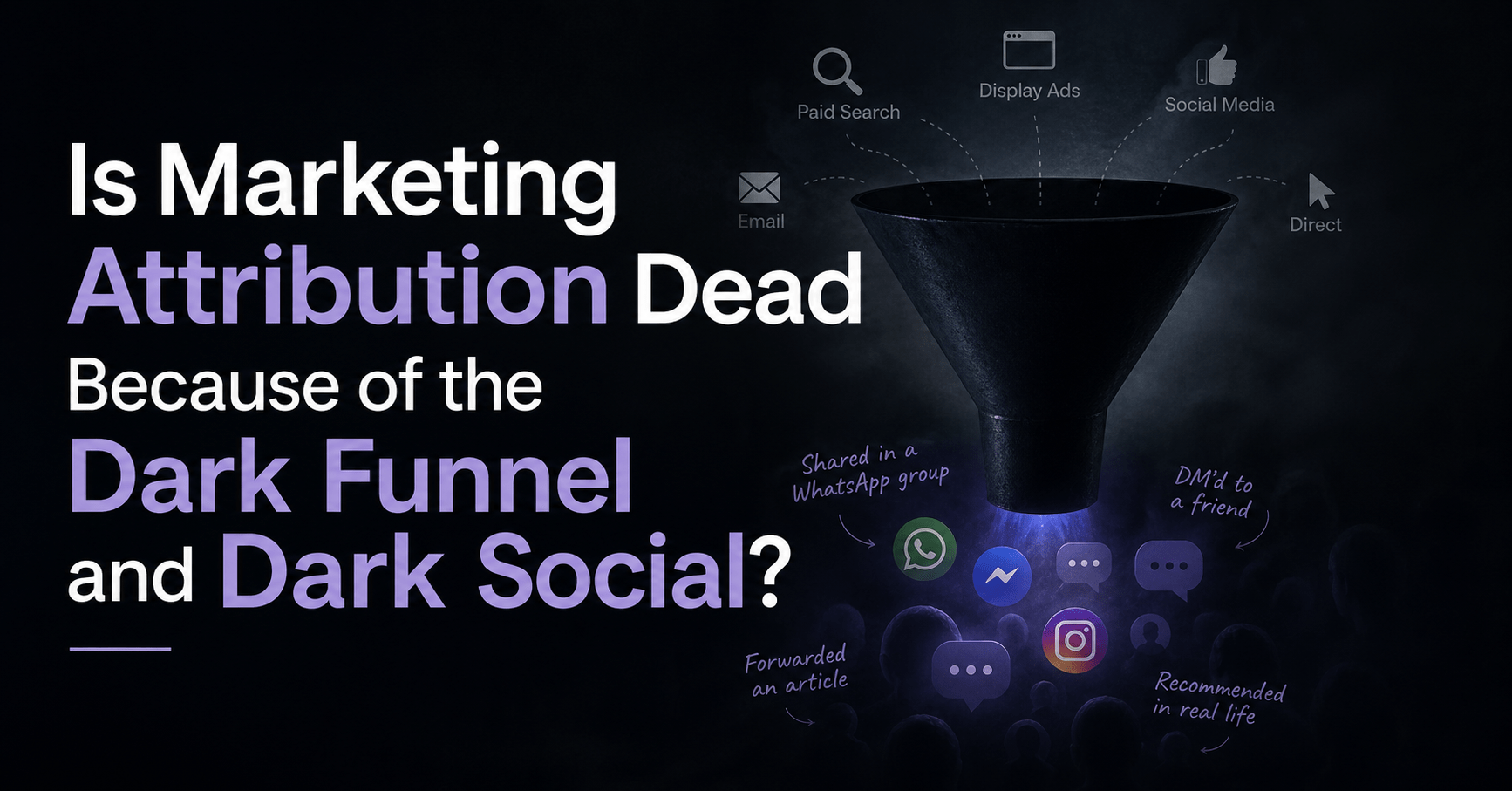
Marketing attribution is not dead, but single-source, deterministic attribution is. Marketing attribution is the practice of assigning revenue credit to the marketing touchpoints that influenced a purchase, and in B2B it now fails because 70% to 80% of the buying journey happens in dark funnel and dark social channels that analytics platforms cannot see. What replaces it is a layered approach combining account-level multi-touch attribution, self-reported attribution, signal correlation, and incrementality testing.
Key Facts at a Glance
- B2B buyers now complete 70% to 80% of their purchase journey before ever engaging with a sales representative, and 61% prefer a completely rep-free experience, according to Gartner 2025/2026 research cited by Similarweb.
- The average B2B buying journey has stretched to 272 days, up from 211 a year earlier, and now spans 88 touchpoints across 4 channels involving 10 stakeholders, per the Dreamdata LinkedIn Ads B2B Benchmarks Report 2026, built on more than 66 million sessions and 3.5 million customer journeys.
- 68% of B2B buyers already have a front-runner vendor in mind at the very start of the purchasing process, and that front-runner wins roughly 80% of the time, per Forrester’s Buyers’ Journey Survey, 2025.
- 100% of visits from TikTok, Slack, Discord, Mastodon, and WhatsApp arrive with no referral data at all and are recorded as direct traffic, along with 75% of Facebook Messenger visits, per SparkToro’s dark social referral research.
- Only 21% of B2B marketers say they can measure the ROI of their marketing with confidence, per the Demand Gen Report 2025 survey.
- 67% of B2B marketing teams still rely on last-touch attribution in 2026, despite buyers engaging with 27 or more touchpoints across 6 to 12 month sales cycles, per Visionary Marketing’s 2026 analysis.
- Self-reported attribution consistently reveals that 30% to 50% of pipeline originates from channels digital attribution cannot see, per ORM’s 2026 B2B SaaS attribution analysis.
This guide was written by Peter Geisheker, Founder and CEO of The Geisheker Group, Inc., a fractional CMO agency serving B2B, B2B SaaS, and investor-backed companies. Peter has spent more than 20 years in direct-response marketing and has managed over $50 million in advertising spend. He takes the attribution problem personally, for a specific reason. His last five inbound leads, which is his entire current pipeline, all came from prospects who first learned about him through an AI citation rather than through any click he could measure. Five is a small number and he does not present it as statistically meaningful. What makes it worth stating is that not one of the five arrived through a channel his analytics could see. The measurement gap this article describes is not theoretical to him; it is where his revenue comes from.
In this article
- Why the “attribution is dead” argument exploded in 2025 and 2026
- What the dark funnel and dark social actually are
- How much of the B2B buying journey is now invisible
- Why last-click attribution in 2026 is worse than no attribution
- A four-layer attribution stack
- Traditional vs. hybrid vs. signal-based measurement
- What B2B CEOs should hold marketing accountable for
- FAQs on dark funnel, self-reported attribution, and AI search
- How to build a dark-funnel-aware attribution system in 90 days
- Conclusion
Your attribution is showing you 20% of the buyer journey.
A fractional CMO can tell you which of your budget decisions are being made from data that cannot see the deal.
Why the “Attribution Is Dead” Argument Exploded in 2025 and 2026
The attribution debate did not start in 2025. B2B marketers have been arguing about last-click versus multi-touch since Google Analytics rolled out Universal Analytics more than a decade ago. What changed is the scale of the measurement gap. Three compounding forces hit B2B marketing all at once.
First, privacy infrastructure collapsed the tracking layer. GDPR, CCPA, iOS tracking restrictions, and the phased deprecation of third-party cookies systematically stripped away the observable signals that multi-touch attribution depends on. Second, buyer behavior migrated into private channels, including Slack communities, LinkedIn DMs, Reddit threads, WhatsApp groups, and peer networks, that no analytics tool can pixel. Third, generative AI inserted itself as a silent intermediary: buyers now ask ChatGPT, Perplexity, Gemini, and Claude for vendor recommendations before ever visiting a vendor’s website.
The cumulative effect is that a large majority of the B2B buying journey is now structurally invisible to traditional attribution. That is why January 2026 saw a wave of B2B marketing leaders, including Jeff Pedowitz at The Pedowitz Group, Chris Walker at Passetto, and analysts at 6sense, publishing “attribution is dead” manifestos. Pedowitz’s argument, published January 20, 2026, captures the consensus view: attribution tools have gotten better, but the problem has changed. We are trying to solve today’s challenges with yesterday’s tools, processes, and mindsets.
The buyer-side data has moved in the same direction, and fast. As of Q1 2026, Dreamdata’s benchmark analysis put the average B2B journey at 272 days, up from 211 the year before, across 88 touchpoints and 10 stakeholders. The journey did not just get harder to measure. It got longer, wider, and more crowded while the measurement tools stayed still.
What Is the Dark Funnel, and Why Did It Break Attribution?
The dark funnel is the portion of the B2B buyer journey that happens outside your trackable stack. It is a broader concept than dark social. Dark social is one component of it. The dark funnel includes:
- Private messaging channels (Slack, WhatsApp, LinkedIn DMs, Microsoft Teams threads)
- Invite-only communities (private Slack groups, Discord servers, industry associations)
- Third-party review platforms (G2, Capterra, TrustRadius) where visits do not pass referrer data
- Podcasts, YouTube, and audio content consumed without clicks
- AI assistants (ChatGPT, Perplexity, Gemini) that summarize vendors without requiring a visit
- Word-of-mouth conversations at conferences, dinners, and one-on-one meetings
- Internal stakeholder forwarding of your content via email, with UTM parameters stripped
The defining characteristic of every dark funnel channel is that it produces real influence over the buying decision but generates no measurable signal for your attribution software. When a procurement lead forwards your pricing comparison to a Slack channel and six executives read it on their phones, your analytics sees, at best, six “direct” traffic sessions with no referrer. The actual influence chain is invisible.
This is not a soft claim. SparkToro tested referral behavior across 11 social networks and 16 referral types and found that visits from TikTok, Slack, Discord, Mastodon, and WhatsApp arrived with no referral information whatsoever, every single time. Facebook Messenger stripped referral data on three quarters of visits. Even public LinkedIn posts lost 14% of their referral data, and Instagram DMs lost 30%. The traffic is real, the influence is real, and the record of where it came from simply does not exist.
Peter Geisheker points to his own LinkedIn account as a working example of how badly visibility and influence come apart. He has over 7,000 followers there, and the platform shows his posts to roughly 100 of them. A reach rate under 2% looks, on any dashboard, like a channel that does not work. It is not a content problem, and it is not evidence that the channel is dead. It is evidence that in-feed reach and actual influence are two different things. The posts still do their job when a CEO looks him up after a referral or a podcast appearance. That job never shows up in an impressions column.
The complete guide to the dark funnel in B2B buying walks through every specific channel in more depth. The short version: the dark funnel is not a gap in your data. It is where the majority of modern B2B buying actually occurs.
How Much of the B2B Buying Journey Is Actually Invisible?
The numbers are starker than most CMOs admit publicly. A few reference points from 2025 and 2026 research:
- Gartner 2025/2026 research, cited by Similarweb: 70% to 80% of the B2B purchase journey is now completed before any engagement with a sales representative, and 61% of buyers prefer a completely rep-free experience.
- Green Hat and 6sense APAC B2B Buyer Journey Research Report: B2B buyers spend approximately 73% of their buying journey researching anonymously before ever contacting a vendor.
- Gartner research cited in Medium analysis: 73% of B2B buyers report a significant portion of their decision-making happens entirely outside vendor touchpoints.
- Forrester’s Buyers’ Journey Survey, 2024: 41% of buyers have a single vendor in mind when they begin the purchase process, and 92% have already formed a shortlist. Forrester surveyed 11,352 buyers globally.
- Forrester 2024 data cited in Medium analysis: 89% of B2B buyers have adopted generative AI as a self-guided research tool, adoption running three times the consumer rate.
- Google October 2025 research: 60% of B2B buyers now use tools like ChatGPT or Gemini to augment vendor lists, summarize content, and surface competitors before any vendor contact.
Combine those numbers and the conclusion is unavoidable. Traditional attribution systems are tracking, at best, the final 20% to 30% of the buying journey. Whatever credit your dashboard assigns to paid search, retargeting, or the “final webinar” before conversion, the real influence was created weeks or months earlier in channels your software cannot see.
The Forrester finding deserves particular attention from anyone still buying late-funnel media. As of its 2025 survey wave, 68% of buyers enter the process with a front-runner already in mind, and that front-runner wins about 80% of the time. If the race is largely decided before the buyer is measurable, then attribution is not merely incomplete. It is measuring the wrong stage entirely.
Rebuilding measurement is a leadership job, not a software purchase.
The Geisheker Group installs layered attribution that produces budget decisions your CFO will actually accept.
Why Last-Click Attribution in 2026 Is Worse Than No Attribution
Here is where the “attribution is dead” argument has its sharpest edge. Visionary Marketing’s March 2026 analysis found that 67% of B2B marketing teams still rely on last-touch attribution. Combined with the Forrester benchmark of 27 or more touchpoints across 6 to 12 month sales cycles, single-touch attribution credits 1 out of 7 touches on average, leaving 86% of the journey with zero credit.
The problem is not just that last-click is incomplete. It is that last-click produces actively wrong budget decisions. When last-click shows branded search or direct traffic driving the majority of your pipeline, the intuitive response is to cut content, thought leadership, and brand-building spend. That cut destroys the top-of-funnel demand creation that produced the branded search in the first place. Six months later, pipeline collapses and no one can explain why.
There is a second failure mode that gets far less attention, and in Peter Geisheker’s experience it is the more common one. Broken conversion tracking does not just distort your reporting. It corrupts your media buying.
“If your conversion tracking is broken, your cost per lead is fiction and your CAC is fiction,” Geisheker says. “And it gets worse, because the platforms learn from the data you send them. Feed Meta and Google bad conversion data and their algorithms get very good at finding you the wrong people. You are not flying blind. You are paying an algorithm to fly you into a wall, confidently, at scale.”
This is the first thing he audits when taking over a B2B ad account, and after generic brand creative it is the failure he finds most often. It is worth being precise about the limit of the point: tracking can be technically correct and still measure the wrong action. A pixel firing reliably on a low-value event is not much better than no pixel at all. Correct firing is necessary, not sufficient.
This is the scenario Pedowitz describes as attribution’s “false sense of security.” The model gives you numbers. The numbers feel authoritative. But if the model is not tracking 70% to 80% of the actual buyers influencing the deal, extrapolating those numbers to budget decisions is worse than guessing, because guessing at least invites humility.
A Four-Layer Attribution Stack: What Replaces the Broken Model
The solution is not to abandon attribution. It is to rebuild it as a layered system in which no single layer is expected to carry the full measurement burden.
The approach below is one Peter Geisheker recommends rather than one he invented. It assembles four established measurement methods, each of them well documented in the attribution literature, into a single stack, and the value is in the combination rather than in any individual layer. Each layer handles a specific blind spot the other layers cannot.
Layer 1: Deterministic attribution, the “what we can see” layer. This is traditional multi-touch attribution (MTA) configured at the account level, not the contact level. Credit is distributed across first-touch, lead-creation, and opportunity-creation events using a W-shaped model, and the mechanics of choosing and configuring that model are covered in detail in this guide to building a B2B lead attribution model. Platforms like Dreamdata, HockeyStack, and HubSpot’s native reporting handle this well for mid-market. The key discipline is that this layer is expected to capture only the 20% to 30% of the journey that actually passes through trackable channels, and no more.
Layer 2: Self-reported attribution, the dark funnel visibility layer. Every high-intent conversion form must include a required open-text field asking “How did you first hear about us?” This is the only tool in the stack that can surface dark social touchpoints, including podcast mentions, Slack recommendations, AI assistant references, and peer referrals, that no cookie or pixel captures. ORM’s research shows that self-reported attribution consistently reveals 30% to 50% of pipeline originates from channels digital attribution cannot track. It is the practical operationalization of dark funnel visibility.
Layer 3: Signal correlation, the leading indicator layer. Rather than trying to attribute past conversions, this layer tracks leading indicators that correlate with future pipeline. Direct traffic growth, branded search volume, G2 and Capterra profile views, LinkedIn engagement on executive posts, podcast mentions, and AI assistant brand visibility are all signals that cannot be directly attributed but can be monitored as pipeline leading indicators. When these signals rise, pipeline rises 30 to 90 days later, without any single source getting “credit.”
Layer 4: Incrementality testing, the causal proof layer. The only way to establish causation in modern B2B attribution is controlled experimentation. Hold back a paid channel from a subset of target accounts for 60 to 90 days. Compare conversion rates. The difference is true incremental lift; not correlation, not credit assignment, but actual causal impact. ORM’s attribution research treats incrementality testing as the gold standard of modern measurement because it is the only method immune to dark funnel blindness.
The layers work together. No single layer is accurate alone. Together, they produce decisions. That is the operative difference between attribution theater and attribution that drives revenue.


Not sure what is working? Get a free written plan
30 minutes with both of us. No hard sell. Written plan in 3 business days.
Comparison: Traditional Attribution vs. Hybrid Attribution vs. Signal-Based Measurement
| Dimension | Traditional Attribution (2015-2020 model) | Hybrid Attribution (four-layer) | Pure Signal-Based |
|---|---|---|---|
| Primary input | Click and form data | Click data, self-reported, correlated signals, holdout tests | Direct traffic, brand search, third-party mentions |
| Credit assignment | Assigned to specific touchpoints | Assigned where provable; correlated elsewhere | Not assigned; trends monitored |
| Dark funnel visibility | Near zero | 30% to 50% of pipeline uncovered | Inferred only |
| Time to actionable insight | 30 to 90 days | 30 to 60 days (hybrid data) | Immediate, but correlative |
| Suited for | Pre-2020 B2C or high-volume transactional B2B | Modern B2B, B2B SaaS, mid-market | Companies with strong brand signal infrastructure |
| CFO defensibility | High in appearance, low in reality | Moderate, honest, defensible | Low without incrementality tests |
| Biggest risk | False precision; wrong budget decisions | Complexity; requires fractional CMO or RevOps ownership | Cannot prove causation |
| Recommended for | Nothing in modern B2B | Default recommendation for B2B $5M to $500M | Supplement, not standalone |
The honest answer for most B2B companies at $5M to $500M in revenue is that the hybrid stack is the only approach that produces both actionable budget decisions and honest conversations with the CFO. Pure signal-based measurement is elegant in theory but fails the moment a CFO asks which program to cut. Traditional attribution is defensible in appearance but produces decisions built on 20% of the buyer journey.
What B2B CEOs Should Hold Marketing Accountable For Instead
This is where the “attribution is dead” debate connects to the larger sales and marketing alignment problem. If attribution cannot prove marketing’s revenue contribution at the touchpoint level, what should marketing be accountable for?
The right answer is a small number of integrated outcomes, not a long list of activity metrics. At The Geisheker Group, Peter Geisheker anchors every engagement against four revenue-integrated KPIs:
- Sales-qualified lead (SQL) volume and conversion. SQLs, not MQLs, are the unit of pipeline accountability that survives dark funnel blindness. MQLs can be inflated with content downloads from the invisible portion of the funnel. SQLs cannot. This is the argument developed in full in why B2B marketing should shift to SQL as its primary KPI.
- Pipeline sourced plus pipeline influenced. Sourced pipeline is what marketing directly generated. Influenced pipeline is every deal that had at least one marketing touch. Industry benchmark: Stage 4 B2B marketing functions source 40% to 55% of pipeline, per Pedowitz Group’s 2026 benchmarks.
- Customer acquisition cost (CAC) and CAC payback period. Fully loaded cost per closed deal measured against average deal value, tracked monthly. This is the financial guardrail that disciplines all other spend decisions regardless of attribution model. It is also the metric fractional CMOs working with PE portfolio companies are typically hired to move first.
- Brand visibility in AI assistants (AXO). An emerging metric, answer engine visibility, that tracks how often your brand appears in ChatGPT, Perplexity, Gemini, and Claude responses for category-relevant queries. Industry average AXO score is 28; Stage 4 benchmark is 60 or above, per Pedowitz Group’s April 2026 analysis.
Attribution at the touchpoint level is broken. Revenue accountability at the outcome level is not. That is the reframe that survives the dark funnel.
FAQs on Marketing Attribution, Dark Funnel, and Dark Social
Is marketing attribution dead?
No. Marketing attribution as a single-source, deterministic methodology is dead, but attribution as a layered, hybrid practice is more important than ever. Dark funnel and dark social activity now represent 70% to 80% of the B2B buying journey, per Gartner 2025/2026 research. Last-click attribution cannot see that activity, so it systematically misallocates budget. The answer is a hybrid stack combining deterministic multi-touch attribution, self-reported attribution, signal correlation, and incrementality testing.
What percentage of the B2B buying journey is actually untrackable?
Between 70% and 80%, depending on industry and company size. Gartner 2025/2026 research found B2B buyers now complete 70% to 80% of their purchase journey before any sales engagement, with 61% preferring a rep-free experience. Green Hat and 6sense APAC research found buyers research anonymously for approximately 73% of the journey. The consistent conclusion across studies: the majority of influence happens in the dark.
What is the difference between the dark funnel and dark social?
Dark social is a subset of the dark funnel. Dark social refers specifically to content shared through private digital channels, including DMs, email forwards, and Slack threads, where referrer data is stripped and analytics records the traffic as “direct.” The dark funnel is a broader concept that includes dark social plus all other untrackable buying activity: offline word-of-mouth, review platform research, podcast influence, AI assistant recommendations, and industry community conversations.
How do you measure marketing attribution in the dark funnel?
Directly, you cannot. The dark funnel is defined by its invisibility to measurement tools. Indirectly, three methods work: self-reported attribution (a “How did you hear about us?” field on high-intent forms), signal correlation (tracking branded search, direct traffic, and third-party mention trends), and incrementality testing (controlled holdouts to measure causal lift). Together, these methods surface the 30% to 50% of pipeline influence that digital tools miss, per ORM’s 2026 B2B SaaS attribution analysis.
What is self-reported attribution and does it actually work?
Self-reported attribution is a measurement method that asks buyers directly “How did you hear about us?” at the point of high-intent conversion, such as a demo request, contact form, or sales meeting. It works, with caveats. The data is subject to recency bias and respondents sometimes give low-effort answers like “Google.” But ORM’s research finds that self-reported attribution consistently reveals 30% to 50% of pipeline originates from channels that digital attribution cannot see. It is the single most valuable tool in a modern attribution stack because it is the only input that surfaces dark funnel influence.
Is last-click attribution officially dead for B2B?
It should be. 67% of B2B marketing teams still rely on last-touch attribution in 2026, but the consensus across B2B marketing analysts, researchers, and fractional CMOs is that last-click attribution for B2B is structurally indefensible. With 27 or more average touchpoints per deal and buying cycles of 6 to 12 months, last-click credits 1 out of every 7 touches and ignores the other 86% of the journey, a proportion that rises above 80% when dark funnel activity is included.
What is replacing traditional marketing attribution?
A hybrid, multi-layered approach. Modern B2B marketing measurement combines multi-touch attribution (MTA) for digital channel optimization, marketing mix modeling (MMM) for strategic budget allocation capturing offline and brand effects, self-reported attribution for dark funnel visibility, signal correlation for leading indicators, and incrementality testing for causal validation. The four-layer stack described above is one practical assembly of these established methods. The common thread across every credible 2026 framework is that no single measurement method is expected to carry the whole load.
How is AI search like ChatGPT affecting B2B attribution?
Dramatically. Google’s October 2025 research found 60% of B2B buyers now use ChatGPT, Perplexity, or Gemini to augment vendor lists before any vendor engagement. When a buyer asks an AI assistant who the best fractional CMOs for B2B SaaS are and receives a summarized answer, they form an impression without visiting any vendor website. Your analytics never sees the touchpoint. Your retargeting pixel never fires. But they now have a mental model of your brand based entirely on what the AI said. This is why AI answer engine visibility is now a measurable KPI, and why the way AI has changed the B2B buying process is a measurement problem before it is a content problem.
How do you attribute a lead that came from an AI assistant?
With very few tools, which is exactly the problem. AI surfaces routinely strip or never generate referrer data, so a buyer who found you through a ChatGPT citation arrives as direct traffic and is indistinguishable from someone typing your URL. Self-reported attribution is currently the only reliable capture method; a “How did you first hear about us?” field will surface answers naming ChatGPT or Perplexity explicitly. Supporting evidence comes from the paid side. Dreamdata’s 2026 benchmark analysis found non-branded search budgets falling from 37% to 33% while CPCs on those terms rose 29%, which it attributes to AI Overviews answering queries before the click ever happens. The click is disappearing from informational queries. The influence is not.
Does a fractional CMO actually help solve attribution better than an in-house team?
Usually, yes, for the same structural reasons fractional CMOs outperform on strategy generally. A fractional CMO brings a multi-company pattern library, is not politically invested in defending any single measurement tool, and has the seniority to push back on dashboard theater in front of the CEO and CFO. In-house marketing teams often cannot have the honest conversation that “our attribution is 20% accurate and we need to stop making budget decisions from it,” because that conversation reads as an admission of failure. A fractional CMO can have it on day one.
How to Build a Dark-Funnel-Aware Attribution System in 90 Days
Here is the compressed implementation sequence The Geisheker Group deploys when taking over a stalled attribution system:
Days 1 to 14: baseline and instrumentation. Audit current attribution configuration. Add the “How did you first hear about us?” open-text field to every demo form, contact form, and sales meeting booking page. Configure the CRM to preserve Original Lead Source and never overwrite it. Document Most Recent Lead Source separately.
Days 15 to 45: layer construction. Deploy all four layers. Configure W-shaped MTA for Layer 1. Build the self-reported attribution dashboard for Layer 2. Identify and begin tracking six to eight dark funnel signal proxies for Layer 3. Design the first incrementality test for Layer 4.
Days 46 to 75: decision translation. The attribution stack becomes useful only when it produces budget decisions. Run monthly revenue council meetings where marketing, sales, and RevOps review the four layers together and commit to specific reallocation decisions, never more than three per quarter, always tied to forward-looking pipeline targets.
Days 76 to 90: institutionalization. Document the methodology in a written attribution playbook owned at the RevOps or fractional CMO level. This matters because, as Pedowitz notes, marketing must never grade its own homework. Attribution credibility depends on the separation of measurement from execution.
This is the operational core of what fractional CMO engagements at The Geisheker Group deliver. Not a new platform purchase. Not another dashboard. A disciplined, layered measurement practice that survives the dark funnel.
Conclusion: Attribution Is Not Dead. The Old Way of Doing It Is.
The “is marketing attribution dead?” question creates a false binary. The real story is more nuanced and more actionable. Traditional, single-source attribution, the last-click, cookie-based model that most B2B companies still quietly depend on, is structurally broken in a world where 70% to 80% of buying happens in channels that model cannot see. Continuing to make budget decisions from that model is not just incomplete; it is actively destructive.
But the response is not to abandon measurement. It is to rebuild it. A four-layer approach combining deterministic attribution, self-reported attribution, signal correlation, and incrementality testing replaces the broken single-source model with a hybrid practice that sees more of the real buying journey, produces honest conversations with CFOs, and drives actual revenue decisions. That is what modern attribution looks like in 2026. That is what survives the dark funnel.
If your B2B company is making budget decisions from last-click dashboards while the majority of your buyer journey happens in Slack, on LinkedIn, inside ChatGPT, and between peers at industry conferences, your attribution is not informing your strategy. It is misleading it.
Ready to see what your attribution actually shows, and what it is missing? Schedule a free 30-minute strategy call with Peter Geisheker to diagnose where your current attribution is breaking down and how a layered measurement stack could reframe your marketing spend decisions.
About Peter Geisheker
Peter Geisheker is the Founder and CEO of The Geisheker Group, Inc., a fractional CMO and B2B marketing advisory serving CEOs and investor-backed companies. He specializes in scalable, capital-efficient revenue systems across B2B SaaS, B2B services, and performance-driven environments, with AI embedded across all engagements. His work includes programs delivering 6X inbound lead growth, 100% year-over-year SaaS revenue growth for three consecutive years, and a 77% reduction in paid acquisition spend while growing revenue. Connect with Peter on LinkedIn.
Ready to explore how a fractional CMO can accelerate your growth? Schedule a free consultation with Peter.
References and Sources
- Pedowitz, Jeff. “The Death of Marketing Attribution (And What Replaces It).” The Pedowitz Group, January 20, 2026. https://www.pedowitzgroup.com/blog/the-death-of-marketing-attribution-and-what-replaces-it
- Pedowitz, Jeff. “Revenue Marketing Benchmarks for B2B: What Good Looks Like in 2026.” The Pedowitz Group, April 23, 2026. https://www.pedowitzgroup.com/blog/revenue-marketing-benchmarks-for-b2b-what-good-looks-like-in-2026
- Dreamdata. “Announcing the LinkedIn Ads 2026 Benchmarks Report.” March 2026. https://dreamdata.io/blog/announcing-linkedin-ads-benchmarks-report-2026
- Forrester. “Building Preference Is The Key To Winning B2B Buyers.” Forrester Blogs, 2026, citing Forrester’s Buyers’ Journey Survey, 2025. https://www.forrester.com/blogs/building-preference-is-the-key-to-winning-b2b-buyers/
- Forrester. “Why ‘Performance Marketing’ Falls Short.” Forrester Blogs, 2025, citing Forrester’s Buyers’ Journey Survey, 2024. https://www.forrester.com/blogs/why-performance-marketing-falls-short/
- Fishkin, Rand. “New Research: Dark Social Falsely Attributes Significant Percentages of Web Traffic as ‘Direct’.” SparkToro, April 2023. https://sparktoro.com/blog/new-research-dark-social-falsely-attributes-significant-percentages-of-web-traffic-as-direct/
- CMO Alliance. “What is Marketing Attribution? 2026 Guide and Resources.” March 4, 2026. https://www.cmoalliance.com/are-we-doing-b2b-marketing-attribution-all-wrong/
- Visionary Marketing. “B2B Marketing Attribution: Statistics, Models and Data (2026).” March 2026. https://visionary-marketing.co.uk/blog/b2b-marketing-attribution-data-2026
- Whitehat SEO. “Marketing Attribution That Actually Works.” February 17, 2026. https://whitehat-seo.co.uk/blog/marketing-attribution-that-works
- Braze. “Challenges of Marketing Attribution in 2026.” January 27, 2026. https://www.braze.com/resources/articles/challenges-of-marketing-attribution
- The B2B Stack. “The Reality of B2B Attribution in 2026: Why Certainty Is Dead and Signals Win.” February 11, 2026. https://www.theb2bstack.com/p/the-reality-of-b2b-attribution-in
- Conveyor Marketing Group. “A New Model to Solve B2B Marketing Attribution Challenges.” March 5, 2026. https://www.conveyormg.com/resources/blogs/solving-the-challenges-of-b2b-marketing-attribution
- ORM. “9 Best Marketing Attribution Software for B2B (2026).” April 2026. https://orm-tech.com/blog/best-marketing-attribution-software/
- ORM. “Marketing Attribution for B2B SaaS: Models, Methods, and What Actually Works.” March 14, 2026. https://orm-tech.com/blog/marketing-attribution-guide/
- Similarweb. “B2B Dark Funnel: Surface Invisible Buyers In 2026.” March 5, 2026. https://www.similarweb.com/blog/marketing/marketing-strategy/dark-funnel-b2b/
- Phoenix, Sterling. “The Dark Funnel Is Not a Measurement Problem. It Is a Buying-System Shift.” Medium, January 2026. https://medium.com/@IamSterlingP/the-dark-funnel-is-not-a-measurement-problem-it-is-a-buying-system-shift-ed03081327d3
- Column Five Media. “The Dark Funnel: Why You’re Missing 73% of Your Buyer’s Journey.” February 20, 2025. https://www.columnfivemedia.com/the-dark-funnel-why-youre-missing-73-of-your-buyers-journey/
- HockeyStack. “B2B Dark Funnel: What Is It and How to Track It.” October 2, 2025. https://www.hockeystack.com/blog-posts/b2b-dark-funnel
- Leadpipe. “What Is Marketing Attribution? Models Explained.” January 21, 2026. https://leadpipe.com/blog/glossary-marketing-attribution/
- Blend B2B. “Self-reported attribution: what it is and why you need it.” May 23, 2025. https://www.blendb2b.com/blog/self-reported-attribution
Free Written Growth Plan
Not sure which of your marketing is actually working?
Give us 30 minutes. We will find where your pipeline is leaking and send you a written plan with the three fixes we would test first. Free, no obligation.
No hard sell on the call. Your plan arrives within 3 business days. See a sample plan