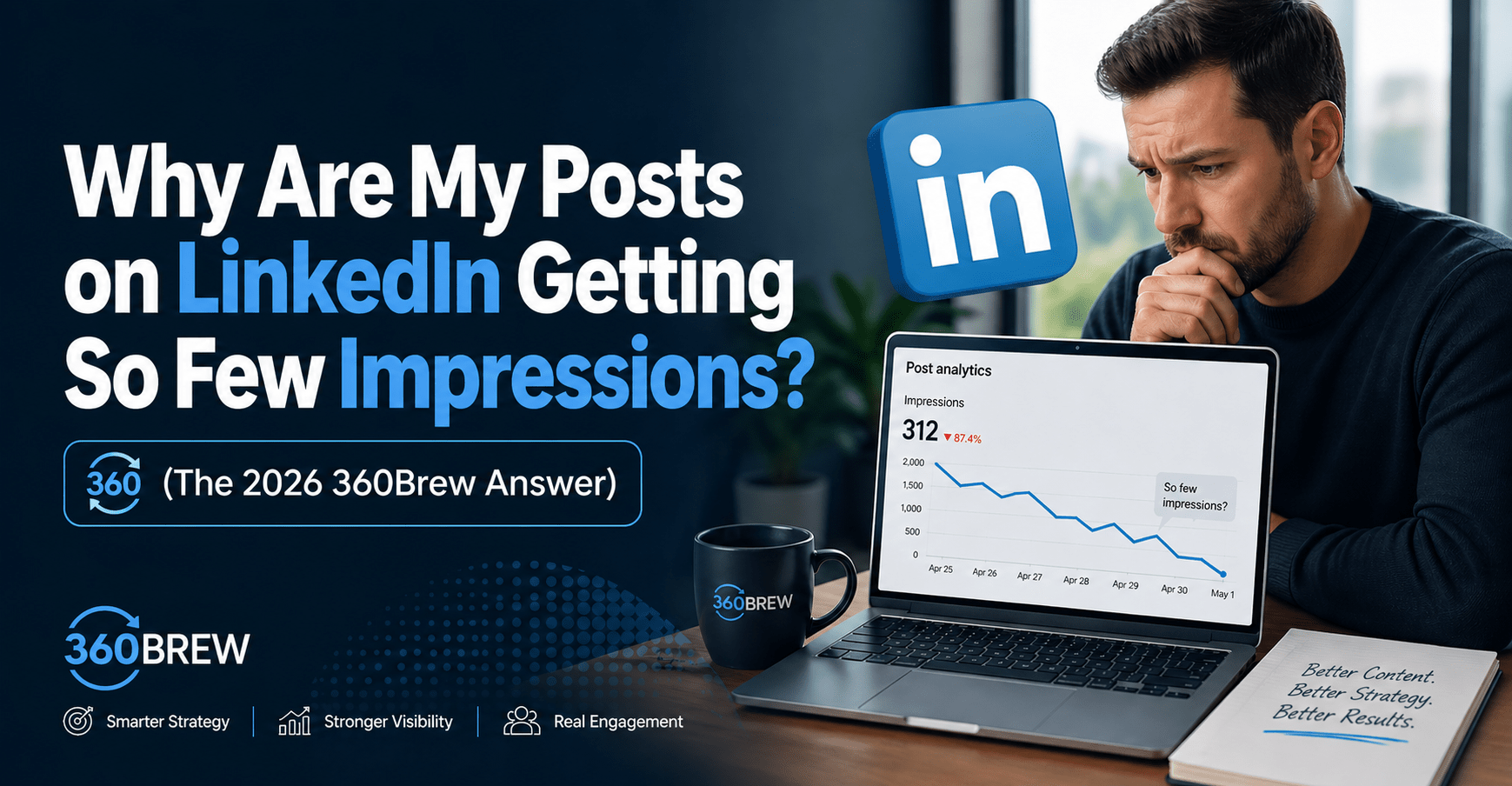
LinkedIn posts get so few impressions in 2026 because the platform replaced its old engagement-based ranking system with 360Brew, a 150-billion-parameter AI model that reads your content semantically and matches it to specific professional audiences. Organic reach is down roughly 50% year over year, company pages have lost 60–66% of their reach, and the top 1% of creators now capture most of the 9 billion weekly impressions LinkedIn generates.
Key Facts at a Glance
- Only about 1% of LinkedIn’s 1 billion+ users share content weekly, and those creators generate approximately 9 billion impressions every week — meaning most impressions are concentrated in a small sliver of active publishers (Kinsta LinkedIn Statistics).
- Organic views are down roughly 50%, engagement is down 25%, and follower growth is down 59% year over year across 1.8 million posts analyzed by LinkedIn expert Richard van der Blom in the Algorithm InSights 2025 Report (Agorapulse summary of Richard van der Blom’s Algorithm InSights 2025).
- Company page organic reach dropped 60–66% between 2024 and 2026, while personal profiles now generate up to 561% more reach than company pages sharing identical content (Ordinal’s LinkedIn reach analysis).
- LinkedIn’s 360Brew ranking model is a decoder-only foundation system with roughly 150 billion parameters, built by LinkedIn’s Foundation AI Technologies team, that evaluates professional content semantically rather than by engagement velocity alone (pettauer.net 360Brew technical breakdown).
- A post save carries roughly 5 to 10 times the algorithmic weight of a like under 360Brew, and saved posts create a 130% higher likelihood of earning a new follower (upGrowth 360Brew analysis).
- Native document (PDF carousel) posts average 7.00% engagement in 2026 — the highest of any format — while standard text posts average approximately 4.00% (Socialinsider LinkedIn Organic Benchmarks 2026, 1.3M posts).
- A LinkedIn impression is counted when your post appears on a screen for at least 300 milliseconds — so even “25 impressions” means only 25 people briefly saw it, not 25 people read it (post-bridge impressions guide).
If you are publishing thoughtful, useful, substantive content on LinkedIn and watching it disappear into the void while someone else’s cat meme racks up 4,200 impressions, your frustration is not misplaced. The game has changed beneath your feet. And the new game is not being decided by how good your content is — it is being decided by whether LinkedIn’s AI can confidently match your content to the right audience and whether that audience signals deep, time-consuming attention back to the platform.
This guide breaks down exactly why posts on LinkedIn are getting so few impressions in 2026, what the 360Brew algorithm actually measures, why a small group of creators capture the vast majority of reach, and the five-pillar methodology — The LinkedIn Signal-Earning Framework — that B2B professionals and CEOs can deploy to rebuild organic LinkedIn visibility without resorting to engagement pods, automation tricks, or content that drifts from their professional identity. Every tactic in this article is grounded in the platform’s own AI architecture and the most recent published research from Richard van der Blom, Socialinsider, AuthoredUp, and LinkedIn’s own engineering team.
In this article:
- Why LinkedIn impressions have collapsed in 2026
- How 360Brew actually decides who sees your content
- Why 1% of creators capture most of the reach
- The LinkedIn Signal-Earning Framework
- What signals now outweigh likes
- Which content formats get the most impressions
- Best times and posting frequency in 2026
- How to fix a post getting low impressions
- Old LinkedIn algorithm vs. 360Brew comparison
- When to rebuild your LinkedIn strategy entirely
- FAQs mirroring People Also Ask
Why Has My LinkedIn Reach Dropped So Much in 2026?
LinkedIn reach collapsed in 2026 because LinkedIn’s engineering team deployed a new AI ranking model called 360Brew, which fundamentally rewrote how content gets distributed. Overall reach is down approximately 50% year over year, with some segments seeing drops of 60 to 80%.
This is not a temporary algorithm fluctuation that will reverse. It is a structural realignment of the entire platform. Richard van der Blom’s analysis of 1.8 million LinkedIn posts in the Algorithm InSights 2025 Report documents a 50% drop in views, a 25% drop in engagement, and a 59% drop in follower growth compared to the prior year. Separate analysis from AuthoredUp across more than 3 million posts found median reach dropped 47% year over year, with video content down 72% and text posts down 34%.
The collapse falls unevenly. Creators who kept posting exactly the same content they published in 2023 saw the most severe drops, because their content was optimized for an older algorithm that rewarded engagement velocity — how fast a post accumulated likes and comments in the first hour. The new system does not care about velocity anywhere near as much. It cares about semantic relevance, dwell time, saves, meaningful conversation, and whether your content matches a user’s demonstrated professional interests.
How Does LinkedIn’s 360Brew Algorithm Actually Decide Who Sees Your Posts?
360Brew decides who sees your posts by reading your content semantically and matching it to users whose professional interests align — not by counting fast likes and distributing to random connections.
LinkedIn’s Foundation AI Technologies (FAIT) team published a research paper on arXiv describing 360Brew as a decoder-only transformer model with roughly 150 billion parameters, trained on LinkedIn’s proprietary Economic Graph data. In plain English: 360Brew is a large language model, built on architecture similar to GPT-4 or Claude, that has been fine-tuned specifically for ranking professional content.
This matters because the old LinkedIn algorithm was a collection of narrow, specialized models — one for feed ranking, one for search, one for job suggestions, one for people you may know. Practitioners could reverse-engineer those systems because each one followed simple numerical rules, like “posts with more than 10 comments in 60 minutes get boosted.” That’s why engagement pods, “bro-etry” line spacing, and tag-baiting worked for years.
360Brew consolidated all of those fragmented systems into one unified reasoning engine. The model evaluates five core inputs together: content depth, professional relevance to the target viewer, profile expertise signals, engagement quality, and audience interest alignment. If your headline says “VP of Marketing at a B2B SaaS company” but your posts are about cryptocurrency, 360Brew registers a mismatch and throttles distribution. If your profile says “RevOps Director” and you post a detailed analysis of Salesforce integration, the model assigns higher confidence and expands your reach beyond your immediate network.
Why Do Some Creators Get 100,000+ Impressions While I Get 25?
A small minority of LinkedIn creators capture most of the impressions because approximately 1% of the platform’s 1+ billion members share content weekly, and those creators generate the roughly 9 billion weekly impressions that LinkedIn content produces. The supply-demand imbalance is extreme.
There are about 1 billion LinkedIn members globally. At any given time, only around 3 million members post content weekly. That 1% minority is competing for the same finite feed space as you, but they have three structural advantages the casual poster does not: they have built topic authority that 360Brew recognizes over months of consistent posting, they have accumulated engaged followers who trigger the early-hour signals the algorithm still uses as a quality check, and they have developed content formats the algorithm actively rewards (carousels, documents, conversation-sparking text posts).
Additional data from van der Blom’s Algorithm InSights report puts it in sharper relief: the typical LinkedIn feed breaks down to roughly 31% top creator content, 28% promoted company content, 28% other creator content, 11% LinkedIn ads, and just 2% organic company page content. Personal profiles absorb most of the organic real estate. Company pages are essentially invisible without employee amplification. And within personal profiles, topic-focused creators with aligned profiles dominate the available slots.
This is not a fair distribution system. It is a reputation-weighted distribution system that compounds over time. The creators pulling 100,000+ impressions per post are not winning because they got lucky — they are winning because they have accumulated the exact signals 360Brew was designed to reward.
What Is The LinkedIn Signal-Earning Framework?
The LinkedIn Signal-Earning Framework is a five-pillar methodology designed specifically for B2B professionals, founders, and CEOs who need to rebuild organic LinkedIn visibility under the 360Brew algorithm. Each pillar targets a specific signal that 360Brew measures and rewards.
Pillar 1 — Profile-Content Alignment. Your LinkedIn headline, About section, skills, and work experience must telegraph the same topic that your content addresses. 360Brew performs what practitioners call a “profile-content audition,” cross-referencing what you post against your profile. Generic or mismatched profiles get downweighted. If you are a Fractional CMO writing about demand generation, your headline should include “Fractional CMO” and “demand generation” explicitly. This is the foundation of every other pillar.
Pillar 2 — Save-Worthy Substance. Saves are the top signal in the 360Brew era, carrying 5 to 10 times the algorithmic weight of a like. Your content must be genuinely useful enough that someone wants to bookmark and return to it. Frameworks, checklists, data breakdowns, step-by-step processes, and contrarian takes backed by experience all earn saves. Motivational quotes and generic “I just shipped a project” updates do not.
Pillar 3 — Conversation Architecture. Meaningful comments of 15 or more words are the second-strongest signal 360Brew tracks. Posts that generate reply threads between commenters — not just reactions to you, but back-and-forth between people in your network — amplify reach disproportionately. Structure your posts to provoke substantive disagreement, specialized debate, or genuine curiosity, not “What do you think?” engagement bait.
Pillar 4 — Topic Consistency Discipline. 360Brew builds topic authority by observing your post within one professional lane for at least 60 days. A creator who publishes consistently on B2B SaaS go-to-market strategy will see their content routed to relevant non-followers far more reliably than a creator who posts on SaaS one week, leadership the next, and personal development the third. Scattered content destroys topic authority.
Pillar 5 — Golden Hour Defense. The first 60 to 90 minutes after publication still matter because that window is how 360Brew confirms its initial audience match. Reply to every early comment within 15 minutes, and those replies should be 2 to 3 sentences that invite further discussion. Author replies drive dwell time and signal conversation depth, which unlocks second-degree and third-degree amplification.
Creators who deploy all five pillars simultaneously consistently outperform those optimizing on any single pillar alone. The framework is additive — each pillar reinforces the others.
How Do Saves and Meaningful Comments Outweigh Likes?
Saves and meaningful comments outweigh likes because 360Brew evaluates content quality through depth of engagement, not volume. A like is a passive, low-friction action that takes half a second. A save is a deliberate high-intent signal that says, “This content is useful enough that I want to reference it later.”
AuthoredUp’s research quantifies the disparity: one save drives roughly five times more reach than one like, and one save boosts reach about twice as much as a meaningful comment. More strikingly, a saved post produces a 130% higher chance that the reader follows you. Creators whose posts consistently earn saves grow their audience about three times faster than creators relying on likes alone.
Meaningful comments operate on a similar logic. A one-word comment like “great post” carries almost no weight. A comment of 10 or more words that adds perspective, asks a substantive question, or disagrees with a specific point carries roughly 15 times the algorithmic weight of a like, according to several practitioner analyses. Comments that trigger reply threads between other commenters — indirect engagement — compound the effect further.
What Content Formats Get the Most LinkedIn Impressions in 2026?
Native document posts (PDF carousels) generate the highest engagement of any LinkedIn format in 2026 — averaging 7.00% engagement across 1.3 million posts analyzed by Socialinsider — because they force 15 to 20 seconds of dwell time as users swipe through slides.
Text posts remain essential for B2B thought leadership, but have a lower ceiling reach. The current sweet spot is 1,200 to 1,800 characters — long enough to develop a complete thought, short enough to avoid reader drop-off. Pure text with no external links (links still suppress reach by 20 to 30%) formatted with line breaks every 2 to 3 sentences works best. Opinion pieces, case breakdowns, and contrarian takes perform strongest within the text format.
Polls achieve roughly a 1.64x reach multiplier on personal profiles, the highest of any format for pure reach. Their engagement rate has doubled since 2023. For pages with more than 50,000 followers, polls become the top format for impressions.
Video continues to grow. LinkedIn video impressions rose 73.39% and video views rose 52.17% between 2024 and 2025, growing much faster than the number of videos being uploaded. When distribution outpaces supply, the algorithm is rewarding the format. Short-form video under 30 seconds for awareness-stage content is hitting roughly 200% higher completion rates than longer-form video.
Single-image posts underperform text-only content by roughly 30% in the 2026 algorithm, reversing patterns from 2024 and 2025. If you are using a single stock photo to decorate a text post, you are likely suppressing your own reach.
Comparison Table: Old LinkedIn Algorithm vs. 360Brew (2026)
The difference between the pre-2025 LinkedIn algorithm and the 360Brew system is not a tune-up. It is a complete rewrite. This table lays out the most strategically important changes for anyone trying to understand why posts on LinkedIn are getting so few impressions.
| Dimension | Old Algorithm (Pre-2025) | 360Brew (2026) |
|---|---|---|
| Core ranking logic | Engagement velocity — how fast likes and comments accumulated in first 60 minutes | Semantic relevance — whether content matches each viewer’s professional interests |
| Top engagement signal | Likes and comment volume | Saves (5–10x weight of like) and meaningful comments (15x weight) |
| Format preference | Text posts with line-break formatting (“bro-etry”), external links penalized | Native documents/carousels (7.00% engagement), video growing fast, polls for reach |
| Personal vs. company | Roughly similar distribution between personal profiles and company pages | Personal profiles get ~561% more reach than company pages on same content |
| Profile relevance | Minimal weight — profile treated separately from posts | Critical — 360Brew cross-references posts against profile for topic authority |
| Hashtag weight | Meaningful discovery signal, 3–5 hashtags standard | Largely irrelevant, 10+ hashtags pattern-matched as spam |
| Engagement pods | Worked but risky | Detected with ~97% accuracy, trigger severe reach suppression |
| Posting frequency | More frequent = more reach, up to daily | 2–5 posts/week optimal; daily cannibalizes previous post reach |
| Topic consistency | Low weight — creators could post across topics | High weight — 60+ days in one lane required for topic authority |
| Link handling | External links heavily penalized | External links suppress reach ~20–30%, slightly softened from prior years |
| Reach decay | Post dies after 24 hours | 360Brew re-surfaces older posts in “Suggested for you” based on new topic-matched engagement |
Data in this table is synthesized from van der Blom’s Algorithm InSights 2025 Report, AuthoredUp’s dataset of 3M+ posts, Socialinsider’s 1.3M post benchmark, and LinkedIn’s FAIT team publication on arXiv.
When Is the Best Time to Post on LinkedIn in 2026?
The best times to post on LinkedIn in 2026 are Tuesday through Thursday between 10 a.m. and 2 p.m. in your audience’s local time zone, with Wednesday morning consistently delivering the highest engagement rates across every major study.
Buffer’s analysis of 4.8 million posts in 2026 added a notable shift: late afternoon and evening slots between 3 p.m. and 8 p.m. on weekdays are now outperforming morning slots in some segments, as professionals increasingly engage with LinkedIn content during their commute home or while unwinding after work. Friday engagement drops off sharply after mid-morning, and weekend posts typically see 30 to 40% lower reach than weekday posts.
Frequency matters more than exact timing. Analysis of more than two million LinkedIn posts confirms the optimal cadence is 2 to 5 posts per week, with 3 to 4 posts per week delivering the best combination of reach and lead quality. Posting more than once per day cannibalizes reach — your second post interrupts the algorithmic distribution of your first. Space posts at least 18 to 24 hours apart.
How Do You Fix a LinkedIn Post Getting Low Impressions?
Fixing a LinkedIn post getting low impressions requires diagnosing which specific quality or relevance test your content is failing, then correcting the underlying signal rather than reposting the same content at a different time.
Start with the hook. LinkedIn truncates your post after two or three lines with a “See more” prompt, and everything before that cutoff determines whether anyone reads the rest. Delete phrases like “I’m excited to share…” or “In today’s world…” Replace them with a contrarian claim, a specific number, or a question. A post with 1,000 impressions and a strong hook will outperform a post with 10,000 impressions and a weak hook.
Audit your profile against your content. If your headline and About section do not align with what you post about, 360Brew is suppressing your reach before the post ever reaches meaningful distribution. Update your headline to include your core topic in plain language.
Remove external links from the body of the post. If a link is necessary, place it in the first comment instead. External links still suppress reach by roughly 20 to 30% in the body of a post.
Audit posting frequency. If you have been posting daily, cut back to 3 to 4 times per week. If you have been posting once every two weeks, increase to at least 2 times per week. Below 1 post per week, LinkedIn deprioritizes your content distribution significantly.
Build in a Golden Hour engagement plan. Reply to every comment within 15 minutes for the first hour after publishing. Tag your replies as 2 to 3 sentence responses that invite further discussion, not single-word thanks. This is one of the easiest signals to control and one of the most underutilized. For B2B companies struggling broadly across their marketing, a structured B2B marketing audit often uncovers that LinkedIn is symptomatic of a deeper strategy problem, not the root cause.
When Should You Rebuild Your LinkedIn Strategy From Scratch?
You should rebuild your LinkedIn strategy from scratch when three conditions are true simultaneously: your impressions have dropped more than 50% from your trailing six-month average, your best-performing posts are not attracting followers in your ideal customer profile, and you cannot name the one professional topic you are known for.
The first test is quantitative. Pull your LinkedIn analytics and compare the last 30 days to the 6-month trailing average. A drop of 50% or more that persists across multiple posts indicates a systemic issue rather than a bad-post week. The most common systemic issues are profile-content misalignment and posting across too many topics.
The second test is qualitative. Even if your impressions are healthy, they are worthless if the audience is wrong. 800 impressions from CEOs at your target account list is more valuable than 8,000 impressions from unrelated professionals who will never buy. Review who is actually engaging with your content. If the pattern does not match your ICP, the algorithm is routing your content to the wrong interest graph.
The third test is the hardest. Ask yourself: “What is the one topic I am known for on LinkedIn?” If you cannot answer that in a single sentence, 360Brew cannot classify you either. You need to pick a lane and stay in it for at least 60 days. The best B2B lane is usually adjacent to what you sell — demand generation, revenue operations, pricing strategy, buyer behavior — rather than the sale itself.
This is where strategic marketing leadership becomes essential. Diagnosing which of the three tests you are failing, and designing the 90-day rebuild that corrects it, requires senior-level thinking about audience, positioning, and content architecture. It is exactly the work Fractional CMO services are designed to handle for B2B companies and founders who need the strategy without the cost of a full-time marketing executive.
Frequently Asked Questions
Why are my posts on LinkedIn getting so few impressions?
Your LinkedIn posts are getting few impressions in 2026 because LinkedIn replaced its prior ranking system with 360Brew, a large foundation model that evaluates semantic relevance, profile-content alignment, saves, dwell time, and meaningful comments rather than simple engagement velocity. Organic reach is down approximately 50% year over year across the platform, and distribution has consolidated toward creators with strong topic authority, aligned profiles, and save-worthy content (Richard van der Blom Algorithm InSights 2025, via Agorapulse).
Why has my LinkedIn reach dropped so much?
LinkedIn reach dropped because of the 360Brew algorithm deployment throughout 2025 and early 2026, which restructured distribution around semantic relevance to individual professional interests. Views are down about 50%, engagement is down 25%, and follower growth is down 59% according to an analysis of 1.8 million posts in the Algorithm InSights 2025 Report. Company pages specifically lost 60 to 66% of their reach, shifting most organic opportunity to personal profiles.
How do I increase my LinkedIn impressions?
Increase LinkedIn impressions by aligning your profile with a single professional topic, creating save-worthy content in native document or long-form text formats, engaging within the first 60 minutes to trigger algorithmic amplification, and posting consistently 3 to 4 times per week. Prioritize signals that 360Brew weights heavily — saves, meaningful comments of 15+ words, and dwell time — over vanity metrics like likes (AuthoredUp 360Brew analysis).
What is a good number of impressions on LinkedIn?
A good number of LinkedIn impressions depends on your follower count and goal, but a healthy baseline is impressions equal to roughly 10 to 20% of your total followers per post. For a creator with 2,000 followers, that means 200 to 400 impressions is typical and 1,000+ is strong. Pay more attention to whether those impressions are reaching the right audience than to raw volume.
Why do some LinkedIn creators get so many more impressions than others?
Some LinkedIn creators get massive impressions because they have accumulated three compounding advantages under 360Brew: topic authority built from 60+ days of consistent posting in one lane, high-save content formats like carousels and frameworks that the algorithm actively rewards, and aligned profiles that let the AI confidently route their content to relevant non-followers. Roughly 1% of LinkedIn’s 1+ billion members publish weekly, and that 1% captures most of the 9 billion weekly impressions the platform generates (Kinsta LinkedIn statistics).
Does posting more frequently increase LinkedIn impressions?
Posting more frequently does not increase LinkedIn impressions past a certain point. Data from more than two million posts shows that 2 to 5 posts per week is the optimal range, with 3 to 4 posts per week generating the best combination of reach and engagement. Posting more than once per day actually cannibalizes your own reach, because LinkedIn’s algorithm suppresses your newer post while the previous one is still in distribution (ConnectSafely posting frequency guide 2026).
Does LinkedIn shadowban accounts with low impressions?
LinkedIn does not typically shadowban accounts in the sense that exists on other platforms. Real LinkedIn restrictions are tied to specific policy violations — using automation tools, scraping, coordinated engagement pods, or identity issues. Sudden impression drops of 10x or more usually stem from removable causes: external links in post bodies, editing a post in the first hour after publishing, tagging 5+ accounts, or recent automation use.
How does the LinkedIn algorithm work in 2026?
The LinkedIn algorithm in 2026 works through 360Brew, a decoder-only foundation model of roughly 150 billion parameters that evaluates each piece of content semantically against each viewer’s professional interests. It weighs saves, meaningful comments, dwell time, and profile-content alignment far above likes and hashtags. Distribution happens in waves: an initial test to 2 to 5% of your network, expansion based on early quality signals, and re-surfacing of older posts in “Suggested for you” feeds when new topic-matched engagement signals arrive (pettauer.net 360Brew breakdown).
How do I know if my LinkedIn account is being suppressed?
You can usually tell your LinkedIn account is being algorithmically suppressed if your impressions drop more than 50% from your trailing 6-month average across multiple consecutive posts, your content fails to reach your existing followers at expected rates, and your engagement rate collapses along with the impression drop. Walk through the diagnostic checklist: recent external links in post bodies, edits within the first hour after publishing, tagging 5+ accounts, automation tool usage, or rapid profile changes. Real shadowbans are rare and almost always tied to specific spam or policy triggers.
Conclusion
LinkedIn impressions have collapsed for most creators because the platform’s underlying ranking logic has changed from an engagement-velocity system to a semantic-relevance system powered by 360Brew, a 150-billion-parameter AI foundation model that evaluates whether your content genuinely matches each viewer’s professional interests. Organic reach is down roughly 50% platform-wide, company pages have lost 60 to 66% of their distribution, and the top 1% of creators who publish weekly capture the vast majority of the 9 billion weekly impressions LinkedIn generates.
The answer to getting more LinkedIn impressions in 2026 is not posting more often, gaming engagement pods, or hunting for algorithm hacks. It is deploying a disciplined, signal-earning methodology — The Geisheker LinkedIn Signal-Earning Framework™ — that systematically builds profile-content alignment, save-worthy substance, conversation architecture, topic consistency, and Golden Hour defense. Every pillar targets a signal that 360Brew was specifically designed to weight heavily, and every pillar compounds the others.
For B2B companies, founders, and CEOs, LinkedIn is still the single highest-leverage organic channel for reaching decision-makers — but only when the content and profile strategy match how the platform actually distributes content in 2026. If your LinkedIn presence feels like shouting into a void despite genuinely useful content, the problem is almost never the content itself. It is the signal architecture around the content.
If you want expert guidance designing a LinkedIn content strategy that earns the signals 360Brew rewards — or a broader B2B marketing strategy that integrates LinkedIn with SEO, email, and paid channels — schedule a free consultation with The Geisheker Group.
About Peter Geisheker
Peter Geisheker is the Founder and CEO of The Geisheker Group, Inc., a Fractional CMO and B2B marketing advisory serving CEOs and investor-backed companies. He specializes in scalable, capital-efficient revenue systems across B2B SaaS, B2B services, and performance-driven environments, with AI embedded across all engagements. His work includes programs delivering 6X inbound lead growth, 100% YoY SaaS revenue growth for three consecutive years, and a 77% reduction in paid acquisition spend while growing revenue.
Ready to explore how a Fractional CMO can accelerate your growth? Schedule a free consultation with Peter.
References and Sources
- Agorapulse — LinkedIn Algorithm 2026: What Has Changed (summary of Richard van der Blom’s Algorithm InSights 2025 Report, 1.8M posts analyzed): https://www.agorapulse.com/blog/linkedin/linkedin-algorithm-2025/
- Kinsta — Mind-Blowing LinkedIn Statistics and Facts (2026), including the 1% of users generate 9B weekly impressions stat: https://kinsta.com/blog/linkedin-statistics/
- Ordinal — LinkedIn Company Page Reach in January 2026 (60–66% drop, 561% personal profile advantage): https://www.tryordinal.com/blog/the-declining-reach-of-linkedin-company-pages
- pettauer.net — LinkedIn 360Brew and the New Physics of Visibility (technical breakdown of 360Brew architecture and engagement signal hierarchy): https://pettauer.net/en/linkedin-360brew-semantic-visibility-2026/
- upGrowth — LinkedIn Algorithm 2026 Explained: What 360Brew Means for Reach & Growth (saves carry 5–10x weight of like; 130% follower uplift from saves): https://upgrowth.in/linkedin-algorithm-2026-360brew-update/
- Socialinsider — LinkedIn Organic Benchmarks 2026 (1.3M posts analyzed, document posts 7.00% engagement rate): https://www.socialinsider.io/social-media-benchmarks/linkedin
- AuthoredUp — LinkedIn 360Brew: What Actually Changed (3M+ posts, 47% median reach drop, 72% video drop): https://authoredup.com/blog/linkedin-360brew
- Post-Bridge — LinkedIn Post Not Getting Impressions? Here’s How to Fix It (300ms impression definition, diagnostic checklist): https://www.post-bridge.com/blog/linkedin-post-not-getting-impressions
- Buffer — Best Time to Post on LinkedIn in 2026 (4.8M posts analyzed): https://buffer.com/resources/best-time-to-post-on-linkedin/
- SupergrowAI — 100+ LinkedIn Statistics 2026 (34K followers generating 100M+ impressions; video growth stats): https://www.supergrow.ai/blog/linkedin-statistics
- ConnectSafely — How Often Should You Post on LinkedIn? The 2026 Frequency Guide (500+ accounts analyzed, 3–4 post sweet spot): https://connectsafely.ai/articles/best-frequency-to-post-on-linkedin-guide-2026
- Growleads — LinkedIn Algorithm 2026: Why Your First 60 Min Decide Everything (Golden Hour, 2–5% initial test audience): https://growleads.io/blog/linkedin-algorithm-2026-text-vs-video-reach/
- Dow Social — LinkedIn Algorithm 2026: 7 Shifts B2B Marketers Need To Know (Richard van der Blom analysis, 8–12% follower reach typical): https://www.dowsocial.com/linkedin-algorithm-2026/
- MagicPost — How to Increase Impressions on LinkedIn in 2026 (carousels 3.7x engagement vs text, save multiplier data): https://magicpost.in/en-in/blog/how-to-increase-impressions-on-linkedin
- LinkBoost — LinkedIn Algorithm Changes 2026: Beat the Depth Score (70% silent lurkers, 3–8 hour evaluation window): https://blog.linkboost.co/linkedin-algorithm-changes-2026/


Free Written Growth Plan
Want more qualified pipeline?
Give us 30 minutes with your toughest marketing problem. You get a written plan with your three best growth opportunities and the first steps your team can take.
Get My Free Growth Plan →For B2B companies with $5M to $50M in revenue. Limited to 10 plans a month. See a sample plan