Hire a fractional CMO when the constraint is too few qualified leads, a fractional CRO when leads arrive but do not turn into revenue, and a fractional CCO when pricing, sales and marketing all need one commercial owner. A fractional chief revenue officer (CRO) is a part-time senior executive who owns the whole revenue engine, from lead generation through closed deals. Diagnose before you hire: the problem is often the handoff between marketing and sales, not the missing title.
Key facts
- Only 11% of Fortune 100 companies have a chief revenue officer, and about 65% of unicorns with a CRO also keep a head of sales, a head of marketing, or both (McKinsey, July 2023).
- In The CMO Survey’s 2025 topline report, 64.8% of marketing leaders said marketing is primarily responsible for lead generation, but only 19.5% said it owns sales and 25.8% said it owns pricing (The CMO Survey, 2025).
- Korn Ferry’s test for whether a company needs a CRO “comes down to size and complexity,” such as having more than a hundred salespeople or two merged sales organizations (Korn Ferry, June 2022).
- Spencer Stuart describes the chief commercial officer as the executive “who owns the full revenue engine from pricing to data, systems and execution discipline” (Spencer Stuart, May 2026).
- Average CRO tenure is about 25 months, among the shortest in the C-suite, in research by SBI Growth published in Harvard Business Review (HBR, October 2024).
- Peter Geisheker’s rule for lead follow-up: a formal sales follow-up system of at least 10 steps, plus email nurture to the lead list one or two times a month, for years.
- The Geisheker Group, Inc. offers Fractional CMO Leadership starting at $10,000 per month with a 90-day minimum sprint, led by two senior B2B CMOs.
Peter Geisheker is the founder of The Geisheker Group, Inc., a fractional CMO agency for B2B, B2B SaaS and PE-backed companies. He has more than 20 years of B2B direct-response marketing experience and has seen companies blame the wrong department for the same revenue problem.
What is the difference between a fractional CMO, a fractional CRO and a fractional CCO?
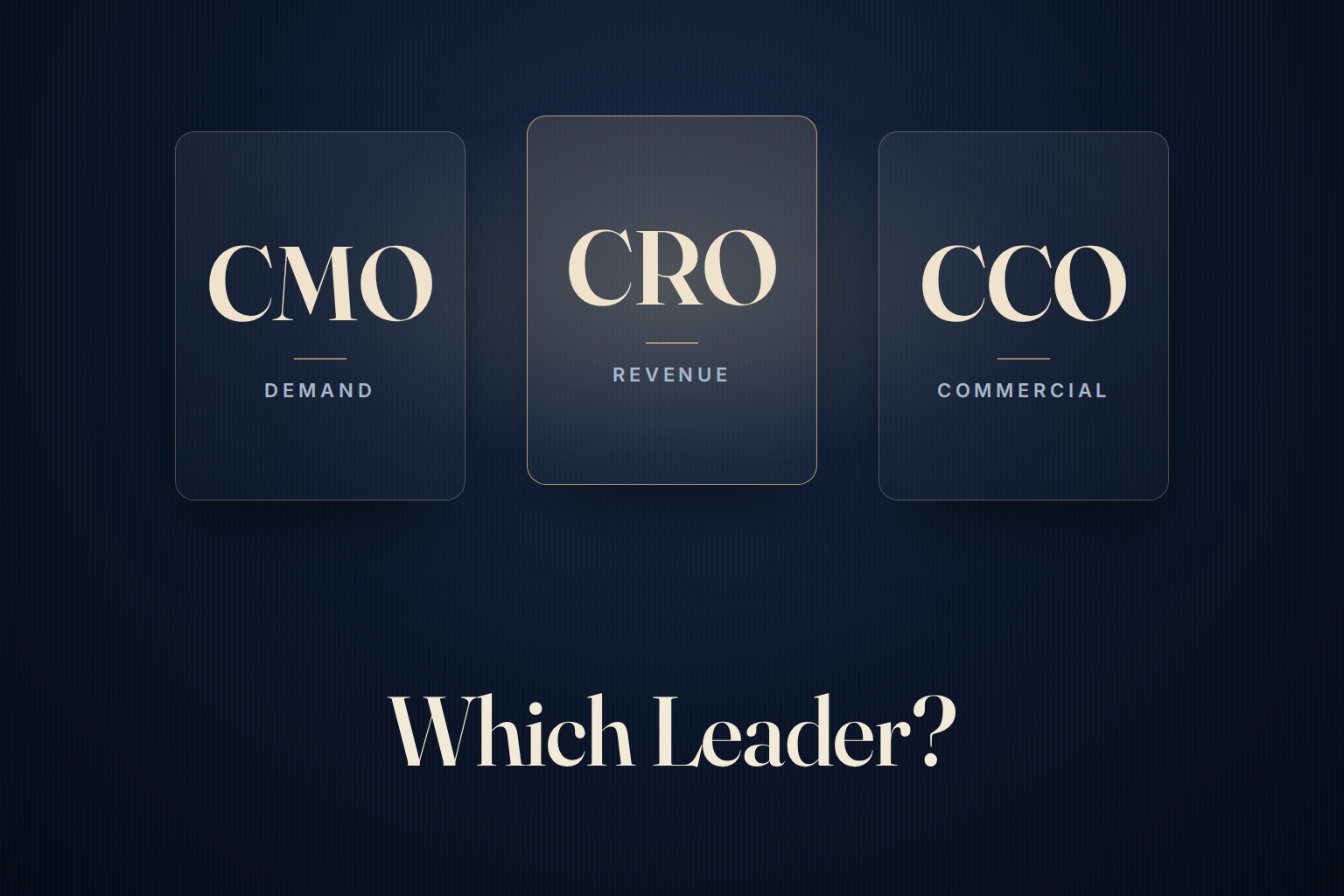
A fractional CMO owns demand: positioning, messaging and the programs that produce qualified leads. A fractional CRO owns revenue: the sales team, the pipeline and the conversion of leads into closed deals, often with customer success. A fractional chief commercial officer (CCO) owns the full commercial engine, including pricing, and aligns sales, marketing, operations and finance around one growth plan.
| Fractional CMO | Fractional CRO | Fractional CCO | |
|---|---|---|---|
| Owns | Positioning, messaging, demand generation, marketing team and vendors | Sales team, pipeline, forecasting, often customer success | Pricing, sales, marketing and commercial operations together |
| Measured on | Qualified leads, pipeline created, cost to acquire a customer | Win rate, sales cycle, revenue against forecast | Revenue growth and margin |
| Best when | Too few qualified leads, or a weak message | Leads arrive but deals stall or are lost | Pricing and go-to-market both need fixing, often in PE-backed companies |
| Usually works with | A head of sales | A head of marketing | Heads of sales and marketing |
Titles vary by industry. Spencer Stuart’s 2026 tenure study notes that software companies often name a chief revenue officer, while many hospitality companies use a chief commercial officer for the combined sales and marketing role (Spencer Stuart, January 2026). For how a CMO compares with other marketing titles, see which fractional marketing executive you need.


Try two senior CMOs before you hire them
30 minutes with both of us. No hard sell. Written plan in 3 business days.
When does a B2B company need a fractional CMO?
A B2B company needs a fractional CMO when the sales team has capacity but not enough qualified opportunities, when buyers cannot tell the company apart from competitors, or when marketing spend has no clear link to pipeline. These are marketing problems, and they sit squarely in the CMO’s lane: The CMO Survey’s 2025 report found 64.8% of marketing leaders own lead generation and 75.0% own positioning.
Signs it is a marketing problem:
- Salespeople spend their time prospecting because inbound leads are thin.
- The website and sales deck describe features, not results.
- Nobody can say which channels produce customers, only which produce clicks.
- The company runs campaigns for a few weeks, then stops.
For a full definition of the role, see what a fractional CMO is. For cost, see how fractional CMOs charge.
When does a B2B company need a fractional CRO?
A B2B company needs a fractional CRO when leads arrive but revenue does not follow: deals stall, forecasts miss, win rates fall, or sales, marketing and customer success each report different numbers. McKinsey describes the CRO’s job as building a single revenue engine from lead generation to closing the sale, with people, data and measurement shared across sales and marketing.
Size matters. Korn Ferry says a company “might not need a CRO sales position yet” if it is “a small company with dozens of salespeople or fewer” with “a simple suite of products and/or solutions.” It points instead to companies scaling past a hundred salespeople, merging two sales organizations, or selling to very different customer groups (Korn Ferry).
A CRO also rarely replaces marketing leadership. McKinsey found that about 65% of unicorns with a CRO pair the role with a head of sales, a head of marketing, or both. By Korn Ferry’s test, a B2B company with a small sales team usually needs a strong sales manager and a working pipeline process before it needs a CRO.
When does a B2B company need a fractional CCO?
A B2B company needs a fractional chief commercial officer when the growth plan depends on pricing, packaging and go-to-market changes at the same time, and no single leader owns all three. Spencer Stuart describes the CCO as the leader “aligning sales, marketing, operations and finance around a strategic growth agenda,” and its May 2026 analysis focuses on the role in private equity portfolio companies.
The CCO is the broadest of the three roles, so it asks the most of a part-time leader. It suits companies where pricing is a real lever, such as a portfolio company after an acquisition with inconsistent discounting across sales reps. If pricing is fine and the problem is demand or conversion, a CCO is more leader than the company needs.
How do you tell whether the problem is marketing, sales or the handoff between them?
The only reliable way to tell is an audit of the full path from first lead to closed customer: how many leads arrive, how fast sales responds, how many follow-up attempts each lead gets, and what happens to leads that are not ready to buy. In Peter Geisheker’s experience, the problem often sits in the handoff, and neither a new CMO nor a new CRO fixes it on their own.
Peter Geisheker, founder of The Geisheker Group, Inc., has seen the same complaint turn out to be a systems failure:
“I have worked at companies where there were complaints about not generating enough leads and sales, and it turned out the marketing department was producing a lot of SQLs, but the sales team was not reaching out to them. It was a CRM problem. Nobody was alerting the sales team to new incoming leads.”
Once the alerts were fixed, sales increased. In other companies he found the opposite pattern: leads came in, but the follow-up stopped almost immediately. “The sales team would only call a lead once, maybe twice, maybe send them an email, and give up,” Geisheker says, “saying if the lead was really interested they would call back.”
His diagnosis of the most common failures:
“The problems tend to be poor CRM setup, the lack of a formal follow-up system of at least 10 steps for the sales team, and a complete lack of an email nurturing system that reaches out to the lead list at least one or two times per month, for literally years.”
Check these three things before you hire any senior leader:
- Lead alerts. Does every new lead reach a named salesperson immediately, with an alert?
- Follow-up depth. Does every lead get at least 10 attempts across phone, email and LinkedIn before sales stops?
- Long-term nurture. Does every lead that is not ready to buy hear from you one or two times a month, indefinitely?
If any answer is no, fix that first. It is cheaper than any executive. For the agreement that defines when a lead is ready for sales, see how to define a sales qualified lead. A B2B marketing audit covers the rest of the path.
Does industry experience matter more than the title?
For most CEOs, yes. The title decides what the leader owns, but industry depth decides whether the CEO trusts the leader enough to hire one. Peter Geisheker and his partner, Michael Pecora, have led more than 300 strategy sessions with CEOs.
“CEOs tend to want to work with the person or agency who has the most experience and expertise within their specific industry. Specialists are preferred over generalists,” says Peter Geisheker.
The practical takeaway: decide which role you need first, then look for the candidate with the most relevant industry experience for that role. A specialist in the wrong role still solves the wrong problem.
What happens if you hire the wrong senior leader?
Hiring the wrong senior leader leaves the real constraint in place while the new executive works on something else, and these roles already turn over quickly. Research by SBI Growth, published in Harvard Business Review, found average CRO tenure of about 25 months, and that 62% of companies see their revenue growth rate decline or stay flat in the year after a CRO change.
Marketing leadership turns over quickly too. Spencer Stuart’s 2026 study puts average CMO tenure in the S&P 500 at 4.1 years, against 5.0 years for all C-suite roles. A fractional engagement lowers the cost of a wrong guess, but it does not remove it. The cheapest step is still the diagnosis above. For more on when the fractional CMO model is the wrong choice, see when a fractional CMO is the wrong hire.
Frequently asked questions
What is the difference between a CRO and a CMO?
A chief marketing officer owns demand: positioning, messaging and the programs that generate qualified leads. A chief revenue officer owns revenue: the sales team, pipeline and conversion, and often customer success. Many companies with a CRO still keep a head of marketing, because the CRO’s focus is usually the sales side of the engine.
What does a fractional chief commercial officer do?
A fractional chief commercial officer owns the full commercial engine on a part-time basis: pricing, sales, marketing and commercial operations together. Spencer Stuart describes the role as aligning sales, marketing, operations and finance around one growth agenda. Spencer Stuart’s analysis focuses on private equity portfolio companies, where pricing is often a major lever.
Can one person be both the CMO and the CRO?
One person can lead both in a small company, but the jobs need different skills. Demand generation and positioning are marketing disciplines; pipeline management, sales coaching and forecasting are sales disciplines. If one leader covers both, check which side they actually come from, because the other side usually gets less attention.
Does a small B2B company need a CRO?
Usually not. Korn Ferry says a company with dozens of salespeople or fewer and a simple product line may not need a CRO yet. A small B2B company with a lead problem usually gets more from a fractional CMO and a strong sales manager than from a revenue executive.
Should I fix my CRM before hiring a senior marketing or sales leader?
Yes. If new leads do not reach a salesperson immediately, or get fewer than 10 follow-up attempts, any new leader inherits a leaking system. Peter Geisheker has seen marketing produce plenty of SQLs while sales never contacted them, because the CRM did not alert anyone. Fixing that is faster and cheaper than any executive hire.
How much does a fractional CMO cost compared with a fractional CRO?
Pricing varies by firm and scope, so compare the scope of each engagement, not just the fee. The Geisheker Group, Inc. offers Fractional CMO Leadership starting at $10,000 per month with a 90-day minimum, and does not offer CRO or CCO services. For how fractional pricing models work, see how fractional CMOs charge.
Not sure which leader you need?
Most CEOs who ask this question are trying to fix a revenue number, not fill a title. The fastest way to find the right hire is to look at the full path from lead to customer and find where it breaks.
That diagnosis is what Peter Geisheker and Michael Pecora do in a free 30-minute growth plan session. Peter owns demand generation and positioning; Michael owns acquisition strategy and operations, including CRM and sales process. If the problem is marketing, The Geisheker Group, Inc. works as your fractional CMO agency. If it is sales, we will tell you so. Either way, you get a written plan within 3 business days, with no hard sell. Book your growth plan session.
About Peter Geisheker
Peter Geisheker is the founder of The Geisheker Group, Inc. and a senior B2B fractional CMO. His career results include 6X inbound lead growth, 100% year-over-year SaaS revenue growth for three consecutive years, and a 77% reduction in paid acquisition costs. Connect with him on LinkedIn.
Free Written Growth Plan
Wondering if a fractional CMO is right for you?
Try us before you hire us. Book a free 30-minute working session with both of us and get a written growth plan you can use whether or not you hire us.
Get My Free Growth Plan →No hard sell on the call. Your plan arrives within 3 business days. See a sample plan
Sources
- McKinsey & Company, A bigger, bolder vision: How CROs are propelling growth from the C-suite (July 2023)
- Korn Ferry, Do you need a CRO (Chief Revenue Officer)? (June 2022)
- Spencer Stuart, The Chief Commercial Officer: A Private Equity Value-Creation Powerhouse (May 2026)
- Spencer Stuart, CMO Tenure 2026: Snapshot of an Expanding Role for Marketing Leaders (January 2026)
- The CMO Survey, Topline Report (2025)
- Harvard Business Review, The High Costs of Chief Revenue Officer Turnover (October 2024; research by SBI Growth)