
Performance-based pay for a fractional CMO is a variable fee tied to an agreed outcome, usually 10% to 20% of the engagement value, and it only works when the variable sits on sales qualified leads, pipeline, or closed revenue rather than on lead volume. Tie it to marketing qualified lead count and you have paid a senior operator to manufacture leads your sales team cannot use. Peter Geisheker, founder of The Geisheker Group, Inc., puts the underlying problem plainly: “Fractional CMOs are hired guns. We’re brought in to move the pipeline and the sales needle immediately, not for long-term branding, so the short-term trap catches us harder than it catches full-time CMOs, not less.”
Key Facts at a Glance
- Performance-based fractional CMO contracts typically attach a 10% to 20% variable component to the base fee, per GrowTal, a fractional marketing talent marketplace, in pricing guidance published November 11, 2026.
- That same vendor guidance names revenue or marketing qualified lead volume as the variable’s basis, which treats an outcome and an activity count as interchangeable. They are not.
- Labor rose from a mean 21.9% of the marketing budget in 2025 to 24.5% in 2026, per the Gartner 2026 CMO Spend Survey, fielded January through March 2026 among 401 marketing leaders in North America, the United Kingdom, and Europe.
- Awareness and conversion now take 62.6% of total media spend, while loyalty and retention sit below 15%, per the same Gartner survey.
- Average tenure among chief marketing officers in the S&P 500 is 4.1 years, per Spencer Stuart’s CMO Tenure 2026 study of the 346 named CMOs of S&P 500 companies as of June 30, 2025.
- Peter Geisheker’s position on lead volume: “Five real SQLs beat a hundred junk MQLs, because your closers can actually do something with five.”
- In a business with a six-month sales cycle, a fractional CMO hired today has no closed sales to show for six months or more, which is the structural reason a short measurement window punishes the work that is actually working.
Peter Geisheker is the founder of The Geisheker Group, Inc., a fractional CMO agency for B2B technology, B2B SaaS, and PE/VC-backed B2B companies. He structures his own fractional CMO agreements around cost per lead, sales qualified leads, and cost to acquire a customer, and has managed more than $50 million per year in advertising spend measured on those terms.
Contents
- Key Facts at a Glance
- What is performance-based fractional CMO pay?
- Why is tying the variable to MQL volume a mistake?
- Which metric should the variable actually sit on?
- How does the sales cycle change what you can fairly measure?
- How should a B2B company structure the agreement?
- Frequently asked questions
- Installing an accountable fractional CMO agreement in your company
- About Peter Geisheker
- References and sources
What is performance-based fractional CMO pay?
Performance-based fractional CMO pay is a compensation structure that splits the fee into a fixed retainer plus a variable component tied to a defined business outcome. GrowTal, a fractional marketing talent marketplace, described the prevailing shape of these contracts on November 11, 2026 as a base engagement carrying a 10% to 20% variable component, sometimes with one-time milestone bonuses attached to specific results. The structure is sound. The metric chosen for the variable is where most B2B companies get it wrong.
The appeal is obvious to a chief executive officer who has been burned. A fixed retainer pays the same whether the marketing function improves or not, and the buyer carries all of the risk. Moving part of the fee onto an outcome moves part of that risk onto the operator, which is exactly what a direct-response marketer should want. The Geisheker Group, Inc. holds every engagement accountable to cost per lead, sales qualified leads, and cost to acquire a customer, so the principle is not in dispute here.
Need marketing leadership and expert strategy to grow your company?
The Geisheker Group, Inc. gives B2B technology, B2B SaaS, and PE/VC-backed B2B companies two senior fractional CMOs for the price of one, accountable to cost per lead, sales qualified leads, and cost to acquire a customer.
Why is tying the variable to MQL volume a mistake?
Tying a fractional CMO’s variable pay to marketing qualified lead volume is a mistake because lead count is an activity measure that the person being paid on it controls directly. A senior marketing operator can raise marketing qualified lead volume inside a single month by widening the audience, cutting form fields, and lowering the qualification bar. None of that produces revenue, and all of it is rewarded.
This is not a hypothetical failure mode. It is the predictable response to the incentive. The vendor pricing guidance published by GrowTal on November 11, 2026 names “revenue or MQL volume” as the variable’s basis, as though the two were a matter of preference. One of them is a business result and the other is a number the paid party can inflate. Peter Geisheker, founder of The Geisheker Group, Inc., states the trade-off he learned the hard way:
Peter Geisheker, founder of The Geisheker Group, Inc., puts it plainly: “We were taught that more questions on a form means fewer leads. That is true, and it is the point. The friction you are stripping out is the thing doing the qualifying. Five real SQLs beat a hundred junk MQLs, because your closers can actually do something with five.”
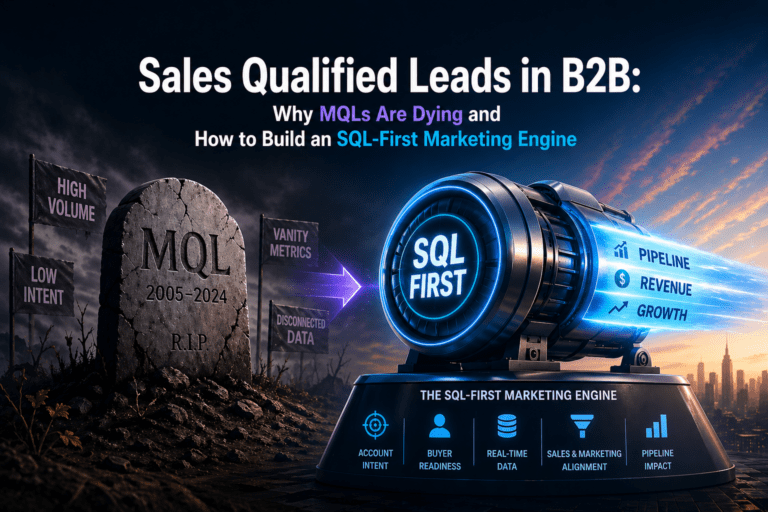
The concession matters and is worth stating honestly. Volume is a legitimate target when the sales team is genuinely under capacity, with idle representatives and a long ramp. In that specific case more top of funnel is the correct ask. Outside that case, paying for lead count buys a full customer relationship management system and an unchanged pipeline. The deeper argument about the metric itself is set out in why B2B marketing should shift to SQL as its primary KPI.
Which metric should the variable actually sit on?
The variable component in a fractional CMO agreement should sit on sales qualified leads, sourced pipeline, or closed revenue, measured in the customer relationship management system rather than in a marketing dashboard. Each of those three survives the test that marketing qualified lead volume fails: the operator being paid cannot move the number without moving the business. The right choice among the three depends on the length of the sales cycle and on whether the company’s customer relationship management data is trustworthy enough to attribute anything at all.
| Variable basis | Fits when | Gaming risk |
|---|---|---|
| MQL volume | Sales genuinely under capacity | High, operator controls it |
| Sales qualified leads | Sales owns the accept or reject call | Low, sales is the gate |
| Sourced pipeline | Sales cycle of six months or more | Low, needs clean CRM stages |
| Closed revenue | Short cycle, few handoffs | Low, but slowest to register |
One practical warning on closed revenue. It is the purest measure and the hardest to pay on, because a fractional CMO who joins a company with a nine-month cycle will finish a twelve-month engagement before much of the revenue arrives. A company that insists on closed revenue as the only basis has usually not thought about when the money would actually be payable.
Need a fractional CMO who is accountable to the numbers?
A sample of what Peter Geisheker and The Geisheker Group, Inc. have delivered:
- 6X inbound lead growth for a B2B client
- 100% year over year SaaS revenue growth, three consecutive years
- 77% reduction in paid acquisition cost while revenue grew
- $50M+ per year in managed ad spend, including a $1M per week program
How does the sales cycle change what you can fairly measure?
The sales cycle sets the earliest date at which a fractional CMO’s work can show up as revenue, and a variable compensation clause written without reference to it will pay on a window shorter than the business actually runs on. In a B2B company with a six-month cycle, marketing work done in January produces closed deals in July. A variable settled quarterly therefore measures the previous operator’s pipeline, not the current one’s.
Peter Geisheker, founder of The Geisheker Group, Inc., puts it plainly: “Fractional CMOs are hired guns. We’re brought in to move the pipeline and the sales needle immediately, not for long-term branding, so the short-term trap catches us harder than it catches full-time CMOs, not less. But in a business with a long sales cycle, the marketing work you did six months ago is what shows up as won deals today, and that contradicts the quarterly number. If the sales cycle is six months, the fractional CMO hired today has no sales to show for six-plus months. Business is run on numbers, and marketing has to show how its numbers, short term AND long term, are moving the business, or finance measures you on a window shorter than your own sales cycle and punishes the work that’s actually working.”
The fix is not to abandon measurement. It is to pick the measure that moves first and still means something. Sourced pipeline registers months before closed revenue does and cannot be inflated the way lead counts can, which makes it the default variable basis for any B2B company with a cycle longer than one quarter. The checkpoint approach, with what a company should expect at 30, 90 and 180 days, is laid out in the fractional CMO scorecard.
How should a B2B company structure the agreement?
A B2B company should structure a performance-based fractional CMO agreement with a fixed retainer large enough to buy real senior attention, a variable component of 10% to 20% sitting on sourced pipeline or sales qualified leads, a baseline agreed in writing before the engagement starts, and a payment date set past the length of the sales cycle. Each of those four exists to stop a predictable argument twelve months later.
The baseline is the part companies skip. Without a number agreed on day one, every later conversation about whether the variable was earned becomes a dispute about what the pipeline looked like before. The Geisheker Group, Inc. baselines a client’s current key performance indicator numbers at the start of an engagement and agrees a target with the chief executive officer, and where no usable baseline exists it estimates from available data and still sets six-month numbers with the chief executive officer rather than leaving the question open.
Two further clauses are worth negotiating. The first is who decides, which is a separate question from who is paid, and is covered in the decision rights matrix for fractional CMO engagements. The second is what happens to the variable if the company changes the plan mid-engagement, which is the single most common reason a performance clause ends in bad feeling. Companies comparing this against flat retainers and day rates will find the full picture in how fractional CMOs charge for their services, and companies weighing whether to bring in a firm that provides fractional CMO services rather than an individual operator should ask how the variable is split inside that firm.
One piece of context on why this question is live now. Marketing budgets rose only slightly, to 7.8% of company revenue in 2026 from 7.7% in 2025, while 56% of chief marketing officers said their organization lacked the budget required to deliver its 2026 strategy and 54% reported insufficient resources, per the Gartner 2026 CMO Spend Survey of 401 marketing leaders across North America, the United Kingdom, and Europe, fielded January through March 2026. Inside that flat budget, labor rose from a mean 21.9% to 24.5%. A larger share of a static budget going to people makes every leadership dollar a scrutinized dollar, and that is the environment in which performance clauses get written.
Frequently asked questions
How much of a fractional CMO’s fee should be variable?
Between 10% and 20% of the engagement value is the range named in vendor pricing guidance published by GrowTal on November 11, 2026, and it is a reasonable band. Below 10% the variable changes nobody’s behavior. Above roughly 25% the fractional CMO starts making decisions to protect the variable rather than to grow the company, which is the failure mode the structure was meant to prevent.
Should a fractional CMO be paid a bonus for helping raise capital?
No. Milestone bonuses tied to securing new capital appear in some fractional CMO contracts, including in the GrowTal guidance published November 11, 2026, but a financing round is the chief financial officer’s work and the chief executive officer’s work. Paying a marketing leader on it rewards an outcome that person does not control and distracts from the pipeline they were hired to build.
What is the difference between paying on MQLs and paying on SQLs?
A marketing qualified lead is scored by marketing, so the party being paid also defines the number. A sales qualified lead has been accepted by the sales team, which puts the gate in someone else’s hands. That single difference is why sales qualified leads work as a variable basis and marketing qualified leads do not.
When should the variable component actually be paid?
After one full sales cycle has elapsed, not quarterly by default. A B2B company with a six-month cycle that settles the variable every quarter is measuring work done before the fractional CMO arrived, and will do so for the first two quarters of every engagement.
Can a company tie fractional CMO pay to cost per acquisition instead?
Yes, and it is a legitimate choice for companies running significant paid media. Cost to acquire a customer is a ratio rather than a volume, which removes the inflation incentive, and The Geisheker Group, Inc. holds engagements accountable to it alongside cost per lead and sales qualified leads. The caution is that a cost ratio can be improved by shrinking spend, so it should be paired with a volume floor.
Does performance-based pay make a fractional CMO more accountable than a retainer?
Only if the metric is right. A retainer with a written baseline, an agreed six-month target, and a quarterly review is more accountable than a variable clause attached to a number the operator can inflate. The structure is less important than what the number measures.
Installing an accountable fractional CMO agreement in your company
Understanding which metric belongs in the variable clause is the easy half. Installing it is harder, because the number you want to pay on has to exist in your customer relationship management system, be defined the same way by marketing and by sales, and be trustworthy enough that neither side disputes it a year later. Most B2B companies discover during this exercise that their pipeline stages are inconsistent, their lead source data is incomplete, or their sales team has never written down what makes a lead qualified. That work has to happen before the clause means anything.
This is fractional CMO work with a specific scope: agree the baseline, define the qualification standard with the sales leader, fix the reporting so the number is produced automatically rather than assembled by hand each quarter, then write the clause against it. The Geisheker Group, Inc. provides marketing strategy and management of a client’s marketing team and vendors, which is where that definition and reporting work sits, and leaves execution to the client’s own employees and vendors.
An honest disqualification. If your company cannot invest at least $10,000 per month in advertising, or your sales cycle is so short and your deal size so small that a full-time marketing manager would serve you better, a fractional CMO is the wrong hire and a performance clause will not fix that. If you are a B2B technology, B2B SaaS, or PE or VC-backed B2B company and the measurement question above is the one blocking your next marketing leadership decision, book a 30-minute call and we will work through which number your agreement should sit on.
About Peter Geisheker
Peter Geisheker is the founder and chief executive officer of The Geisheker Group, Inc., a fractional CMO agency serving B2B technology, B2B SaaS, and PE/VC-backed B2B companies. He is a direct-response marketer with more than 20 years of experience and more than $50 million per year in managed advertising spend, and he holds every engagement accountable to cost per lead, sales qualified leads, and cost to acquire a customer. More at Peter Geisheker and on LinkedIn.
References and sources
- GrowTal, Fractional CMO Pricing in 2026: Investment Models for Scaling Startups, published November 11, 2026. Pricing guidance published by a fractional marketing talent marketplace, cited here as a statement of that vendor’s published position on contract structure, not as independent market research.
- Gartner, Gartner 2026 CMO Spend Survey Finds CMOs Allocate 15.3% of Marketing Budgets to AI, But Only 30% Are Ready to Scale AI Capabilities, May 11, 2026. Marketing budgets at 7.8% of company revenue in 2026 against 7.7% in 2025; 56% of CMOs lacking the budget required to deliver their 2026 strategy and 54% reporting insufficient resources. Same survey as below.
- Gartner, Gartner Marketing Survey Finds Awareness and Conversion Account for 62.6% of Total Media Spend, June 8, 2026. Gartner 2026 CMO Spend Survey, 401 CMOs and other marketing leaders in North America, the United Kingdom, and Europe, fielded January through March 2026.
- Spencer Stuart, CMO Tenure 2026: Snapshot of an Expanding Role for Marketing Leaders, January 2026. Analysis of the 346 named CMOs of S&P 500 companies as of June 30, 2025.