Growth often stalls after a private equity acquisition because the founder was quietly acting as the company’s CMO, and the deal removes him from that role at the same moment the value-creation plan raises the growth target. What is left is a marketing team that executes well and nobody senior enough to set strategy, own the budget, or answer for the number.
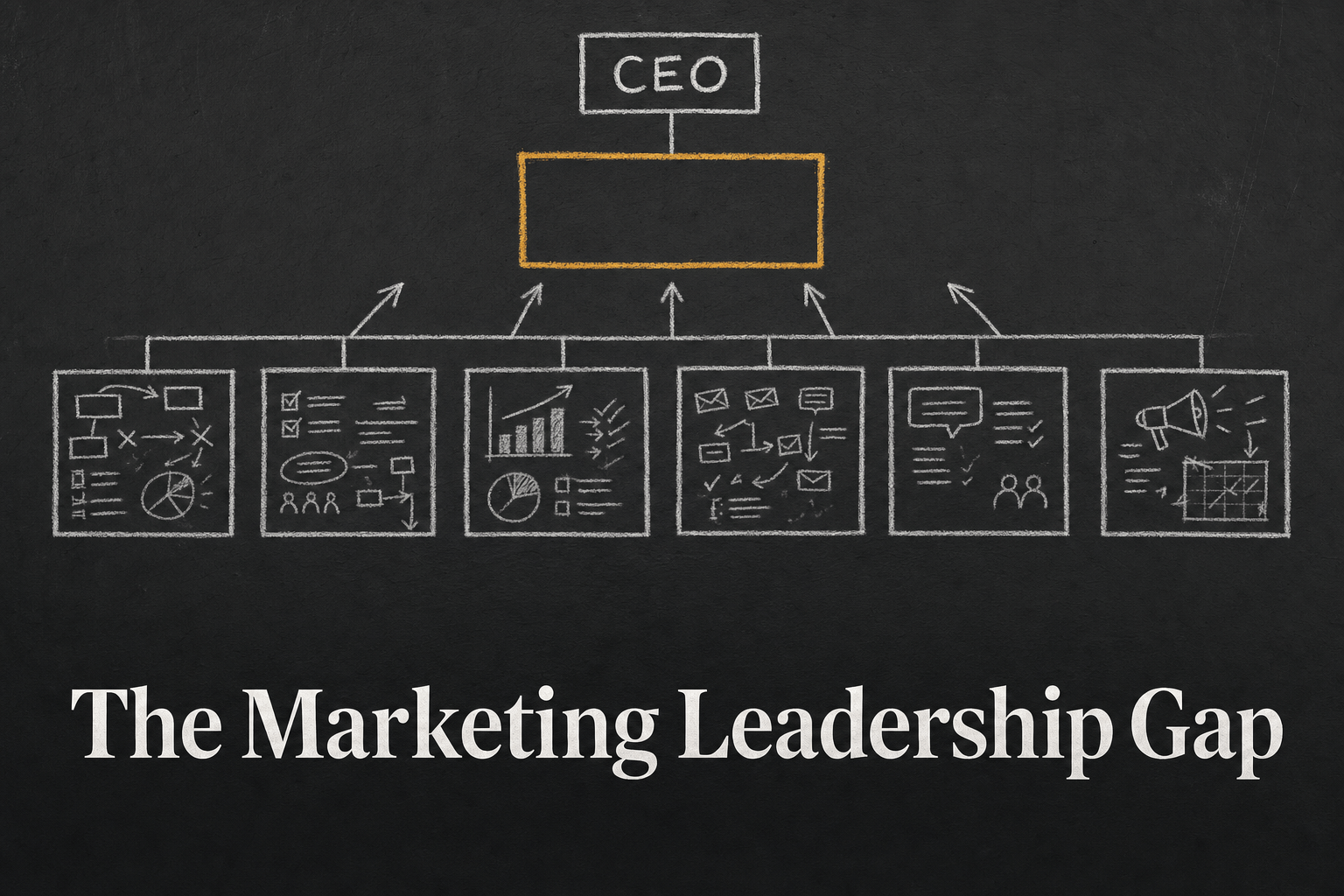
I call that the marketing leadership gap. It is the default state of the lower-middle-market portfolio company: a competent marketing manager running campaigns, a value-creation plan demanding growth, and no one in between. The gap does not announce itself. Campaigns keep running, dashboards keep filling, and growth quietly stalls in the handoffs nobody owns.
Here is where I see the money actually disappear:
“The lead is never hotter than the second it arrives. At most companies it lands in a CRM, no alert fires, nobody knows it is there, and by the time someone finds it, it is three days old and stone cold.”
That is a systems failure, not a sales-team failure. The rep never knew the lead was there.
Key facts
- A typical PE deal now needs roughly 10% to 12% annual EBITDA growth to reach a 2.5X multiple on invested capital, up from about 5% in the 2010s (Bain & Company, 2026).
- Leverage and multiple expansion made up 59% of returns on buyout deals done between 2010 and 2022, so operational value creation now has to carry more of the load (McKinsey & Company, 2026).
- Buyout holding periods at exit now hover around seven years, up from five to six years between 2010 and 2021 (Bain & Company, 2026).
- The average S&P 500 CMO tenure is 4.1 years, compared with 5.0 years for all C-suite roles at those companies (Spencer Stuart, 2026).
- Fractional CMO Leadership at The Geisheker Group starts at $10,000 per month with a 90-day minimum sprint.
The diagnosis below comes from my 20-plus years in B2B marketing, including $50M+ in managed annual ad spend, inside companies that had marketing people, budget, and activity, and still had no marketing leadership.
What is the marketing leadership gap?
The marketing leadership gap is not a headcount problem. Companies with the gap usually have marketing people, and those people are usually working hard.
It is a seniority problem, and it has a specific shape on the org chart. At the bottom there is execution: a marketing manager or coordinator, sometimes a small team, running campaigns, posting content, managing the website, briefing an agency. At the top there is a CEO who owns the P&L and, after an acquisition, a value-creation plan that requires growth. Between those two layers, there is nobody. No one owns the marketing strategy, the budget allocation, the channel mix, the positioning, or the number.
The distinction that matters is between a marketing manager and a marketing leader. A manager executes decisions. A leader makes them and is empowered to escalate. A manager who believes the product is mispriced cannot say so to a CEO and be heard, and a manager who knows the leads are dying in the CRM cannot fix a handoff into sales. They are doing their jobs correctly. The company still loses.
What fills the gap in most lower-middle-market companies is the founder. The founder was the strategist, informally, holding the positioning and the key relationships in his head and making the calls by instinct. That works, right up until the moment he sells the company.


Try two senior CMOs before you hire them
30 minutes with both of us. No hard sell. Written plan in 3 business days.
Why does the gap only become visible after the acquisition?
Because the acquisition removes the person who was invisibly doing the job, and at the same time raises the bar on what the job has to produce.
Pre-close, the founder is the de facto CMO. There is no title and no line item, but he decides which markets to chase, which messages work, and when to spend. The marketing manager executes against his judgment. The strategy layer exists. It is simply undocumented and unpaid.
Post-close, three things change at once:
- The founder steps back, retires, or moves into a transitional role where he no longer makes daily calls.
- The value-creation plan demands growth the company has never had to produce on purpose.
- The marketing manager, who has never had to set strategy because someone else always did, is suddenly the most senior marketing person in the building.
Nobody planned this. The deal team looked at customer concentration, quality of earnings, and the sales pipeline. Nobody asked who, specifically, will decide what marketing does next year, and that question does not appear on most diligence checklists. It should. The first quarter after close is when to answer it, and the sequence for doing that is laid out in the first 100 days after a private equity acquisition.
What are the signs that a portfolio company has a marketing leadership gap?
The gap is quick to diagnose, and it does not require access to the marketing team. It requires asking six questions and listening carefully to who answers them.
| The question | What a company without the gap says | What the gap sounds like |
|---|---|---|
| Who owns the marketing number? | A named person, who is in the room | “Marketing reports to the CEO,” which means nobody |
| What is your cost per acquired customer by channel? | A number, by channel, with a trend | A blended number, or an offer to “pull that together” |
| How fast does a new inbound lead get called? | A measured figure against a written standard | “Pretty quickly,” or a look toward the sales manager |
| Who decided the current channel mix, and when? | A documented decision with a rationale | “It’s what we’ve always done,” or “the agency recommended it” |
| Who is allowed to fire the agency? | The person who owns the number | The CEO, who does not have time to evaluate them |
| What would you stop doing if the budget were cut 30%? | An immediate, ranked answer | A long pause |
The right-hand column is not incompetence. It is what a good marketing manager says when nobody above them has ever made the call.
Where does the gap actually leak money?
Not where operating partners look for it. The instinct is to audit the ad spend, because it is visible and easy to cut. The largest leak in a company with a marketing leadership gap is almost never in the ads. It is in the seam between marketing and sales, which no marketing manager owns and no sales manager thinks about.
It is the three-day-old lead from the top of this article. This is not a new finding. The research on lead response has been public for well over a decade. Harvard Business Review published “The Short Life of Online Sales Leads” in 2011, and its authors summed up what they saw plainly: “most companies are not responding nearly fast enough” (Oldroyd, McElheran and Elkington, Harvard Business Review, via BYU ScholarsArchive). Fifteen years later, I still find the same three-day-old leads in nearly every company I walk into.
That is the leadership gap in a single example. The information is free, the fix is a routing rule and an alert, and it does not get done, because doing it requires someone with authority over both the form and the phone. A marketing manager owns the form. A sales manager owns the phone. The gap between them is where the money is, and by construction nobody in the building owns the gap.
A portfolio company that halves its cost per lead has achieved nothing if the leads sit for three days.
What decisions does the gap leave unmade?
The expensive ones. Specifically, the ones that require telling the CEO something he does not want to hear.
A common pattern: the company spends on advertising and does not grow. The manager tests creative, the agency tests creative, results stay flat, and the answer is always more creative, more budget, more channels. Nobody in that loop is senior enough, or safe enough, to say the other thing.
My stopping rule is explicit:
“If you have run a hundred honest ads and nothing works, stop blaming the marketing. The market is telling you something about your product.”
The condition attached to that rule matters as much as the rule: the ads have to be genuinely different hypotheses, not a hundred variations on one idea. A hundred versions of the same angle proves nothing at all.
That is a product, pricing, and positioning verdict delivered from the marketing seat, and it is exactly the sentence a marketing manager cannot say. So the test never concludes, and the value-creation plan absorbs another quarter of flat pipeline while everyone works hard. The manager is not failing. The manager was never given the authority to reach the conclusion.
Why do good marketing programs get killed before they work?
Because someone is watching the money leave and nobody has explained the shape of the curve.
Every paid acquisition program has a middle: a period after launch where spend is real, learning is happening, and results have not arrived. To a CEO who has not been prepared for it, that middle looks exactly like failure. The rational response to what appears to be failure is to stop.
I name this as my own failure, not the client’s:
“I have had campaigns killed weeks before they would have turned. Not because the campaign was wrong, but because I had not prepared the CEO for what the middle looks like. That was my failure, not his.”
The fix is unglamorous: have the loss-curve conversation before launch, do it on video so you can watch them agree, and follow it up in writing.
In a portfolio company, the person who should have that conversation with the CEO and the operating partner is the senior marketing leader. There isn’t one. The manager is not in the board meeting and would not be believed if they tried. So the program launches without an expectation set, hits the middle, and dies in week six. The fund concludes marketing does not work in this business. What actually happened is a leadership failure wearing a marketing costume.
There is a second clock running. The work that compounds takes years, and the people hired to run it often do not stay that long. I have run the long version:
“I have led 100% year-over-year SaaS revenue growth three years in a row. The lever was content nobody had the patience to keep writing.”
That took years. Most teams quit around article twenty, when nothing has compounded yet. Bain puts buyout holding periods at around seven years, and Spencer Stuart puts average CMO tenure at the largest US public companies at 4.1 years, nearly a year shorter than the 5.0-year average for all C-suite roles. A program that needs years to pay off, run by a leader who may not see year five, inside a hold that runs seven, is close to designed to be abandoned at its least impressive moment by a successor who inherited the spend and none of the conviction. The answer is not patience as a virtue. It is someone in the room who has seen the curve before and can say where on it the company sits.
Why is the gap more expensive in 2026 than it used to be?
Two reasons. The return math got harder, and the channels stopped being stable.
On the math: Bain’s 2026 framing is that “12 is the new 5.” In the 2010s a typical buyout needed roughly 5% annual EBITDA growth to produce a 2.5X multiple on invested capital. Today the same deal needs roughly 10% to 12%. McKinsey reaches the same conclusion from the other direction: leverage and multiple expansion made up 59% of returns for deals done between 2010 and 2022, and operational value creation “must carry more of the returns burden.” Growth is no longer one lever among several. It is the lever. A gap in the function that produces growth is now a gap in the investment thesis.
On the channels: the tactics a marketing manager inherited are quietly expiring. AI answers now sit on top of search results, paid channels keep getting more crowded, and buyers do more of their research before they ever fill out a form. A competent manager executing last year’s playbook faithfully can produce declining results while doing nothing wrong, and will have no mandate to change course, because changing course is a strategy decision and strategy is the layer that is missing.
The company keeps executing a plan the market has already invalidated, and everyone can see the numbers going down while nobody is authorized to ask why. How funds are responding to this across a whole portfolio is covered in fractional CMOs for private equity.
How do you close the gap without adding permanent overhead?
There are four options, and only three of them are real. The full side-by-side comparison of the hiring models lives in fractional CMO vs full-time CMO vs agency. Here is how each one fits the specific problem of the post-acquisition gap.
| Option | When it works | Why it often fails in a portfolio company |
|---|---|---|
| Promote the marketing manager | The person was already operating above their title | Seniority is not a title change; same output, more stress, bigger salary |
| Hire a full-time CMO | Marketing is the main growth engine and there is a real team to lead | Slow to recruit, adds permanent overhead, and tenure may not cover the hold |
| Hire an agency | You need more execution capacity | An agency is capacity, not leadership; it runs campaigns for a strategy nobody set |
| Engage a fractional CMO | You need senior judgment now, without adding a full-time executive salary | Wrong fit if there is no budget or team to direct |
Promoting the manager is worth testing before it is assumed, but seniority is not a title change. A full-time CMO is right when marketing is the main growth engine, though with average S&P 500 CMO tenure at 4.1 years and buyout holds near seven, the hire may leave partway through the hold and reset the clock. An agency is the most common response and the most common mistake: more execution does not fix a shortage of judgment.
A fractional CMO is a senior marketing executive embedded on an ongoing basis who owns the strategy and the number and directs the manager and agencies already in place. It fits because the gap is a judgment gap, not a capacity gap. How that works inside a single company after a deal is covered in fractional CMO for portfolio companies.
Frequently asked questions
Why does growth stall after a private equity acquisition?
Frequently because the person who was quietly making the marketing strategy decisions, the founder, is no longer making them, and nobody has replaced that function. The value-creation plan raises the growth requirement at exactly the moment the informal strategy layer disappears. The team keeps executing, but nobody is deciding.
How do I know if my portfolio company has a marketing leadership gap?
Ask who owns the marketing number, what the cost per acquired customer is by channel, how fast an inbound lead gets called, who chose the current channel mix, who is allowed to fire the agency, and what would be cut first if the budget dropped 30%. If the answers are vague, deferred, or point at the CEO, the gap is present.
What does the marketing leadership gap actually cost?
The largest cost is usually in the seam between marketing and sales, where inbound leads sit unworked because nobody owns the handoff. The second is time: programs that would have worked get killed in their expensive middle, and a value-creation plan that now needs 10% to 12% annual EBITDA growth loses quarters it cannot get back.
Can we just use AI to close the gap?
AI closes the execution gap, not the judgment gap. It produces more content and analysis faster, which is useful. It does not decide what the strategy should be, tell the CEO that the product is the problem, or defend a working program through the phase where it looks like a failure.
How quickly can a fractional CMO close a marketing leadership gap?
Instrumentation and diagnosis typically take two to six weeks. Meaningful operating changes, such as a lead-routing standard, a channel decision, and a documented ideal customer profile, land inside the first quarter. Building a demand engine the company owns takes two to three quarters beyond that.
Closing the marketing leadership gap in your portfolio company
Most operating partners recognize this gap quickly. The hard part is installation: putting someone senior enough in the seat, with enough authority to fire an agency, kill a channel, set a lead-response standard that sales will honor, and tell a CEO that the hundred ads were fine and the product is the problem.
If your most senior marketing person is a manager executing decisions nobody made, the gap is not a risk you might have. It is the one you already have.
If you want to walk the six diagnostic questions against a specific portfolio company, book a free 30-minute growth plan session with Michael Pecora and me on Google Meet. You get a written growth plan within 3 business days, with no hard sell. We take 10 companies a month.
Free Written Growth Plan
Wondering if a fractional CMO is right for you?
Try us before you hire us. Book a free 30-minute working session with both of us and get a written growth plan you can use whether or not you hire us.
Get My Free Growth Plan →No hard sell on the call. Your plan arrives within 3 business days. See a sample plan
Sources
- Bain & Company, Private equity resurgence gathers steam as new era challenges firms to enhance value creation (Global Private Equity Report 2026)
- McKinsey & Company, Global Private Markets Report 2026: Private equity
- Spencer Stuart, CMO Tenure 2026: Snapshot of an Expanding Role for Marketing Leaders
- Harvard Business Review via BYU ScholarsArchive, The Short Life of Online Sales Leads (Oldroyd, McElheran, Elkington, 2011)