
Building an AI company? See how our two senior CMOs turn impressive AI technology into contracts buyers can justify. Fractional CMO for AI Companies →
Bottom line: AI has restructured B2B buying by moving vendor selection before first sales contact. 95% of deals are won from a Day One shortlist buyers form independently, and the pre-contact favorite wins 80% of the time (6sense, 2025). B2B buying is now a mostly self-directed, AI-mediated research process in which buyers ask ChatGPT, Gemini, and Perplexity to compare vendors, complete 70 to 80% of their evaluation before contacting sales, and arrive validating a decision rather than exploring options. If you still measure marketing by form fills and MQL volume, you are measuring the 5% of deals that are not already decided.
Key Facts at a Glance
- 95% of the time, the winning vendor was already on the buyer’s Day One shortlist, formed before any seller contact, and the pre-contact favorite wins 80% of deals (6sense, 2025).
- 94% of B2B buyers now use AI in their buying process, up from 89% the prior year, and generative AI and conversational search are now named a more meaningful information source than vendor websites, product experts, or sales (Forrester, Buyers’ Journey Survey, 2025).
- The average B2B buying cycle compressed from 11.3 months in 2024 to 10.1 months in 2025, driven by faster AI-enabled research, not less of it (6sense, 2025).
- 60% of B2B buyers now use tools like ChatGPT or Gemini to augment their vendor lists (Google, 2025), and 72% encounter Google AI Overviews during research (TrustRadius, 2025).
- Traditional attribution captures only about 27% of the B2B buyer journey; the other 73% happens in dark funnel channels with no trackable signal.
- Industry expertise (52%) now outranks price (49%) and product fit (46%) as the most significant factor in final vendor selection (Demand Gen Report, 2025).
- The average shortlist has shrunk to about 2.5 vendors, down from 3.2 a few years earlier (Apollo, 2026), and buyers place four of the five vendors they evaluate on the shortlist on day one (6sense, 2025).
This guide draws on Peter Geisheker’s 20-plus years of B2B marketing experience as founder and CEO of The Geisheker Group, Inc., a fractional CMO agency serving B2B, B2B SaaS, PE-backed, and law firm clients. Peter works directly with CEOs to rebuild go-to-market strategy around how buyers actually behave in an AI-mediated market, with documented client outcomes including 6X inbound lead growth and a 77% reduction in paid acquisition spend while revenue grew. The framework below reflects engagements adapting B2B and B2B SaaS marketing programs to pre-contact, AI-influenced buying, informed by 2025 and 2026 buyer research from 6sense, Forrester, Gartner, and others.
Table of Contents
- The B2B Buying Process Has Already Been Restructured by AI
- Which AI Platforms Influence B2B Buyer Research?
- Buyers Form Shortlists Before You Know They Exist
- The Buying Cycle Is Compressing, But Not for the Reasons You Think
- The Dark Funnel: Where B2B Buying Decisions Actually Happen
- AI Has Raised the Stakes for Trust
- The Five-Layer Shift: Building Pre-Contact Authority
- What This Means for B2B Marketing Strategy
- Frequently Asked Questions
If you manage marketing for a B2B company and you are still measuring success by form fills, demo requests, and MQL volume, you are measuring the wrong things. Artificial intelligence has quietly restructured the B2B buying process from the inside out, not by replacing salespeople, but by allowing buyers to complete the most critical decisions before your sales team ever gets involved. This is not a theoretical shift; it is a structural transformation that has already happened, and most B2B marketing strategies have not caught up. Understanding what changed, and why, is the first step. Knowing what to do about it is the job of a senior marketing leader.
Here is a snapshot of how the buying process itself has changed.
| Dimension | Pre-AI B2B buying | AI-era B2B buying (2026) |
|---|---|---|
| Where research starts | Google search, vendor websites | AI tools (ChatGPT, Gemini, Perplexity) and AI Overviews |
| When vendors get shortlisted | During formal evaluation | Before first contact; 95% from a Day One shortlist |
| Buyer knowledge at first contact | Still exploring options | Validating a near-final decision, 70 to 80% through the journey |
| What marketing can track | Most of the funnel | About 27%; the other 73% is dark funnel |
| Winning criterion | Product features and price | Trust and demonstrated expertise |
| Highest-leverage marketing | Demand capture and MQLs | Pre-contact brand authority that AI will cite |
Explore Fractional CMO Services →
The B2B Buying Process Has Already Been Restructured by AI
The data is unambiguous. Forrester’s Buyers’ Journey Survey, 2024 found that 89% of B2B buyers had adopted generative AI, naming it one of their top sources of self-guided research across every phase of the buying process, at three times the rate seen in consumer markets. The 2025 wave of the same survey puts that figure at 94%, and records a more consequential shift: twice as many buyers now name generative AI or conversational search as a more meaningful information source than any other, ahead of vendor websites, product experts, and sales.
What does that mean in practice? Before a buyer ever contacts your company, they have likely already:
- Asked ChatGPT, Claude, or Gemini to compare your company against competitors
- Reviewed AI-generated summaries of third-party reviews on G2 or TrustRadius
- Had AI synthesize your content, positioning, and pricing signals into a usability assessment
- Used AI to draft internal evaluation criteria and RFP requirements
By the time a buyer initiates outreach, they are not exploring. They are validating a decision they have already made. This is the most consequential change in B2B marketing in a generation. The buying journey has not disappeared; it has just moved somewhere your attribution tools cannot see it.
Which AI Platforms Influence B2B Buyer Research?
ChatGPT is the AI platform B2B buyers use most, but Microsoft Copilot matters more in B2B than its consumer reach suggests. Forrester found that business buyers are twice as likely to use ChatGPT and four times as likely to use Microsoft Copilot as consumers, and that 61% use private AI tools provided by their organization. By share of AI referral traffic, Google Gemini, Perplexity, and Claude make up most of the rest.
The table below shows what the data says about each platform. Two notes on the numbers: the Statcounter figures measure each tool’s share of AI chatbot referral traffic to websites worldwide, not B2B usage, and the G2 figure is vendor research from a review site.
| Platform | What the data shows | Source |
|---|---|---|
| ChatGPT | 76.85% of AI chatbot referrals to websites worldwide in April 2026, its lowest share on record. The favorite AI tool of 47% of B2B software buyers, nearly three times any other. | Statcounter; G2 (vendor research) |
| Microsoft Copilot | Business buyers are four times as likely to use it as consumers. 3.76% of AI chatbot referrals in April 2026. | Forrester; Statcounter |
| Google Gemini | Second place at 9% of AI chatbot referrals in April 2026, and still growing. | Statcounter |
| Perplexity | 7.73% of AI chatbot referrals in April 2026. | Statcounter |
| Claude | 2.66% of AI chatbot referrals in April 2026. | Statcounter |
These tools do more than answer questions. In G2’s April 2026 buyer research, 51% of B2B software buyers said they now start their research with an AI chatbot more often than with Google, and 69% chose a different vendor than they first planned because it appeared in the chatbot’s recommendation (G2, vendor research).
What to do about it:
- Cover more than one platform. Do not optimize for ChatGPT alone. Your buyers’ companies may hand them Copilot, and Gemini and Perplexity are growing.
- Make sure Bing can index your key pages. Microsoft Copilot answers are grounded in Bing’s index. Bing Webmaster Tools now has an AI Performance report that shows which of your pages Copilot cites and for which questions.
- Answer the buyer’s question in the first paragraph. AI tools quote pages that state the answer plainly, with specifics such as who you serve and what you charge.
- Measure citations, not just clicks. Many AI answers never send a click. Track how often you are cited, and which pages earn those citations, alongside your traffic numbers.
Buyers Form Shortlists Before You Know They Exist
The 6sense 2025 Buyer Experience Report, which surveyed nearly 4,000 B2B buyers across North America, EMEA, and APAC, found a pattern that should change how every B2B marketer allocates budget: 95% of the time, the winning vendor was already on the buyer’s Day One shortlist.
Let that sink in. Nineteen out of twenty deals are won by a vendor the buyer had already identified before formal evaluation began.
The same research found that the average buying group evaluates approximately five vendors, and already has prior experience with four of them. That means your ability to get onto an evaluation shortlist depends almost entirely on whether buyers already know who you are before they start looking. By 2026, that shortlist has narrowed further, to roughly 2.5 vendors on average, down from 3.2 a few years ago (Apollo, 2026), which raises the stakes on pre-contact visibility even higher.
This reality has profound implications for how B2B companies should structure their marketing investment. Aggressive lead generation campaigns, cold outreach at scale, and MQL-focused demand capture programs are, by definition, targeting buyers who have already made their shortlist without you. The window where marketing can actually influence a B2B purchase decision is earlier and narrower than most go-to-market strategies account for.
Want to explore how your current marketing strategy stacks up against the way buyers actually behave? Schedule a free consultation with Peter Geisheker to find out.
The Buying Cycle Is Compressing, But Not for the Reasons You Think
One of the more surprising findings from recent B2B buyer research is that buying cycles are actually getting shorter, not longer. The average B2B purchase cycle dropped from 11.3 months in 2024 to 10.1 months in 2025, according to the 6sense report, a compression of more than a month in a single year.
But here is the nuance that most coverage of this data misses: the cycle is compressing not because buyers are doing less research. They are doing more. The compression is happening because AI is making their pre-contact research faster and more efficient.
According to the 6sense findings, 58% of buyers reported that they engaged with sellers earlier, specifically because they needed to evaluate how vendors were implementing AI within their products, not because they had moved further through their own evaluation process.
This distinction matters for your sales team. Earlier outreach from buyers is often not an invitation to begin the sales process; it is a capability audit. Buyers showing up six weeks earlier than they did in 2024 are showing up to confirm a decision they have largely already made.
The Dark Funnel: Where B2B Buying Decisions Actually Happen
The “dark funnel” refers to every interaction a potential buyer has with your brand, or your competitors’ brands, that your marketing and sales tools cannot track. It includes private Slack communities, peer conversations, LinkedIn DMs, Reddit threads, podcast mentions, and word-of-mouth recommendations that never touch your CRM.
AI has added a powerful new layer: LLM-mediated discovery.
According to Google’s October 2025 research, 60% of B2B buyers now use tools like ChatGPT or Gemini to augment their vendor lists, summarize content, and surface competitors. These conversations happen entirely outside your marketing attribution stack, in private browser sessions that leave no traceable signal.
According to a 2025 TrustRadius study, 72% of buyers now encounter Google AI Overviews as part of their research process, and 90% of those buyers click through to sources featured in those AI answers. If your company is not referenced in AI-generated answers, you are invisible to a majority of buyers during the most influential phase of their journey.
The companies winning in AI-influenced buying environments are not those with the best lead gen campaigns. They are the companies with the most authoritative, structured, accessible content that AI systems choose to cite and summarize.
AI Has Not Replaced Human Judgment, It Has Raised the Stakes for Trust
One important counterpoint deserves attention: buyers are not blindly trusting AI output.
The 6sense 2025 research found that despite 94% of B2B buyers using LLMs during their buying process, the number of interactions with the winning vendor remained essentially unchanged, 16 interactions per person in 2025 versus 17 in 2024 (6sense LLM research guide). AI is not replacing vendor engagement. It is front-loading and filtering it.
The TrustRadius 2025 data reinforces this. Among buyers who use AI tools frequently in the research process, 62% report that they always or very often fact-check AI-generated claims against primary sources.
What this means for B2B marketers: AI has increased the volume of research buyers conduct, while simultaneously raising the bar for trust and credibility. A company that shows up in an AI answer but cannot validate that answer with authoritative, detailed primary content will lose ground quickly.
McKinsey research estimates that generative AI could unlock an incremental $0.8 trillion to $1.2 trillion in productivity across sales and marketing, and sales and marketing showed the greatest jump in gen AI adoption from 2023 to 2024. Source: McKinsey & Company


Put AI to work in your marketing: get a free plan
30 minutes with both of us. No hard sell. Written plan in 3 business days.
The Five-Layer Shift: Building Pre-Contact Authority
Across his fractional CMO work with B2B and B2B SaaS companies, Peter Geisheker organizes this shift around five structural changes AI has introduced into B2B buying behavior, and the strategic response each one demands. This is a way of reading the research rather than a proprietary methodology; the underlying findings come from 6sense, Forrester, TrustRadius, and Demand Gen Report, all cited below. What follows is how he sequences them when rebuilding a go-to-market plan.
Shift 1: Discovery has moved to AI-native channels
Buyers increasingly begin their research by asking an AI tool to recommend or compare vendors, rather than starting with a Google search. According to Demand Gen Report research, nearly one in three B2B buyers is more likely to consider a vendor if that vendor is known to be using or implementing GenAI or agentic AI in their solutions.
Strategic response: Your content must be structured, authoritative, and AI-accessible. Long-form, data-rich articles that AI systems can summarize with confidence, not thin blog posts optimized purely for historical SEO signals. Learn how to create authoritative B2B content.
Shift 2: Shortlisting happens before outreach
As documented by 6sense, 95% of deals are won from the Day One shortlist. That shortlist is built before first contact, based entirely on brand awareness, prior experience, and AI-mediated research.
Strategic response: B2B marketing investment must shift upstream toward brand authority and top-of-funnel visibility. LinkedIn recommends allocating 60% of B2B marketing budget to brand building and only 40% to demand capture, a direct inversion of how most small and mid-size B2B companies currently allocate spend.
Shift 3: Buying cycles compress, but not linearly
Cycles are shorter in calendar time, but buyers are doing more research in less time. The compression is AI-enabled efficiency, not reduced rigor.
Strategic response: Sales teams must be prepared for buyers who arrive already informed. Reps who lead with discovery questions about basic product features are misaligned with how modern buyers show up. The sales conversation has shifted from education to validation.
Shift 4: Attribution has collapsed
Traditional marketing attribution captures only an estimated 27% of the B2B buyer journey. The remaining 73% happens in dark funnel channels, AI queries, peer communities, review platforms, and private messaging, that leave no trackable signal.
Strategic response: MQL-based metrics and last-click attribution are structurally misleading for B2B marketing performance. Companies that continue to optimize for trackable signals while ignoring untrackable influence are misallocating both budget and effort.
Shift 5: Trust has become the primary shortlisting criterion
According to research from Responsive covering enterprise B2B buyers, industry expertise (52%) outranks price (49%) and product fit (46%) as the most significant factor in final vendor selection. Trust is the filter AI-era buyers apply most heavily.
Strategic response: Thought leadership content, case studies, third-party validation, and consistent expert positioning are no longer nice-to-have brand assets. They are primary pipeline drivers.
What This Means for B2B Marketing Strategy
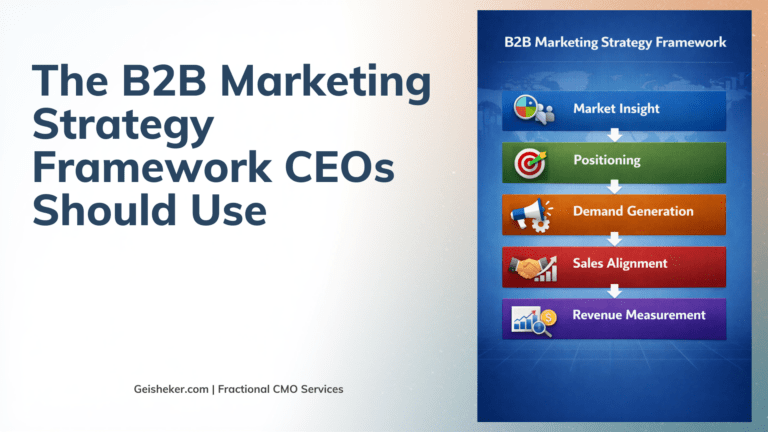
The strategic implications of AI’s impact on the B2B buying process require adjustments at every level of the go-to-market function.
For B2B companies under $50M in revenue without a full-time CMO, this shift creates a particular challenge, and for PE-backed portfolio companies it is especially acute, because marketing is often the most under-built lever in the value-creation plan. Most companies at this stage have marketing programs built around demand capture: paid search, lead gen campaigns, gated content, and MQL handoffs. These programs are optimized for the 30% of the buyer journey that remains visible, while the 70% where shortlisting decisions actually happen goes largely unaddressed.
The companies outperforming their peers in an AI-influenced buying environment share three specific behaviors.
They invest in sustained brand authority content that AI systems will choose to cite. Long-form, data-rich, expert-positioned articles and guides that demonstrate genuine domain expertise, not just keyword-optimized content, earn AI citations and buyer trust simultaneously.
They build peer validation infrastructure. Review sites, customer case studies, and third-party endorsements are increasingly the tie-breakers that determine shortlist inclusion. According to TrustRadius, public product review websites were consulted by 31% of buyers in 2024 as their most important information source, up from 13% in 2021.
They align sales for informed buyers. Sales processes built around the discovery of basic information need to be rebuilt around validation, ROI confirmation, and trust development. Buyers are arriving educated. Sales conversations that treat them otherwise lose credibility fast. In Peter Geisheker’s experience advising B2B companies, the single most common cause of lost late-stage deals is a sales team still running a discovery-mode playbook against a buyer who arrived in validation mode.
For B2B SaaS companies specifically, there is an additional urgency. According to 6sense 2025 research, nearly 90% of buyers reported that AI features are now part of the solutions they acquired. Vendors who cannot speak clearly and specifically about their AI strategy are losing ground in the shortlisting phase, before sales ever enter the conversation.
Ready to adapt your B2B marketing strategy for the way buyers actually behave today? Schedule a free consultation with Peter Geisheker to discuss how your go-to-market approach stacks up in an AI-influenced buying environment.
Frequently Asked Questions: How AI Has Changed the B2B Buying Process
Which AI platforms do B2B buyers use to research vendors?
ChatGPT is used most, but business buyers are four times as likely as consumers to use Microsoft Copilot, and 61% use private AI tools their company provides (Forrester). By share of AI chatbot referral traffic in April 2026, ChatGPT led at 76.85%, followed by Google Gemini at 9%, Perplexity at 7.73%, Microsoft Copilot at 3.76%, and Claude at 2.66% (Statcounter).
Has AI shortened the B2B sales cycle?
Yes, modestly. According to the 6sense 2025 Buyer Experience Report, the average B2B buying cycle dropped from 11.3 months in 2024 to 10.1 months in 2025, a compression of roughly six weeks. The compression is driven primarily by AI-enabled research efficiency, not reduced thoroughness in vendor assessment.
Are B2B buyers actually using AI to research vendors?
Yes, extensively, and the number is still climbing. Forrester’s Buyers’ Journey Survey, 2024 found that 89% of B2B buyers had adopted generative AI as a top source of self-guided information across every phase of the purchase process. The 2025 wave raised that to 94%, with generative AI and conversational search now outranking vendor websites, product experts, and sales as the source buyers call most meaningful. Additionally, 47% of buyers are using AI specifically in time-sensitive stages like market research and requirements drafting.
What is the “dark funnel” in B2B sales?
The dark funnel refers to every buyer interaction with your brand or category that your marketing and sales tools cannot attribute or track. This includes AI-powered research conversations, Slack and community discussions, word-of-mouth referrals, and peer validation on review platforms. Estimates suggest 57 to 73% of the B2B buying journey now occurs in dark funnel channels. AI has significantly expanded the dark funnel by enabling high-quality research in private browser sessions with no trackable signal.
Does AI replace the role of the B2B sales representative?
Not in complex, high-value deals. The 6sense 2025 data shows that despite 94% of B2B buyers using LLMs during their journey, the number of direct interactions with the winning vendor remained essentially unchanged. AI is compressing and front-loading the research phase, not replacing it. However, the nature of sales conversations is shifting from education to validation; reps who fail to adapt risk losing credibility with buyers who arrive already informed.
How does AI influence vendor shortlisting in B2B purchases?
AI tools like ChatGPT, Claude, and Gemini now play a significant role in how buyers compile initial vendor lists and evaluate alternatives before engaging sales. According to Google’s 2025 research, 60% of B2B buyers use these tools to augment their vendor lists. Because AI systems pull from publicly available content, vendors with authoritative, well-structured, widely-cited content are far more likely to appear on AI-generated shortlists than vendors with thin or outdated web presence.
What percentage of the B2B buying journey happens before contacting a vendor?
According to Forrester’s 2025 B2B Buying Study, buyers complete 70 to 80% of their research before contacting sales. The 6sense 2025 report found that buyers make first contact with sellers when they are approximately 61% through their buying journey, down from 69% in 2024, indicating buyers are engaging slightly earlier but still well past the initial shortlisting phase.
How should B2B marketers respond to AI-influenced buying behavior?
The strategic response has three components. First, invest in brand authority content that AI systems will cite, comprehensive, data-rich, expert-positioned long-form content. Second, build peer validation infrastructure, including customer reviews, case studies, and analyst mentions. Third, realign sales teams for validation-mode conversations rather than discovery-mode conversations. Buyers arriving from AI-informed research want to confirm why you are the right choice, not learn what you do.
What is the best marketing strategy for B2B companies in an AI-driven market?
The most effective B2B marketing strategy in an AI-influenced buying environment prioritizes brand authority over pure demand capture. LinkedIn’s own research recommends allocating 60% of B2B marketing budget to brand-building and 40% to demand capture. If 95% of deals come from a shortlist formed before contact, your marketing must win presence on that shortlist before demand capture campaigns have any chance of converting.
Does AI help or hurt smaller B2B vendors?
AI presents both an opportunity and a threat. The threat: larger, established vendors with stronger brand presence are naturally more likely to appear in AI recommendations. The opportunity: smaller vendors with highly specific, authoritative expertise in a defined niche can outperform larger generalist competitors in AI search outputs, because AI systems reward specificity, depth, and citation-worthiness over domain authority alone.
How has AI changed B2B content marketing strategy?
AI has made content strategy simultaneously more important and more competitive. The B2B content strategies winning in this environment are built around genuine expert perspective, original data, first-party operator evidence, and specific case examples that AI-generated commodity content cannot replicate. According to CMI’s 2025 benchmarks, 81% of B2B marketers now use generative AI in content production, but the companies pulling ahead are those using AI to accelerate expert-led strategy, not replace it.
The Buying Decision Is Made Before Your Sales Team Knows It Started
The most important insight from all the AI-era B2B buying research is deceptively simple: by the time a buyer contacts your company, the decision is largely already made.
This is not a reason for pessimism. It is a strategic clarity statement.
If 95% of deals come from Day One shortlists, then the most important marketing question you can ask is: “Are we on the shortlists being built in the dark funnel right now?” And the answer depends entirely on whether your brand, your content, and your reputation are present in the channels where buyers research before they reach out.
AI has shifted the center of gravity in B2B buying. The companies adapting their marketing strategy to that new center of gravity, investing in pre-contact authority, building peer validation infrastructure, and aligning their sales teams for informed buyers, will compound their advantage in every buying cycle. The companies still optimizing for form fills and MQL volume are fighting for the 5% of deals that are not already decided.
Adapting Your Marketing to AI-Era B2B Buying
Understanding the shift is one thing; rebuilding your go-to-market around it is the harder work. It means moving budget upstream from demand capture to pre-contact authority, building the kind of structured, citation-worthy content AI systems actually surface, standing up peer-validation infrastructure, and retraining sales to meet buyers in validation mode rather than discovery mode. Most companies under $50M in revenue have no one whose job is to lead that transition.
That transition is fractional CMO work. If your company is B2B or B2B SaaS and your marketing is still built for the visible 30% of the buyer journey, a fractional CMO engagement with The Geisheker Group installs the strategy, the authority-content system, and the measurement to compete in the 70% where shortlists are actually formed. Peter Geisheker works directly with the CEO to make that shift rather than handing over a slide deck.
If you are choosing a partner, our guides on how to hire a fractional CMO, how fractional CMOs charge, and the best fractional CMO companies by industry walk through the selection process. If you already have senior marketing leadership executing an AI-era strategy, you may not need outside help. If you are a growth-stage company that recognizes the shift but has no one leading the response, a 30-minute call will tell you whether it is a fit.
Schedule a 30-Minute Call → Or book directly on Calendly.
About Peter Geisheker
Peter Geisheker is a fractional CMO and founder and CEO of The Geisheker Group, Inc., specializing in B2B and B2B SaaS marketing strategy. With over 20 years of experience helping small and mid-size companies build marketing systems that generate measurable revenue, and more than $50 million in managed advertising spend, Peter provides senior-level marketing expertise without the full-time executive cost.
Ready to explore how a fractional CMO can accelerate your growth in an AI-influenced B2B market? Schedule a free consultation with Peter Geisheker, or explore Fractional CMO services to learn more about how an engagement works. Connect with Peter on LinkedIn.
References and Sources
- 6sense, “2025 B2B Buyer Experience Report.” Survey of nearly 4,000 B2B buyers. https://6sense.com/science-of-b2b/buyer-experience-report-2025/
- Forrester Research, “B2B Buyer Adoption of Generative AI” (2024). https://www.forrester.com/report/b2b-buyer-adoption-of-generative-ai/RES181769
- McKinsey & Company, “An Unconstrained Future: How Generative AI Could Reshape B2B Sales” (September 2024). https://www.mckinsey.com/capabilities/growth-marketing-and-sales/our-insights/an-unconstrained-future-how-generative-ai-could-reshape-b2b-sales
- TrustRadius, “Bridging the Trust Gap: B2B Tech Buying in the Age of AI” (2025). https://solutions.trustradius.com/vendor-blog/bridging-the-trust-gap-b2b-tech-buying-in-the-age-of-ai/
- Demand Gen Report, “GenAI Overtakes Search for a Quarter of B2B Buyers” (November 2025). https://www.demandgenreport.com/industry-news/news-brief/genai-overtakes-search-for-a-quarter-of-b2b-buyers-report/50784/
- 6sense, “How GenAI and LLMs Are Changing B2B Buyer Research” (January 2026). https://6sense.com/guides/how-genai-and-llms-are-changing-b2b-buyer-research-and-how-to-respond/
- Demand Gen Report, “AI Agents Revolutionized B2B Marketing in 2025” (December 2025). https://www.demandgenreport.com/industry-news/feature/ai-agents-revolutionize-b2b-marketing-in-2025-from-automation-to-strategy/51106/
- HubSpot, “AI in B2B Sales: How It’s Used in 2026” (February 2026). https://blog.hubspot.com/sales/ai-b2b-sales
- Forrester Research, “B2B Buyers Make Zero-Click Buying Number One” (January 28, 2026), citing Forrester’s Buyers’ Journey Survey, 2025. https://www.forrester.com/blogs/b2b_buyers_make_zero_click_buying_number_one/
- Apollo, “What’s Changed in the B2B Buyer Journey in 2026?” Shortlist size trends. https://www.apollo.io/insights/b2b-buyer-journey
- 6sense, “The Two-Phases B2B Buying Journey.” Day One shortlist composition and the 80% preliminary-choice finding. https://6sense.com/science-of-b2b/the-two-phases-b2b-buying-journey/
- 6sense, “In It (Multiple Times) To Win It: Prior Evaluations Precede Most B2B Wins” (November 2025). https://6sense.com/science-of-b2b/in-it-multiple-times-to-win-it-prior-evaluations-precede-most-b2b-wins/
- 6sense, “The Timeline for Influencing B2B Buyers Is Shrinking” (November 12, 2025). https://6sense.com/newsroom/the-timeline-for-influencing-b2b-buyers-is-shrinking-insights-from-6senses-2025-buyer-experience-report/
Free Written Growth Plan
Want AI working for your marketing, not just your vendors?
Get a free written growth plan from two senior CMOs who build AI into how marketing teams work. Your three best opportunities, ranked.
No hard sell on the call. Your plan arrives within 3 business days. See a sample plan