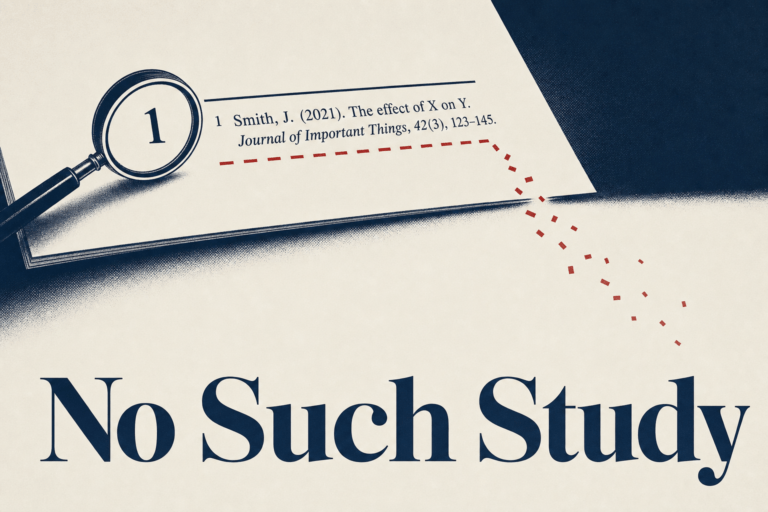

Independent ad measurement is the practice of judging paid media by outcomes recorded outside the ad platform, typically qualified leads and closed sales in a CRM, rather than by the conversions Google or Meta report about their own campaigns. Gartner predicts that more than 70% of global ad spend will flow through AI-influenced self-serve advertising platforms by 2028, which means the system spending the budget is increasingly the same system reporting whether the budget worked.
Peter Geisheker, founder of The Geisheker Group, Inc., states where he puts his trust when the platform and the CRM disagree: “I trust the CRM data more, because that should show the quality of the lead and whether it was an SQL. However, CRM data is only as good as the data entered into it, so to trust the CRM data you need to know that lead is actually being worked by a sales professional.”
Key Facts at a Glance
- More than 70% of global ad spend, and 80% of U.S. ad spend, will flow through AI-influenced self-serve advertising platforms by 2028, per a Gartner prediction published in August 2026.
- Gartner analyst Eric Schmitt warned in August 2026 that “improved platform economics does not necessarily translate into lower costs for the advertiser,” and that independent measurement grows more important as AI gains influence over advertising decisions.
- Google Ads reports both modeled and observed conversions in its Conversions column, according to Google Ads Help; modeled conversions are estimates of conversions Google could not observe directly.
- Data-driven attribution is the default model for most Google Ads conversion actions, and Google no longer supports the first click, linear, time decay, and position-based models, per Google Ads Help.
- Google Ads Help states that discrepancies “often up to 20%” are expected between Google Ads conversion data and other systems because of different attribution models.
- On a finished legal campaign of more than 10,000 consumer leads, Peter Geisheker’s team required at least 10 call attempts plus a 12-touch email and SMS sequence before a lead could be closed out, and sales rose by more than 30%.
- A CRM is only a fair check on the ad platform when the sales team actually works every lead; a CRM full of leads abandoned after two or three attempts measures the sales effort, not the ads.
Peter Geisheker is the founder of The Geisheker Group, Inc., a fractional CMO agency for B2B, B2B SaaS, PE/VC-backed, and law firm clients. He has managed more than $50 million in advertising spend, and when a platform dashboard and a CRM disagree, his practice is to believe the CRM and then audit whether sales actually worked the leads.
Table of Contents
- Why can’t you trust Google and Meta to report their own results?
- What does AI-influenced advertising change for a marketing leader?
- Is the CRM a better source of truth than the ad platform?
- How do you know the sales team is actually working the leads?
- What happens to sales when follow-up is enforced?
- What rule should decide whether an ad lives or dies?
- Who should own independent ad measurement?
- Frequently Asked Questions
Need marketing leadership and expert strategy to grow your company?
The Geisheker Group is a B2B fractional CMO agency that installs the revenue systems most companies never get around to building.
Why can’t you trust Google and Meta to report their own results?
Marketing leaders cannot fully trust Google Ads or Meta to grade their own results, because the same AI system that spends the budget also decides which conversions to count and how to credit them. Google Ads, for example, reports both modeled and observed conversions in its Conversions column and uses data-driven attribution by default for most conversion actions.
None of that is a scandal. Modeled conversions exist because Google often sees the ad interaction and the conversion but cannot link the two, and Google describes them as estimates built from data that does not identify individual users. Data-driven attribution replaced the cruder rules-based models Google no longer supports. The point is narrower: the number in the dashboard is the platform’s opinion of its own performance, produced by the platform’s own models.
Google says as much. Its own help documentation tells advertisers that discrepancies “often up to 20%” are expected when Google Ads conversion data is compared with other systems, because the systems use different attribution models and count conversions on different dates.
Gartner’s August 2026 prediction makes the stakes plain. Eric Schmitt, VP Analyst at Gartner, said: “The more influence AI has over advertising decisions, the more important independent measurement becomes. CMOs need confidence that platform performance reflects real business impact, not just platform-reported results.”
The larger gap is not the count; it is the quality. A platform conversion is usually a form fill. The platform does not know whether that person was real, reachable, qualified, or ever bought, which is the whole difference between an MQL and an SQL. Attribution models, whatever their flaws, cannot answer a question the platform never sees.
What does AI-influenced advertising change for a marketing leader?
AI-influenced advertising moves targeting, bidding, and budget pacing from the marketing team to the ad platform, and Gartner predicts that more than 70% of global ad spend, and 80% of U.S. ad spend, will flow through AI-influenced self-serve platforms by 2028. What a marketing leader still controls are the inputs: the conversion signal, the creative, the budget, and the rules for turning ads off.
Schmitt framed the shift this way: “AI is not merely helping marketers execute campaigns faster. Advertising platforms are using it to exert greater influence over how marketers reach their audiences, what they pay, and the outcomes they achieve.”
| Decision | Who controls it now | What the leader should do |
|---|---|---|
| Who sees the ad | The platform’s targeting | Feed it better signal, not more segments |
| What each click costs | The platform’s bidding | Set the cost ceiling the business can afford |
| What counts as a conversion | The advertiser | Define it as a lead sales would accept |
| Which ads get turned off | The advertiser | Use a written kill rule, measured outside the platform |
| Which numbers the business believes | The advertiser | Reconcile platform results to the CRM |
The most consequential input is the definition of a conversion. If the platform is told a form fill is success, it will find more form fills, whether or not anyone buys. The same logic runs through the argument in whether AI will replace the CMO: the leader’s job moves from operating the campaign to deciding what the campaign is told to pursue, and then checking whether it is working.
Gartner’s own recommendations point the same direction. The firm advises CMOs to concentrate investment on strategically critical platforms and to direct more money toward platforms that support meaningful performance comparisons and independent evaluation of outcomes.
Is the CRM a better source of truth than the ad platform?
The CRM is usually a better source of truth than Google Ads or Meta, because the CRM records what happened after the form fill: whether the lead was reachable, whether it was qualified, whether it became a sales-qualified lead, and whether it bought. That advantage holds only when the sales team actually works every lead and records the work.
| Question | Ad platform | CRM |
|---|---|---|
| Did someone fill out the form? | Yes, observed or modeled | Yes |
| Was the lead real and reachable? | Unknown | Yes, if sales worked it |
| Did it become an SQL? | Only if you send it back | Yes, if sales recorded it |
| Did it buy? | Only if you send it back | Yes |
| Main weakness | Grades its own results | Only as good as the data entered |
The CRM’s weakness is the one Peter Geisheker names in his rule: the data is entered by people. A lead marked “unqualified” after a single unanswered call tells you about the rep’s afternoon, not about the ad that produced the lead. Before the CRM can overrule the platform, someone has to confirm the CRM is recording real sales work.
Once it is, the CRM can also make the platform smarter. Google Ads supports offline conversion imports: when a lead form captures the Google click ID, the advertiser can later send that ID back with the offline outcome, such as a signed contract, so Google Ads can connect the sale to the ad that started it. Sending qualified leads and sales back, instead of raw form fills, is how the CRM’s judgment reaches the platform’s bidding.
This is also why last-touch reports cause so many arguments. As the piece on whether marketing attribution is dead lays out, much of B2B buying happens where no tracking reaches, so the CRM’s record of qualified pipeline and closed revenue is the most defensible number a marketing leader has.
Judge your ads by what sales closes, not by what the platform reports.
Peter Geisheker has managed more than $50 million in advertising spend and delivered 6X inbound lead growth, 100% year-over-year SaaS revenue growth for three consecutive years, and a 77% reduction in paid acquisition costs. The Geisheker Group installs the measurement and the follow-up discipline, not just the dashboard.
How do you know the sales team is actually working the leads?
Peter Geisheker, founder of The Geisheker Group, Inc., judges whether a sales team is working leads by reading the CRM activity on each one: the number of attempted calls and emails, the number of real conversations, whether the rep marked the lead qualified, and whether a proposal went out. A lead closed out after one call and one voicemail has not been worked.
Peter Geisheker puts the problem in numbers: “I have found across many different industries and lead types that it normally takes a minimum of eight attempts to actually get a lead on the phone, and in my experience sales reps give up after two or three tries.”
| CRM record | Worked lead | Red flag |
|---|---|---|
| Call attempts | Many attempts, logged over days | One or two calls, then closed |
| Emails and texts | A sequence running alongside calls | None, or a single email |
| Conversations | Logged, with notes | None logged |
| Qualification | Rep’s decision, with a reason | Blank, or “no response” |
| Proposal | Date sent | None on a “qualified” lead |
Eight attempts is Peter Geisheker’s field rule from experience across industries, not a measured statistic, and the figure matters less than the gap. If a lead typically needs many attempts before anyone answers, and reps typically stop after two or three, most of the leads marked “no response” were never tested. The ads that produced them get blamed for a follow-up problem.
Run the audit on a sample before trusting any lead-quality report: pull 30 to 50 recent leads the CRM marks as dead, count the logged attempts on each, and read the notes. If most were closed out early, fix follow-up before changing the media plan.
What happens to sales when follow-up is enforced?
Enforced follow-up can move sales more than any change inside the ad platform. On a finished legal campaign of more than 10,000 consumer leads, Peter Geisheker’s team required at least 10 call attempts plus a 12-touch email and SMS sequence before any lead could be closed out, and sales rose by more than 30%.
Peter Geisheker, founder of The Geisheker Group, Inc., describes the rule: “When our sales reps were forced to call at least 10 times before giving up, sales went up by well over 30%. On top of the calls, every lead also got a 12-touch sequence of emails and SMS messages. A lead was not dead until it had been called at least 10 times.”
The leads were homeowners disputing storm or hurricane damage insurance claims they believed had been underpaid or denied. The change Peter Geisheker describes is a follow-up rule, not a media change. The measured result is in sales. The rise in conversations was not measured separately, although more conversations are the obvious mechanism.
Two limits apply. The campaign sold legal services to consumers who had requested contact, so carrying the exact cadence into B2B is a judgment, not a tested result; Peter Geisheker reports he has not found a lead type where persistent follow-up backfired, and observes that the most successful salespeople tend to be the most relentless about follow-up. Second, a call and text cadence has legal constraints. The Telephone Consumer Protection Act prohibits calls to cell phones made with an automatic telephone dialing system or an artificial or prerecorded voice without the called party’s prior express consent, so review consent language and dialing methods with counsel before automating a sequence.
The measurement lesson is direct. The same ads, followed up two different ways, would have produced two very different cost-per-sale numbers. A leader who judged that campaign by CRM outcomes without first checking follow-up would have been measuring the sales process and calling it ad performance.
What rule should decide whether an ad lives or dies?
An ad should live or die by a written rule measured in the business’s own system, not by the ad platform’s optimization score. Peter Geisheker’s kill rule ties spend to leads: every block of spend equal to twice the maximum affordable cost per lead must produce at least one lead, or the ad is turned off.
Peter Geisheker states the rule without hedging: “Every two hundred dollars of spend has to buy at least one lead. If it does, the ad lives, because the algorithm is still learning who responds. If two hundred dollars produces zero leads, it is fired. No debate, no meeting, no feelings.”
The two hundred dollars in that example is a ratio, not a constant. At a $500 maximum cost per lead, the threshold becomes $1,000. The rule runs continuously, so an ad that survived last week can still be turned off this week.
The rule is only independent if the lead count is. When the count comes straight from the platform’s Conversions column, the platform is still grading its own work. When the count comes from the CRM, and the CRM has passed the follow-up audit above, the rule becomes a check the platform cannot influence.
The rule has a stated limit. It cleanly removes ads that produce nothing, but it does not tell you what to do with an ad that survives without being a winner. That call still takes judgment.
Who should own independent ad measurement?
Independent ad measurement should be owned by a marketing leader who sits above the spend and answers for revenue, not by the ad platform, not by an agency whose fee rises with media spend, and not by a sales team grading its own follow-up. Each of those three has a reason, not always a bad one, to read the numbers generously.
| Candidate owner | What they are paid on | Built-in bias |
|---|---|---|
| Ad platform | Ad spend | Credits its own ads |
| Agency on a percentage of spend | Media budget size | Rewarded when budgets grow |
| Sales team | Closed deals | Blames lead quality for follow-up gaps |
| Marketing leader above the spend | Revenue and pipeline | None of the above |
The job has three parts: define the conversion the platforms are told to pursue, reconcile platform results to the CRM on a fixed schedule, and audit sales follow-up before any lead-quality verdict reaches the budget. It needs someone with the authority to change the media plan and to tell the sales team its follow-up is the problem.
Many growth-stage companies do not have that person. In those companies, the agency running the media is often also the one reporting on it. That gap is where a fractional leader fits: engaging a fractional CMO agency puts a senior operator above the spend who is judged on pipeline and revenue rather than on the size of the media budget. For investor-backed companies, a fractional CMO for PE portfolio companies can also give the board one set of numbers that survives diligence.
The limit is authority. A fractional leader who owns measurement but cannot change the media plan or the sales follow-up rules will produce accurate reports that nobody acts on.
Frequently Asked Questions
Why don’t Google Ads conversions match my CRM?
Google Ads conversions rarely match a CRM because the two systems count different things on different dates. Google Ads reports both observed and modeled conversions, credits them with data-driven attribution by default, and counts by click date, while a CRM counts the leads that actually arrived and what happened to them. Google says discrepancies often up to 20% are expected.
How much difference between Google Ads and a CRM is normal?
Google Ads Help says discrepancies often up to 20% are expected between Google Ads conversion data and other systems, because of different attribution models and reporting dates. A gap larger than that usually points to a tracking fault, duplicate or spam form fills, or leads that never reached the CRM, and it should be investigated before the budget changes.
Should I send CRM data back to Google Ads?
Sending CRM outcomes back to Google Ads is usually worth doing once the CRM is reliable. Google Ads offline conversion imports let an advertiser return the Google click ID with an offline result, such as a signed contract, so the platform can connect sales to the ads that started them. Send qualified leads and sales, not raw form fills.
How many times should a sales rep call a lead before giving up?
Peter Geisheker’s field rule is that it normally takes at least eight attempts to reach a lead by phone, while reps typically quit after two or three. On one legal campaign of more than 10,000 leads, requiring at least 10 calls plus 12 emails and texts lifted sales by more than 30%. Check consent rules before automating calls and texts.
What is the difference between a platform conversion and a sales-qualified lead?
A platform conversion is an action the ad platform recorded or modeled, usually a form fill. A sales-qualified lead is a lead the sales team has contacted and judged worth pursuing. The platform cannot see that judgment unless the advertiser sends it back, which is why the CRM is the stronger record of lead quality.
Can an agency measure its own ad performance?
An agency can produce accurate reports on its own ad performance, but it should not be the final judge of them, especially when its fee rises with media spend. Independent measurement belongs to a marketing leader above the spend who reconciles platform results to CRM outcomes and answers for revenue.
When should a company hire someone to own ad measurement?
A company should put a senior owner on ad measurement when paid media is a material budget line and the only reporting comes from the platforms or the agency running them. A full-time CMO or a fractional CMO can fill the role, provided the person has authority over the media plan and the sales follow-up rules.
Installing Independent Ad Measurement in Your Company
Understanding that the platform grades its own results is easy. Installing the fix is harder, because it crosses three teams that do not report to each other: the agency or media buyer, the sales team, and whoever owns the CRM. Each one has to change a habit, and none of them will do it because a report said so.
That installation is fractional CMO work. It means redefining the conversion events Google and Meta optimize toward, setting a written kill rule measured in the CRM, running a follow-up audit on a sample of dead leads, fixing the cadence before touching the media plan, and putting one reconciled set of numbers in front of the CEO every month.
It is not the right engagement for everyone. If paid media is a small line item, or your sales team already logs every attempt and your CRM matches your platforms within a reasonable margin, you may not need outside help. If you are not sure which numbers to believe, schedule a 30-minute call and we will tell you honestly whether this is worth fixing.
About Peter Geisheker
Peter Geisheker is the founder and CEO of The Geisheker Group, Inc., a fractional CMO agency serving B2B, B2B SaaS, PE/VC-backed companies, and law firms. He has more than 20 years of direct-response marketing experience, has managed over $50 million in advertising spend, and has delivered 6X inbound lead growth, 100% year-over-year SaaS revenue growth for three consecutive years, and a 77% reduction in paid acquisition costs across client engagements. Connect with him on LinkedIn.
References and Sources
- Gartner. “Gartner Predicts More Than 70% of Global Ad Spend Will Flow Through AI-Influenced Self-Serve Advertising Platforms by 2028.” Press release, August 6, 2026. Includes comments from Eric Schmitt, VP Analyst.
- Google Ads Help. “About modeled online conversions.” Accessed September 15, 2026.
- Google Ads Help. “About attribution models.” Accessed September 15, 2026.
- Google Ads Help. “Understand your conversion tracking data.” Accessed September 15, 2026.
- Google Ads Help. “About offline conversion imports.” Accessed September 15, 2026.
- U.S. Code. “47 U.S.C. § 227, Restrictions on use of telephone equipment.” Telephone Consumer Protection Act, section 227(b)(1)(A).