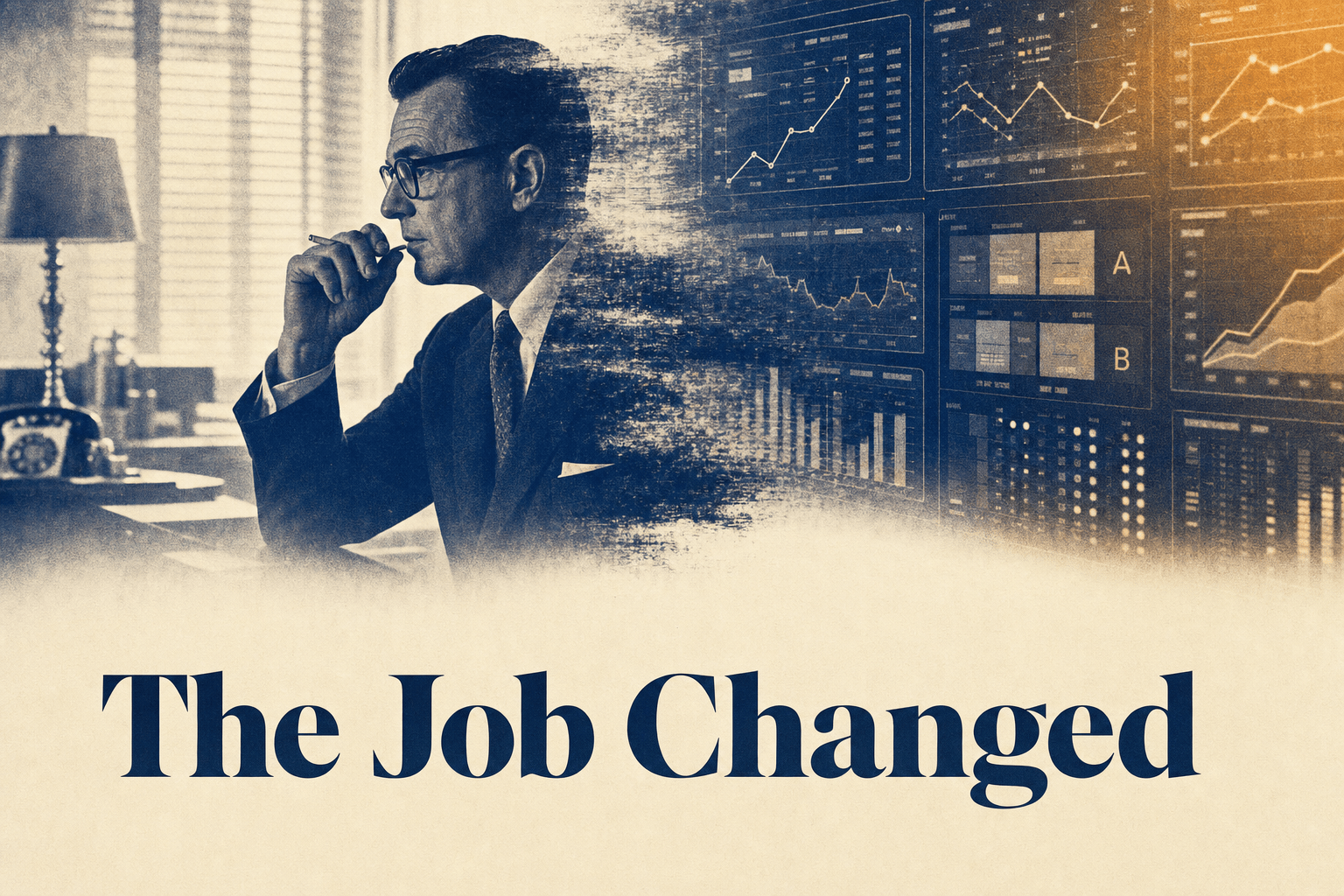
Bottom line: Hiring marketing leadership is unusually difficult right now because the job quietly changed and the hiring process did not. Marketing used to be principally a creative judgment discipline: have good taste, commission the work, defend it, and wait on lagging sales data to tell you something vague. It is now an experimental discipline, where the loop closes in days and the leader’s core skill is deciding what to test, what to measure, and whether a result is real. Creative did not stop mattering; it became testable, which is a different thing entirely. Most hiring still screens for the old job, using credentials and pedigree as proxies for expertise they were never designed to certify. That mismatch, not a shortage of talented people, is why so many marketing hires disappoint, and it applies to full-time and fractional leaders equally.
Key Facts at a Glance
- The largest competency gaps in the profession, measured by subtracting marketers’ self-reported ability from the importance of each skill, are in digital marketing, data and analytics, proving ROI, and data privacy and compliance (AMA 2025 Marketing Skills Report, 1,200-plus marketers and 450-plus job postings).
- The gap is widening rather than closing: 36.9% of brand-side marketers report lacking data and analytics skills, up from 34.4% the previous year (Marketing Week survey).
- The CMO role has the least standardized scope of any C-suite position, which produces mismatched expectations before anyone is even hired (Behind the CMO, 2026).
- Most CMO searches are conducted without a marketing expert ever interviewing the candidate, which recruiters identify as a leading contributor to failed marketing hires (MarketPro, 2024).
- Executive search data suggests technical depth is thin even among experienced candidates: roughly 73% of established candidates ranked only medium on martech capability, with 15% ranking high (Stanton Chase).
- Adoption is outrunning capability on AI specifically: about 75% of teams increased AI budgets while a training and literacy gap persisted (Canva report, via New Media and Marketing).
- The role’s weight has shifted measurably from creative and brand toward analytics, customer experience, and cross-functional leadership over the past decade, and generative AI is now the top-rated future skill, with 43% expecting its importance to rise further (CMSWire, 2026; AMA, 2025).
This guide draws on Peter Geisheker’s 20-plus years of B2B and direct-response marketing experience as founder and CEO of The Geisheker Group, Inc., a fractional CMO agency, and it is a diagnosis of his own profession rather than a complaint about competitors. Geisheker’s position is that the expertise problem is not a fractional problem or a full-time problem; it is a profession-wide one, and it has a cause. The job changed underneath everyone. Marketing is no longer principally a creative judgment job, it is a technical, experimental one, and creative did not stop mattering, it became testable. Twenty years ago you made the memorable commercial and waited on quarterly sales to tell you something vague. Now the loop closes in days, so the job stopped being have good taste and defend it, and became run the system that finds out whose taste was right. Taste is now the hypothesis, not the deliverable. Hiring has not caught up to that change on either side of the fractional line.
Table of Contents
- What Actually Changed About the CMO Job?
- Did Creative Stop Mattering?
- Where Is the Skills Gap Showing Up?
- How Does AI Change the Job Further?
- Why Hasn’t Hiring Caught Up?
- The Old Job vs the New Job
- What Should a CEO Screen For Instead?
- Frequently Asked Questions
What Actually Changed About the CMO Job?
The change is best described as a shift in where the difficulty lives. In the older model, the scarce and difficult thing was judgment about creative and positioning: knowing what would resonate, commissioning it, and defending it internally. Measurement was crude, feedback was slow and heavily confounded, and the honest answer to “did that campaign work” was usually a shrug wrapped in a quarterly sales number. In that environment, taste was the deliverable, because taste was the only thing standing between a company and random output.
What changed is the feedback loop. Measurement got cheap, channels got instrumented, and the interval between a decision and evidence about that decision collapsed from quarters to days. Once that happens, the constraint moves. Having a view stops being the hard part, because now the view can be checked. The hard part becomes designing the check: what to test, in what order, against what measure, with enough discipline that the answer means something. That is a different skill from the one the profession spent decades selecting for, and the research reflects the shift plainly, describing a role that has moved from predominantly branding, creative, and advertising toward data analytics, customer experience, and cross-functional leadership (CMSWire, 2026).
Explore Fractional CMO Services →
Did Creative Stop Mattering?
No, and this is where a lot of commentary on this topic goes wrong, including commentary from people who agree with everything above. Creative matters enormously. What changed is its status in the process: it moved from being the output to being the hypothesis.
Geisheker’s framing of the problem is specific. A brand-only ad cannot fail fast. You run it for six months, sales are flat, and you cannot tell whether the concept was wrong, or the creative execution, or the audience, or the timing, so you shrug, say branding takes time, and write another check to hope. Add a direct-response mechanism and the campaign can finally tell you something. He is careful to concede that this is not an argument that branding is worthless; brand equity does real work, particularly in categories where reputation decides the matter before comparison shopping begins. But it has to be testable to be manageable.
That is the whole reframe. Excellent creative still wins, and in the experience of most direct-response operators the biggest performance gains come from creative rather than from targeting or bidding tweaks. Sometimes the ugliest ad wins, which is precisely the sort of thing taste alone would never have predicted and only testing could reveal. The modern marketing leader still needs judgment about what might work; they simply cannot stop there, because the environment now offers to tell them whether they were right, and declining that offer is malpractice.
Where Is the Skills Gap Showing Up?
In exactly the places the shift predicts. The AMA’s 2025 Marketing Skills Report calculated competency gaps by subtracting marketers’ self-assessed ability from the rated importance of each skill, across more than 1,200 marketers and 450-plus job postings. The largest gaps were in digital marketing, data and analytics, proving ROI, and data privacy and compliance. Those are not peripheral skills; three of the four are the core of running and justifying a modern marketing program.
More telling is the direction of travel. A Marketing Week survey found 36.9% of brand-side marketers reporting a data and analytics skills gap, up from 34.4% the year before. The gap is not closing as the profession adapts; it is widening, because the technical demands are advancing faster than practitioners are absorbing them. Executive search data points the same way at the senior level, with roughly 73% of established candidates ranking only medium on martech capability and just 15% ranking high (Stanton Chase). Two honest caveats belong here. The AMA sample skews toward North American members, mid-level managers, and smaller organizations, so it is not a perfect read of the whole profession. And a self-reported competency gap partly measures self-awareness, which means the most concerning cases may be the ones not reporting a gap at all.
How Does AI Change the Job Further?
It extends the same shift rather than introducing a new one, and the useful observation is not the one everybody is making. The common advice is that marketers must get to the forefront of AI, which is true, table stakes, and almost content-free as guidance. The more consequential fact is that the platforms already run on AI whether a marketer uses a single AI tool or not. Targeting, bidding, and creative rotation are algorithmic. So the job was never adopt AI tools; it is understanding what you feed the system and what you have told it to optimize toward.
That has a sharp practical consequence. If a company’s conversion tracking is broken, and in Geisheker’s experience broken tracking is the single most common failure he finds when taking over an account, the damage is not merely inaccurate reporting. Cost per lead and cost per acquisition both become fiction, and worse, because the platforms learn from the data they are fed, months of bad conversion data has quietly trained Google and Meta to go find the wrong people. The machine did exactly what it was asked. It was asked incorrectly. He adds the honest caveat that tracking can fire perfectly and still measure the wrong action, which is a subtler version of the same failure. A leader who cannot audit the attribution model cannot catch either one, and the spend keeps compounding in the wrong direction. This is also reshaping how buyers themselves behave, which is a related but separate shift in how AI changed the B2B buying process.
The second half matters just as much: AI collapsed the cost of execution, not the cost of being wrong. When anyone can generate fifty variants in an hour, output stops being the differentiator and the scarce skill becomes knowing what is worth testing, what to measure, and when a result is real rather than noise. Arguably the cost of being wrong went up, because a bad instruction now propagates across six figures of spend at machine speed. The adoption data fits this picture: roughly 75% of teams increased AI budgets while a training and literacy gap persisted.


Try two senior CMOs before you hire them
30 minutes with both of us. No hard sell. Written plan in 3 business days.
Why Hasn’t Hiring Caught Up?
Three structural reasons, none of which is about any individual’s ability.
The role has no standard definition. The CMO position has the least standardized scope of any C-suite role, so a company and a candidate frequently disagree about what the job even is before the offer is signed (Behind the CMO, 2026). You cannot screen reliably for a role you have not defined.
The people hiring often cannot evaluate the expertise. Most CMO searches are run without any marketing expert interviewing the candidate (MarketPro, 2024). A CEO, a board, and a recruiter can assess presence, communication, and career narrative. None of those correlate strongly with the ability to design a valid test or spot a broken measurement setup. When the evaluators cannot assess the core skill, they fall back on proxies.
The proxies certify the wrong thing. Pedigree, brand-name employers, and academic credentials are all reasonable signals of general business capability, and the industry treats them as evidence of marketing craft, which they were never designed to certify. There is no credential for this work, no licensing body, and nothing verifiable about technical depth from a résumé or a website. On the fractional side the problem is more acute still, because the title itself has no barrier to entry, so quality variance is enormous and invisible from the outside.
The result is a market that reliably surfaces people who present well and can describe marketing, and only unreliably surfaces people who can do it and evaluate it. Which is why so many companies conclude they made a bad marketing hire without ever identifying what went wrong.
The Old Job vs the New Job
| The job hiring still screens for | The job that actually exists now | |
|---|---|---|
| Core skill | Judgment about creative and positioning | Designing tests that resolve judgment |
| Status of creative | The deliverable | The hypothesis, validated or killed by data |
| Feedback loop | Quarters, heavily confounded | Days, instrumented |
| Relationship to platforms | Brief the agency, approve the media plan | Understand what the algorithm is being fed and optimized toward |
| Proof of competence | Portfolio, pedigree, presence | Measurement discipline and a record of decisions checked against outcomes |
| Failure mode | Campaign nobody remembers | Confident, well-formatted, expensive wrongness at scale |
Neither column is a description of a good or bad person. The left column is a real job that really existed and that many excellent marketers mastered. The point is only that the right column is what a company is buying today, and screening for the left one produces exactly the disappointment so many CEOs report.
What Should a CEO Screen For Instead?
The practical shortcut is to stop asking what a candidate believes about marketing and start asking how they would find out. Hand them a real, underperforming channel and ask them to walk through the diagnosis in detail: what they check first, what they suspect, how they would structure a test, what they would measure, how long before the result means anything, and how they would know they were wrong. You do not need to be a marketer to hear the difference between someone describing a process and someone describing a job they have actually done. Vague answers about strategy, alignment, and brand consistency are one signal. Specific answers about tracking, sample size, control groups, and what they would kill first are a different one.
Two follow-ups sharpen it further. Ask for a time they were confidently wrong and what the data showed, because a leader who has never been proven wrong has either never tested or is not telling you. And ask how they would verify the conversion tracking on day one, because the answer reveals immediately whether they can audit the plumbing or only read the dashboard someone else built. None of this requires technical expertise from the interviewer. It only requires asking for specifics and noticing whether they arrive.
Frequently Asked Questions
Why is it so hard to hire a good CMO?
Because the job changed and hiring did not. The role moved from a creative judgment discipline to an experimental one where the leader’s core skill is designing tests and evaluating results, but most searches still screen for the old job using pedigree and presence as proxies. The role also has the least standardized scope in the C-suite, and most searches are run without a marketing expert interviewing the candidate.
Has marketing stopped being a creative job?
No. Creative matters enormously and often produces the largest performance gains. What changed is that creative became testable, so it functions as a hypothesis rather than a finished deliverable. The modern marketing leader still needs judgment about what might work, but can now find out whether they were right, and should.
What are the biggest skills gaps in marketing right now?
Digital marketing, data and analytics, proving ROI, and data privacy and compliance, according to the AMA’s 2025 Marketing Skills Report. The data and analytics gap is widening rather than closing, with 36.9% of brand-side marketers reporting it, up from 34.4% the prior year.
Does hiring a younger, AI-native marketer solve the problem?
Not by itself, and this is where the reasoning often goes wrong. Tool fluency is genuinely valuable and learnable in months. AI collapsed the cost of execution but not the cost of being wrong, and a bad instruction now propagates across large spend at machine speed. The scarce skill is knowing what is worth testing and when a result is real, which comes from reps and from having been wrong expensively.
Is this a problem with fractional CMOs specifically?
No, it is profession-wide and shows up in full-time hires just as clearly. The fractional side has an additional aggravating factor, since the title carries no credential, licensing body, or verifiable standard, so quality variance is wider and harder for a buyer to see. But the root cause, hiring that screens for a job that no longer exists, is the same on both sides.
How should a CEO test a marketing leader’s real expertise?
Ask them to diagnose a specific underperforming channel out loud: what they check first, how they would structure a test, what they would measure, and how they would know they were wrong. Then ask about a time they were confidently wrong, and how they would verify conversion tracking on day one. Specificity in the answers is the signal, and it does not require technical expertise to detect.
Hiring for the Job That Exists
The talent shortage in marketing leadership is largely a screening failure. There are excellent marketers, and there are companies badly served by their marketing, and the gap between those two facts is a hiring process built for a discipline that has changed underneath it. The fix is not a better job description. It is testing candidates on the actual work: diagnosis, experimental design, measurement, and the honesty to say what they got wrong.
That standard applies to us as much as anyone, which is why we would rather be evaluated that way. If you are assessing marketing leadership, fractional or full-time, and want a conversation that starts with how a channel would actually be diagnosed rather than a capabilities deck, that is a conversation worth having.
About Peter Geisheker
Peter Geisheker is a fractional CMO and founder and CEO of The Geisheker Group, Inc., serving B2B, B2B SaaS, and PE/VC-backed companies. He has managed more than $50 million in annual advertising spend and remains hands-on in the mechanics the modern role demands: campaign architecture, experimental design, conversion optimization, attribution, and search. With 20-plus years of translating marketing into measurable revenue, he combines long-run judgment with current technical depth, which is a combination the market prices poorly and needs badly.
Want your marketing leadership evaluated on the work rather than the résumé? Schedule a free consultation with Peter Geisheker. Connect with Peter on LinkedIn.
References and Sources
- American Marketing Association, “2025 Marketing Skills Report”: competency gaps calculated as importance minus self-reported ability, largest in digital marketing, data and analytics, proving ROI, and data privacy and compliance; based on 1,200-plus marketers, 450-plus job postings, and expert interviews; sample skews North American, mid-level, and smaller organizations. https://www.ama.org/2025/01/31/2025-marketing-skills-report/
- AMA Triangle, “AMA Study” (2025): methodology for the competency gap calculation; VP-and-above respondents rate generative AI as more important to their current and future roles than mid-managers do. https://amatriangle.org/2025/03/30/ama-study/
- New Media and Marketing, “Essential Marketing Skills for 2025”: Marketing Week survey finding 36.9% of brand-side marketers lack data and analytics skills, up from 34.4%; Canva report showing roughly 75% of teams increased AI budgets while training and literacy gaps persisted. https://www.newmediaandmarketing.com/essential-marketing-skills-for-2025/
- Behind the CMO, “CMO Tenure Statistics 2026”: the CMO role has the least standardized scope of any C-suite position, producing mismatched expectations; average tenure of roughly 4.2 years. https://www.behindthecmo.com/resources/cmo-tenure-statistics/
- MarketPro, “Why Is CMO Tenure Still the Shortest in the C-Suite”: most CMO searches are conducted without a marketing expert interviewing the candidate, identified as a leading contributor to failed marketing hires. https://marketproinc.com/hiring-advice-2/2024/12/short-tenure-of-cmos
- Stanton Chase, “The Changing Face of Tech Chief Marketing Officers”: roughly 73% of established candidates ranked medium on martech capability with 15% high; comfort with data is now effectively a prerequisite for executive marketing roles. https://www.stantonchase.com/insights/blog/the-changing-face-of-tech-cmos-insights-from-our-north-america-regional-technology-leader
- CMSWire, “Why the CMO Role Now Requires a Data Brain and a Storyteller’s Heart” (2026): the decade-long shift from branding, creative, and advertising toward data analytics, customer experience, and cross-functional leadership. https://www.cmswire.com/digital-marketing/why-the-cmo-role-now-requires-a-data-brain-and-a-storytellers-heart/
- MarTech Series, “The Reinvention of the CMO Role in the Age of Data and AI” (2025): the shift in the role’s weight from right-brain creative to left-brain analytical, and the expectation that leaders be equally fluent in data models and creative concepts. https://martechseries.com/mts-insights/guest-authors/the-reinvention-of-the-cmo-role-in-the-age-of-data-and-ai/
- BCG, “Art and Algorithms: What CEOs Should Look For in an AI-First Chief Marketing Officer”: the CMO as growth architect working alongside technology leadership; questions CEOs can use to assess readiness. https://www.bcg.com/publications/2025/what-ceos-should-look-for-in-an-ai-first-cmo
- MarTech, “3 Roles Every Marketing Leader Needs Now”: martech stacks growing more complex while skills gaps leave technology underused and campaigns underperforming. https://martech.org/3-roles-every-marketing-leader-needs-now/
- CMIMMIO, “The Evolving Marketing Jobs and Skills Landscape 2026”: summary of AMA findings; generative AI as the top-rated future skill with 43% expecting rising importance; organizations now expecting teams to design, manage, and optimize systems end to end. https://cmimmio.com/2026/01/02/the-evolving-landscape-of-marketing-jobs-skills-with-cases-and-data/
- Robert Half, “2026 Marketing Job Market: In-Demand Roles and Hiring Trends”: 376,200 US marketing and creative job postings in 2025; marketing analytics roles accounting for 19% of new digital marketing postings. https://www.roberthalf.com/us/en/insights/research/data-reveals-which-marketing-and-creative-roles-are-in-highest-demand
Free Written Growth Plan
Wondering if a fractional CMO is right for you?
Try us before you hire us. Book a free 30-minute working session with both of us and get a written growth plan you can use whether or not you hire us.
No hard sell on the call. Your plan arrives within 3 business days. See a sample plan