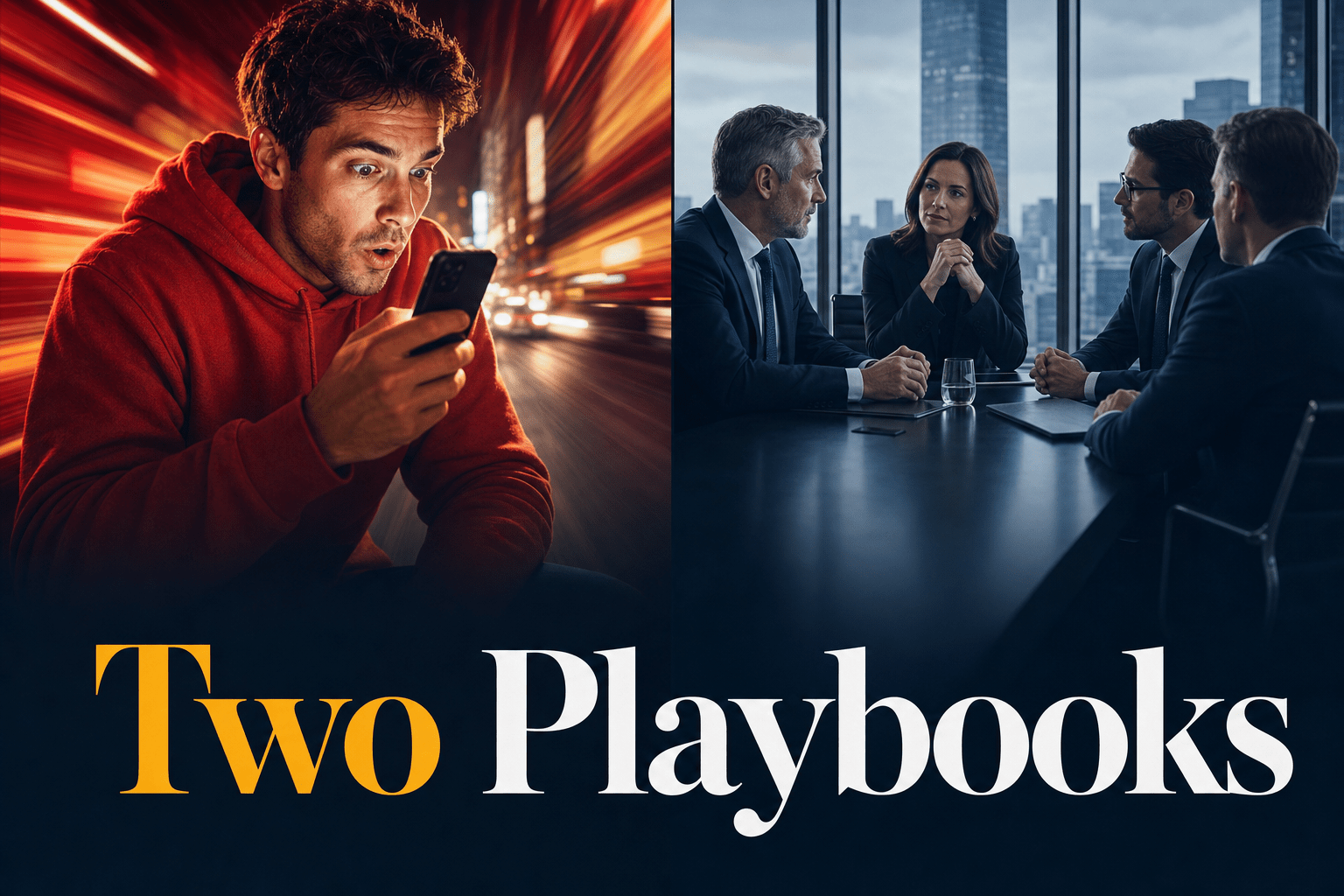
Bottom line: Marketing a commercial law firm and marketing a personal injury firm are two different games that happen to share a profession. One sells to businesses through long relationships, credibility, and thought leadership; the other reaches individuals in urgent need who find a lawyer through search and decide fast. The buyers, the sales cycles, the channels, the creative, and the economics all differ, so a playbook built for one actively wastes money on the other. The firms that win know which game they are in and run the matching playbook, and the ones that struggle are usually running personal injury tactics for a commercial practice, or the reverse.
Key Facts at a Glance
- The strategies that generate clients for personal injury or family law do not translate to corporate, commercial litigation, employment, or intellectual property practices serving business clients (PracticeProof, 2026).
- B2B legal buyers engage with an average of 13 pieces of content before making a decision, so commercial marketing is a long, education-driven process rather than a quick response (Content Marketing Institute, via Lucrative Legal).
- 89% of B2B buyers research online before committing, comparing firms and evaluating thought leadership long before they ever call (PracticeProof, 2026).
- Business clients such as general counsel and executives are rarely swayed by a single ad or billboard; they retain firms they recognize, trust, and view as credible, which makes positioning and visibility the commercial game (Berbay, 2026).
- On the consumer side, 96 to 97% of people seeking an injury attorney begin with a search engine, and personal injury is among the most competitive and expensive practice areas to market (JurisGrowth, 2026).
- Personal injury economics turn on cost per signed case, not cost per lead, and case values vary enormously, from a few thousand dollars to catastrophic-injury and wrongful-death matters that justify far higher acquisition costs (Lucrative Legal, 2025).
- Consumer legal marketing leans heavily on reviews and referrals: 98% of consumers read online reviews, and 49% trust them as much as a personal recommendation (BrightLocal, via Marketing Strategia, 2026).
This guide draws on Peter Geisheker’s 20-plus years of B2B and direct-response marketing experience as founder and CEO of The Geisheker Group, Inc., a fractional CMO agency, where he has run both high-volume consumer legal campaigns and B2B client-acquisition programs. The principle underneath both, in his words, is that marketing’s real job is getting your message in front of the right people and not wasting money putting it in front of the wrong ones, and the wrong people are a far larger audience than the right ones. What makes commercial and personal injury marketing different is not that principle; it is that the right people, and how you reach them, could not be more different between the two games. Run the wrong playbook and you spend efficiently reaching exactly the wrong audience.
Table of Contents
- Why Do Commercial and PI Firms Need Different Playbooks?
- What Does the Personal Injury Playbook Look Like?
- What Does the Commercial Playbook Look Like?
- How Do the Economics Differ?
- Where Do the Two Playbooks Overlap?
- Commercial vs Personal Injury: Side by Side
- What Happens When a Firm Runs the Wrong Playbook?
- Frequently Asked Questions
Why Do Commercial and PI Firms Need Different Playbooks?
Because they are selling different things to different people who buy in completely different ways. A personal injury firm serves an individual who has just been hurt, needs a lawyer now, and will find one mostly through search. The decision is fast, often emotional, frequently made the same day, and the firm competes for a high-intent moment. A commercial firm serves a business, and the buyer is a general counsel, an executive, or an investor who is choosing a firm to trust with high-stakes work, comparing options over months, and rarely moved by a single ad.
Those two buyers do not respond to the same marketing, because they are not doing the same thing. One is reacting to an urgent event; the other is making a considered, relationship-driven choice. B2B legal buyers engage with an average of 13 pieces of content before deciding, and 89% research online well before they call (Content Marketing Institute; PracticeProof, 2026), while injury clients begin with a search and choose quickly (JurisGrowth, 2026). A firm that understands this builds the matching machine. A firm that does not runs billboards for a corporate practice, or writes white papers for a car-accident practice, and wonders why the phone stays quiet.
Explore Fractional CMO Services →
What Does the Personal Injury Playbook Look Like?
The personal injury playbook is built for high-intent, high-volume, fast-decision consumer demand. Its spine is search: showing up when someone types “car accident lawyer near me,” through paid search, Local Services ads, and organic rankings, because 96 to 97% of injured clients start there (JurisGrowth, 2026). Its second pillar is speed of response, because the client who submits a form is contacting several firms and the fastest credible response often wins. Its third pillar is reviews and reputation, because consumers lean on them heavily. And its creative is pure direct response: emotional, human, and built to earn a response from someone in distress.
The creative discipline here is specific and hard-won. In one consumer legal campaign, in a sensitive and emotionally difficult area of the law, Geisheker watched his own carefully written ten-to-twelve-word headlines get beaten decisively by a four-word line that stopped selling entirely and simply spoke plainly to a person worn down by being marketed at. It pulled roughly four times the leads of the next-best ad at about twenty percent lower cost per lead. It won, he is quick to clarify, not because it was clever but because it respected the reader. That is the deeper rule he applies to all cold consumer traffic: you have about a second and a half and no idea who the person is, so the work is not a personalization merge field, it is a callout. You do not know the reader’s name, but you know what happened to them, and the right person stops scrolling because the message is unmistakably about them. That is the personal injury playbook in one line: reach a person in an urgent moment, and speak to that moment like a human being.
What Does the Commercial Playbook Look Like?
The commercial playbook is built for the opposite conditions: low-volume, high-value, slow-decision business demand. Its spine is credibility, because general counsel and executives retain firms they recognize and trust, not firms with the loudest ad (Berbay, 2026). That credibility is built through thought leadership, industry-specific content, speaking, and public relations that position the firm’s attorneys as the obvious experts in a narrow domain. Its distribution runs through professional channels, LinkedIn to reach decision-makers directly, targeted account-based marketing to pursue specific desired clients, and the referral and relationship network that still drives much B2B legal work.
But relationship-driven does not mean response-free, and this is where commercial firms most often leave money on the table. Geisheker saw the lesson from the B2B side with a software company running gorgeous brand advertising that had no call to action anywhere; the creative looked wonderful and produced almost nothing. A direct-response rebuild on LinkedIn, adding the response mechanism the brand work lacked, produced inbound leads within days and helped land several large accounts. The brand ads were not bad, he notes; they were unfinished. The same correction applies directly to a commercial law firm running elegant, awareness-only marketing that never asks the reader to take a next step. The commercial playbook is patient and credibility-first, but it still has to convert, and thought leadership that generates admiration without pipeline is only half a strategy.
How Do the Economics Differ?
The economics are where the two playbooks diverge most sharply, and where using the wrong one does the most financial damage. Personal injury runs on volume and cost per signed case. A firm may generate thousands of leads to sign hundreds of cases, paying anywhere from a few hundred dollars to several thousand per signed case, and it works because case values, which range from modest to the very large in catastrophic-injury and wrongful-death matters, can justify aggressive acquisition costs (Lucrative Legal, 2025). The right metric is cost per signed case measured against average case value, and the right posture is high-volume, fast, and relentlessly optimized.
Commercial economics invert almost every variable. The firm wants a small number of high-value, long-term client relationships, each potentially worth enormous lifetime value across many matters. Acquisition is slow and relationship-driven, the payback horizon is long, and the right metric is not cost per lead at all but the cost and cultivation of a client relationship measured against its lifetime value and pipeline. A commercial firm chasing lead volume the way a PI firm does will generate noise and waste; a PI firm nurturing a handful of prospects over months the way a commercial firm does will starve. The economics dictate the tempo, and the tempo is opposite.


Want more qualified pipeline? Get a free growth plan
30 minutes with both of us. No hard sell. Written plan in 3 business days.
Where Do the Two Playbooks Overlap?
For all their differences, both playbooks rest on the same foundation, and it is worth naming so firms do not conclude the two have nothing in common. Both are governed by the principle that marketing’s job is to reach the right people and stop paying to reach the wrong ones; the playbooks differ only because the right people differ. Both demand direct-response discipline, the insistence that marketing produce a measurable response and that every dollar be tied to a result, whether that result is a signed injury case or a booked meeting with a general counsel. And both require honest measurement, because a commercial firm that cannot measure pipeline is as lost as a PI firm that cannot measure cost per signed case.
What changes is the application, not the principles. The same operator discipline, reach the right audience, ask for a response, measure the result, produces a search-and-speed machine for a PI firm and a credibility-and-relationship machine for a commercial firm. This is why the playbooks are different but the underlying craft is one craft, and why a firm’s real question is less “which tactics” than “which game are we in, and are we running its playbook with discipline.”
Commercial vs Personal Injury: Side by Side
The contrast is sharpest laid out directly:
| Dimension | Personal injury (consumer) | Commercial (B2B) |
|---|---|---|
| The buyer | An individual in urgent need | A business, general counsel, or executive |
| Decision speed | Fast, often the same day | Slow, many months, often by committee |
| Primary channels | Search, paid search, Local Services ads, reviews | Thought leadership, LinkedIn, ABM, referrals, PR |
| Creative | Direct-response, emotional, human | Credibility, expertise, relationship |
| Volume and value | High volume, per-case value varies widely | Low volume, high value per client |
| Key metric | Cost per signed case vs case value | Client acquisition cost vs lifetime value and pipeline |
| Intake | Speed-to-contact is critical, minutes matter | Nurture across a long cycle |
Neither column is harder or better; they are different sports. The mistake is bringing the equipment for one onto the field of the other.
What Happens When a Firm Runs the Wrong Playbook?
The failures are predictable and expensive. A commercial firm that adopts consumer tactics buys clicks and leads that go nowhere, because business buyers do not retain counsel from a search ad the way an injured person hires an accident lawyer; the firm generates volume with no pipeline and concludes, wrongly, that marketing does not work for it. A personal injury firm that adopts commercial tactics invests in slow-burn thought leadership and relationship nurture while its high-intent competitors capture the search moment and sign the cases the same day; the firm builds a beautiful reputation and starves for volume.
Both failures come from the same root: running a playbook the practice’s economics and buyers do not support. And the fix is the same in both directions: match the playbook to the game. That match is a strategic decision, made before the tactics, about which buyers the firm serves, how they decide, and what the economics reward. Getting it right is exactly the kind of judgment a fractional CMO for law firms exists to provide, and getting it wrong is how firms spend real money efficiently reaching people who will never hire them.
Frequently Asked Questions
Is commercial law firm marketing really different from personal injury marketing?
Fundamentally, yes. Personal injury serves individuals who decide fast and find lawyers through search, so the playbook is high-intent search, speed of response, and emotional direct-response creative. Commercial serves businesses that decide slowly through relationships and credibility, so the playbook is thought leadership, LinkedIn, ABM, and referrals. The buyers, channels, and economics all differ.
What marketing channels work best for a personal injury firm?
Search-driven channels, because 96 to 97% of injured clients start with a search engine: paid search, Google Local Services ads, and organic SEO, backed by fast intake and a strong review profile. The creative should be direct-response and human, and the economics are managed as cost per signed case against average case value.
What marketing works best for a commercial or B2B law firm?
Credibility-building over time: thought leadership and industry-specific content, LinkedIn to reach decision-makers, account-based marketing to pursue specific target clients, public relations, and a strong referral network. Business buyers engage with many content pieces before choosing, so the playbook is patient and relationship-driven, but it still needs a response mechanism to convert.
Why can’t a firm use the same marketing playbook for both?
Because the buyers behave in opposite ways. An injured individual reacts to an urgent moment and hires quickly; a business selects counsel through a long, considered, relationship-driven process. Running search-and-speed tactics at business buyers, or slow thought-leadership nurture at urgent consumers, means spending efficiently to reach the wrong audience.
How do the economics of commercial and PI marketing differ?
Personal injury runs on volume and cost per signed case, justified by case values that can be substantial. Commercial runs on a small number of high-value, long-term client relationships measured by lifetime value and pipeline, with a long payback horizon. The metrics and tempo are essentially inverted, which is why the budgets and tactics must differ.
What do the two playbooks have in common?
The underlying craft: reach the right people rather than paying to reach the wrong ones, insist on a measurable response, and measure results honestly. Both need direct-response discipline; they simply apply it to different audiences. The principles are shared, so the difference is in application, which is why the strategic question is which game the firm is in.
Running the Right Playbook
The firms that market well are not the ones with the biggest budgets; they are the ones running the playbook that matches their game. A personal injury practice needs a high-intent search-and-speed machine; a commercial practice needs a credibility-and-relationship machine; and both need the direct-response discipline to make marketing measurable. The strategic work is choosing the right playbook for the firm’s buyers and economics, then running it well.
That is fractional CMO work. If your firm already knows exactly which playbook it is running and executes it with discipline, you may not need outside help. If your firm suspects it is running the wrong one, spending on tactics that do not fit its buyers, a short conversation will tell us whether we can help you match the playbook to the game.
About Peter Geisheker
Peter Geisheker is a fractional CMO and founder and CEO of The Geisheker Group, Inc. He has managed more than $50 million in annual advertising spend across both high-volume consumer campaigns and B2B client-acquisition programs, and specializes in direct-response marketing that produces measurable client growth. With 20-plus years of experience matching the marketing playbook to the buyer and the economics, Peter provides senior marketing leadership to law firms without the cost of a full-time executive hire.
Ready to make sure your firm is running the right playbook? Schedule a free consultation with Peter Geisheker. Connect with Peter on LinkedIn.
References and Sources
- PracticeProof, “B2B Marketing Strategy for Law Firms” (2026): personal injury and family law strategies do not translate to corporate, commercial litigation, employment, or IP practices; 89% of B2B buyers research online before committing. https://www.practiceproof.com/leverage-this-killer-b2b-marketing-strategy-for-your-law-firm/
- Lucrative Legal, “The Best Law Firm Marketing Companies”: B2B attorneys benefit from long-term relationship building and thought leadership rather than quick-response leads; B2B buyers engage with an average of 13 content pieces before deciding (Content Marketing Institute); evaluate marketing on cost per signed client against case value. https://lucrativelegal.com/who-are-the-best-law-firm-marketing-companies/
- JurisGrowth, “Corporate Law Firm Marketing: Winning B2B Clients”: the business-development-driven thought leadership approach for corporate firms; 97% of injured victims begin their attorney search online. https://jurisgrowth.me/legal-marketing-insights/winning-b2b-clients-in-a-competitive-legal-market
- INGAGE, “B2C vs. B2B Legal Marketing: A Comprehensive Guide for Attorneys”: consumer practices (PI, family, criminal, bankruptcy) versus B2B practices (corporate, IP, employment, tax, M&A) and the distinct tactics each requires. https://www.ingage.biz/blog/b2s-vs-b2b-marketingguideforattorneys
- Berbay, “Law Firm Marketing Strategies That Actually Work” (2026): general counsel, executives, and referral sources select firms they recognize and trust rather than responding to a single ad; positioning and visibility drive B2B legal selection. https://www.berbay.com/blog/law-firm-marketing-strategies/
- Content Allies, “Top Growth and Marketing Agencies for Law Firms”: ABM campaigns, content systems, and thought leadership as the engine for B2B and referral-driven legal practices. https://contentallies.com/learn/top-law-marketing-agencies
- Attorney Journals, “Bridging the Marketing-BD Gap”: in B2B firms, marketing (brand, content, events) and business development (relationships, RFPs, target accounts) too often operate in silos rather than in unison. https://www.attorneyjournals.com/marketing-advice
- Marketing Strategia, “Law Firm Marketing: The Ultimate Guide”: referrals remain the strongest channel for smaller firms, and 98% of consumers read online reviews with 49% trusting them as much as a personal recommendation (BrightLocal). https://marketingstrategia.com/ultimate-law-firm-marketing-guide/
- Custom Legal Marketing, “Cost Per Click Benchmarks for Personal Injury”: personal injury as the most expensive practice area in paid search, with case values that justify high acquisition costs. https://custom.legal/practice-areas/personal-injury-law-firm-marketing/cost-per-click-benchmarks-for-personal-injury/
- Clio, “2025 Legal Trends Report”: referrals as a leading client-acquisition channel and the growing role of intake technology and measurable client acquisition across practice types. https://www.clio.com/about/press/legal-trends-solo-small-law-firms-2025/
Free Written Growth Plan
Want more qualified pipeline?
Give us 30 minutes with your toughest marketing problem. You get a written plan with your three best growth opportunities and the first steps your team can take.
No hard sell on the call. Your plan arrives within 3 business days. See a sample plan