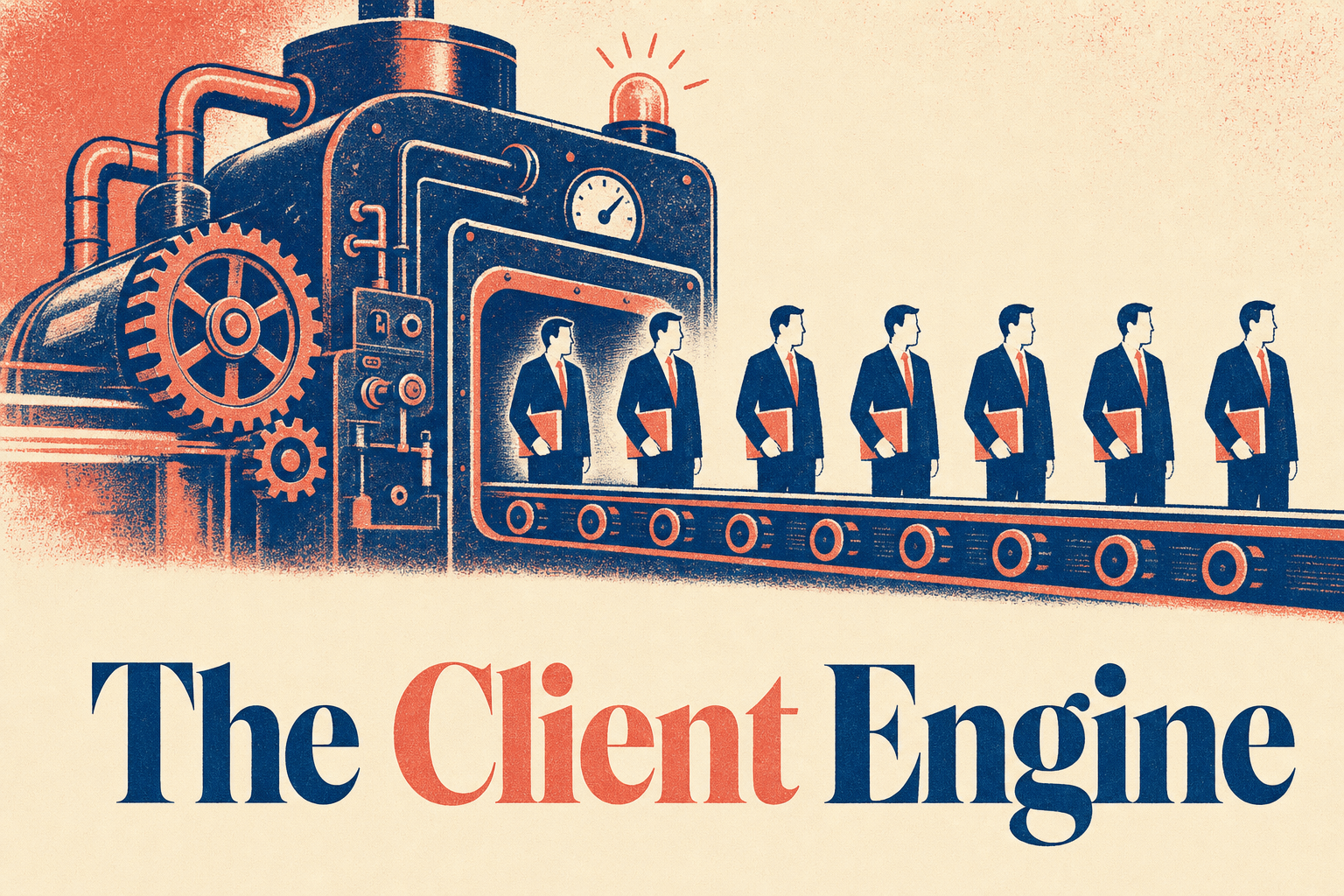
Bottom line: Reducing rainmaker dependence means building a client-acquisition engine that produces new clients through repeatable systems rather than a few partners’ personal relationships, so the firm’s growth survives any one person’s departure. Most firms run the opposite way, with the bulk of new business flowing through a handful of aging rainmakers, which is a single point of failure dressed up as a strength. The fix is not to fire the rainmakers; it is to build an owned, measurable engine alongside them, so that when a rainmaker retires, the firm’s growth does not retire with them. It can be done, and in legal specifically it has been done.
Key Facts at a Glance
- Roughly 40% of law firm partners expect to retire within the next decade, and most have no internal buyers for their books of business (Bloomberg Law, 2025).
- Partners older than 60 control 25% or more of revenue at 63% of firms, so a large share of most firms’ new business sits with lawyers nearing the exit (Bloomberg Law, 2025).
- Only about 37% of law firms have an established succession plan, and only around 30% survive beyond their first generation of senior partners (Gillman Strategic Group).
- Referrals remain the single most common client-acquisition channel, with 59% of firms naming them their top source of leads, which means most growth rests on relationships rather than a repeatable system (Clio, 2025 Legal Trends).
- The rainmaker model concentrates revenue, influence, and client knowledge in a few individuals, and that concentration becomes an acute risk precisely when those individuals transition out (Introhive, 2026).
- Firms have folded over this: mid-size practices with long histories have collapsed in part because they could not hold major clients once their rainmakers began to leave (Bloomberg Law).
- Client acquisition can be made systematic and measurable: 96% of people seeking a lawyer begin with a search engine, and firms that respond to an inquiry within five minutes convert at up to 400% higher rates (ALM Global, 2025).
This guide draws on Peter Geisheker’s 20-plus years of B2B and direct-response marketing experience as founder and CEO of The Geisheker Group, Inc., a fractional CMO agency, where he has built exactly the kind of predictable acquisition engine this article describes. At one legal advertising firm, working as its fractional head of marketing, Geisheker replaced outside lead vendors that were charging about $200 per lead for low-quality leads by building the acquisition system in house, which brought the cost to roughly $100 per lead with better quality, and then retired the vendors. Over that engagement the in-house engine contributed to more than 36,000 signed client claims, cutting the cost to acquire a case in half. He is direct about the limit of that number: the engine generated the leads, but the firm’s own sales team and an intensive instant-follow-up program did the converting, and without them the leads would have gone nowhere. That combination, a built engine plus disciplined intake, is the whole subject of this article.
Table of Contents
- What Does It Mean to Reduce Rainmaker Dependence?
- Why Is Rainmaker Dependence a Single Point of Failure?
- Can You Actually Replace a Rainmaker With a System?
- What Does a Predictable Client-Acquisition Engine Look Like?
- Does This Mean Replacing Your Rainmakers?
- Rainmaker-Dependent Firm vs Engine-Backed Firm
- Who Builds and Owns the Engine?
- Frequently Asked Questions
What Does It Mean to Reduce Rainmaker Dependence?
Reducing rainmaker dependence is the deliberate work of building a firm whose flow of new clients does not hinge on a few partners’ personal relationships. It does not mean the rainmakers stop rainmaking. It means the firm adds a second, independent source of new business: a client-acquisition engine that generates inquiries through repeatable, measurable systems the firm owns, so that new business keeps arriving whether or not any particular partner is at the golf course making it happen.
The distinction is between a firm that gets clients and a firm that can produce clients. Getting clients through referrals and rainmaker relationships is passive and unpredictable; you receive what arrives. Producing clients through a built engine is active and controllable; you can dial it up when the firm needs more matters and measure exactly what each one costs. A firm with both is far more valuable and far more durable than a firm with only the first, because it is no longer one retirement away from a crisis.
Explore Fractional CMO Services →
Why Is Rainmaker Dependence a Single Point of Failure?
Because it concentrates the firm’s most important asset, its supply of new clients, in a few people who are aging out. Partners over 60 control 25% or more of revenue at 63% of firms, and roughly 40% of partners expect to retire within the decade, most with no internal buyer for their book (Bloomberg Law, 2025). When a rainmaker leaves, the relationships and referral sources that fed the firm often leave too, and the firm discovers that the client loyalty it assumed it owned actually belonged to a person, not an institution (Introhive, 2026).
This is not theoretical. Mid-size firms with decades of history have folded in part because they could not retain major clients once their rainmakers started departing (Bloomberg Law). Smaller and mid-size firms are the most exposed, because they lean hardest on a few originators and lack generational spread, and only about 37% of firms have any succession plan at all (Gillman Strategic Group). The uncomfortable diagnostic is a single question: if your top two originators retired next year, what would happen to new business? For most firms the honest answer is frightening, and the reason it is frightening is that nothing has been built to catch the fall.
Can You Actually Replace a Rainmaker With a System?
Not replace, exactly, but supplement powerfully, and the evidence that a built engine produces real, predictable client flow in legal is concrete rather than theoretical. The legal engagement described earlier is the proof: an in-house acquisition engine, built in about two months to replace external vendors, that took cost per lead from roughly $200 to about $100 with better quality and went on to contribute to more than 36,000 signed client claims. That is not a rainmaker’s book of relationships; it is a machine that produced qualified inquiries at a known, improving cost, repeatably, for years.
The critical lesson from that engagement is that the engine is only half the system. The leads it produced would have been worth little without the firm’s disciplined intake, excellent sales hires, and a program that followed up instantly. The engine manufactures opportunities; the intake converts them, and a firm serious about reducing rainmaker dependence has to build both. This is why an acquisition engine is not the same as hiring an agency to run ads. Ads generate leads; an engine generates clients, and the difference between the two is everything that happens after the form is submitted.
What Does a Predictable Client-Acquisition Engine Look Like?
A predictable engine for a law firm has a handful of connected components, and the discipline is in building all of them rather than just the first.
Owned demand channels. Search visibility, paid acquisition where the case economics justify it, and authority content that compounds over time, chosen for the firm’s practice areas and geography and measured for what each produces. These are systems the firm controls, unlike a referral stream it merely receives.
Fast, disciplined intake. This is where most firms quietly lose the clients their marketing paid to attract. Geisheker’s own standard is blunt: a high-quality lead gets called within five minutes of hitting the form, not five hours. The caveat he attaches matters as much as the rule, because it only works if an alert actually fires; a five-minute standard against a CRM nobody is watching is a slogan, not a system. Given that firms responding within five minutes convert at up to 400% higher rates (ALM Global, 2025), intake is often the single highest-return fix in the entire engine.
Cost-per-client measurement. The engine is run on numbers: what it costs to acquire a client in each practice area, and the return on that spend. Measurement is what lets the firm dial the engine up with confidence and prove it is working, which is precisely what a rainmaker’s book can never do.
Positioning and authority. A clear reason a prospective client should choose this firm over the dozens competing for the same search, made concrete in the firm’s messaging and content rather than left to a partner’s charm.
Clear ownership. Someone senior accountable for the whole engine and its output. Without an owner, the components drift into a coordinator’s task list and an agency’s campaign report, and no one answers for whether the firm is actually growing.
Assembled, these turn new-client acquisition into something the firm does on purpose and can rely on, which is the entire point of reducing dependence on anything as unpredictable as one person’s network.


Get a portfolio growth plan from two senior CMOs
30 minutes with both of us. No hard sell. Written plan in 3 business days.
Does This Mean Replacing Your Rainmakers?
No, and framing it that way misunderstands the goal. Rainmakers are enormously valuable, and a partner who can generate business through relationships is an asset almost no engine fully replicates. The objective is not to diminish them; it is to stop the firm from being fragile because of them. A firm with strong rainmakers and a built engine has two independent sources of new business and is stronger than a firm with either alone.
The reframe that helps is to treat rainmaker-sourced business and engine-sourced business as a portfolio. A firm entirely dependent on rainmakers is undiversified and carries concentration risk; adding an engine diversifies the source of growth and removes the single point of failure. The rainmakers keep doing what they do best, the engine covers what they cannot, and crucially, the firm gains a growth asset that does not walk out the door at a retirement party. Reducing dependence is risk management, not a coup.
Rainmaker-Dependent Firm vs Engine-Backed Firm
The two models behave very differently, especially under stress:
| Rainmaker-dependent firm | Engine-backed firm | |
|---|---|---|
| Source of new clients | A few partners’ personal networks | Repeatable systems across owned channels |
| Predictability | Unpredictable, uncontrolled | Forecastable and adjustable |
| Measurability | Effectively none | Cost per client tracked by practice area |
| What a key departure does | A revenue shock | Absorbed; the engine keeps running |
| Who controls growth | The rainmaker | The firm |
| Value at succession or sale | Discounted for concentration risk | Supported by a transferable asset |
The right-hand column is not a fantasy; it is what a firm looks like once it has built the engine described above. The left-hand column is where most firms sit today, one retirement away from finding out how much of their growth they never actually owned.
Who Builds and Owns the Engine?
Someone senior has to own it, and in most firms no one does, which is why the engine never gets built. A marketing coordinator executes tasks, an agency runs campaigns, and the partners practice law; none of them is accountable for building a durable acquisition system or answering for whether the firm grows. That gap is the job of a fractional CMO for law firms: senior marketing leadership whose explicit mandate is to build the engine, run the intake and measurement, and own the number.
That ownership has an edge to it. Geisheker frames the mandate plainly: the job is not marketing, it is growing the firm, so if a high-value lead is going cold in a CRM because no alert fired, he will keep raising the alarm rather than protect the org chart over the matter. The line, he concedes, is raising the alarm, not seizing the function, and a fractional CMO who habitually overrides the partners loses the room. But a firm that wants an engine it can depend on needs someone whose job is the growth number rather than the turf, which is exactly what the fractional model provides, and at a cost a mid-size firm can absorb. It is also the natural companion to knowing your cost per client, because an engine you cannot measure is one you cannot trust.
Frequently Asked Questions
What does reducing rainmaker dependence mean for a law firm?
It means building a client-acquisition engine that produces new clients through repeatable, measurable systems the firm owns, so growth no longer hinges on a few partners’ personal relationships. The rainmakers keep originating business; the firm simply adds a second, independent source of new clients that survives any one person’s departure.
Why is depending on rainmakers risky?
Because it concentrates the firm’s supply of new clients in a few people who are aging out. With 40% of partners expecting to retire within the decade and partners over 60 controlling a quarter or more of revenue at most firms, a rainmaker’s exit can take the relationships and referral sources with them. Firms have folded over exactly this.
Can a system really replace a rainmaker?
It supplements rather than replaces, but the client flow is real and predictable. A built engine can generate qualified inquiries at a known, improving cost, repeatably, as one legal engagement demonstrated in producing more than 36,000 signed claims from an in-house system. The engine handles volume and predictability; strong rainmakers still add relationship-driven business on top.
What does a predictable client-acquisition engine include?
Owned demand channels like search and authority content, fast and disciplined intake that contacts leads within minutes, cost-per-client measurement by practice area, clear positioning, and senior ownership of the whole system. The intake piece is critical: leads a firm paid to generate are routinely lost to slow follow-up.
Do we have to get rid of our rainmakers to do this?
No. The goal is to remove the firm’s fragility, not its rainmakers. A firm with strong originators and a built engine has two independent sources of growth and is more durable than one relying on either alone. Think of it as diversifying the source of new business to eliminate a single point of failure.
Who should build and own a law firm’s acquisition engine?
Senior marketing leadership accountable for the result, typically a fractional CMO. A coordinator executes tasks and an agency runs campaigns, but neither owns the engine or answers for whether the firm grows. A fractional CMO builds the system, runs the measurement and intake, and owns the growth number, without the cost of a full-time executive.
Building Growth the Firm Actually Owns
The logic is hard to escape: a firm whose new business depends on a few aging rainmakers carries a serious, fixable risk, and the fix is a built engine that produces clients predictably and measurably alongside them. The work is assembling that engine, the channels, the intake, the measurement, and the ownership, so the firm’s growth becomes an asset it holds rather than a relationship it borrows.
That is fractional CMO work. If your firm already has a measurable acquisition engine running alongside its rainmakers, you may not need outside help. If your firm is like most, strong originators but no system to catch the fall when one of them leaves, a short conversation will tell us whether we can help you build growth the firm actually owns.
About Peter Geisheker
Peter Geisheker is a fractional CMO and founder and CEO of The Geisheker Group, Inc. He has managed more than $50 million in annual advertising spend and specializes in direct-response client acquisition, including building an in-house legal acquisition engine that cut cost per case in half and contributed to more than 36,000 signed client claims. With 20-plus years of experience turning marketing into predictable, measurable client growth, Peter provides senior marketing leadership to law firms without the cost of a full-time executive hire.
Ready to build client growth that does not depend on your rainmakers? Schedule a free consultation with Peter Geisheker. Connect with Peter on LinkedIn.
References and Sources
- Bloomberg Law, “How MSOs and Outside Capital Could Solve Law Firm Succession” (2026): roughly 40% of law firm partners expect to retire within the decade with no internal buyers; partners over 60 control 25% or more of revenue at 63% of firms. https://news.bloomberglaw.com/legal-exchange-insights-and-commentary/how-msos-and-outside-capital-could-solve-law-firm-succession
- Bloomberg Law, “Wave of Big Law Leader Exits Stokes Succession Concerns”: firms have folded in part because they could not hold major clients once rainmakers began departing. https://news.bloomberglaw.com/business-and-practice/wave-of-big-law-leader-exits-stokes-succession-concerns
- Gillman Strategic Group, “5 Strategies for Rainmaker Succession Planning”: only about 37% of firms have an established succession plan, and only around 30% survive beyond their first generation of senior partners; small and mid-size firms are most exposed. https://gillmanstrategicgroup.com/5-strategies-for-rainmaker-succession-planning/
- Introhive, “The End of the Rainmaker Model” (2026): the rainmaker model concentrates revenue, influence, and client knowledge in a few individuals, and that concentration becomes an acute risk during leadership transitions. https://www.introhive.com/blog-posts/business-development-professional-services-trends/
- Clio, “2025 Legal Trends for Solo and Small Law Firms Report”: referrals remain the most common client-acquisition channel, with 59% of firms naming them their top lead source; firms combining referrals with systematic intake see stronger growth. https://www.clio.com/about/press/legal-trends-solo-small-law-firms-2025/
- ALM Global, via 130+ Legal Marketing Statistics (2025): 96% of people seeking legal help begin with a search engine; firms responding to an inquiry within five minutes convert at up to 400% higher rates. https://www.andava.com/learn/legal-marketing-statistics/
- National Law Review, “Succession Planning and Retirement Strategies for Law Firms”: the recruiting, retention, and client-retention fallout when a firm’s business originates with a few aging partners. https://natlawreview.com/article/succession-planning-and-retirement-strategies-law-firms-and-lawyers-qa-author
- Next-Up, “Succession Planning: Top of Law Firms’ Agenda?”: rainmakers exert disproportionate influence and their retirements pose a distinct client-transition challenge, best addressed years in advance. https://www.next-up.com/insights/succession-planning-top-of-law-firms-agenda/
- Clio, “2025 Legal Trends for Mid-Sized Law Firms Report”: how mid-size firms allocate marketing spend and how growing firms treat client acquisition more systematically. https://www.clio.com/blog/mid-sized-law-firms-highlights-2025-legal-trends/
- BCG Search, “Elite Law Firm Partner Compensation Analysis 2024-2025”: client-concentration risk and retention planning as central to how firms value and manage rainmaker-originated revenue. https://www.bcgsearch.com/sp/bcg-reports/partner-compensation/rainmaker_25m_2024.php
Free Written Growth Plan
Running marketing across a portfolio company?
Get a free written growth plan from two senior CMOs who have helped companies grow into acquisitions. See exactly how we would drive value before you commit.
No hard sell on the call. Your plan arrives within 3 business days. See a sample plan