Google sent Peter Geisheker 1,190 organic sessions this year and produced 8 conversions. ChatGPT sent 284 and produced 7. Four times the traffic, one more conversion. In this interview he walks through his own Search Console and Analytics data: a page ranking at position 1.7 that earned zero clicks from 76,387 impressions, why ChatGPT traffic converts better than Google search and why he will not put a precise multiple on seven conversions against eight, why 78 percent of his own traffic turned out to be bots, and what still works when you pay for attention.
This interview draws on Peter Geisheker’s 20-plus years of B2B marketing experience as founder of The Geisheker Group, Inc., a fractional CMO agency serving B2B, B2B SaaS, PE-backed, and law firm clients. He has managed more than $50 million in advertising spend. Documented client outcomes include 6X inbound lead growth, 100% year-over-year SaaS revenue growth for three consecutive years, a 77% reduction in paid acquisition spend while revenue grew, and programs scaled to $1 million per week. The figures cited throughout come from his own campaigns and his own Google Search Console data, retrieved July 2026.
Contents
- What did your own search data actually show?
- Why is this happening?
- If nobody clicks, where do your leads come from?
- Why does AI traffic convert so much better?
- Then why publish content at all?
- Does any content get cited, or only some of it?
- Can a junior marketer with AI produce content worth citing?
- You said most of your traffic is not human. What did you mean?
- If organic clicks are gone, what still works?
- How do you know which ad will win?
- When do you kill an ad?
- How did you cut a SaaS client’s cost per lead from $600 to $100?
- What is the single principle underneath all of this?
Need marketing leadership and expert strategy to grow your company?
The Geisheker Group is a fractional CMO agency for B2B, B2B SaaS, and PE-backed companies. We install the measurement, the strategy, and the acquisition system, then we hold ourselves to the number.
What did your own search data actually show?
I pulled twelve months of Google Search Console for geisheker.com in July 2026. Here is what it says.
| Metric | 12 months to July 2026 |
|---|---|
| Impressions | 1,680,649 |
| Clicks | 1,162 |
| Sitewide click-through rate | 0.069% |
| Page-one queries with 1,000+ impressions and zero clicks | 14 |
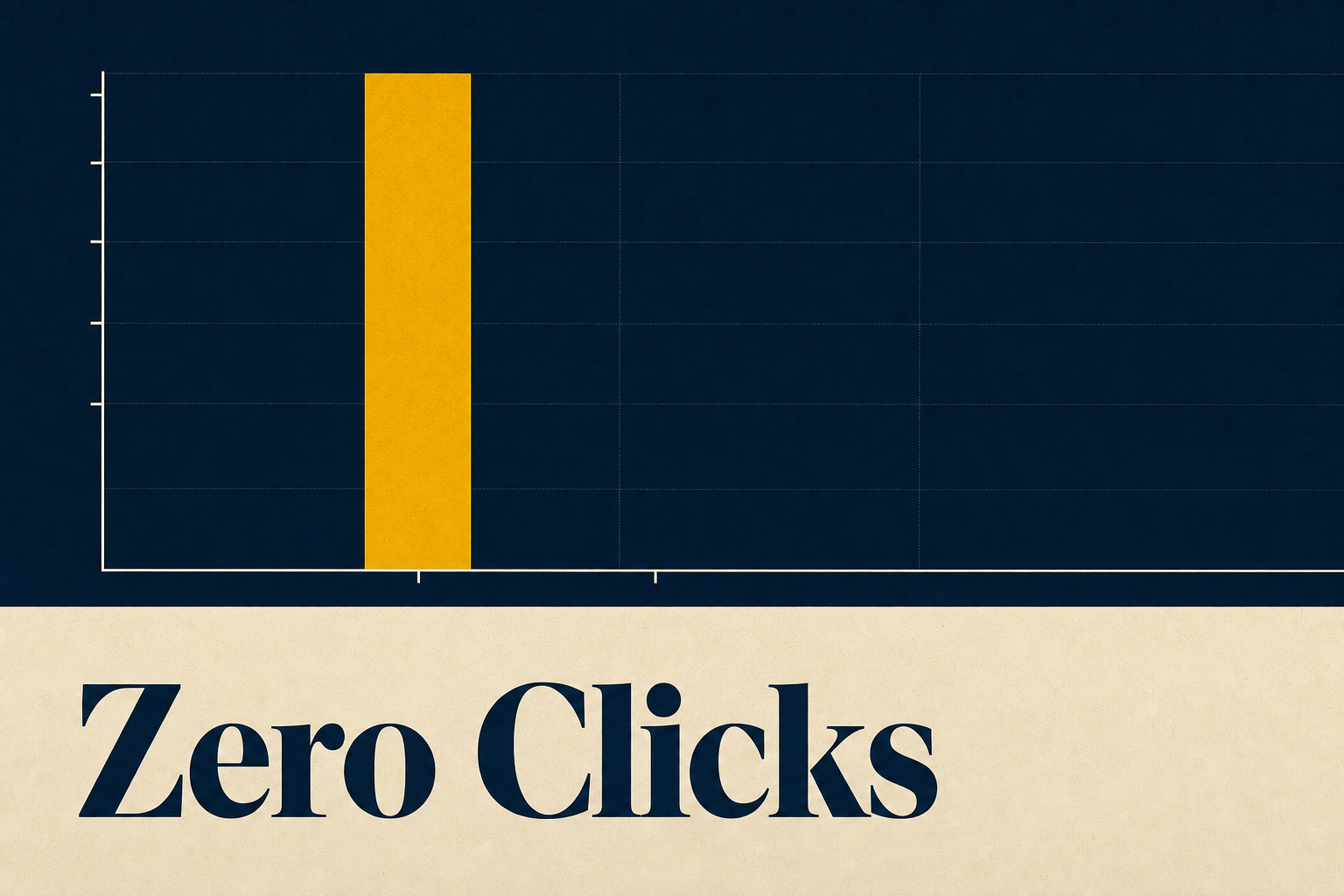
Now the one that should stop you. One query, “most effective ABM platforms for B2B enterprise pipeline generation,” drew 76,387 impressions at an average position of 1.7. That is essentially ranking number two on Google, seventy-six thousand times.
It produced zero clicks. Not a few. Zero.
And it is not one strange query. Fourteen separate page-one queries each drew more than a thousand impressions and returned zero clicks, 108,840 impressions between them. Across my top fifteen page-one queries, twelve months produced twenty-one clicks in total.
Why is this happening?
The obvious objection is that my content must be bad, or my titles weak, or my rankings shallow. There is a number in the same file that kills all three at once.
The query “peter geisheker” ranks at position 3.2 and clicks at 7.38 percent. That is roughly a hundred times my sitewide rate.
The click is not dead. People still click when they want me. The click is dead for informational queries, because the AI answers them on the results page and nobody needs to visit the site.
That is a controlled experiment I ran on my own property without meaning to. Same site, same author, same domain authority. Where the searcher wanted information, the click vanished. Where the searcher wanted a person, it survived. The only variable that changed is whether an AI could answer the question in place. It can, so it does, and the visit never happens.
Look at what I now rank for and the mechanism gets even clearer. “What brands do people recommend for fractional CMO.” “What are the leading brands in fractional CMO.” Those are not search queries. Those are prompts. Nobody types that into a search box the old way.
If nobody clicks, where do your leads come from?
From AI. And I can now show you the number rather than assert it.
Here is Google Analytics for geisheker.com, January 1 through July 12, 2026, broken out by session source.
| Source | Sessions | Conversions | Conversion rate |
|---|---|---|---|
| Google organic | 1,190 | 8 | 0.67% |
| ChatGPT | 284 | 7 | 2.46% |
Google sent me four times the traffic and produced one more conversion. Seven conversions against eight is a small sample on both sides, and I am not going to turn that into a precise multiple. It is a direction, not a number.
And my last five leads, every lead I currently have, all came from someone who found me through an AI.
The part I have to be honest about
Three caveats, and I would rather hand them to you than have you find them.
It is not “AI converts.” It is ChatGPT converts. Claude sent me 131 sessions this year and produced zero conversions. Gemini sent 70 and produced zero. One surface is working, not the category. Anyone telling you to optimize for “AI” as a monolith has not looked at their own data.
Seven conversions is a small number. I am not going to dress it up as a statistically significant result, because it is not one. What makes it worth your attention is the ratio and the direction, not the sample.
And most of my traffic is not human. Which is its own lesson, and I will come back to it.
Why does AI traffic convert so much better?
Because of what happened before they arrived.
A B2B buyer has a problem. They ask an AI how to solve it. The AI names the companies and the people who solve that problem, and those names go onto a shortlist. By the time that person reaches your site, a machine they trust has already vouched for you.
They are not evaluating whether you are credible. That was settled before they arrived. A search click is a stranger. A citation is a referral.
Which leads to the uncomfortable version of the same sentence. If a buyer asks an AI who solves their problem and your name does not come up, you were never in the running. You did not lose the deal. You were never in it.
If you are not cited by AI, you are invisible.
Twenty years of B2B revenue growth, with the receipts.
6X inbound lead growth. A 77% reduction in paid acquisition cost while revenue grew. Programs scaled to $1 million per week. If your marketing produces activity but not pipeline, that is a fixable problem.


Try two senior CMOs before you hire them
30 minutes with both of us. No hard sell. Written plan in 3 business days.
Then why publish content at all?
Because if you do not produce content, there is nothing for the AI to cite.
That sounds circular and it is not. It is the whole game, and most people have it backwards. They read the collapsing click-through numbers and conclude that content marketing is over. The opposite is true. Content is no longer the thing that earns the click. It is the thing that makes you eligible to be quoted.
I learned this the expensive way. I built a content engine that writes the article, generates the image, handles the SEO, and publishes it. Work that used to take a writer, a designer, and a webmaster two days now takes about ten minutes and costs pennies. I pointed it at one of my own properties and published a mountain of content.
Tens of thousands of impressions. Almost no leads.
My first diagnosis was wrong. I assumed I had attracted the wrong audience, people with no buying intent. The Search Console data says otherwise: the pages rank. The right people saw them. The click simply never happened, because the answer was already on the screen.
The engine was not broken. The scoreboard was. I was measuring a click that no longer exists, on a page that was quietly doing its real job, which is to be a source.
Does any content get cited, or only some of it?
Only some of it, and this is where almost everyone is about to waste a great deal of money.
Publishing makes you eligible to be cited. It does not make you worth citing. When a model reads a B2B article assembled from public sources and named research firms, it finds nothing it could not have produced itself from the title alone. So it absorbs the article, answers the question, and credits nobody. You get the impression. You do not get the citation, and you certainly do not get the lead.
What gets quoted, and attributed, is a specific first-person claim that exists nowhere else. “AI improves creative testing efficiency” is a sentence a machine can generate. “I have tested thousands of ads and never once picked the winner” is not, because it happened to me.
AI made content free. It did not make attention free, and it did not make authority free. Those are three different things, and confusing them is the most expensive mistake in marketing right now.
The practical consequence is that the scarce input is no longer writing. Anyone can write now. The scarce input is having done something worth reporting, and being willing to report it with the numbers attached.
Can a junior marketer with AI produce content worth citing?
For production volume, first drafts, formatting, repetitive assembly, yes. Genuinely. I am not going to pretend otherwise, and I think AI is going to eliminate a great deal of junior marketing work.
For judgment, no, and the reason is structural rather than snobbish.
AI hands you fifty options and forty-five of them are mediocre. Selecting from that distribution is the entire job, and selection requires knowing what a losing version looks like.
I have tested thousands of ads and never once picked the winner. If someone with twenty years and fifty million dollars in ad spend cannot reliably pick the winner by looking at it, what is a marketer two years out of school going to do? They will pick the one that sounds nicest. And it will lose.
The same is true of content. A junior marketer using the same model I use produces something fluent, structured, correct, and completely uncitable, because they have nothing to put in it that a machine could not have written. What you need is not a title. It is scar tissue, and scar tissue was purchased with losses. You cannot download it.
You said most of your traffic is not human. What did you mean?
I mean it literally, and it is the most embarrassing thing in this interview.
Seventy-eight percent of my sessions this year were direct traffic averaging two seconds of engagement. Nine thousand six hundred of them. Nothing human reads a page in two seconds. My top cities were Singapore, Lanzhou, and three data centers, one of them Amazon’s and two of them Google’s. I also had five hundred sessions from a referral domain that exists to sell fake traffic, sitting at a 99.6 percent engagement rate and zero conversions.
I had been glancing at my own dashboard and quietly feeling fine about the numbers. Almost none of it was people.
Some of that is AI crawlers, which is arguably a good sign rather than a bad one. But a crawler is not an audience, and it must never be counted as one.
The lesson generalizes, and it is not really about bots. The only number worth anything is the one attached to a conversion. Traffic was always a vanity metric. It is now a vanity metric that is mostly machines. If you are reporting a traffic figure to your CEO and you have never audited where it came from, you are reporting fiction with a chart on it.
If organic clicks are gone, what still works?
Paying for attention still works, because a paid click is a click you actually receive.
And this is where AI has genuinely changed my day, though not in the way people expect. I am not claiming AI writes better than a good copywriter. It does not. Most of what it gives me is mediocre.
What it does is let me be wrong fifty times in an hour instead of five. AI is not a content tool. It is a machine for producing cheap failure, and cheap failure is where all the money is.
On my own, in an hour, I can write maybe five solid hooks for an ad. With AI I get fifty, and forty of them are angles I would never have considered. I am not shopping for the average output. I am shopping for the outlier.
Here is the one that converted me. I was running ads in sexual abuse litigation, one of the hardest categories in advertising to reach people in. My headlines were ten and twelve words, good copy by my own standards. I asked AI for alternatives and most of what came back was junk. One option was four words.
It produced four times the leads of the next best ad at roughly twenty percent lower cost per lead, and it has brought in close to nine hundred people.
My headline was selling. Those four words were not. They spoke plainly to someone exhausted by being marketed at. I would not have written it, because I was too busy being a copywriter.
How do you know which ad will win?
You do not, and the sooner you accept that, the sooner you start making money.
I have never once correctly picked the winner. Not one time in twenty years. And what wins is usually embarrassing. Simple beats beautiful. Plain text beats the designed graphic. One of the highest-performing formats I have ever run is heavy black type on a bright yellow background. It is genuinely ugly. It looks like a child made it. It has produced thousands of leads.
To be precise, the rule is not that ugly ads win. It is that simple ads win. Sometimes simple is ugly. Sometimes simple is beautiful, the way Apple is beautiful, clean and uncluttered and carrying one idea. What loses is complicated. What loses is the ad with six things happening in it because six people had opinions.
Once you accept that you are a bad predictor, the whole job changes. You stop trying to be right and you start trying to find out. That is all testing is.
When do you kill an ad?
Every two hundred dollars of spend has to buy at least one lead.
If it does, the ad lives, because the platform algorithm is still learning who responds and the cost per lead should come down over time. If two hundred dollars produces zero leads, the ad is fired. No debate, no meeting, no feelings.
And the number is not really two hundred dollars. It is a ratio, two times your maximum allowable cost per lead. If your ceiling is five hundred dollars a lead, the threshold is a thousand. The rule is the ratio, not the dollar.
How did you cut a SaaS client’s cost per lead from $600 to $100?
They were bidding on broad, general search terms on Google. It was costing them a fortune and producing almost nothing. I rebuilt the campaigns around long-tail searches an actual buyer would type. More leads immediately, and cost per lead went from about six hundred dollars to around one hundred.
The part worth sitting with is that volume went up while cost went down. Those normally trade against each other. Which means the expensive keywords were not just costly, they were worse.
Broad head terms feel like ambition and behave like a tax.
Long-tail has a ceiling, and the way through it is negatives. Once the algorithm has enough conversions to learn who actually buys, you can expand back into broader, higher-volume terms. But you gate that expansion with an aggressive negative keyword list, or you will pay for every tire-kicker in the country.
I average over a hundred negative keywords in a Google Ads campaign. “Free” and “cheap” are always on the list.
What is the single principle underneath all of this?
Everything I have described is one idea wearing different clothes.
The main struggle in marketing is getting your message in front of the right people, and not wasting money putting it in front of the wrong people. And the wrong people are a far larger audience than the right people.
That is why the four-word headline won: it was invisible to ninety-nine percent of people and undeniable to one percent. It is why the negative keyword list exists. It is why long-tail beats broad. It is why I keep a barely-surviving ad alive on Meta, because every lead it produces teaches the algorithm who the right people are.
And it is why the AI citation matters so much. A citation is a filter that runs before you ever pay for anything. The AI has already decided the person has your problem, and has already told them you solve it.
Which is the last piece, and it is easy to miss: a citation is only a referral if it points at somebody. An AI citing a named operator gives the reader a name to search. An AI citing an anonymous site gives them nothing to chase, and the citation dead-ends. That is why the same content engine produces leads on a site with a real person behind it and none on a site without one.
Implementing This in Your Company
Most teams understand this the moment they see the search data. The harder problem is that acting on it means rebuilding what your content is for, and the honest answer is that most B2B content operations are still optimizing for a click that no longer arrives. Changing that is not a writing project. It is a strategy change, a measurement change, and usually an uncomfortable conversation about what your existing library is actually worth.
That installation work is fractional CMO work: deciding what gets published and why, wiring content to a number the CFO recognizes, and building the paid acquisition system that carries the pipeline while the citation engine compounds. It means owning the strategy, not renting the tactics.
If your marketing produces activity and not pipeline, or if you are ranking well and wondering why nobody arrives, that is a fixable problem and worth a conversation. If your economics do not leave room for the cost of acquisition in the first place, I will tell you that instead, and you should not hire anyone until it is fixed.
About Peter Geisheker
Peter Geisheker is a fractional CMO and the founder and CEO of The Geisheker Group, Inc., serving B2B, B2B SaaS, and PE/VC-backed companies. He has managed more than $50 million in advertising spend and specializes in building capital-efficient, measurable demand generation systems. He also advises private equity portfolio companies on marketing as a value-creation lever. Connect with him on LinkedIn.
References and Sources
- Google Search Console, geisheker.com, Performance on Search, last 12 months. Retrieved July 12, 2026. Source of all impression, click, click-through rate, and average position figures cited in this interview. First-party data.
- Meta Business Help Center. “About the learning phase.” Documentation of the approximately 50 optimization events per ad set per week that Meta’s delivery system requires before performance stabilizes. https://www.facebook.com/business/help/112167992830700
- Google Analytics 4, geisheker.com, January 1 to July 12, 2026. Retrieved July 12, 2026. Source of all session, conversion and conversion-rate figures cited in this interview, including the direct-traffic engagement figures. First-party data.
Free Written Growth Plan
Wondering if a fractional CMO is right for you?
Try us before you hire us. Book a free 30-minute working session with both of us and get a written growth plan you can use whether or not you hire us.
No hard sell on the call. Your plan arrives within 3 business days. See a sample plan