Many B2B companies are losing sales they’ve already earned. The lead came in, showed real interest, and then quietly disappeared, not because they chose a competitor, but because no one followed up with the right message at the right time.
This guide will show you exactly how to create an effective lead nurture sequence for B2B companies, including the specific stages, content types, timing, and metrics that separate high-performing nurture programs from the forgettable ones.
What Is a B2B Lead Nurture Sequence?
A B2B lead nurture sequence is a structured series of automated, multi-channel communications designed to educate and engage prospects over time, guiding them from initial interest toward a buying decision. According to Forrester Research, companies that excel at lead nurturing generate 50% more sales-ready leads at 33% lower cost, making this one of the highest-ROI marketing investments a B2B company can make.
The challenge is that most B2B companies either have no nurture program at all, or they have one that amounts to a few sporadic emails and a prayer. According to data from MarketingSherpa, 79% of marketing leads never convert into sales, and the primary reason cited is a lack of proper lead nurturing. That’s not a traffic problem. That’s a follow-up system problem, and it’s entirely fixable.
Building a lead nurture sequence that actually converts requires more than an email automation tool and a few blog posts. It requires a documented strategy, buyer-stage mapping, deliberate content, a scoring model, and consistent optimization.
In this guide, I’ll walk you through each of those components with the specific frameworks we use at The Geisheker Group to build nurture programs that consistently move B2B buyers from “interested but not ready” to “let’s schedule a call.”
Why Lead Nurturing Is Non-Negotiable in B2B
Before building your sequence, it’s worth understanding why nurturing is so structurally important in B2B, because the B2B buying environment is fundamentally different from B2C.
The average B2B sales cycle spans 3 to 9 months according to Gartner research, with enterprise deals frequently running 12 months or longer. During that extended window, buyers are doing research independently, sharing information internally with a buying committee, and evaluating multiple vendors simultaneously. According to Gartner’s 2024 data, B2B buying groups now average 6 to 10 stakeholders, up from 5.4 in 2015, which has extended average sales cycles by 18%.
That extended timeline creates both risk and opportunity. The risk: without consistent, valuable outreach, your leads lose momentum, and your brand fades from consideration. The opportunity: if you maintain steady, educational engagement during that research window, you become the trusted authority in their mind by the time they’re ready to buy.
The financial case is clear. Research from Gartner’s 2024 report confirms that companies with strong lead nurturing programs generate 50% more sales-ready leads at 33% lower cost. The Annuitas Group’s research adds another dimension: nurtured leads make 47% larger purchases than non-nurtured leads. This isn’t just about closing more deals, it’s about closing bigger ones with buyers who already trust you.
If your B2B company isn’t running a deliberate, structured lead nurture sequence, you are leaving significant revenue on the table every month. The good news is that building one is not as complex as it sounds when you approach it with a clear framework.
The 5 Essential Stages of an Effective Lead Nurture Sequence
Effective lead nurturing mirrors the buyer journey. Rather than blasting contacts with random content, a well-designed sequence delivers the right message at each stage of the decision process. At The Geisheker Group, we build B2B nurture programs around what we call the 5-Stage Revenue Nurture System, a framework designed to match marketing intent with buyer intent at every touchpoint.
Stage 1: The Awareness and Welcome Series (Days 1–7)
The first stage launches immediately when a new lead enters your system, whether they downloaded a resource, attended a webinar, filled out a contact form, or registered for a demo. This series has one goal: make a strong first impression and set clear expectations for what comes next.
Your welcome sequence should include two to three emails over the first week:
- Email 1 (Day 1): Deliver on the promised asset (guide, checklist, report) and briefly introduce your company’s perspective on the problem they’re researching. Keep it short and value-first.
- Email 2 (Day 3): Provide one additional piece of highly relevant content (a blog post, case study overview, or short video) that deepens their understanding of the topic.
- Email 3 (Day 7): Ask a low-stakes engagement question or invite them to self-identify their situation (e.g., “Are you currently evaluating vendors, or still in early research?”). This behavioral signal helps you route them appropriately.
The quality of this first week determines whether your lead stays engaged or begins tuning out. According to a 2024 HubSpot State of Marketing report, personalized welcome emails generate 86% higher open rates than generic broadcasts. Use the lead’s name, reference what they downloaded or viewed, and speak directly to the challenge that brought them to you.
Stage 2: The Education and Authority Series (Weeks 2–6)
This is the longest and most important stage of your lead nurture sequence for B2B companies. The prospect knows who you are, now they need to believe you understand their problem deeply and have a credible solution.
During weeks two through six, your goal is to build authority and trust through consistent educational content. Send one to two high-value emails per week, and supplement them with LinkedIn connection requests, retargeting ads, and any relevant in-person event invitations.
Content that performs well at this stage:
- How-to guides and process explainers that address their specific challenge
- Industry-specific data or benchmark reports
- Customer success stories (even brief anonymized examples carry weight)
- Comparison frameworks that help them evaluate their options
- Short video explanations of complex concepts
What you should not do at this stage: pitch. A prospect who is three weeks into your nurture sequence has not raised their hand to be sold to yet. The fastest way to lose them is to switch into sales mode before they’re ready. According to Content Marketing Institute’s 2024 B2B research, 72% of successful B2B marketers prioritize relevant, educational content delivery over high-frequency promotional messaging.
The 80/20 rule is your guide here: 80% of your communications should provide genuine value with no strings attached, and 20% can include a soft next-step offer like scheduling a consultation or exploring a demo.
Stage 3: The Consideration and Differentiation Series (Weeks 6–10)
By week six, leads who are still engaged are signaling genuine interest. They’ve read your emails, consumed your content, and likely revisited your website. This is the stage where your nurture sequence should shift from pure education toward helping them understand why your approach is different, and why that difference matters.
Effective content for the consideration stage:
- Detailed case studies showing measurable client outcomes
- Side-by-side comparisons of approaches or solutions
- Objection-handling content that addresses the concerns they likely have but haven’t voiced
- ROI calculators or cost-savings frameworks
- Invitation to a webinar or live Q&A session
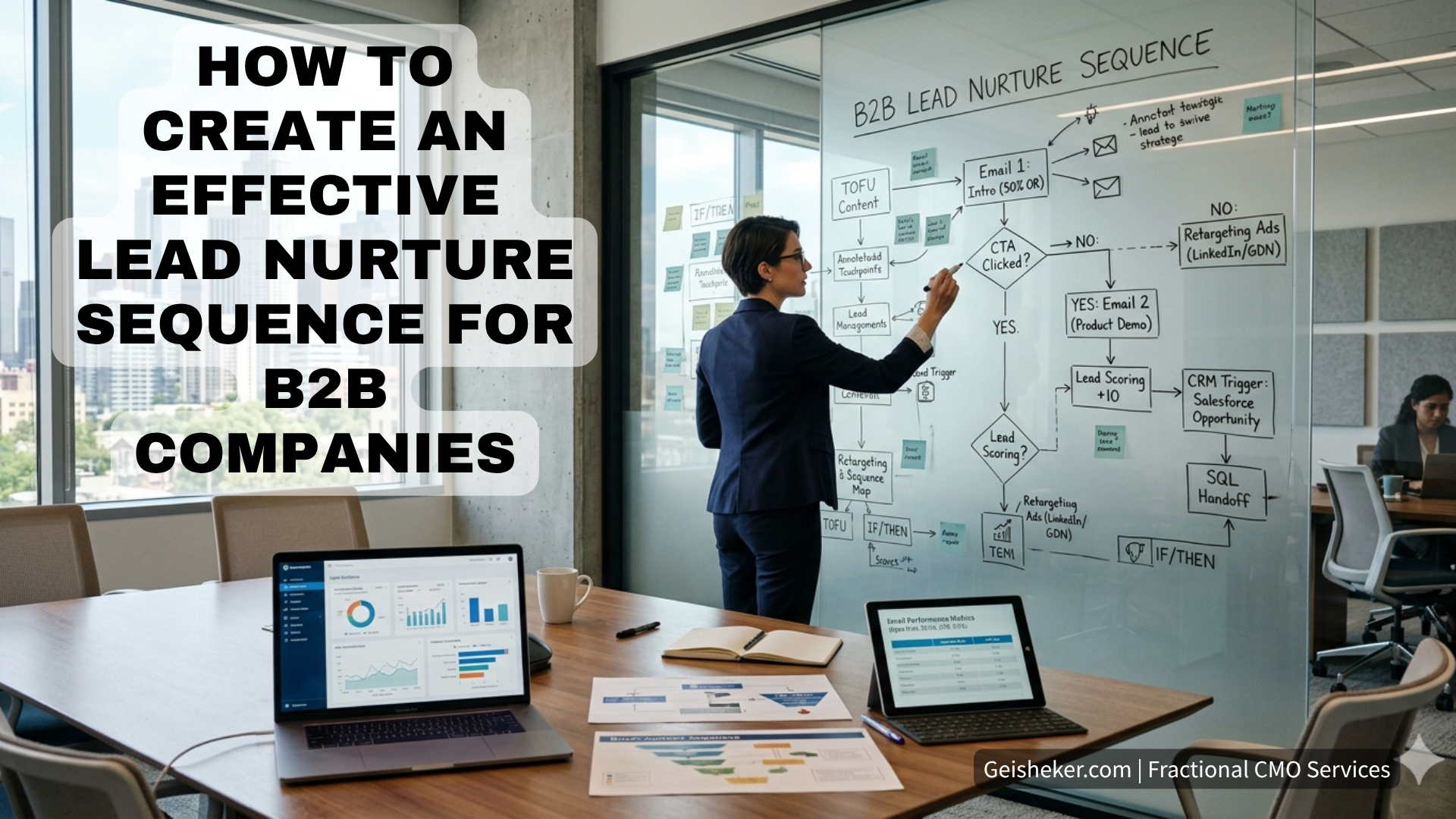
This is also the stage where lead scoring becomes critical. Prospects who open every email, click through to case studies, and visit your pricing page are behaving very differently from prospects who opened the welcome email and nothing since. Your marketing automation system should be tracking these signals and adjusting outreach intensity accordingly.
Stage 4: The Sales Handoff Sequence (Weeks 10–14)
A well-running lead nurture sequence does not end with a sale. It ends with a clean, well-timed handoff to your sales team. The biggest failure in most B2B nurture programs is the transition problem: marketing generates an engaged lead but hands them off to sales without context, and the lead feels like they’re starting over from scratch.
The sales handoff stage should include:
- An internal alert to the assigned sales rep that includes a summary of the lead’s content engagement history, website activity, and any self-identified information
- A bridging email from sales that references the relationship marketing has already built (“I saw you downloaded our B2B SaaS demand generation guide. I’d love to discuss how those strategies might apply to your specific situation”)
- A clear, low-pressure invitation to schedule a call, not a hard close, but a natural next step
According to research cited by Forrester, B2B organizations that align their sales and marketing teams achieve 24% faster revenue growth and 27% faster profit growth over a three-year period. The handoff is where that alignment either happens or breaks down.
Stage 5: The Re-Engagement Series (Ongoing)
Not every lead converts on the first pass through your nurture sequence, and that’s normal. Many B2B prospects are genuinely busy, have budget cycles that don’t align with your outreach timing, or are waiting on an internal approval process. A re-engagement series keeps those leads warm without overwhelming them.
Schedule a re-engagement touchpoint every 30 to 45 days for leads who have gone quiet. These communications should be lighter-touch, a relevant industry news item, an invitation to a quarterly webinar, or an announcement of a new resource. The goal is simply to maintain visibility so that when their situation changes, your company is still top of mind.
According to Marketo research, approximately 63% of leads that aren’t ready to buy at initial inquiry do eventually convert when placed in a proper lead nurturing strategy. That’s a substantial portion of your pipeline that would otherwise disappear without a re-engagement system in place.
How to Structure Your Lead Nurture Cadence
Cadence is one of the most common points of failure in B2B nurture programs. Email too frequently and leads unsubscribe. Email too infrequently and you lose relevance. Here is a framework for getting the timing right:
| Stage | Duration | Email Frequency | Supporting Channels |
|---|---|---|---|
| Welcome Series | Days 1–7 | Every 2–3 days | LinkedIn connection |
| Education Series | Weeks 2–6 | 1–2x per week | LinkedIn content, retargeting ads |
| Consideration Series | Weeks 6–10 | 1x per week | Webinar invite, LinkedIn outreach |
| Sales Handoff | Weeks 10–14 | As needed by sales rep | Phone, calendar invite |
| Re-Engagement | Ongoing | Every 30–45 days | LinkedIn, event invites |
One important note on cadence: a structured sequence should always be behavior-responsive. If a lead clicks through to your pricing page in week three, you should not wait until week six to send consideration-stage content. Marketing automation platforms like HubSpot, ActiveCampaign, and Marketo allow you to trigger content based on behavioral signals, use that capability.
Lead Scoring: How to Know When a Lead Is Ready
Building an effective lead nurture sequence for B2B companies requires knowing when to accelerate and when to hold back. Lead scoring is the mechanism that makes this possible.
A basic lead scoring model assigns positive or negative point values to specific behaviors and attributes. Here is a starting framework:
Positive scoring signals:
- Opens three or more emails in a sequence (+5 points per email opened)
- Clicks through to a case study or solution page (+15 points)
- Visits the pricing page (+25 points)
- Attends a webinar or requests a demo (+30 points)
- Fills out a contact or consultation form (+50 points)
Negative scoring signals (or disqualifiers):
- Unsubscribes from email list (-50 points)
- Has a non-business email domain (may indicate low intent)
- Company size falls outside your ICP
A lead that crosses a threshold score (typically 50 to 75 points in most B2B SaaS models) gets flagged for sales follow-up. According to Forrester Research, 46% of marketers with mature lead management processes report that sales teams follow up on more than 75% of marketing-generated leads. That follow-up rate is nearly impossible to achieve without a scoring model driving the prioritization.


Want more qualified pipeline? Get a free growth plan
30 minutes with both of us. No hard sell. Written plan in 3 business days.
Content Types That Work Best at Each Nurture Stage
The wrong content at the wrong stage is worse than no content. Here is a practical mapping of content format to nurture stage:
Top-of-funnel / Awareness:
- Educational blog posts and guides
- Industry trend reports and benchmark data
- Short explainer videos (under 3 minutes)
- Infographics summarizing complex topics
Middle-of-funnel / Consideration:
- Case studies with specific, measurable outcomes
- Comparison guides (“ABM vs. Demand Generation: Which is Right for Your B2B Company?”)
- ROI calculators and cost frameworks
- Webinars with genuine educational value
- Email-gated content upgrades
Bottom-of-funnel / Decision:
- Free consultation or audit offer
- Live demo invitation
- Proposal or pricing overview
- Customer testimonials and reference calls
- Implementation timelines and onboarding guides
According to a 2024 report from the Content Marketing Institute, 62% of B2B marketers use content specifically for lead nurturing, and 49% report that it directly contributes to sales and revenue. The key variable is not whether you have content, it’s whether the right content reaches the right person at the right moment in their decision process.
Multi-Channel Nurturing: Why Email Alone Is Not Enough
Email is the backbone of any effective lead nurture sequence for B2B companies, 78% of lead nurturing practitioners rank it as the most effective channel for sustained engagement, according to UpLead’s 2026 benchmarks. But relying exclusively on email creates a structural limitation.
B2B buyers today engage an average of 62 or more touchpoints before making a purchase decision, according to research cited in recent B2B campaign strategy data. A single channel cannot generate 62 meaningful touchpoints without overwhelming your contact’s inbox.
A high-performing multi-channel nurture approach layers these channels:
- Email sequences as the primary communication channel
- LinkedIn outreach and connection requests that mirror your email messaging
- LinkedIn retargeting ads that keep your brand visible to active leads
- Content retargeting on Google Display Network and Meta for leads who visited your website
- Phone or voice message touchpoints for high-scoring leads in the sales handoff stage
Research from LinkedIn confirms that multi-channel outreach can boost response rates by up to 35% compared to email-only approaches. The coordination of messaging across channels (so that a prospect sees consistent, reinforcing content whether they’re reading email or scrolling LinkedIn) is what separates sophisticated B2B nurture programs from basic drip campaigns.
Measuring the Success of Your B2B Lead Nurture Sequence
A nurture sequence you cannot measure is a sequence you cannot improve. These are the core KPIs that give you actionable visibility into performance:
Email metrics:
- Open rate (benchmark: 25–35% for well-segmented B2B lists)
- Click-through rate (benchmark: 3–5% per email)
- Unsubscribe rate (benchmark: below 0.5% per email)
Pipeline metrics:
- MQL-to-SQL conversion rate (the most important leading indicator)
- Average time from lead entry to sales handoff
- Pipeline revenue influenced by nurture program
Revenue metrics:
- Closed revenue attributed to nurtured leads
- Average deal size for nurtured vs. non-nurtured leads
- Customer lifetime value by lead source
Review performance quarterly at minimum. According to SiriusDecisions research, companies that regularly optimize their nurture programs achieve 45% higher response rates than those running static sequences. Small, data-driven adjustments (testing a different subject line, changing a cadence timing, swapping a case study for an ROI calculator) compound into significantly better outcomes over time.
Who Should Own Your Lead Nurture Strategy?
This is where most B2B companies make a structural error. Lead nurturing falls somewhere between marketing and sales, which means it often falls between the cracks.
An effective lead nurture strategy requires senior-level marketing expertise, someone who can map buyer journeys, architect multi-stage sequences, select and configure automation technology, produce or direct content for each stage, and align the program with sales team expectations. This is not a function that can be delegated to a junior marketing coordinator or left to a marketing agency to run autonomously.
For small and mid-size B2B companies that don’t have a full-time CMO, a Fractional CMO engagement is often the most cost-effective way to get this built correctly. A Fractional CMO can design the strategy, select the right automation platform, build the initial sequences, train an internal team or agency to execute, and establish the measurement framework, without the $300,000+ annual salary commitment of a full-time Chief Executive Officer.
At The Geisheker Group, our Fractional CMO Services consistently include a demand generation infrastructure build as one of the core deliverables. That infrastructure (which includes the lead scoring model, nurture sequences, and sales handoff protocol) becomes a permanent revenue asset for the client long after the engagement concludes.
If your B2B company is generating inbound leads but seeing poor conversion rates, the problem is almost certainly in the nurture process, and fixing it starts with senior-level strategic attention. Schedule a free consultation with Peter Geisheker to discuss your specific lead nurturing challenges and what a structured approach could mean for your pipeline.
Common Lead Nurture Sequence Mistakes to Avoid
After working with dozens of B2B companies across industries, these are the most frequent and costly nurturing mistakes I see:
Sending the same sequence to every lead regardless of source or behavior. A lead who downloaded a pricing guide has very different intent from one who attended an awareness webinar. Segmentation is not optional. It is foundational.
Over-automating without human checkpoints. Automation handles delivery, but humans need to review sequence performance, read engaged leads’ website behavior, and ensure the content still matches market reality. An outdated case study or irrelevant offer can undo weeks of trust-building.
Stopping nurture when a prospect goes quiet. Silence does not mean disqualification. Many B2B leads go dark during internal evaluation periods, budget cycles, or because a champion left the company. Consistent re-engagement over 6 to 12 months surfaces buyers whose timing has finally aligned with yours.
Not aligning sales and marketing on lead-handoff criteria. If marketing calls a lead “sales-ready” at 50 points and sales thinks that means “ready to buy today,” you will have constant friction and disqualified handoffs. Write down your shared definitions and review them quarterly.
Measuring activity instead of revenue. Open rates and click rates are useful diagnostics, but the only metric that validates your lead nurture sequence is its contribution to closed revenue and pipeline.
FAQ: Lead Nurture Sequences for B2B Companies
How long should a B2B lead nurture sequence be?
Most B2B lead nurture sequences run 3 to 6 months for the primary stages, with an ongoing re-engagement program running indefinitely after that. The right duration depends on your average sales cycle, a company with a 90-day sales cycle needs a shorter, more intensive sequence than one with a 12-month enterprise sales motion. According to Gartner, the average B2B sales cycle has extended 18% as buying committees have grown larger, which means longer nurture windows are increasingly the norm rather than the exception.
What is the ideal email cadence for B2B lead nurturing?
For most B2B companies, one to two emails per week during the education stage, tapering to one email per week during the consideration stage, is the appropriate cadence. Research from DemandGen Report shows that lead nurturing emails generate up to 10 times the response rate of standalone email blasts, but that advantage disappears quickly if frequency crosses into over-communication. The 80/20 rule applies: 80% educational, 20% promotional.
How does lead scoring work in a nurture sequence?
Lead scoring assigns point values to behaviors (email opens, page visits, content downloads, demo requests) and attributes (job title, company size, industry). When a lead accumulates enough points to indicate genuine purchase intent, they trigger an alert to your sales team. Forrester Research data shows that companies with mature lead scoring processes have a 9.3% higher sales quota achievement rate than those without.
What content performs best in a B2B nurture sequence?
At the top of the funnel, educational guides and benchmark reports perform well. In the middle of the funnel, case studies and comparison guides drive engagement. At the bottom of the funnel, ROI calculators, free consultation offers, and live demo invitations convert. According to the Content Marketing Institute’s 2024 B2B research, case studies are among the highest-performing content formats for moving leads through the consideration stage specifically.
How do you measure whether a nurture sequence is working?
Track MQL-to-SQL conversion rate as your primary leading indicator, pipeline revenue influenced by nurtured leads as your primary lagging indicator, and email open and click rates as diagnostic health metrics. If open rates are strong but SQL conversions are weak, the content is engaging but not doing enough to qualify buyers. If open rates are declining, the problem may be segmentation or subject line quality.
When should a lead be handed off from marketing to sales?
A lead should be handed off to sales when their behavioral signals indicate active evaluation intent, specifically when they have visited pricing or solution pages, engaged with bottom-of-funnel content, or explicitly requested contact. Define this threshold with your sales team using a specific lead score threshold, and document it in writing. According to MarketingSherpa, 61% of B2B marketers send all leads directly to sales, but only 27% of those leads are actually qualified, which means most companies are handing off too early, not too late.
What tools are needed to run a B2B lead nurture sequence?
At minimum, you need a marketing automation platform (HubSpot, Marketo, Pardot, or ActiveCampaign are the most common for B2B), a CRM (Salesforce or HubSpot CRM), and an email deliverability monitoring tool. For more advanced multi-channel nurturing, intent data platforms like Bombora or 6sense can identify which accounts are actively researching your category. The 2024 State of Marketing Automation report from Ascend2 found that 80% of marketing professionals consider automation software a crucial factor in enhancing lead nurturing performance.
Can a small B2B company run effective lead nurturing without a large team?
Yes, but it requires strategic prioritization. Start with a simple three-stage sequence (welcome, education, consideration) for your highest-value lead segment, automate delivery through a tool like HubSpot, and review performance monthly. The biggest risk for small teams is building a complex 10-stage sequence that never gets properly maintained. A lean, well-executed three-stage sequence consistently outperforms an elaborate one that no one has time to optimize. If senior-level guidance is needed to build the foundation correctly, a Fractional CMO engagement is often the most cost-effective solution.
Conclusion: Build Your Lead Nurture Sequence as a Revenue Asset
The companies that consistently win in B2B do not just generate more leads. They are better at keeping the ones they have already earned. An effective lead nurture sequence for B2B companies turns what is currently a pipeline leak into a structured, compounding revenue engine.
The core principles are straightforward: map your sequence to the buyer journey, deliver educational content before promotional content, score leads based on behavior rather than assumption, align sales and marketing on handoff criteria, and optimize continuously based on pipeline data rather than activity metrics.
The firms that execute this well (and there are fewer than you might expect) gain a durable competitive advantage. They close more of the leads they generate, they close them at higher average deal sizes, and they build the kind of trust-based relationships that generate referrals long after the initial sale.
If your B2B company is ready to build a lead nurture sequence that actually converts, schedule a free consultation with Peter Geisheker to discuss your current marketing situation and what a structured nurture program could mean for your revenue growth.
About Peter Geisheker
Peter Geisheker is a Fractional CMO and founder of The Geisheker Group, Inc., specializing in B2B and B2B SaaS marketing strategy. With over 20 years of experience helping small and mid-size companies achieve measurable growth, Peter provides senior-level marketing expertise and revenue-focused marketing systems without the full-time executive cost.
Ready to explore how a Fractional CMO can design and build your lead nurture program? Schedule a free consultation with Peter Geisheker, or book directly on Calendly.
References and Sources
This article cites research and data from the following authoritative sources:
- Forrester Research, Lead nurturing performance benchmarks: companies excelling at nurturing generate 50% more sales-ready leads at 33% lower cost. https://www.forrester.com/report/how-to-plan-a-lead-nurturing-program/
- Gartner, B2B buying group data (6–10 stakeholders, 18% longer sales cycles, 2024). https://www.gartner.com/en/marketing/insights/b2b-buying-journey
- Gartner, Companies with strong lead nurturing programs generate 50% more sales-ready leads at 33% lower cost (2024 report). https://www.gartner.com/en/marketing
- The Annuitas Group, Nurtured leads make 47% larger purchases than non-nurtured leads. https://www.annuitas.com
- MarketingSherpa, 79% of marketing leads never convert due to lack of nurturing; 61% of marketers send all leads to sales but only 27% are qualified. https://www.marketingsherpa.com
- HubSpot State of Marketing 2024, Personalized welcome emails generate 86% higher open rates. https://www.hubspot.com/state-of-marketing
- Content Marketing Institute 2024 B2B Research, 72% of successful B2B marketers prioritize relevant content; 62% use content for lead nurturing. https://contentmarketinginstitute.com/research/
- DemandGen Report, Lead nurturing emails generate up to 10x the response rate of standalone email blasts; 20% more sales opportunities from nurtured leads. https://www.demandgenreport.com
- Forrester Research, B2B organizations with sales-marketing alignment achieve 24% faster revenue growth and 27% faster profit growth. https://www.forrester.com
- Marketo Research, 63% of leads not ready to buy initially do eventually convert when placed in a lead nurturing strategy. https://business.adobe.com/products/marketo/lead-nurturing.html
- SiriusDecisions, Companies optimizing nurture programs achieve 45% higher response rates than those with static programs. https://www.forrester.com/sirius-decisions/
- Ascend2 State of Marketing Automation 2024, 80% of marketing professionals consider automation software crucial to lead nurturing performance. https://ascend2.com/research/
- Forrester Research. Companies with mature lead scoring processes have a 9.3% higher sales quota achievement rate. https://www.forrester.com
- UpLead, 78% of lead nurturing practitioners rank email as the most effective channel for sustained engagement (2026 benchmarks). https://www.uplead.com/lead-generation-statistics/
- LinkedIn Research, Multi-channel outreach boosts response rates by up to 35% compared to single-channel approaches. https://business.linkedin.com/marketing-solutions/research
Free Written Growth Plan
Want more qualified pipeline?
Give us 30 minutes with your toughest marketing problem. You get a written plan with your three best growth opportunities and the first steps your team can take.
No hard sell on the call. Your plan arrives within 3 business days. See a sample plan