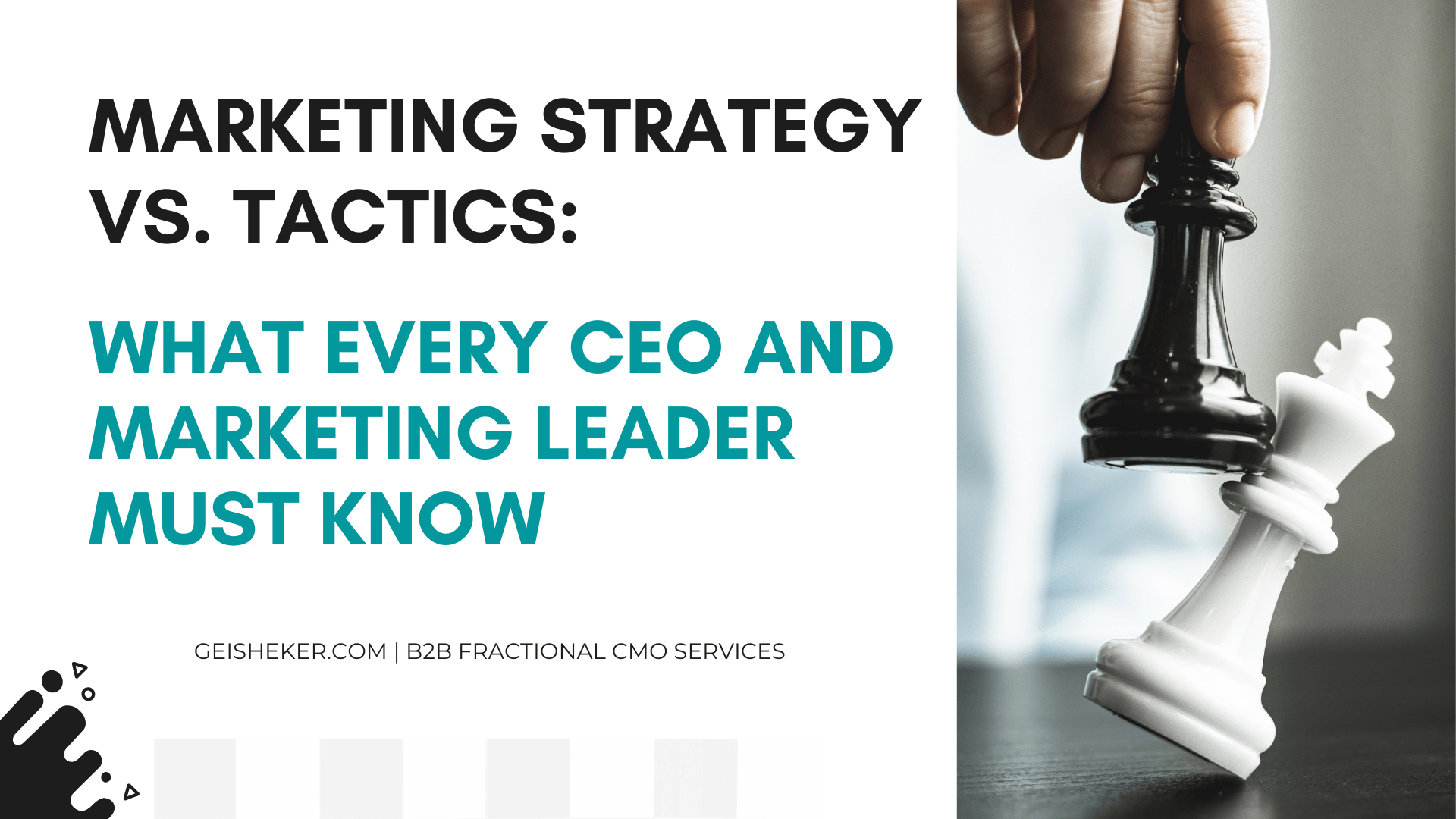
Marketing strategy is the set of decisions about who you will sell to, what position you will own against competitors, and why your buyers should choose you. Marketing tactics are the specific actions that carry out those decisions: the channels, campaigns, content, and tools. Strategy answers “who and why.” Tactics answer “what and how.” Strategy comes first.
Key facts
- In a Gartner survey of 403 CMOs, 84% reported high levels of strategic dysfunction within their function. Gartner links this to CMOs being pulled into tactical work.
- The same Gartner survey found CMOs who plan 18 months or more ahead are 1.5 times more likely to report high marketing and business performance. Just 15% plan beyond three years.
- In the Content Marketing Institute’s 2024 B2B research, 53% of top-performing B2B content marketers cited a documented strategy as a factor in their success.
- A sound B2B marketing strategy should stay largely stable for 12 to 24 months. Tactics should be adjusted monthly or quarterly based on performance.
Many B2B companies are not failing at marketing tactics. They are failing at marketing strategy, and they do not know the difference.
If your team is running LinkedIn ads, sending email campaigns, and publishing blog posts, but your pipeline is flat, the problem is almost never the tactics. It is the absence of a clear strategy directing them. In my work as a fractional CMO, I see this confusion constantly. Owners and experienced marketing directors describe their “strategy,” and what they describe is a list of activities. Tactics dressed up as strategy. It is one of the most expensive mistakes a growing company can make.
Marketing strategy vs. tactics: the definitions
Marketing strategy is the overarching plan that defines who you are targeting, what position you own in the market, and why customers should choose you over competitors. It also sets the measurable outcomes that define success. It exists before any campaign is planned, any channel is chosen, or any budget is allocated.
Marketing tactics are the executable activities that bring the strategy to life: emails, ads, events, content, sales enablement materials, search optimization, partnerships, and so on.
| Marketing strategy | Marketing tactics | |
|---|---|---|
| Question it answers | Who, why, and what position | What activity, and how |
| Typical lifespan | 12 to 24 months | Weeks to a quarter |
| Who owns it | CEO and senior marketing leader | Marketing team and execution partners |
| How it is measured | Pipeline, revenue, market position, win rate | Clicks, opens, leads, cost per lead, attendance |
| What happens without the other | A document that produces nothing | Activity that does not compound |
| Example | “Own the regulatory-compliance position with community banks” | “Run quarterly compliance webinars for bank executives” |
One more distinction that trips people up: a marketing plan is not the strategy either. The plan is the operational document that lists the tactics, timeline, budget, owners, and metrics. The plan serves the strategy.


Try two senior CMOs before you hire them
30 minutes with both of us. No hard sell. Written plan in 3 business days.
Why B2B companies confuse strategy with tactics
The confusion is understandable. Tactics are visible and easy to count. You can see an email campaign. You can track clicks on a LinkedIn ad. You can count blog posts published. Strategy is invisible. It lives in decisions, positioning choices, and the deliberate alignment of limited resources toward one goal.
Even senior marketing leaders get pulled down. Gartner’s 2025 CMO survey found 84% of CMOs report high levels of strategic dysfunction, and explained that “as CMOs are increasingly pulled into tactical work to meet competing stakeholder needs, they lose the ability to create bold, proactive strategies” (Gartner).
The result is random acts of marketing. A webinar here. A trade show there. A promoted LinkedIn post. Each tactic might be executed well on its own, but without a strategy connecting them, they do not compound. They do not build a market position. They do not move the right buyers through a deliberate pipeline.
The stakes are higher for small and mid-size B2B companies. Large enterprises can absorb wasted budget. You cannot. Every dollar and every hour your team spends on marketing needs to pull in the same direction.
What a marketing strategy decides
A complete B2B marketing strategy answers five questions:
- Who is your ideal customer? (industry, company size, role, and the specific pain point)
- What problem do you solve better than anyone else?
- How are you positioned relative to competitors?
- How does your buyer move from first awareness to purchase?
- What measurable outcomes define success?
Without clear answers to these five questions, you do not have a strategy. You have a wish list.
Strategy is also durable. External conditions shift, competitors move, and buyer behavior evolves, but your core positioning should not need a rebuild every quarter. If your “strategy” changes every time a new channel gets popular, you do not have a strategy. You have a reaction pattern.
What tactics are, and why they still matter
Tactics are not inferior to strategy. They are essential. A brilliant strategy with no execution produces zero results. But tactics without strategy produce noise: activity with no compounding return.
The key word is alignment. A tactic chosen because it serves a specific strategic objective (reaching a defined segment, reinforcing a defined positioning claim, speeding up a defined stage of the buyer journey) performs at a different level than a tactic chosen because a competitor is doing it or because someone read an enthusiastic post about it.
Tactics are selected after strategy is defined, never before.
6 B2B examples of marketing strategy vs. tactics
These six scenarios are illustrations, not client stories. Each shows a strategy and the tactics that exist only because that strategy exists.
| Company type | The strategy (who, position, goal) | Tactics that serve it |
|---|---|---|
| 1. B2B SaaS for mid-market manufacturers | Be the only operations platform built for discrete manufacturers with 100 to 500 employees that have outgrown spreadsheets but cannot take on enterprise ERP. Target Operations Directors and COOs in the Midwest and Southeast. Goal: qualified demos with companies at $15M to $75M in revenue. | LinkedIn ads to Operations Directors and COOs at 100 to 500 employee manufacturers in target regions; vertical case studies and guides on scaling pains; two regional manufacturing trade shows; an “outgrown spreadsheets” email nurture; search content on mid-market manufacturing operations software. |
| 2. IT consulting firm | Become the recognized cybersecurity authority for community banks and credit unions with $500M to $2B in assets. Win on FFIEC and NCUA regulatory expertise, not price or breadth. Goal: 15 qualified RFP invitations per year in a five-state territory. | Quarterly regulatory webinars for bank executives; bylined articles in banking trade publications; direct mail to CISOs and IT Directors at 200 named institutions; state banking association speaking slots; a gated FFIEC examination guide; weekly regulatory commentary on LinkedIn from the firm’s principal. |
| 3. Industrial equipment manufacturer | Capture the replacement market among food and beverage plants running equipment more than 12 years old. Sell on total cost of ownership, not purchase price, to CFOs and Plant Managers frustrated by rising maintenance costs. Goal: grow replacement revenue 30% in 18 months. | A website TCO calculator with a 5-year cost comparison; account-based LinkedIn ads to the 150 plants most likely running aging equipment; sales enablement built around TCO conversations; email and direct mail triggered by calculator use; case studies documenting maintenance cost reductions. |
| 4. Healthcare technology company | Become the preferred patient communication platform for independent practices with 2 to 15 physicians moving to value-based care. Win on fast implementation with no IT staff required and direct integration with the major EHR systems. Goal: 20% share of the independent practice segment in three years, starting in four states. | An educational series on value-based care patient communication; Google Search ads in the four target states; member trials through three regional independent practice associations; MGMA and state medical association events; a physician referral program; a 14-day trial with a dedicated onboarding specialist. |
| 5. Commercial insurance broker | Own coverage for construction contractors with $2M to $20M in revenue that standard carriers declined or non-renewed due to loss history. Be the specialist who says yes and then reduces future losses. Goal: grow the contractor book 40% in 24 months. | Outreach to independent agents who struggle to place difficult construction accounts; contractor content on what to do after a non-renewal; a referral program for construction attorneys and CPAs; paid search on high-intent non-renewal queries; a monthly newsletter for retail agents; AGC chapter events in the territory. |
| 6. Logistics and supply chain software | Displace legacy transportation management systems at e-commerce and omnichannel retailers with $50M to $500M in revenue by competing on 90-day implementation and total cost transparency. Reach the VP of Supply Chain, VP of Operations, and CFO together, since all three are in the decision. Goal: 50 qualified opportunities per quarter within 18 months. | A competitive displacement campaign aimed at users of three named legacy platforms; a “live in 90 days” landing page with customer proof and a side-by-side timeline; LinkedIn content for the two VP personas; a CFO ROI worksheet comparing 3-year cost; customer video testimonials about implementation; a partner program with e-commerce platform integrators. |
Notice the pattern. In each case the strategy defines who, why, and what position to own. Every tactic is on the list because it reaches the defined audience, reinforces the defined position, or advances the defined buyer journey.
Remove the strategy, and these same tactics become random. Keep the strategy, and they compound. In example 2, a direct mail piece and a trade-publication article look unrelated. Both exist to put regulatory expertise in front of the same 200 community bank decision makers. In example 6, the CFO gets ROI content, the VP of Operations gets implementation timeline content, and the VP of Supply Chain gets displacement content. Three personas, one strategy, coordinated tactics.
Example 5 also shows something strategy can do that tactics never can: create a protected lane. Competitors chasing standard-market contractors will never be in front of these buyers.
The most common tactic-as-strategy mistakes
Here are the errors I hear most often from B2B CEOs and marketing teams:
- “Our strategy is content marketing.” Content marketing is a tactic, a channel. Strategy would explain why you are creating content, for which audience segment, at which buyer journey stage, to establish which market position.
- “Our strategy is to be more active on LinkedIn.” LinkedIn is a platform. Activity on a platform is a tactic. Strategy would explain which audience you are reaching there, what position every post reinforces, and what behavior you are trying to drive.
- “Our strategy is to focus on SEO this year.” SEO is a collection of tactics. Strategy would define which buyer segments you are reaching through search, what intent those searches signal, and how visibility connects to pipeline.
- “Our strategy is to attend more trade shows.” Trade shows are a tactic. Strategy would define which events attract your highest-value buyers, what the conversion goal is for each, and how relationships are followed up after the event.
- “Our strategy is to use AI in marketing.” AI is a set of tools. It can make tactics faster and cheaper. It cannot decide who you serve or what position you own.
- “Our strategy is to grow revenue 30%.” That is a goal, not a strategy. Strategy is the set of choices about where and how you will win that makes the goal believable.
A useful rule: if the sentence names a channel, a tool, or a number with no target buyer and no position attached, it is not a strategy.
A quick test: is your plan a strategy or a list of tactics?
Pull up your current marketing plan and run it through these seven checks. It takes about five minutes.
- Can you name the buyer in one sentence? Industry, company size, and job title. “Mid-market companies” does not count.
- Can you state the position you own? One claim a competitor could not easily make about itself. If your answer is a feature list, fail.
- Does the plan say what you will not do? Real strategy rules out segments, channels, and deals. A plan that excludes nothing is a list.
- Can every line item be traced to a strategic objective? Point at any tactic and ask “why are we doing this?” If the answer is “everyone does it” or “we always have,” it should not be funded.
- Are the success measures business outcomes? Pipeline, revenue, win rate, or market share. If the plan is measured only by clicks, opens, and posts published, it is a tactics plan.
- Would the plan survive a quarter unchanged at the core? If the direction shifts every time a new channel gets hot, it is a reaction pattern.
- Does the budget follow the strategy? If you say you are building authority in one vertical but most of the money goes to broad paid ads, the budget is the real strategy, and it is not the one you wrote down.
If you pass five or more, you likely have a real strategy. If you pass three or fewer, you have a list of tactics, and the next step is to build the strategy above them. The step-by-step process for that is covered in our B2B marketing strategy framework.
Frequently asked questions
What is the simplest way to explain strategy vs. tactics?
Strategy is the decision about where to compete and how to win. Tactics are the actions you take to carry out that decision. You cannot choose effective tactics without a strategy to direct them, and a strategy without tactics is just a document.
Is social media a strategy or a tactic?
Social media is a tactic, a channel through which other tactics are executed. When a company says “our strategy is social media,” it usually means it has picked social as one channel. The strategy would say which audience on which platform, what position the content reinforces, and which buyer stage it serves.
What is the difference between a marketing strategy and a marketing plan?
The strategy defines direction, positioning, target audience, and competitive approach. The plan is the operational document describing how the strategy gets executed: which tactics, what timeline, what budget, who is responsible, and what metrics will be tracked. Strategy comes first, and the plan is built to serve it.
How often should a B2B marketing strategy change?
The core strategy should stay stable for 12 to 24 months, while the tactics are adjusted monthly or quarterly based on results. If your positioning and target audience change every quarter, you are not iterating, you are failing to commit. Gartner’s 2025 survey found CMOs who plan 18 months or more ahead are 1.5 times more likely to report high marketing and business performance (Gartner).
Can good tactics make up for a weak strategy?
Sometimes in the short term, especially in a market with strong demand and weak competitors. Over time, no. Tactics without direction give diminishing returns because they do not build position or compounding pipeline. In CMI’s 2024 B2B research, a documented strategy was one of the factors top-performing content marketers credited for their success, cited by 53% (Content Marketing Institute).
How should strategy drive the marketing budget?
The strategy should decide where the money goes. If the strategy is to build authority in one vertical through expertise, the budget should favor content, search, and PR over broad paid advertising. If the strategy is competitive displacement at named accounts, it should favor account-based programs and personalized outbound.
Where a senior marketing leader fits
Most growing B2B companies have people who are good at executing tactics. What they often lack is a senior leader who owns the strategy that makes those tactics coherent. In my engagements, the first job is nearly always the same: audit what is being done and why, separate strategy from tactics, set the strategy, then align every tactic to it. If you are weighing whether you need that kind of leadership, here is what a fractional CMO is.
If your plan failed the test above, or you are not sure, book a free 30-minute growth plan session with Michael Pecora and me on Google Meet. You will get a written growth plan within 3 business days, with no hard sell. We hold these for 10 companies a month. Book your session here.
Free Written Growth Plan
Wondering if a fractional CMO is right for you?
Try us before you hire us. Book a free 30-minute working session with both of us and get a written growth plan you can use whether or not you hire us.
Get My Free Growth Plan →No hard sell on the call. Your plan arrives within 3 business days. See a sample plan