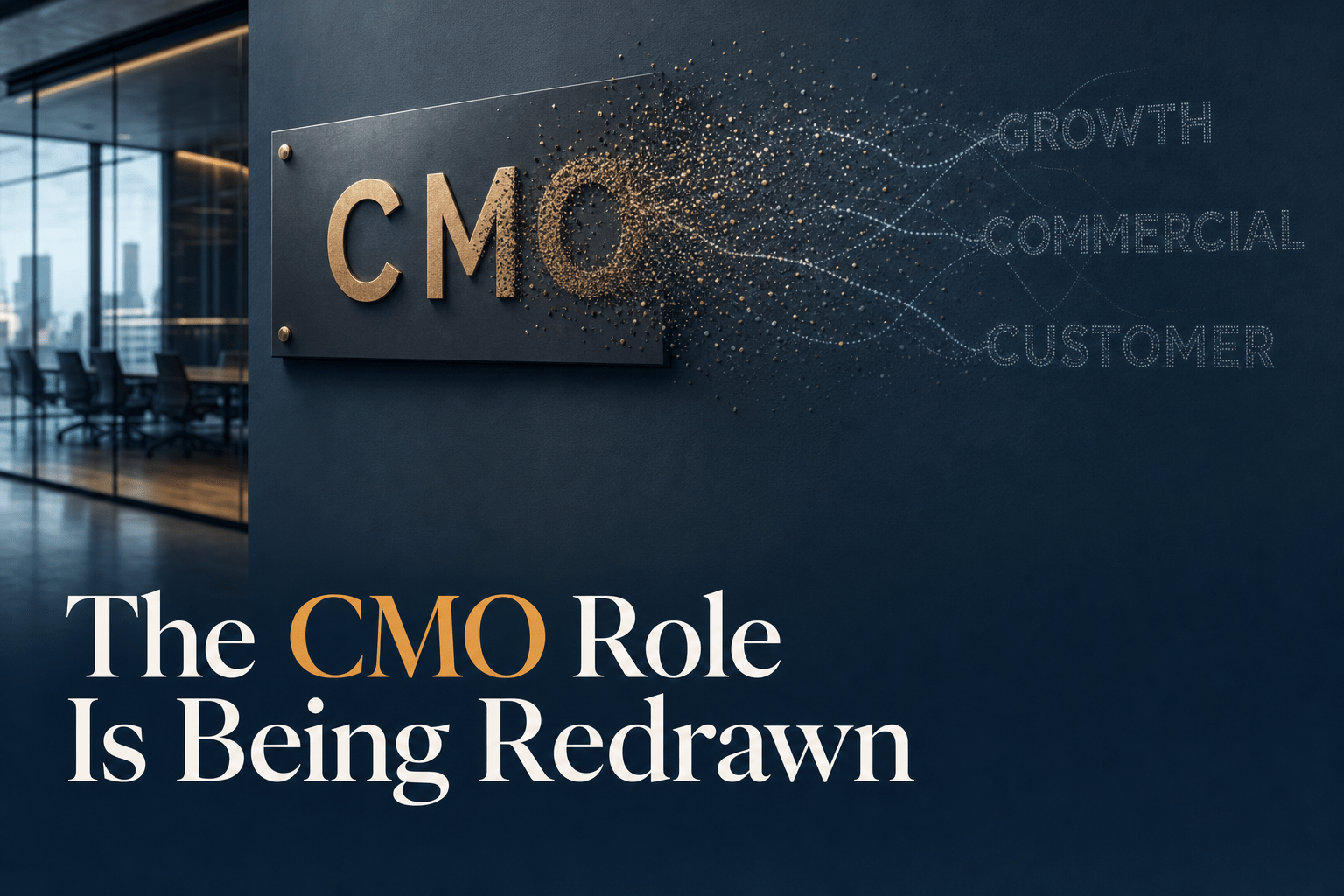
Bottom line: The CMO role is being unbundled, not eliminated; boards are moving marketing’s revenue accountability into growth, commercial, and customer titles because the job changed faster than hiring practices did. The standalone “CMO” title is shrinking inside the Fortune 500, but marketing itself is not. For a company staffing marketing leadership in 2026, the real risk is not choosing full-time versus fractional; it is hiring for a job that no longer exists the way you picture it.
Key Facts at a Glance
- The average tenure of an S&P 500 CMO is 4.1 years in 2026, the shortest of any core C-suite role, per Spencer Stuart’s 2026 CMO Tenure Study.
- CMO tenure sits below every other core executive seat except COO; CEOs average 7.6 years, CFOs 4.7 years, and COOs 3.3 years, per Spencer Stuart via ADWEEK (2026).
- Only about 49% of top marketers in the Fortune 500 now hold the “CMO” title, down from roughly 55% a year earlier, per Forrester’s analysis of Fortune 500 marketing leadership (2025).
- The share of Fortune 500 companies with a marketing executive reporting directly into the CEO or C-suite has slipped to roughly 58%, from about 63% the prior year, per the same Forrester analysis.
- UPS, Etsy, and Walgreens each eliminated the standalone CMO role outright, folding the responsibilities into commercial and operating titles rather than backfilling them (Forrester, 2025).
- 88% of B2B decision-makers say their organizations are adopting or planning to adopt AI agents, pushing growth and revenue squarely into the marketing leader’s remit, per Forrester’s “The AI CMO” report (April 2026).
- Forrester frames the shift as the role moving up rather than out, toward enterprise growth orchestration and explicit revenue accountability, per “The AI CMO: Growth Accountability Gets Next-Level” (April 2026).
This guide draws on Peter Geisheker’s 20-plus years of B2B marketing experience as founder and CEO of The Geisheker Group, Inc., a fractional CMO agency serving B2B, B2B SaaS, PE/VC-backed, and law firm clients. Documented client outcomes include 6X inbound lead growth, 100% year-over-year SaaS revenue growth for three consecutive years, a 77% reduction in paid acquisition spend while growing revenue, and $1 million per week in managed ad spend for law firm lead generation. Peter and Michael Pecora lead engagements together as embedded senior marketing executives, and the analysis below reflects a pattern seen firsthand across dozens of companies where the marketing leadership seat was redrawn, informed by 2026 benchmark data from Spencer Stuart and Forrester.
Peter Geisheker, who has embedded as a fractional operator across dozens of marketing organizations, frames the instability underneath these numbers this way:
The expertise problem is not a fractional problem, it is a profession-wide one. I have seen full-time CMOs with impressive credentials and very little actual marketing expertise, and I have seen the same on the fractional side. The reason is that the job changed underneath everyone. Marketing is no longer principally a creative judgment job; it is a technical, data-driven, experimental one. Creative did not stop mattering, it became testable. Twenty years ago you made the memorable commercial and waited on quarterly sales to tell you something vague. Now the loop closes in days, so the job stopped being have good taste and defend it, and became run the system that finds out whose taste was right. Taste is now the hypothesis, not the deliverable. Hiring has not caught up to that change on either side of the fractional line.
Table of Contents
- What is actually happening to the CMO title in 2026?
- Why is CMO tenure the shortest role in the C-suite?
- Does a shrinking CMO title mean marketing matters less?
- What actually changed underneath the role?
- What does the title shift mean for how you staff marketing?
- Where does a fractional CMO fit a restructured mandate?
- Frequently Asked Questions
- Implementing this staffing decision in your company
- About Peter Geisheker
- References and Sources
Explore Fractional CMO Services →
What is actually happening to the CMO title in 2026?
Two data sets are getting read as a death notice for the CMO. They are not one, and if you make a staffing decision on the headline you will make an expensive one.
Spencer Stuart’s 2026 CMO Tenure Study puts the average tenure of an S&P 500 chief marketing officer at 4.1 years, the shortest of any core C-suite seat. Separately, Forrester’s ongoing analysis of Fortune 500 marketing leadership found that the proportion of top marketers who actually carry the “CMO” title has fallen to roughly 49% in 2025, down from about 55% a year earlier, and that fewer of those leaders report directly into the CEO than did the year before, roughly 58% versus 63%.
The headline writers turned that into “the CMO is dead.” What the data shows is unbundling, not elimination. A handful of large companies, UPS, Etsy, and Walgreens among them, did remove the standalone title and move the work into commercial, growth, or operating roles. Most did not remove the function at all; they renamed and re-scoped the seat around revenue. In 2026 the title is contracting while the mandate is expanding, which is a very different problem to staff for than a function in decline.
Why is CMO tenure the shortest role in the C-suite?
Short tenure reads as failure. Most of it is not. For context, the 4.1-year 2026 figure sits below CEOs at 7.6 years and CFOs at 4.7 years, and only COOs, at 3.3 years, turn over faster, per Spencer Stuart data reported by ADWEEK in 2026.
A meaningful share of CMO exits are promotions or lateral moves into bigger jobs: chief growth officer, chief commercial officer, chief customer officer, or general manager of a business line. The most commercially capable marketing leaders are leaving the title on purpose because it has become a ceiling rather than a peak. When a strong operator can trade “CMO” for a seat that owns a P&L, the tenure number drops without anything going wrong.
The other pressure is real. Boards are raising what they expect the role to deliver, faster than ever, while shortening the window to prove it, and AI is the accelerant. Forrester’s read in “The AI CMO” (April 2026) is that AI is not shrinking the role so much as stripping away its insulation: with 88% of B2B decision-makers adopting or planning to adopt AI agents, and large language models becoming the first stop for search, shopping, and product discovery, the marketing leader gets pushed straight into commercial accountability whether they wanted it or not. A leader hired to “own brand and awareness” in 2026, then measured mid-stream on pipeline and revenue, is a leader with a short tenure ahead of them.
Does a shrinking CMO title mean marketing matters less?
No. It means the opposite, and the structure change is the tell.
When a company folds the CMO role into a chief commercial or chief growth officer, it is not downgrading marketing; it is refusing to let marketing sit at a distance from revenue. Richard Sanderson of Spencer Stuart put the point plainly: when people say the CMO role is being eliminated, that does not mean marketing is unimportant, it means the company has chosen to structure around the role in a different way.
Forrester’s framing lands in the same place. In “The AI CMO,” the role moves up rather than out: as AI agents absorb orchestration, execution, and dynamic optimization, the marketing leader spends less time running programs and more time making enterprise-level trade-offs about where to invest, where to automate, and where human judgment still decides the outcome. That is a bigger job, not a smaller one. It is also a different job than the one most hiring processes are still written for in 2026.
Try two senior CMOs before you hire them
30 minutes with both of us. No hard sell. Written plan in 3 business days.
What actually changed underneath the role?
This is the part the tenure charts do not explain, and it is the whole reason the title is unstable: the work changed.
The title churns because boards keep hiring for the old job, a brand steward with good instincts and a big budget, then measure the person against the new job, an operator who runs a measurable revenue system. Peter Geisheker argues that the gap between those two definitions is where four-year tenures and eliminated titles come from. Creative did not stop mattering; it became testable, and the feedback loop that used to take a quarter now closes in days. A leader who cannot run that loop is staffed for a role that is disappearing, whatever their title or resume says.
That mechanism is profession-wide, not fractional-specific, and it is exactly why a long resume is no longer proof of fitness for the current version of the job. It is the single most important thing to understand before you decide who owns marketing next.
What does the title shift mean for how you staff marketing?
If you run a company with $2M+ in revenue, the Fortune 500 title reshuffle is not your story, but its cause is exactly your story.
You are not deciding whether to rename your CMO into a chief growth officer. You are deciding who owns marketing at all, and against what definition. The trap is inheriting the Fortune 500’s old definition without its budget: hiring or contracting a “marketing leader” to own brand and awareness, then being surprised when the number does not move. Peter Geisheker argues that the title on the business card is irrelevant; the definition of the job is everything.
Three practical implications for 2026:
Staff for the revenue definition, not the brand definition. Whoever owns marketing should own a measurable contribution to pipeline and revenue, sit in the numbers, and be accountable for a system, not a look. If the person you are considering cannot describe how they will measure and improve conversion, attribution, and cost per acquisition, they are staffed for the job that is disappearing.
Do not assume seniority equals current expertise. The role changed fast enough that a long resume is not proof of fluency in the technical, testable version of the job, and that is true on both sides of the fractional line. Screen for how someone runs the measurement loop, not how many logos they have managed.
Decouple “how much leadership” from “which title.” Most companies your size do not need a full-time executive owning marketing five days a week; they need the changed job owned competently at the dose they can actually use. That is the staffing question worth answering.
Where does a fractional CMO fit a restructured mandate?
A fractional CMO is a senior marketing executive who owns the marketing function on an embedded, ongoing basis and is accountable for marketing’s contribution to revenue, not an advisor who recommends and exits. For a mid-market or investor-backed company, the model fits the restructured mandate for a specific reason: it lets you buy the changed job, at the dose you need, without paying full-time executive compensation for a definition of marketing that no longer exists.
The Fortune 500 solved the “old job versus new job” gap by merging titles and moving accountability toward revenue. A growing company solves the same gap differently. Drawing on 20-plus years of embedded engagements, Peter Geisheker recommends staffing for the revenue definition of the role regardless of title: installing an operator who owns the measurable revenue system directly, meaning pipeline measurement, go-to-market strategy, lead generation, and sales-marketing alignment. You get the new definition of the job without inheriting the churn, the compensation, or the risk of hiring a full-time leader statistically likely to leave inside four years.
That is the practical read on the title story in 2026. The seat is being redrawn around revenue accountability everywhere, at the top of the market by merging C-suite titles, and in the mid-market by embedding a fractional CMO agency operator who owns the number from day one. For PE-backed portfolio companies on a compressed hold, that accountability is the entire point of the engagement. If you are weighing the model against a full-time hire or an agency, start with the diligence in this guide to hiring a fractional CMO, and if you are still mapping the landscape, what a fractional CMO actually is and does breaks the role down before you decide how to staff the seat.
Frequently Asked Questions
Is the CMO role going away in 2026?
No. The standalone “CMO” title is shrinking inside the Fortune 500, with a handful of companies such as UPS, Etsy, and Walgreens eliminating it outright, but in most cases the function is being renamed and re-scoped around revenue rather than removed. Marketing accountability is moving into growth, commercial, and customer titles, which is a structural change, not a downgrade.
Why is CMO tenure so short?
Average S&P 500 CMO tenure is 4.1 years in 2026, the shortest core C-suite role except COO, per Spencer Stuart. A large share of that churn is voluntary, with strong marketers moving into bigger revenue-owning roles. The rest is driven by boards raising expectations faster than they give leaders time to deliver, with AI accelerating the pressure.
Does a shrinking CMO title mean companies value marketing less?
No. Folding the CMO into a chief growth or commercial role usually reflects a decision to pull marketing closer to revenue, not push it away. Forrester describes the role as moving up rather than out, toward enterprise growth orchestration.
How does the CMO title shift affect a company that is not in the Fortune 500?
Directly, through the cause rather than the title. The reason the seat is being redrawn is that the marketing job became technical, measurable, and revenue-accountable. A growing company should staff for that definition, whoever owns the seat and whatever the title, rather than hiring for the older brand-steward version of the role.
What is the difference between a full-time CMO, a fractional CMO, and an agency for a restructured mandate?
It depends on the dose of leadership you need and whether the person will own a measurable revenue system. Many companies with $2M+ in revenue do not need full-time executive leadership five days a week; they need the changed job owned competently at a fraction of the cost and commitment. An agency executes tactics; a fractional CMO owns the function and the outcome.
How do I know if I am staffing for the old CMO job or the new one?
Ask whoever will own marketing to describe exactly how they will measure and improve conversion, attribution, and cost per acquisition. If the answer is about brand, awareness, and taste with no measurement loop attached, you are staffing for the version of the role that is disappearing.
Implementing this staffing decision in your company
Most CEOs and operating partners understand the title shift the moment they see the data; the harder problem is translating it into a staffing decision that actually holds. Reading that the job changed is easy. Building a marketing function around the revenue definition of the job, with the measurement, accountability, and pipeline rigor that keep it from drifting back into brand-and-awareness theater, is the work.
That installation work is fractional CMO work, scoped to your stage. It means owning the marketing function as an embedded executive, standing up the measurement and attribution layer, aligning marketing with sales, and being accountable for a number rather than a look, at the dose a $2M+ company can actually use.
It is not for everyone. If you have mature in-house marketing leadership already, you do not need this; if you are under $2M in revenue and not well funded, your resources belong in sales and product first. If you are past that point and staffing the marketing seat is the decision in front of you, the fastest way to pressure-test whether an embedded fractional CMO fits is a short conversation about your specific situation.
About Peter Geisheker
Peter Geisheker is founder and CEO of The Geisheker Group, Inc., a fractional CMO agency serving B2B, B2B SaaS, and PE/VC-backed companies with $2M+ in revenue. He and Michael Pecora lead engagements together as embedded senior marketing executive, drawing on 20-plus years of B2B revenue growth experience and documented client outcomes including 6X inbound lead growth, 100% year-over-year SaaS revenue growth for three consecutive years, a 77% reduction in paid acquisition spend while revenue grew, and $1 million per week in managed ad spend for law firm lead generation. Connect with Peter on LinkedIn.
References and Sources
- Spencer Stuart, “CMO Tenure Study” (2026): aaaa.org/research-report/cmo-tenure-study
- ADWEEK, “Why CMO Tenure Remains Stubbornly Short” (January 2026): adweek.com/brand-marketing/why-cmo-tenure-remains-stubbornly-short
- ANA, “CMO Trends and Best Practices” (2026): ana.net/miccontent/show/id/aa-2026-08-cmo-trends
- Forrester, “The AI CMO: Growth Accountability Gets Next-Level” (April 2026): forrester.com/blogs/the-ai-cmo-growth-accountability-gets-next-level
- Forrester, Chief Marketing Officer research category, Fortune 500 CMO analysis: forrester.com/blogs/category/chief-marketing-officer-cmo
- Campaign, “AI turns CMOs into chief growth officers: Forrester” (April 2026): campaignlive.com/article/ai-turns-cmos-chief-growth-officers-forrester/1956317
- Behind the CMO, “The CMO Is Dead. Long Live the CMO.” (December 2025), summarizing Forrester Fortune 500 figures and the Richard Sanderson (Spencer Stuart) quote: behindthecmo.com/p/the-cmo-is-dead-long-live-the-cmo
- MarketScale, “CMO tenure hits a 4.1-year floor at S&P 500 companies” (August 2026): marketscale.com/industries/marketing-tech/cmo-tenure-hits-a-41-year-floor-at-sp-500-companies-as-marketing-chiefs-trade-titles-for-broader-mandates
- Marketing Dive, “Forrester: Chief growth officers will replace CMOs”: marketingdive.com/news/forrester-chief-growth-officers-will-replace-cmos/510242
- Retail Dive, Spencer Stuart Fortune 500 CMO tenure reporting: retaildive.com/news/chief-marketing-officer-tenure-stabilizes-retail/713346
- Spencer Stuart, firm overview: spencerstuart.com
- Forrester, “Five Strategic CMO Moves Heading Into 2026”: forrester.com/blogs/five-strategic-cmo-moves-heading-into-2026
- Campaign US, “AI turns CMOs into chief growth officers: Forrester” (UK edition): campaignlive.co.uk/article/ai-turns-cmos-chief-growth-officers-forrester/1956392
Free Written Growth Plan
Wondering if a fractional CMO is right for you?
Try us before you hire us. Book a free 30-minute working session with both of us and get a written growth plan you can use whether or not you hire us.
No hard sell on the call. Your plan arrives within 3 business days. See a sample plan