How to Hire a Fractional CMO in 2026

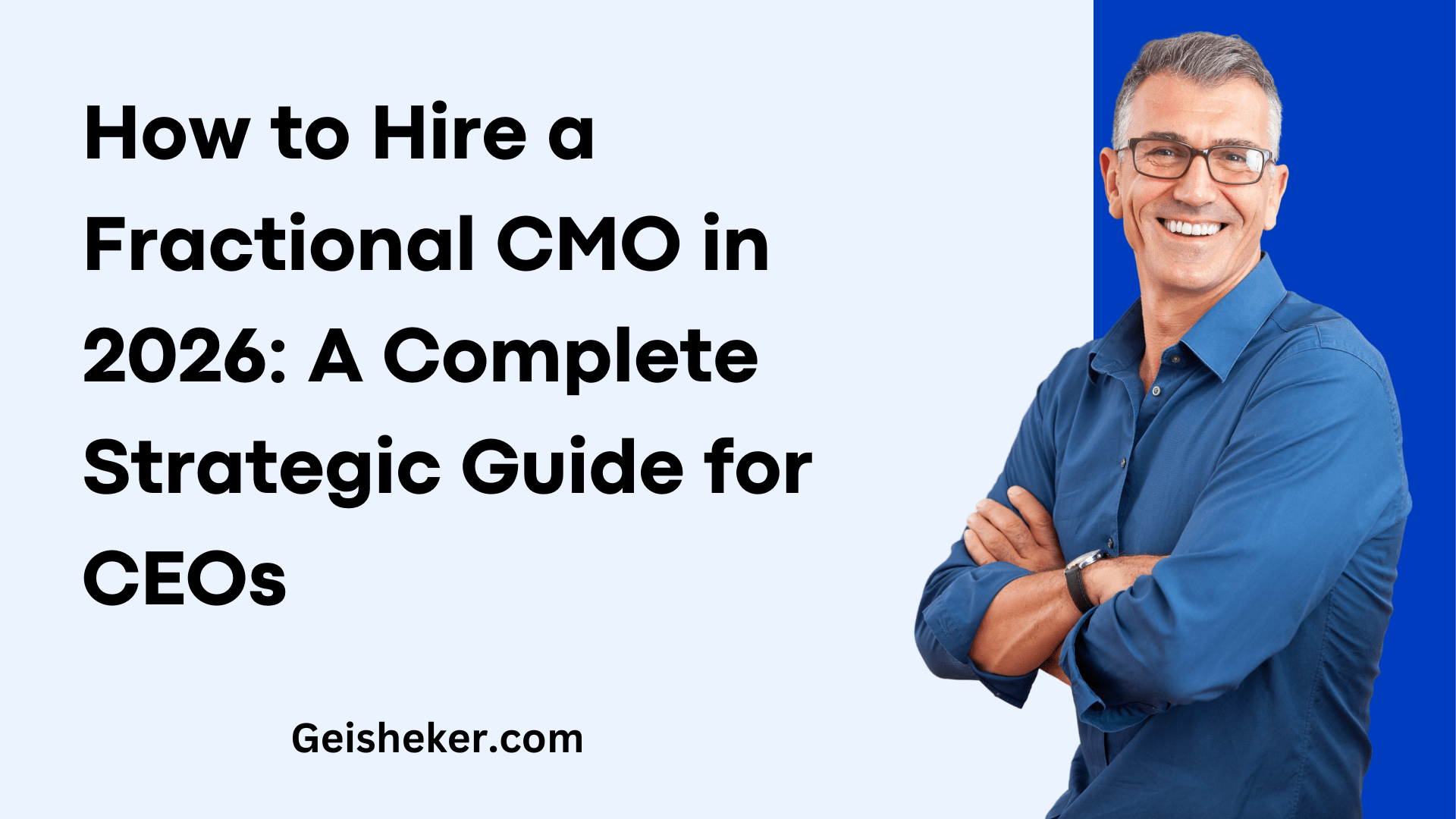
How to hire a Fractional CMO hero image

How to Hire a Fractional CMO in 2026: A Complete Strategic Guide for CEOs

You’ve recognized the gap in your marketing leadership. Your business needs strategic direction, but a $300,000+ full-time CMO salary isn’t in the budget. You’re considering a fractional CMO, but where do you even begin?

Hiring the wrong fractional CMO can cost you months of momentum and tens of thousands of dollars. Hiring the right one can transform your marketing from tactical chaos into a revenue-generating machine.

This guide walks you through exactly how to hire a fractional CMO who will deliver measurable results for your business. You’ll learn the proven seven-step framework, understand what to look for (and what red flags to avoid), and discover how to structure an engagement that sets both parties up for success.

What Is a Fractional CMO and Why Should You Hire One?

A fractional Chief Marketing Officer provides executive-level marketing leadership on a part-time or project basis. Unlike full-time CMOs who work exclusively for one company, fractional CMOs typically work with multiple clients simultaneously, bringing cross-industry expertise and proven frameworks to each engagement.

According to data from Toptal’s 2024 survey of 340 startup and SMB executives, 9% were already working with a fractional CMO or planning to hire one within 12 months. This represents a significant shift in how companies approach marketing leadership.

The fractional CMO model offers several distinct advantages. You gain senior-level strategic thinking without the six-figure salary commitment. These executives bring battle-tested experience from multiple companies and industries, meaning they’ve likely solved challenges similar to yours before. Most importantly, you can scale the engagement up or down based on your needs and budget.

But a fractional CMO isn’t the right solution for every business. Companies with established marketing teams executing well may not need strategic leadership. Organizations requiring 40+ hours per week of hands-on management might be better served by a full-time hire. The key is understanding where your business sits and what you actually need.

When to Hire a Fractional CMO: Recognizing the Right Timing

Knowing how to hire a fractional CMO starts with understanding whether you need one at all. Several situations make fractional CMO services particularly valuable for B2B companies.

Your business is experiencing rapid growth but lacks marketing structure. Revenue is increasing, but you don’t have a cohesive strategy connecting your marketing activities to business objectives. You’re spending money on tactics without a clear framework for what’s working.

You’re between full-time marketing leaders. Perhaps your CMO left, or you’re scaling up and not ready for a permanent executive hire. A fractional CMO provides continuity and strategic direction during these transitional periods.

Your marketing budget exceeds $5,000 monthly, but you can’t justify a full-time CMO salary. According to 2025 data from Glassdoor and MarketerHire, full-time CMOs command salaries between $250,000 and $400,000 annually, plus benefits and equity. If you have meaningful marketing spend but not that level of budget for leadership, the fractional model makes financial sense.

You need specialized B2B or B2B SaaS expertise. The SaaS buying journey involves longer sales cycles, multiple decision-makers, and complex evaluation criteria. A 2025 report from McKinsey found that SaaS firms with tightly aligned marketing and sales functions achieve 15-20% higher revenue growth than those without. A fractional CMO with specific B2B SaaS experience understands these dynamics.

Your founders are stretched too thin. If the CEO is managing marketing strategy while also handling product development, fundraising, and operations, something will suffer. A fractional CMO takes marketing leadership off the founder’s plate.

Understanding Fractional CMO Pricing: What You’ll Actually Pay in 2025

Before diving into how to hire a fractional CMO, you need to understand the investment required. Fractional CMO pricing varies based on experience, scope, and engagement structure, but 2025 data provides clear benchmarks.

Most fractional CMOs use one of three pricing models: hourly rates, monthly retainers, or project-based fees.

Hourly rates typically range from $200 to $500 per hour according to data from MarketerHire and O-CMO. Entry-level fractional CMOs with 10-15 years of experience charge $200-$250 per hour, while seasoned executives with 20+ years and specialized industry expertise command $300-$500 per hour. This model works best for occasional strategic consulting or specific problem-solving needs.

Monthly retainers represent the most common engagement structure. Current market rates range from $5,000 to $20,000 per month, with the average landing around $10,000-$12,000 monthly according to research from Go Fractional and Ryan Holck. This typically covers 20-40 hours of work per month, including strategic planning, team leadership, campaign oversight, and executive reporting.

Project-based engagements range from $15,000 to $50,000 depending on scope and timeline. A website overhaul might cost $20,000-$30,000, while a complete go-to-market strategy for a product launch could reach $40,000-$50,000.

To put this in perspective, a fractional CMO working 40 hours per month at a $10,000 retainer costs approximately $120,000 annually. Compare this to the $250,000-$400,000 total compensation for a full-time CMO (according to Spencer Stuart’s 2025 CMO Tenure Study), and the cost savings become clear. You’re accessing 40-65% cost reduction while still getting executive-level strategic expertise.

The financial model makes particular sense for small to mid-size B2B companies. You invest in strategic leadership without the overhead of benefits, equity, recruiting fees, and long-term salary commitments.

The 7-Step Framework: How to Hire a Fractional CMO

Now let’s walk through the proven process for how to hire a fractional CMO who will actually move the needle for your business.

Step 1: Define Your Marketing Challenges and Objectives

Start by documenting exactly what you need to solve. Avoid vague statements like “we need better marketing.” Instead, identify specific challenges and measurable objectives.

Are you struggling with lead generation? Document your current cost per lead, conversion rates, and lead volume. Do you lack a cohesive brand position? Describe how prospects currently perceive you versus how you want to be positioned. Is your marketing team underperforming? Outline the specific capabilities and leadership gaps.

Write down your top 3-5 business objectives for the next 12 months. These might include: increase qualified leads by 40%, improve sales and marketing alignment, launch into a new market segment, or reduce customer acquisition cost by 25%.

This clarity serves two purposes. First, it helps you evaluate candidates against specific needs rather than general marketing expertise. Second, it establishes the baseline for measuring your fractional CMO’s impact.

Step 2: Determine Your Budget and Engagement Structure

Based on the pricing data above and your specific needs, establish a realistic budget. Consider both the direct cost of the fractional CMO and any additional budget they’ll need to execute strategy (advertising spend, tools, content creation, agencies).

Decide which pricing model fits your situation. If you need ongoing strategic leadership and team management, a monthly retainer makes sense. If you’re solving a specific challenge like rebuilding your demand generation engine, a project-based engagement might work better. For occasional strategic input, hourly consulting could suffice.

Most successful fractional CMO engagements involve 20-40 hours per month of strategic work. Less than 20 hours often isn’t enough for meaningful impact. More than 40 hours might indicate you actually need a full-time leader.

Be prepared for a 3-6 month minimum commitment. Marketing strategy takes time to show results. A fractional CMO needs at least 90 days to assess your situation, develop strategy, begin implementation, and demonstrate early wins.

Step 3: Source Qualified Candidates

You have several options for finding fractional CMO candidates, each with distinct advantages.

Fractional CMO agencies like Chief Outsiders, Kalungi (for B2B SaaS), and MarketerHire maintain vetted networks of executives. These agencies handle matching and often provide some quality assurance. The tradeoff is you’re working within their roster and pricing structure.

Freelance platforms like Upwork and specialized sites like Go Fractional offer direct access to individual fractional CMOs. You have more control over selection and potentially lower costs, but you’re responsible for all vetting.

Professional networks and referrals often yield the highest quality candidates. Ask other CEOs, investors, or your professional network for recommendations. LinkedIn’s data shows fractional executive roles grew from 2,000 professionals in 2022 to over 110,000 in early 2024, so your network likely includes someone who can make introductions.

Industry-specific searches can be valuable if you need specialized expertise. For B2B SaaS companies, look for fractional CMOs with proven experience in software businesses. Search for candidates who understand metrics like CAC payback period, LTV:CAC ratios, and product-led growth.

Prioritize candidates with a track record in companies similar to yours in size, industry, and growth stage. A fractional CMO who scaled marketing for a Series B SaaS company will understand your challenges better than one who only worked with Fortune 500 enterprises.

Step 4: Evaluate Experience and Industry Expertise

When reviewing candidates, go beyond surface-level credentials. Here’s what to assess:

Relevant industry experience matters significantly. According to Gartner’s research, marketing now averages just 7.7% of total company revenue, down from 12% pre-pandemic. This means marketers must deliver more with constrained budgets. A fractional CMO with specific experience in your industry understands these dynamics and brings proven approaches.

For B2B companies, look for evidence of successful demand generation, sales and marketing alignment, and account-based marketing. For B2B SaaS specifically, you want someone who understands subscription metrics, product-led growth, and longer sales cycles.

Ask for specific examples and quantified results. Don’t accept vague claims like “improved marketing performance.” Instead, look for: “Increased qualified pipeline by 47% within six months while reducing cost per lead by 23%” or “Led go-to-market strategy for product launch that generated $2.3M in first-year ARR.”

Request case studies or client references from businesses similar to yours. Speak with at least 2-3 references and ask specific questions: What were the measurable outcomes? How did they handle challenges? Would you hire them again?

Assess their strategic thinking versus tactical execution focus. A true fractional CMO should be able to articulate frameworks for brand positioning, customer segmentation, go-to-market strategy, and marketing attribution. If they primarily talk about tactics (email campaigns, social media, ads) rather than strategy, they may not be operating at the CMO level.

Step 5: Conduct Strategic Interviews

Your interview process should assess both strategic capability and cultural fit. Structure interviews to test how candidates think, not just what they know.

Present a real marketing challenge your business faces. Ask them to walk through how they would approach it. Strong candidates will ask clarifying questions about your business model, customer base, and existing capabilities before jumping to solutions. They should demonstrate a structured problem-solving approach.

Ask about their experience with metrics and data-driven decision making. In today’s environment, marketing leaders must prove ROI. Ask: “How do you determine which marketing channels to prioritize? Walk me through how you would set up our marketing attribution and reporting.” Listen for familiarity with analytics tools, testing methodologies, and financial metrics.

Evaluate their communication style. Your fractional CMO will need to present to your board, collaborate with sales leaders, and potentially manage a team. Do they communicate clearly? Can they translate complex marketing concepts into business language?

Test their understanding of your industry’s specific challenges. For B2B SaaS, ask about their approach to product-led growth, usage-based pricing impact on marketing, or PLG versus sales-led growth strategies. Their answers will reveal depth of relevant experience.

Discuss their working style and engagement expectations. How often will they be available? How do they prefer to communicate? What do they need from you to be successful? What does success look like at 90 days, six months, and one year?

Step 6: Establish Clear Scope, KPIs, and Contract Terms

Once you’ve selected a candidate, document everything in writing before starting work. Vague agreements lead to misaligned expectations and disappointing outcomes.

Define the specific scope of work. What exactly will the fractional CMO be responsible for? This might include: developing overall marketing strategy, managing the marketing team, overseeing campaign execution, reporting to executive leadership, managing marketing budget, hiring and onboarding marketing staff, and establishing marketing operations and processes.

Be explicit about what’s not included. If you expect them to personally execute tactics (writing blog posts, building email campaigns, managing ad accounts), state that clearly. Most fractional CMOs operate at the strategic and leadership level, not execution.

Establish measurable KPIs aligned with your business objectives. These should be specific, measurable, achievable, relevant, and time-bound. Examples: Increase monthly qualified leads from 45 to 75 within six months, improve marketing-attributed revenue from 25% to 40% by end of year, reduce customer acquisition cost from $4,200 to $3,000 by Q3, or launch into new vertical with 15 qualified opportunities by end of quarter.

Determine the engagement structure. Monthly retainer? Project-based? Specify hours committed per month, meeting cadence, deliverables, and reporting requirements.

Address contract terms including engagement length, termination clauses, intellectual property ownership, confidentiality agreements, and payment terms. Most fractional CMO contracts include 30-60 day termination clauses, allowing either party to exit if the relationship isn’t working.

Discuss how success will be measured and reviewed. Schedule regular check-ins (weekly or bi-weekly) plus formal quarterly reviews to assess progress against KPIs.

Step 7: Onboard Effectively and Enable Success

The quality of your onboarding directly impacts your fractional CMO’s effectiveness. They need to understand your business deeply to make sound strategic decisions.

Provide comprehensive access to business information including financial performance, product roadmap, sales data and processes, existing marketing performance metrics, customer data and insights, competitive intelligence, and brand guidelines and assets.

Facilitate introductions to key stakeholders. Your fractional CMO should meet with sales leadership, product managers, customer success, finance, and any existing marketing team members. These conversations help them understand organizational dynamics and build necessary relationships.

Share your strategic context. What are the board’s expectations? What’s your growth trajectory? What are the biggest business risks and opportunities? What have you already tried in marketing that failed or succeeded?

Set up necessary systems access. They’ll need access to your CRM, marketing automation platform, analytics tools, project management systems, and any other relevant software.

Establish regular communication rhythms. Weekly one-on-one meetings with you, participation in executive team meetings, regular team meetings if managing staff, and agreed-upon reporting cadence.

Give them space to assess before expecting solutions. Most experienced fractional CMOs will spend their first 30 days conducting an audit of your current marketing. This assessment period is valuable and should be expected, not rushed.

Red Flags: What to Avoid When Hiring a Fractional CMO

Not every fractional CMO will be right for your business. Watch for these warning signs during your hiring process.

Lack of specific, quantified results from previous engagements. If a candidate can’t articulate measurable outcomes they’ve driven, they likely haven’t delivered them. Marketing is increasingly data-driven. Your fractional CMO should speak fluently about metrics.

No relevant industry experience. A fractional CMO who has only worked with B2C e-commerce companies will struggle to understand B2B SaaS challenges. While some skills transfer, industry-specific knowledge matters significantly.

Overemphasis on tactics versus strategy. If the candidate primarily discusses execution (running ads, posting on social media, sending emails) rather than strategic frameworks, they may not operate at the executive level you need.

Unrealistic promises. Be wary of anyone guaranteeing specific outcomes like “I’ll double your leads in 60 days.” Marketing involves too many variables to make such promises. Experienced CMOs set ambitious but realistic goals based on data and context.

Unavailability for your needs. If you need 30 hours per month but they can only commit 10, the engagement won’t succeed. Ensure their availability aligns with your requirements.

Resistance to measurement and accountability. Strong fractional CMOs embrace metrics and want to be held accountable for results. If a candidate is vague about how they’ll measure success or seems uncomfortable with KPI-based evaluation, that’s concerning.

No clear process or framework. Experienced fractional CMOs have battle-tested approaches to marketing strategy, whether it’s specific to their expertise or proprietary frameworks they’ve developed. If they can’t articulate their strategic process, they likely don’t have one.

Fractional CMO vs. Marketing Agency: Understanding the Difference

Many business leaders wonder whether they should hire a fractional CMO or work with a marketing agency. Understanding the distinction helps you make the right choice.

A fractional CMO provides strategic leadership and becomes part of your executive team. They attend your leadership meetings, understand your business deeply, align marketing with overall business strategy, and take ownership of marketing outcomes. They typically manage your marketing team and external vendors, making strategic decisions about resource allocation.

A marketing agency provides specialized execution services. They excel at specific tactics like paid advertising, SEO, content production, or web development. Agencies generally work on defined projects or campaigns rather than owning your overall marketing strategy.

The two models can work together effectively. Many companies hire a fractional CMO to provide strategic direction and team leadership, then the fractional CMO manages relationships with specialized agencies for execution. This combination provides both strategic thinking and tactical expertise without requiring a massive in-house team.

Choose a fractional CMO when you need strategic marketing leadership, someone to build and manage your marketing function, alignment between marketing and business objectives, and accountability for overall marketing performance.

Choose an agency when you need specialized tactical expertise, execution capacity your team lacks, project-based work with defined deliverables, or specific capabilities like paid media management or content production.

For many B2B companies, the optimal structure involves a fractional CMO for strategy and leadership, a lean internal team for brand and messaging, and specialized agencies for execution in areas like demand generation, content creation, or paid media.

Making the Most of Your Fractional CMO Engagement

Once you’ve hired a fractional CMO, certain practices maximize the value of the relationship.

Give them real authority and access. If you hire a fractional CMO but don’t give them decision-making authority or access to key information, they can’t be effective. Treat them as a true executive team member.

Provide honest feedback regularly. If something isn’t working, address it promptly. Most fractional CMOs appreciate direct communication and want to course-correct quickly.

Respect their time boundaries. Remember they’re fractional for a reason. Don’t expect 24/7 availability or unlimited hours. Work within the agreed-upon time commitment.

Be prepared to invest in execution. A fractional CMO provides strategy and leadership, but strategy requires execution. You’ll need budget for advertising, content creation, tools, and potentially additional team members or agencies.

Allow time for results. Marketing strategy takes time to show impact. While you should see early wins within 90 days, meaningful transformation often takes 6-12 months. Patience and commitment matter.

Leverage their broader experience. One unique advantage of fractional CMOs is they work with multiple companies. Ask them about approaches they’ve seen work in other contexts. This cross-pollination of ideas often yields innovative solutions.

Final Thoughts: Making Your Fractional CMO Decision

Learning how to hire a fractional CMO is one thing. Actually doing it successfully requires careful planning, thoughtful evaluation, and realistic expectations.

The fractional CMO model offers B2B companies a powerful solution to the marketing leadership challenge. You gain executive-level strategic thinking, proven experience across multiple companies, and the flexibility to scale engagement based on needs and budget. For businesses at the right stage with the right challenges, it can be transformative.

But success requires selecting the right candidate for your specific situation, establishing clear expectations and metrics, providing them with real authority and access, and committing to the engagement long enough for strategy to show results.

If you’re a B2B company with meaningful marketing budget but not the resources for a full-time CMO, if you need strategic leadership to transform marketing from a cost center to a revenue driver, or if you’re experiencing growth but lack the marketing structure to sustain it, a fractional CMO might be exactly what you need.

The question isn’t whether fractional CMOs can deliver value. The data shows they can. The question is whether you’re ready to engage one effectively.

Ready to explore whether fractional CMO services make sense for your business? Schedule a free consultation with Peter Geisheker at The Geisheker Group to discuss your marketing leadership needs and develop a customized approach to scaling your B2B marketing.

Frequently Asked Questions About Hiring a Fractional CMO

How much does it cost to hire a fractional CMO?

Fractional CMO costs typically range from $5,000 to $20,000 per month for retainer-based engagements, according to 2025 market data from MarketerHire and Go Fractional. Hourly rates range from $200 to $500 per hour depending on experience level and specialization. Project-based engagements typically cost $15,000 to $50,000 depending on scope. The average monthly retainer is approximately $10,000-$12,000, which translates to roughly $120,000 annually, compared to $250,000-$400,000 total compensation for a full-time CMO according to Glassdoor and Spencer Stuart research.

What’s the difference between a fractional CMO and a marketing consultant?

A fractional CMO serves as an executive team member with strategic leadership responsibility for your entire marketing function. They own outcomes, manage teams, make budget decisions, and report directly to the CEO. A marketing consultant typically provides specialized advice or tactical expertise in specific areas but doesn’t own overall marketing strategy or outcomes. Fractional CMOs integrate into your business and take accountability for results, while consultants generally provide recommendations for others to implement.

How many hours per week does a fractional CMO work?

Most fractional CMO engagements involve 10-40 hours per month, or roughly 2.5 to 10 hours per week, according to industry research from O-CMO and CMOx. The most common arrangement is 20-30 hours monthly, which provides enough time for strategic planning, team leadership, campaign oversight, and executive reporting without the cost of a full-time role. Less than 20 hours monthly often proves insufficient for meaningful impact, while more than 40 hours might indicate you actually need a full-time marketing leader.

When should a company hire a fractional CMO instead of a full-time CMO?

Hire a fractional CMO when you have meaningful marketing budget (typically $5,000+ monthly) but can’t justify or afford a $250,000-$400,000 full-time executive salary. Other indicators include being between marketing leaders, experiencing growth without marketing structure, needing specialized B2B or SaaS expertise temporarily, or having founders stretched too thin managing marketing strategy. Choose a full-time CMO when you need 40+ hours weekly of marketing leadership, have the budget for $300,000+ total compensation, require someone embedded full-time in company culture, or are at a stage where marketing leadership is clearly a permanent strategic priority.

What qualifications should I look for in a fractional CMO?

Look for 15+ years of progressive marketing experience including 5+ years at the CMO or VP Marketing level. Prioritize candidates with specific industry expertise relevant to your business, especially B2B or B2B SaaS experience if applicable. They should demonstrate quantified results from previous engagements, showing measurable improvements in metrics like lead generation, customer acquisition cost, or revenue attribution. Strong fractional CMOs articulate clear strategic frameworks, show comfort with data and analytics, communicate effectively at the executive level, and have experience building and leading marketing teams. Request and check references from companies similar to yours in size and industry.

How long does a typical fractional CMO engagement last?

Most fractional CMO engagements last 6-18 months according to industry benchmarks from Toptal and MarketerHire. The first 90 days typically involve assessment and strategy development. Months 4-6 focus on implementation and early wins. Months 7-12 drive optimization and scaling. Some engagements extend beyond a year if ongoing strategic leadership provides value, while others naturally conclude when the company is ready to hire a full-time CMO or has achieved specific transformation goals. Contracts typically include 30-60 day termination clauses allowing flexibility for both parties.

Can a fractional CMO work remotely?

Yes, most fractional CMOs work remotely, especially post-pandemic. Virtual collaboration tools make remote strategic leadership highly effective. However, some in-person presence is often valuable, particularly during onboarding and quarterly planning sessions. Discuss expectations upfront. Some engagements specify monthly or quarterly on-site visits, while others operate entirely remotely. For B2B companies with distributed teams, fully remote fractional CMO arrangements work well as long as communication rhythms are established clearly.

What metrics should I use to measure my fractional CMO’s success?

Measure fractional CMO performance using metrics aligned with your business objectives. Common KPIs include marketing-qualified leads generated, cost per lead or customer acquisition cost, marketing-attributed revenue percentage, conversion rates through the funnel, customer lifetime value, and return on marketing investment. For B2B SaaS specifically, track metrics like pipeline velocity, sales cycle length, CAC payback period, and LTV:CAC ratio. Establish baseline metrics before engagement begins, set specific improvement targets, and review progress monthly and quarterly. Focus on business outcomes, not just marketing activity metrics.

What if the fractional CMO engagement isn’t working out?

Strong fractional CMO contracts include termination clauses (typically 30-60 days) allowing either party to end the engagement if it’s not working. Before terminating, try addressing specific concerns directly. Schedule a candid conversation about what’s not working and whether it can be improved. If the relationship is truly misaligned, invoke the termination clause and begin searching for a replacement. Most reputable fractional CMOs want to deliver value and will work collaboratively to course-correct if concerns are raised promptly. If you’re working through an agency, they may be able to provide a replacement candidate.

Should I hire a fractional CMO or build an internal marketing team first?

This depends on your stage and situation. If you have no marketing function, hiring a fractional CMO first often makes sense. They can develop your strategy, establish processes, and help you make smarter decisions about what marketing roles to hire. If you already have marketing team members executing tactics but lack strategic direction, a fractional CMO can provide the leadership to maximize their effectiveness. If you have both strategy and a team but need more execution capacity, additional team members or agencies might be the priority. Many companies successfully use a hybrid model: fractional CMO for leadership and strategy, lean internal team for brand and coordination, and specialized agencies for execution.

About The Author

Peter Geisheker is a Fractional CMO and B2B marketing strategist at The Geisheker Group, Inc., specializing in helping small to mid-size B2B and B2B SaaS companies build revenue-generating marketing engines. With over 15 years of experience developing data-driven marketing strategies, Peter helps business leaders transform marketing from a cost center into a measurable growth driver.

Want to discuss whether fractional CMO services make sense for your business? Schedule a free consultation with Peter to explore your marketing leadership needs and develop a customized approach.

References and Sources

  1. Toptal – “What Is a Fractional CMO? A Guide for SaaS Companies” (2025) – Survey data on fractional CMO adoption rates – https://www.toptal.com/executive-guidance/growth-and-digital-marketing/what-is-a-fractional-cmo
  2. Glassdoor – CMO Salary Data (2025) – Full-time CMO compensation benchmarks – https://www.glassdoor.com
  3. MarketerHire – “Fractional CMO Salary in 2025: What Should You Really Be Paying?” – Hourly rates and retainer pricing data – https://marketerhire.com/blog/fractional-cmo-salary
  4. O-CMO – “How Much Does a Fractional CMO Cost in 2025? Pricing Breakdown” – Regional pricing comparisons and engagement models – https://o-cmo.com/blog/fractional-cmo-cost/
  5. Go Fractional – “Fractional CMO Salary: Average Retainers & Hourly Rates” – 2025 pricing models and engagement structures – https://www.gofractional.com/blog/fractional-cmo-salary
  6. Spencer Stuart – “CMO Tenure Study 2025: The Evolution of Marketing Leadership” – Full-time CMO compensation and tenure data – https://www.spencerstuart.com/research-and-insight/cmo-tenure-study-2025-the-evolution-of-marketing-leadership
  7. McKinsey – “SaaS Marketing and Sales Alignment Research” (2024) – Data on revenue growth and marketing-sales alignment – https://www.mckinsey.com
  8. Ryan Holck – “Fractional CMO Rates for 2025: Hourly, Retainer & Project Costs” – Detailed pricing breakdown and ROI analysis – https://ryanholck.com/fractional-cmo-rates-2025/
  9. ZipRecruiter – “Salary: Fractional CMO” (January 2026) – Compensation benchmarks and geographic data – https://www.ziprecruiter.com/Salaries/Fractional-Cmo-Salary
  10. Gartner – “2025 CMO Spend Survey Reveals Marketing Budgets Have Flatlined at 7.7% of Overall Company Revenue” – Marketing budget as percentage of revenue data – https://www.gartner.com/en/newsroom/press-releases/2025-05-12-gartner-2025-cmo-spend-survey-reveals-marketing-budgets-have-flatlined-at-seven-percent-of-overall-company-revenue
  11. LinkedIn – Fractional Executive Growth Data (2024) – Growth statistics showing 2,000 to 110,000 professionals self-identifying as fractional leaders – https://www.linkedin.com
  12. HubSpot – “2025 State of Marketing Report” – GTM strategy adoption statistics and marketing trends – https://www.hubspot.com/state-of-marketing
  13. Shiny – “Fractional CMO Cost: How Much Does It Really Cost?” – Comprehensive pricing analysis and ROI calculations – https://useshiny.com/blog/fractional-cmo-cost/
  14. CMOx – “Fractional CMO Salary: Typical fCMO Hourly Rates & Costs” – Pricing models and cost comparisons – https://cmox.co/fractional-cmo-salary/
  15. Fractional CMO Partners – “How Much Does a Fractional CMO Cost? Pricing Models Explained” – Engagement structure and pricing guidance – https://www.fractionalcmopartners.com/blogs/fractional-cmo-cost-pricing-models

Similar Posts