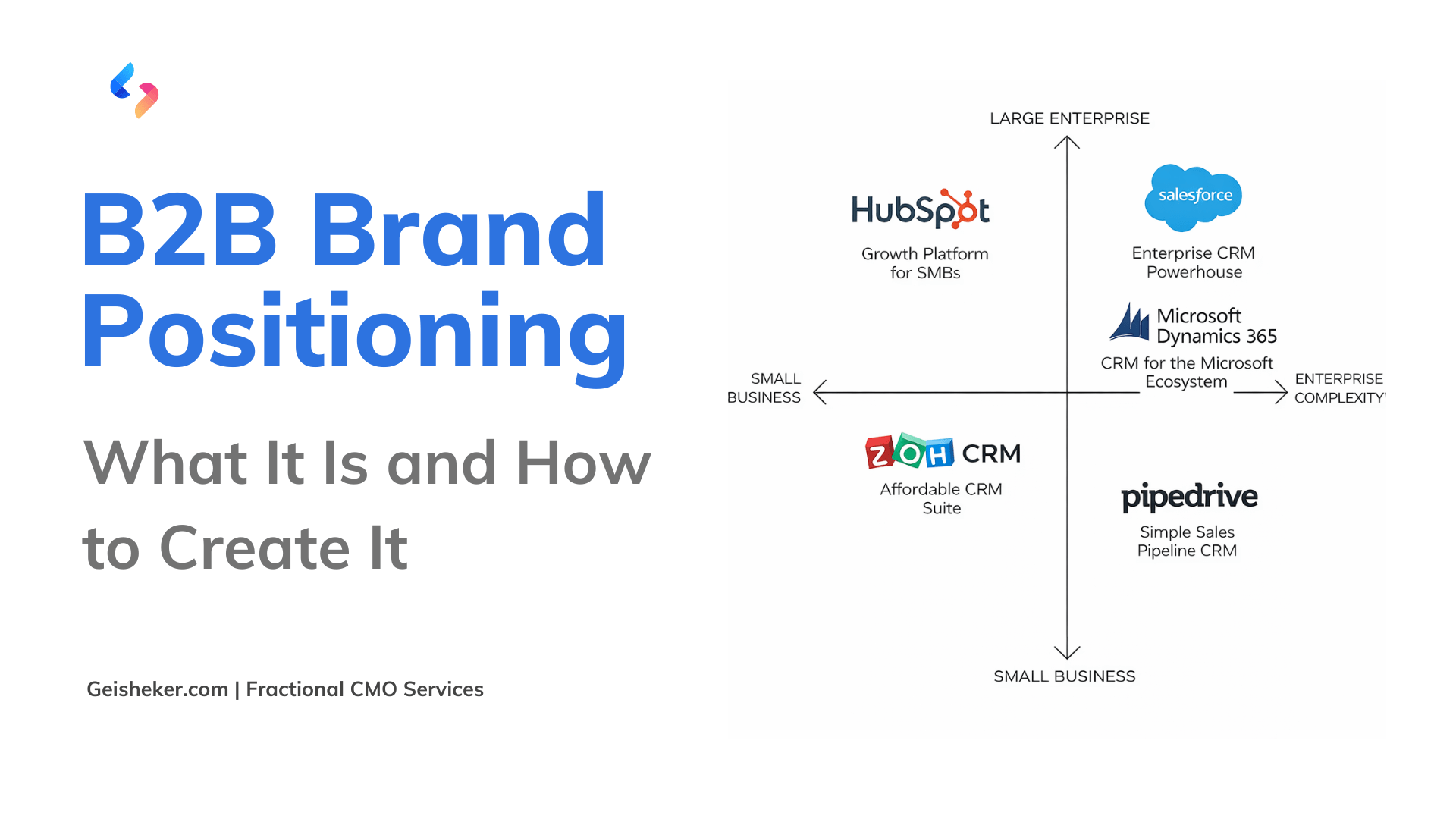
Your B2B company is solving real problems. But if prospects can’t quickly grasp why you are the right choice over every other option, you are leaving revenue on the table. That is the heart of B2B brand positioning, and getting it right is one of the highest-leverage investments your business can make.
In this guide, Fractional CMO Peter Geisheker breaks down exactly what B2B brand positioning means, why most companies get it wrong, and the step-by-step process to build a position so clear and compelling that decision-makers stop scrolling and start calling.
📌 What Is B2B Brand Positioning?
B2B brand positioning is the strategic process of defining how your company is perceived in the marketplace relative to competitors. It aligns your messaging with your unique value proposition and ensures that target buyers (often a committee of multiple decision-makers) immediately understand what you do, who you serve, and why you are the better choice. According to McKinsey & Company, B2B companies with strong brand positioning outperform weaker brands by 20 percent or more.
Why B2B Brand Positioning Is the Foundation of All Your Marketing
Most B2B companies pour money into marketing tactics (paid ads, trade shows, content, cold outreach) without first answering the fundamental strategic question: why would an informed buyer choose us over every credible alternative?
That question is brand positioning. And the answer is not your tagline, your logo, or your product features. It is a clear, ownable statement of the unique value you deliver to a specific audience, grounded in your real advantages over the competition.
When your positioning is sharp, everything downstream becomes easier. Your sales team has a coherent story. Your content has a point of view. Your ads resonate. Your website converts. Without it, you have a collection of tactics pointing in different directions.
📊 Key Stat
B2B companies with strong brands outperform weak brands by 20% according to McKinsey research, yet most B2B companies still treat branding as an afterthought.
The stakes are especially high in B2B. Unlike consumer purchases, B2B buying decisions typically involve committees of six to ten stakeholders, take months to close, and represent significant financial risk for the buyer. In that environment, brand clarity and trust are not nice-to-haves. They are prerequisites for getting into the consideration set.
According to Gartner research, a typical buying group for a complex B2B solution consists of six to ten decision-makers, each arriving with their own research, priorities, and concerns. And the Edelman–LinkedIn B2B Thought Leadership Impact Study (2024) found that 64% of B2B buyers favor thought leadership content over promotional materials when assessing a supplier’s capabilities, meaning positioning that isn’t communicated through insightful content is invisible positioning.
What Exactly Is B2B Brand Positioning?
Brand positioning is the space your brand occupies in the mind of your target buyer relative to competitors. The classic definition comes from Jack Trout and Al Ries in Positioning: The Battle for Your Mind, who argued that positioning is not what you do to a product. It is what you do to the mind of the prospect.
In the B2B context, this is nuanced. You are not trying to occupy the mind of one consumer. You are trying to shape the perception of multiple stakeholders, the CFO worried about ROI, the IT leader worried about integration risk, the CMO or VP of Marketing worried about adoption and results. A strong B2B brand position must resonate across that entire committee.
Harvard Business School’s brand positioning curriculum describes the core purpose as answering the question: Why should I buy? It frames positioning around three inputs: the consumer (or buyer) perspective, the competitive landscape, and the company’s genuine strengths. In B2B, the same three inputs apply. You just have to account for the complexity of a multi-stakeholder buying process.
What Brand Positioning Is NOT
Before going further, it is worth clearing up what B2B brand positioning is not, because many companies confuse adjacent concepts with positioning itself:
- A tagline or slogan, Catchy phrases can express a position, but they are not the position itself.
- A mission statement, Your mission describes why your company exists. Your position describes how you are different and better for a specific buyer.
- A list of product features, Features are evidence that supports your position. They are not the position.
- A value proposition. Your value proposition is the benefit you promise. Your positioning tells buyers why you are uniquely suited to deliver that benefit better than anyone else.
The Core Components of a Strong B2B Brand Position
A complete brand position for a B2B company must address five specific components. These are the building blocks you will need before you write a positioning statement or create a single piece of marketing content.
1. Target Audience Definition
You cannot position for everyone. The most common positioning mistake in B2B is attempting to be relevant to too broad an audience, resulting in messaging so generic it resonates with no one in particular. Strong B2B positioning starts with a specific target profile: industry, company size, role or title, and the pain they are actively trying to solve.
The more precisely you define your audience, the more powerfully you can address their specific concerns. A cybersecurity firm that positions itself for mid-size healthcare companies speaks directly to HIPAA compliance anxiety, EHR integration complexity, and limited internal security expertise, all of which are far more compelling than a generic claim about being a “trusted security partner.”
2. Competitive Frame of Reference
Your frame of reference tells buyers what category or alternative they should compare you to. This is a strategic choice. Are you positioning against direct competitors? Against a legacy process your product replaces? Against the do-it-yourself option?
Choosing the wrong frame can undermine an otherwise excellent position. If you define your frame too broadly, you get lost in a crowded category. If you define it too narrowly, you may limit your total addressable market. The goal is to pick the frame where your differentiation is most compelling and credible.
3. Point of Difference
This is the core of your positioning: the specific reason why a buyer in your target audience should choose you over every alternative. It must be genuinely meaningful to your buyer, credibly deliverable by you, and truly differentiated from what competitors offer.
Walker Sands emphasizes that strong B2B positioning requires specific proof points, not just claims of superiority, but evidence that supports outcomes. Vague differentiators like “innovative solutions” or “customer-first approach” are table stakes, not differentiation.
4. Proof Points and Reasons to Believe
Your point of difference becomes credible when backed by evidence. Proof points might include customer case studies, third-party validation (awards, analyst recognition), specific data on results delivered, a proprietary methodology, or unique capabilities not available from competitors.
McKinsey’s B2B branding research confirms that B2B decision-makers select suppliers primarily based on perceived honesty and specialized expertise. Fact-based positioning that closes the gap between your claims and your buyers’ actual needs creates a durable competitive advantage.
5. Brand Personality and Tone
Particularly in B2B services and SaaS, how you communicate your position matters as much as what you say. Your brand personality (whether authoritative and direct, collaborative and consultative, bold and disruptive, or something else entirely) shapes how your positioning lands with buyers.
Personality is not decoration. It is a differentiator, especially in categories where products and services are functionally similar. When a buyer interacts with ten vendors whose offerings are roughly comparable, the brand that communicates a clear, distinctive point of view stands out.
B2B Brand Positioning Strategies: 7 Approaches That Work
There is no single correct positioning strategy for B2B brands. The right approach depends on your genuine competitive advantages, your target audience’s primary concerns, and the competitive dynamics of your market. Here are the most effective positioning approaches, as documented by Beneath Agency’s positioning research:
| Positioning Type | Core Claim | Best Used When |
|---|---|---|
| Value / Unique Benefit | We deliver a distinct benefit no competitor can match | You have a genuine, provable advantage |
| Problem / Villain | We solve the problem your current solution creates | Buyers are frustrated with the category status quo |
| Category Leadership | We are the specialist in this specific space | You serve a niche the market underserves |
| Outcome / ROI | We deliver measurable results that justify the investment | Buyers are ROI-focused with clear metrics |
| Target Customer | We built this specifically for people like you | A specific buyer type is chronically underserved |
| Market Shift / Trend | The world is changing and we help you capitalize on it | A genuine macro trend backs your offering |
| Contrarian / Alternative | There is a better way than the market leader | A dominant incumbent has known weaknesses |
One important note: the most powerful B2B positioning statements often combine elements of multiple approaches. A company might position around a specific target audience (SMB finance teams) + a specific problem (manual reconciliation taking three weeks) + a unique benefit (AI-driven close that takes three days). The combination creates a position that is precise, credible, and hard to copy.
📊 Key Stat
57% of B2B marketers are planning or executing Account-Based Marketing programs, a strategy that requires clear, audience-specific brand positioning to execute effectively.
How to Create Your B2B Brand Positioning: A Step-by-Step Framework
Building a defensible B2B brand position requires research, strategic thinking, and the willingness to make real choices about where to compete. Here is the process used by senior B2B marketers and Fractional CMOs working with growing companies.
If you would like expert help with this process, schedule a free consultation with Peter Geisheker to discuss your positioning challenges.
Step 1: Conduct Audience Research
You cannot define a powerful position from the inside out. Start by deeply understanding your best-fit customers. The ones you deliver the most value to and would clone if you could. The goal is to understand three things: the specific problems that motivated them to look for a solution, what they care about most in a vendor, and what language they use to describe their own situation.
Methods include customer interviews (6 to 12 conversations minimum), win/loss analysis on recent deals, and a review of CRM data to identify patterns in your best accounts. Pay particular attention to the exact phrases customers use. The words you hear in interviews are often far more powerful in your positioning than anything your internal team would generate.
Equally important: talk to buyers who did not choose you. Understanding why you lost deals (and to whom) is critical intelligence for competitive positioning.
A Real-World B2B Brand Positioning Example: From Invisible to Explosive Growth
Several years ago, I was working as a marketing consultant for a Silicon Valley B2B SaaS startup called Paperless Proposal, now known as ClientPoint, that offered powerful software for creating business proposals.
The core challenge was positioning. We tested several Facebook and LinkedIn ad campaigns using different messaging approaches, and nothing was gaining meaningful traction. Clicks were weak. Conversions were worse.
So we did what every strong positioning process requires: we went directly to our best customers and asked them what the software actually meant to them.
The answer came back the same way, over and over: “It used to take us hours, sometimes days, to put together a business proposal. With your software, we can create a beautiful, professional proposal in 10 minutes or less.”
That was it. That was the position.
We stopped guessing and started listening. We built a new campaign around a single, customer-validated headline: Create Beautiful Business Proposals in 10 Minutes or Less. We ran it on Facebook and LinkedIn, and the response was immediate. The campaign took off, lead volume surged, and the company entered a period of explosive growth.
The lesson is one of the most important in B2B brand positioning: your best positioning rarely comes from a brainstorm inside your own walls. It comes from the words your best customers use to describe the transformation your product created for them. Your job is to listen carefully enough to hear it, and then be bold enough to build your entire market position around it.
Step 2: Map the Competitive Landscape
Gather detailed intelligence on each credible competitor. Analyze their messaging, positioning, and claimed differentiation. Look for gaps: positions that are available because competitors are not occupying them, or positions competitors claim but do not credibly support with proof.
A perceptual map is useful at this stage. Plot competitors on a two-axis grid using the two dimensions your buyers care about most. The goal is to identify white space, a position that is meaningful to buyers but not currently owned by a competitor.
Open Strategy Partners recommends this approach: understand what each competitor offers at the feature level, then map those features to the business value they enable for buyers, then identify where gaps exist between what buyers need and what competitors actually deliver.
Step 3: Define Your Genuine Competitive Advantages
Audit your own capabilities, outcomes, and differentiators honestly. What do you do better than anyone else? What results do you consistently deliver that competitors do not? Where do you have unique expertise, methodology, or access that others lack?
The McKinsey B2B branding research is clear on this point: B2B buyers respond to honest, fact-based positioning grounded in real evidence. Claimed advantages without proof points create skepticism rather than preference. Focus on the advantages you can back up.
Step 4: Write Your Positioning Statement
A positioning statement is an internal strategic document, not a tagline or customer-facing headline, but a clear articulation of your position that guides all downstream messaging. The classic structure is:
The B2B Positioning Statement Formula
For [target audience] who [have a specific need or problem], [Company Name] is the [frame of reference / category] that [point of difference / core benefit] because [reason to believe / proof].
An example: For B2B SaaS companies with 50 to 500 employees that are growing beyond their current marketing capabilities, The Geisheker Group is the fractional CMO service that delivers senior-level marketing strategy and execution at a fraction of the full-time executive cost, because our team has successfully guided B2B SaaS companies through exactly this growth stage.
Once you have a working statement, test it against three questions: Is it specific enough that your target buyer immediately recognizes themselves in it? Is your differentiation claim credible based on your actual capabilities? Would it still be meaningful and true five years from now?
Step 5: Translate Positioning Into Messaging
A positioning statement is the strategic foundation, but you still need to translate it into the actual messaging that appears on your website, in your sales materials, and in your marketing content. This translation involves developing your headline value proposition, supporting messages for each major audience segment, and proof points that make your claims credible.
One of the most common failures at this stage: companies write the positioning statement, put it in a Google Doc, and then never use it. As B2B positioning expert Anthony Pierri explains, this is the single most common reason positioning work fails to impact revenue. The positioning must be operationalized, embedded into the homepage, trained into the sales team, and reflected in every piece of content.
Step 6: Validate and Refine
Before you roll out a new positioning broadly, validate it with real buyers. This means taking your updated messaging to a sample of ideal customers and prospects and gauging their response. Does the headline immediately communicate value? Do they recognize the problem you describe as their own? Does your differentiation claim make them more likely to engage?
Validation does not require a large study. Even five to eight conversations with target buyers can surface critical issues before you invest in full execution.
One of the most practical ways to validate your B2B brand positioning before committing to a full rollout is to run a small, controlled test campaign. Platforms like LinkedIn and Meta allow you to put multiple different positioning angles in front of your exact target audience simultaneously (different headlines, different core promises, different frames of reference) and let the market tell you which one resonates.
The metric to watch is not impressions or clicks. It is lead quality. Which positioning angle attracts prospects who actually convert into sales conversations? Which one brings in the tire-kickers? The market’s response to a well-structured test campaign is often the most honest positioning feedback you will ever receive, more reliable than internal opinion and faster than waiting months for organic signals to emerge.


Want more qualified pipeline? Get a free growth plan
30 minutes with both of us. No hard sell. Written plan in 3 business days.
Step 7: Activate Across All Touchpoints
Brand positioning only drives revenue when consistently expressed across every buyer touchpoint, your website, LinkedIn company page, sales deck, email sequences, content marketing, paid ads, and event presence. Inconsistency undermines positioning: buyers encounter your brand across multiple channels, and fragmented messaging creates confusion.
Establish a messaging guide that documents your positioning statement, headline value prop, key supporting messages, proof points, and language to avoid. Distribute it to everyone who communicates on behalf of the company.
How B2B Brand Positioning Differs from B2C Positioning
B2B and B2C brand positioning share the same underlying logic (you are defining a unique, valuable position in the mind of your buyer) but the execution differs significantly. As Walker Sands notes, B2B positioning must resonate with a group of stakeholders who focus on logic, ROI, and long-term business benefits, whereas B2C positioning can rely more heavily on emotional appeals to individuals.
| Dimension | B2C Brand Positioning | B2B Brand Positioning |
|---|---|---|
| Primary Buyer Motivation | Emotional, personal identity, lifestyle | Logic, ROI, risk mitigation, business outcomes |
| Number of Decision-Makers | Usually 1 individual | Typically 6–10 stakeholders per deal (Gartner) |
| Purchase Cycle | Often days or weeks | Typically 3–18 months for complex solutions |
| Proof Points | Social proof, lifestyle imagery, reviews | Case studies, ROI data, analyst recognition, demos |
| Key Message Channels | Social media, TV, retail presence | Website, LinkedIn, events, content, sales team |
| Risk Tolerance | Relatively low risk per purchase | High risk, wrong vendor can impact the business |
| Category Education Needed | Often low | Often high. Buyers may need to understand the category first |
The most important implication: in B2B, your positioning must simultaneously resonate with multiple stakeholders who have different priorities. The CFO cares about total cost of ownership and ROI timeline. The IT leader cares about integration complexity and security. The end user cares about ease of use and time savings. Strong B2B positioning identifies the central value that matters across all of them.
The Most Common B2B Brand Positioning Mistakes
In working with B2B companies across industries, the same positioning mistakes appear repeatedly. Avoiding them significantly improves your odds of building a position that drives revenue.
Positioning for Everyone
The most damaging mistake is trying to appeal to the entire market rather than a specific segment. Generic claims like “we help businesses grow” or “the only all-in-one platform you need” communicate nothing differentiated and resonate with no one in particular. The paradox of positioning is that the narrower and more specific your claim, the more powerfully it resonates with the right buyer.
Claiming What Competitors Also Claim
If five competitors all say they are the “most trusted partner in your category,” trust is not your differentiator. It is a baseline expectation. Effective positioning requires honest competitive analysis to identify claims that are both meaningful to buyers and genuinely differentiated from what the market already offers.
Features Instead of Outcomes
Technical B2B companies are particularly prone to leading with features rather than outcomes. Buyers do not purchase features. They purchase solutions to problems and paths to results. Your positioning must translate what your product or service does into what the buyer experiences, fewer compliance violations, faster revenue recognition, lower cost per acquisition.
Positioning That Dies in a Document
Positioning work that does not get embedded into sales and marketing execution delivers zero value. As Anthony Pierri of Fletch PMM points out, most B2B positioning failures happen not at the strategy stage but at the activation stage. Build implementation into the process from day one.
Ignoring the Buying Committee
Positioning solely for one role, typically the economic buyer, misses the other stakeholders who have veto power. Map each member of the buying committee, understand their individual concerns, and develop supporting messages that address those concerns while staying true to your core position. Per Gartner’s 2024 B2B buyer research, 74% of B2B buying teams experience unhealthy conflict during the decision process, misaligned positioning across stakeholders is a key contributor.
📊 Key Stat
71% of B2B buyers begin their purchase journey with a generic search, not a branded one, meaning your positioning must be established before buyers know to look for you by name.
💡 Is Your B2B Positioning as Sharp as It Could Be?
If your current messaging feels generic, if sales is struggling to articulate why you are different, or if you are attracting the wrong types of leads, your brand positioning may need a strategic refresh. Peter Geisheker works with B2B and B2B SaaS companies to build positioning that drives pipeline and accelerates growth. Schedule a free consultation to discuss your positioning challenges.
The Role of a Fractional CMO in B2B Brand Positioning
For small and mid-size B2B companies, the positioning challenge is often compounded by resource constraints. Conducting thorough competitive research, facilitating positioning workshops, writing and testing messaging, and activating it across all channels requires senior marketing expertise that many growing companies do not have in-house.
This is one of the most high-value contributions a Fractional CMO makes. Because brand positioning underpins every other marketing investment (your website, your content, your paid advertising, your events strategy) getting it right first creates a multiplier effect on every dollar you spend downstream.
A Fractional CMO brings three things to the positioning process that internal teams often lack: the objectivity to see your company the way buyers see it rather than the way insiders see it, the cross-industry experience to recognize positioning patterns that work versus patterns that fail, and the strategic framework to translate insight into executable messaging.
The investment in getting your B2B brand positioning right is typically far less than the cost of running marketing programs with the wrong positioning for another year. According to Forrester’s 2024 B2B Marketing Budget Benchmarks, the average B2B company allocates 8% of annual revenue to marketing. Without clear positioning, a significant portion of that budget generates less pipeline than it should.
How to Measure Whether Your B2B Brand Positioning Is Working
Brand positioning is a strategic asset, but its impact is measurable. Here are the key indicators that your positioning is working, and the warning signs that it needs to be strengthened.
Indicators of Effective Positioning
- Win rate improvement. You are winning a higher percentage of deals where you compete head-to-head.
- Lead quality improvement, More of your inbound leads match your ideal customer profile.
- Shorter sales cycles, Buyers arrive more pre-sold because your positioning resonates at the top of funnel.
- Higher average deal size. Buyers who understand your unique value are less likely to negotiate on price.
- Consistency in how prospects describe you, When prospects describe your company in ways that match your intended position, your messaging is landing.
- Increased share of voice, Your brand appears more frequently in category conversations, searches, and analyst coverage.
Warning Signs That Your Positioning Needs Work
- Sales tells multiple different stories about what you do and why you are different.
- You regularly lose deals to competitors on price, suggesting buyers do not perceive differentiated value.
- Your website analytics show high bounce rates and low conversion, suggesting messaging is not connecting.
- Your best customers describe the value you delivered in ways that differ from how you market yourself.
- New sales hires struggle to learn the pitch because there is no clear, defensible story to internalize.
Walker Sands recommends tracking three key positioning metrics: brand perception scores, lead quality, and share of voice. An integrated mix of owned, earned, and paid media is needed to build and maintain a strong B2B brand position over time.
B2B Brand Positioning Examples: What Great Looks Like
Examining real B2B brand positioning cases reveals the principles above in action.
Salesforce: Against the Villain
In its early years, Salesforce built its position entirely around a villain: traditional, on-premise enterprise software. The “No Software” message and the cloud logo with a line through it were a masterclass in problem-focused B2B positioning. Salesforce did not just describe what it was. It defined what it was against, creating immediate clarity for a frustrated market. As Beneath Agency notes in its analysis of B2B positioning types, this “villain positioning” is one of the most powerful approaches when buyers are actively frustrated with the category status quo.
HubSpot: For the Underserved Audience
HubSpot identified an underserved segment (small and mid-size businesses that needed sophisticated marketing and sales tools but could not afford or operate enterprise solutions) and built its entire positioning around serving that audience better than anyone else. The inbound marketing methodology was not just a product feature; it was a point of view that became synonymous with the brand.
Zoom: Owning a Single Attribute
Zoom entered a crowded video conferencing market and focused its positioning on a single attribute: it just works. In a category defined by unreliable and complex tools, a product that was simple, reliable, and accessible from any device was a genuinely differentiated position. When remote work surged in 2020, Zoom’s clear positioning made it the default choice for millions of buyers who needed exactly what it had been promising.
Frequently Asked Questions About B2B Brand Positioning
What is B2B brand positioning?
B2B brand positioning is the strategic process of defining how your company is perceived in the minds of business buyers relative to competitors. It involves identifying your target audience, your competitive frame of reference, your point of differentiation, and the proof points that make your claims credible. Effective B2B positioning guides all marketing and sales messaging, ensuring that every buyer touchpoint reinforces a consistent, compelling story about why your company is the best choice. According to McKinsey, B2B companies with strong brand positioning outperform weak brands by 20%.
How is B2B positioning different from B2C positioning?
B2B positioning must account for multi-stakeholder buying committees (typically 6–10 people per Gartner research), longer and more complex purchase cycles, and a primary buyer motivation rooted in logic, ROI, and risk reduction rather than emotion. B2C positioning can rely more heavily on emotional appeals and individual identity signals. B2B positioning requires stronger emphasis on proof points, case studies, ROI data, and functional outcomes that address the business concerns of multiple decision-makers simultaneously.
How long does it take to develop B2B brand positioning?
A thorough B2B brand positioning process typically takes 4 to 8 weeks when done properly. This includes customer research (2–3 weeks), competitive analysis (1–2 weeks), positioning development and internal alignment (1–2 weeks), and initial messaging validation (1 week). Cutting corners on research is the most common reason positioning work fails to hold up in market. Companies that skip straight to writing a positioning statement without conducting buyer and competitive research typically create messaging that reflects internal assumptions rather than market reality.
What is a B2B positioning statement?
A B2B positioning statement is an internal strategic document that articulates who you serve, what problem you solve, what category you compete in, your primary point of difference, and your reason to believe. It is not a tagline. It is the strategic foundation that guides all downstream messaging. The classic structure (documented in the Harvard Business School brand positioning curriculum) is: For [target audience] who [have a specific need], [Company] is the [frame of reference] that [point of difference] because [reason to believe].
What are the most common B2B brand positioning mistakes?
The most common B2B positioning mistakes include: trying to appeal to too broad an audience, claiming generic differentiators that competitors also claim (most trusted, innovative, customer-centric), leading with features rather than outcomes, creating a positioning statement that is never activated in sales and marketing, and ignoring the multiple stakeholders who make up the B2B buying committee. Each of these mistakes results in messaging that feels generic to buyers and fails to create a preference for your brand. Per Gartner, 74% of buying teams experience unhealthy conflict, poorly differentiated positioning makes this worse.
How do I know if my B2B brand positioning is working?
Signs your positioning is working include: improving win rates in competitive deals, higher quality inbound leads that match your ideal customer profile, prospects who describe your company in ways that align with your intended position, shorter sales cycles as buyers arrive more pre-sold, and reduced price sensitivity. Warning signs include: inconsistent sales stories, frequent loss on price, high website bounce rates, and best customers describing your value differently than you market it. Walker Sands recommends tracking brand perception, lead quality, and share of voice as the three key positioning metrics.
Can a small B2B company compete on brand positioning against larger competitors?
Absolutely, and in fact, sharp positioning is one of the most powerful competitive tools available to smaller B2B companies. Large competitors often have diluted positioning because they serve too many segments. A smaller company that takes a clear, specific position in an underserved niche can dominate that segment despite having a fraction of the competitor’s resources. The key is choosing a position where your genuine strengths align with an underserved need, and then executing that position with extraordinary consistency.
How does brand positioning relate to content marketing?
Your brand position is the foundation of your entire content marketing strategy. Every piece of content should reinforce your positioning, your point of view, your target audience, your differentiation. Content marketing without a clear brand position produces what the Content Marketing Institute’s 2025 B2B research identifies as the top challenge for 40% of B2B marketers: creating content that drives a desired action. That difficulty almost always traces back to the absence of a clear positioning foundation that the content is meant to build.
How do I maintain my brand positioning over time?
Brand positioning requires periodic review and deliberate maintenance. Markets shift, competitors evolve, and buyers’ priorities change. A practical rhythm is a comprehensive positioning review every 12 to 18 months, with lighter-touch checks after major market events, competitive moves, or shifts in your product offering. The goal is not constant repositioning, consistency is a strategic asset, but ensuring your position remains relevant, differentiated, and credible. As McKinsey research notes, strong brands never submit to passing fads while still staying in tune with customer needs.
What is the difference between brand positioning and a value proposition?
Your value proposition is the promise of value you make to buyers. It answers what you deliver and why it matters. Your brand positioning is broader: it defines where you stand in the market relative to competitors, who you serve, and why you are the best choice. The value proposition is one component of your positioning. A complete positioning strategy includes your target audience definition, competitive frame of reference, point of difference, reasons to believe, and brand personality, of which your value proposition forms the benefit-focused core. For a deeper dive, see Open Strategy Partners’ guide to B2B positioning frameworks.
How much does it cost to develop B2B brand positioning?
The cost depends on the depth of research, the complexity of your competitive landscape, and whether you use internal resources, an agency, or a Fractional CMO. Agency-led positioning projects typically range from $25,000 to $100,000 or more. A Fractional CMO engagement focused on positioning delivers senior-level strategic expertise at a more accessible investment for small and mid-size companies. The more important question is the cost of not having clear positioning, a year of marketing spend without a defensible brand position can easily cost multiples of the investment required to build one. According to Forrester, the average B2B company spends 8% of annual revenue on marketing, without positioning, a significant portion of that budget underperforms.
Conclusion: Your B2B Brand Position Is a Revenue Asset
Brand positioning is not a branding exercise. It is a revenue strategy. When your positioning is clear, your sales team has a coherent story, your marketing resonates with the right buyers, and your pipeline fills with better-fit opportunities. When it is vague or generic, even excellent products struggle to gain the traction they deserve.
The companies that invest in sharp B2B brand positioning early reap compounding benefits. Every content piece, every ad, every sales conversation builds on a consistent foundation. Buyers remember you because you stand for something specific. You win deals not just on features but on fit, because your positioning made buyers feel understood before they ever spoke to a sales rep.
If your current B2B brand positioning needs a strategic reset (or if you have never done this work formally) the time to invest is now, before you spend another dollar on marketing tactics that lack a strategic foundation to build on.
Ready to Build a B2B Brand Position That Drives Revenue?
Peter Geisheker is a Fractional CMO specializing in B2B and B2B SaaS marketing strategy. He works with small and mid-size companies to build clear, compelling brand positioning and execute the marketing programs that bring it to life. Schedule your free consultation and discover what sharper positioning can do for your pipeline.
About Peter Geisheker
Peter Geisheker is a Fractional CMO and founder of The Geisheker Group, Inc., specializing in B2B and B2B SaaS marketing strategy. He partners with small and mid-size B2B companies to build clear brand positioning, develop marketing strategy, and execute the programs that drive measurable pipeline growth, without the cost or commitment of a full-time marketing executive.
Ready to explore how a Fractional CMO can sharpen your brand positioning and accelerate your growth? Schedule a free consultation with Peter Geisheker.
References and Sources
This article cites research and data from the following authoritative sources:
- McKinsey & Company, B2B Business Branding: Bringing Strategy to Life. Confirms B2B companies with strong brands outperform weak brands by 20%, and that B2B decision-makers select suppliers based on perceived honesty and specialized expertise. https://www.mckinsey.com/capabilities/growth-marketing-and-sales/our-insights/b2b-business-branding
- Harvard Business School, Marketing Reading: Brand Positioning (HBS Case 8197-PDF-ENG). Covers principles of brand positioning and frameworks for crafting competitive brand positions. https://www.hbs.edu/faculty/Pages/item.aspx?num=49151
- Gartner, Sales Survey: 74% of B2B Buyer Teams Demonstrate Unhealthy Conflict (2024–2025). Confirms buying groups of 6–10 decision-makers for complex purchases, and that 74% experience unhealthy buying committee conflict. https://www.gartner.com/en/newsroom/press-releases/2025-05-07-gartner-sales-survey-finds-74-percent-of-b2b-buyer-teams-demonstrate-unhealthy-conflict-during-the-decision-process
- Edelman & LinkedIn, 2024 B2B Thought Leadership Impact Report. Reports 64% of B2B buyers favor thought leadership content over promotional materials when assessing supplier capabilities. https://www.edelman.com/sites/g/files/aatuss191/files/2024-01/2024-edelman-linkedin-b2b-thought-leadership-impact-report.pdf
- Walker Sands, B2B Brand Positioning in the Modern Market (2025). Covers outcome-based positioning approach, proof points, and how to measure positioning effectiveness including brand perception, lead quality, and share of voice. https://www.walkersands.com/about/blog/b2b-brand-positioning-in-the-modern-market/
- Beneath Agency, 7 Kinds of Positioning for B2B Brands. Covers the full typology of B2B positioning approaches including value-based, problem-focused, category, and target customer positioning. https://beneathagency.com/blog/7-kinds-of-positioning-for-b2b-brands/
- Open Strategy Partners, B2B Brand Positioning Frameworks and Strategies for 2025. Covers Value Mapping process and how to build B2B positioning from technical truth. https://openstrategypartners.com/blog/b2b-brand-positioning-framework/
- The B2B Playbook / Anthony Pierri, B2B Positioning Strategy: Framework, Examples and Mistakes. Covers the gap between positioning strategy and execution, and the 4-question positioning model. https://theb2bplaybook.com/b2b-positioning-strategy
- Forrester Research, The Average B2B Firm Invests 8% of Revenue in Marketing (2024 B2B Marketing Budget Benchmarks). Reports average B2B marketing investment of 8% of annual revenue. https://www.forrester.com/blogs/the-average-b2b-firm-invests-8-of-revenue-in-marketing-but-thats-not-the-whole-story/
- KLIQ Interactive, B2B Marketing Reports and Benchmarks 2025–2026. Reports 57% of B2B marketers planning or executing ABM programs. https://kliqinteractive.com/insights/b2b-reports-benchmarks-and-statistics-2025-2026/
- Content Marketing Institute, 2025 B2B Content and Marketing Trends Research. Reports creating content that drives a desired action as the top challenge for 40% of B2B marketers. https://contentmarketinginstitute.com/b2b-research/b2b-content-marketing-trends-research
- Marketing LTB, B2B Marketing Statistics 2025. Reports 71% of B2B buyers begin their purchase journey with a generic search, not a branded search. https://marketingltb.com/blog/statistics/b2b-marketing-statistics/
Free Written Growth Plan
Want more qualified pipeline?
Give us 30 minutes with your toughest marketing problem. You get a written plan with your three best growth opportunities and the first steps your team can take.
Get My Free Growth Plan →No hard sell on the call. Your plan arrives within 3 business days. See a sample plan