If you want to grow your B2B company in 2026, you need a marketing strategy that actually works — not a list of buzzwords and disconnected tactics. This guide gives you everything: a clear framework for building your strategy, the most effective tactics available today, and the metrics that tell you whether any of it is working.
It’s written simply, so your entire team can understand and execute it.
What Is B2B Marketing?
B2B marketing (business-to-business marketing) is the process of promoting products or services from one business to other businesses. Unlike B2C marketing, B2B targets smaller, well-defined audiences with longer sales cycles, multiple decision-makers, and purchasing decisions driven by logic, ROI, and risk reduction — not impulse or emotion. The most effective B2B marketing builds trust, educates buyers, and generates qualified pipeline that turns into predictable revenue.
Table of Contents
- What Is B2B Marketing — And How It Differs from B2C
- Building Your B2B Marketing Strategy
- Defining Your Ideal Customer Profile and Buyer Personas
- B2B Content Marketing
- B2B SEO Strategy
- B2B Social Media and LinkedIn
- B2B Demand Generation and Lead Generation
- B2B Email Marketing That Actually Works
- B2B Paid Advertising
- Marketing and Sales Alignment
- Measuring B2B Marketing Performance
- AI in B2B Marketing for 2026
What Is B2B Marketing — And How It Differs from B2C
B2B marketing is one business marketing its products or services to other businesses. A software company selling project management tools to corporations, a manufacturer selling industrial equipment to factories, or a Fractional CMO Agency selling marketing strategy management services to enterprises — all of this is B2B marketing.
The mechanics look similar to B2C marketing: you’re still trying to get attention and persuade people to buy. But the context is completely different, and it changes everything about how you market.
Why B2B Marketing Is Fundamentally Different
| Factor | B2B Marketing | B2C Marketing |
|---|---|---|
| Decision-makers | Committee of 6–13 people | Usually 1 person |
| Sales cycle | Weeks to 18+ months | Minutes to days |
| Buying motivation | Logic, ROI, risk reduction | Emotion, desire, convenience |
| Deal size | Thousands to millions | Dollars to hundreds |
| Content needed | In-depth, educational, technical | Emotional, entertaining, quick |
| Relationship | Long-term partnerships | Often transactional |
| Success metric | Pipeline, revenue, customer lifetime value | Sales volume, brand awareness |
The B2B Buying Committee Reality
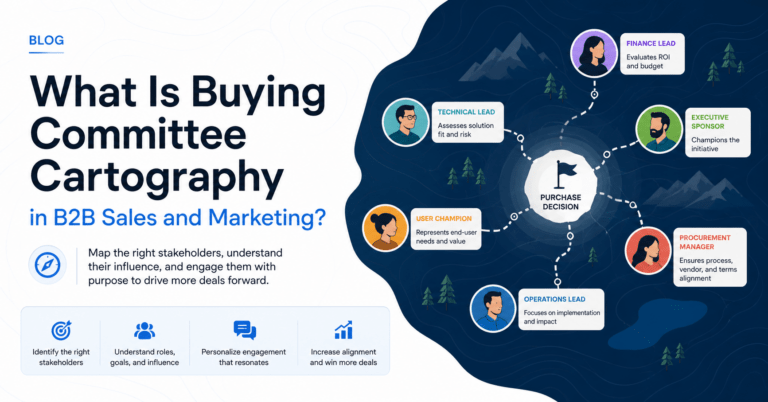
One of the most important things to understand about B2B marketing: you are almost never marketing to one person.
According to Gartner’s research on the B2B buying journey, the typical buying group for a complex B2B solution involves 6 to 10 decision-makers, each arriving with their own research, priorities, and concerns. Forrester’s 2024 State of Business Buying Report puts the average even higher at 13 stakeholders involved in the typical B2B purchase, with 89% of buying decisions crossing multiple departments.
That buying committee typically includes:
- The Economic Buyer — controls the budget; focused on ROI and cost justification
- The Champion — your internal advocate who wants this solution to win
- The End User — the person who will actually use the product daily
- The Technical Evaluator — assesses integration, security, and compatibility
- Legal / Procurement — reviews contracts and vendor risk
- The Skeptic — exists in almost every committee; reasons vary
Your marketing must speak to all of these people, at different stages, with different messages. This is why a single generic campaign rarely works in B2B.
The Self-Directed Buyer Journey
Here is the other defining reality of B2B marketing today: according to Gartner’s 2024 research, approximately 80% of the B2B buying journey takes place without direct vendor contact. B2B buyers spend only about 17% of their total buying time actually meeting with potential vendors — and that time is split across all vendors they are evaluating.
This means your marketing must be doing the heavy lifting long before any salesperson enters the conversation.
“In B2B, your marketing is your first salesperson. By the time a buyer reaches out to you, they’ve already formed an opinion about your company based on your content, your positioning, and how clearly you speak to their specific problems. If your marketing isn’t doing that work, you’re starting every sales conversation at a disadvantage.”
— Peter Geisheker, Fractional CMO, The Geisheker Group
Building Your B2B Marketing Strategy
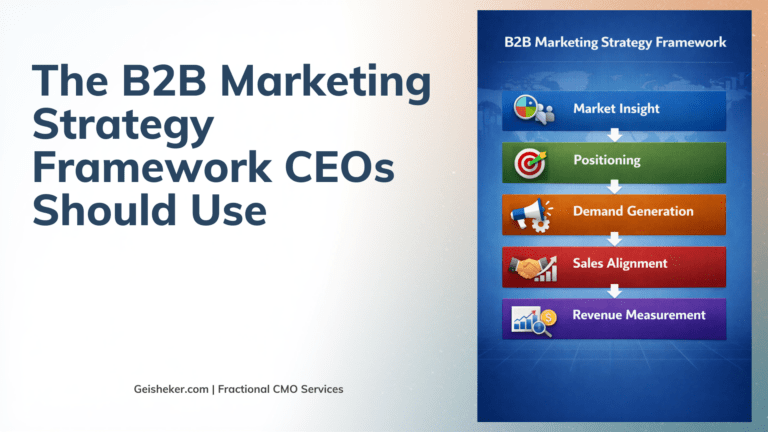
A B2B marketing strategy is not a content calendar. It’s not a list of campaigns. It’s the decision framework that determines where to focus your energy, what to say, and how to win. Everything else — tactics, channels, content — flows from the strategy.
Too many B2B marketing teams skip this step and jump straight into “doing things.” They post on LinkedIn, run ads, sponsor a webinar — and wonder why nothing connects. Strategy first, tactics second. Always.
The PLAN Framework: B2B Marketing Strategy in 4 Steps
P — Position Define exactly who you are, who you serve, and why you’re the only logical choice. Your positioning must be specific and differentiated. “We help mid-market SaaS companies reduce churn” beats “We help companies grow.”
L — Locate Identify where your ideal buyers spend their time, how they find solutions like yours, and which channels reach them most cost-effectively. Don’t try to be everywhere. Be where it matters.
A — Attract Create the content, campaigns, and assets that pull buyers toward you. This is where tactics live — but they’re chosen based on your positioning and channel strategy, not guesswork.
N — Nurture Most B2B buyers aren’t ready to buy when they first encounter you. Build a system to stay relevant, build trust, and move buyers through their decision process over time.
💡 Need a B2B Marketing Strategy That Actually Drives Revenue?
Building a B2B marketing strategy from scratch — or fixing one that isn’t working — is exactly what a B2B Fractional CMO does. Peter Geisheker works with B2B and B2B SaaS companies to develop clear positioning, choose the right channels, and build a marketing engine that generates predictable pipeline.
Step 1: Set Revenue-Linked Marketing Goals
Before you do anything, get clear on what success actually looks like. Vague goals produce vague results.
The Revenue-First Rule: Every marketing goal should have a line of sight to revenue. “Increase website traffic” is not a goal — it’s an activity. “Generate 50 qualified sales opportunities per quarter that close at a 25% rate, producing $2M in new ARR” is a goal.
How to build revenue-linked goals:
- Start with the company’s revenue goal. Work backward to determine how much marketing must contribute — typically 30–50% of pipeline in a mature B2B company.
- Divide your revenue target by average deal size and win rate to calculate the pipeline needed.
- Work backward from pipeline to lead volume: if 10% of leads become opportunities and you need 240 opportunities per year, you need roughly 2,400 qualified leads — about 200 per month.
- Allocate lead targets across channels based on historical data or benchmarks.
Step 2: Define Your Positioning
Positioning is the most important strategic decision you’ll make. Use this template:
For [specific target customer]
Who [has this specific problem or need]
We provide [solution]
That [delivers this specific, measurable outcome]
Unlike [key competitor or alternative]
We [differentiator — what makes you the only logical choice]
Real positioning stakes out territory competitors don’t occupy. “Faster, better, cheaper” is not positioning — everyone says that. A specific promise to a specific audience is.
Step 3: Set Your Marketing Budget
According to the 2025 Gartner CMO Spend Survey, marketing budgets across industries have stabilized at 7.7% of total company revenue. For B2B specifically, research compiled by Avid Demand from Forrester and Gartner data puts average B2B marketing spend at 8.4% of revenue, though high-growth sectors like SaaS invest significantly more.
Use these benchmarks as a starting point:
| Company Stage | Revenue | Typical Marketing Budget | Primary Focus |
|---|---|---|---|
| Early Stage / Startup | Under $5M | 15–25% of revenue | Brand building, channel experiments |
| Growth Stage | $5M–$50M | 10–15% of revenue | Scaling proven channels |
| Mid-Market | $50M–$250M | 7–12% of revenue | Pipeline efficiency, brand authority |
| Enterprise | $250M+ | 5–9% of revenue | Market share, retention marketing |
Defining Your Ideal Customer Profile and Buyer Personas
The most common reason B2B marketing fails: companies try to market to everyone. The result is messaging that resonates with no one. Ruthless clarity about exactly who your ideal customer is fixes this.
In B2B, two tools define your audience: the Ideal Customer Profile (ICP) and Buyer Personas. They’re related but distinct, and you need both.
Ideal Customer Profile (ICP)
Your ICP defines the type of company that is the best possible fit for what you sell. It’s firmographic — it describes the organization, not the person.
A strong ICP includes:
- Industry / Vertical — which industries do you serve best, and where are your best wins?
- Company Size — by employees, revenue, or both; a 500-person company is a very different buyer than a 50-person company
- Geography — where are they located, and do you serve globally or in specific regions?
- Technology Stack — what tools do they already use? Relevant for integrations and positioning.
- Business Model — SaaS, services, manufacturing, distribution? This shapes their problems.
- Growth Stage — startup, scaling, mature? Growth-stage companies have different needs than stabilized ones.
- Budget Authority — do they have the budget and authority to buy what you sell?
Pro Tip — Mine Your Best Customers: Don’t guess at your ICP. Look at your top 10–20 customers — the ones who got the most value, renewed, expanded, and referred others. What do they have in common? That pattern IS your ICP. Let your best customers define who you should go find more of.
Buyer Personas
Where ICP describes the company, personas describe the humans inside that company who are involved in buying. In B2B, you typically need 2–4 personas — one for each key stakeholder role.
Each persona should capture:
- Role and Responsibilities — what they do day-to-day and what they’re accountable for
- Primary Goals — what success looks like for them personally and professionally
- Key Challenges — the problems keeping them up at night that your product solves
- Information Sources — where they go to learn: LinkedIn, industry publications, podcasts, conferences
- Objections — what they’ll push back on, and why
- Decision Criteria — what they care most about when evaluating vendors
“If you’re speaking to everyone, you’re speaking to no one. The most powerful B2B marketing feels like it was written specifically for the person reading it — because it was.”
B2B Content Marketing
Content marketing is the engine of most successful B2B marketing programs. It’s how you attract buyers who are still researching, build trust before a conversation happens, and position your company as the undisputed authority in your space.
The key insight: B2B buyers don’t want to talk to a salesperson until they’re ready. They want to educate themselves first. If your content is there — helping them at every stage of that journey — your company becomes the obvious choice by the time they’re ready to buy.
The B2B Content Funnel
Not all content serves the same purpose. Effective B2B content strategy maps content to where the buyer is in their decision process.
| Funnel Stage | Buyer Mindset | Content Types | Goal |
|---|---|---|---|
| Top of Funnel (TOFU) | “I have a problem / I’m curious” | Blog posts, podcasts, social content, videos, reports | Attract and create awareness |
| Middle of Funnel (MOFU) | “I’m evaluating options” | Ebooks, webinars, case studies, comparison guides, email nurture | Build trust and capture intent |
| Bottom of Funnel (BOFU) | “I’m ready to decide” | Demos, ROI calculators, proposals, testimonials, pricing pages | Convert to opportunity |
High-Impact B2B Content Formats
Long-Form Blog Posts and Guides Comprehensive, 2,000+ word articles that answer your buyers’ most important questions. These rank in search and build authority over time. “Ultimate guides” like this one are a prime example.
Original Research and Data Reports Survey your customers or industry and publish proprietary data. Nothing earns backlinks, press coverage, and credibility faster than data no one else has.
Video and Webinars Video is the fastest-growing B2B content format. Explainer videos, product demos, thought leadership interviews, and live webinars all drive engagement and pipeline.
Case Studies The most powerful BOFU content in B2B. A well-written case study — with specific results, a real customer name, and a clear before/after story — eliminates sales objections and builds trust better than almost anything else.
Podcasts A podcast builds intimate relationships with an audience over time. B2B podcasts with industry-specific topics generate highly engaged listeners who become loyal buyers.
Tools and Calculators Interactive ROI calculators, assessment tools, and templates are among the most-shared B2B content assets. They provide immediate value and demonstrate your expertise.
The Content Repurposing System
Creating great content is expensive and time-consuming. The solution isn’t to create more — it’s to extract more value from every piece you create.
- Create one pillar asset — a comprehensive blog post, an in-depth webinar, or a detailed report. This is the “mother content.”
- Extract 5–10 LinkedIn posts — take key insights, data points, or frameworks and turn each into a standalone post.
- Create an email newsletter edition — summarize the key takeaways and link to the full piece.
- Turn it into a slide deck — a well-structured blog post naturally becomes a presentation useful for sales or conference talks.
- Build a short video — take the most interesting insight and turn it into a 60–90 second video for LinkedIn or YouTube.
One pillar asset becomes 15–20 pieces of content. This is how lean B2B marketing teams produce enough volume to stay consistently visible.
B2B SEO Strategy
Search engine optimization for B2B is one of the highest-ROI long-term investments you can make. When done right, it delivers a steady, compounding stream of qualified buyers who are actively searching for what you sell — with no ongoing ad spend required.
In 2026, B2B SEO has evolved. It’s not just about keywords and backlinks. It’s about topical authority, E-E-A-T (Experience, Expertise, Authoritativeness, Trustworthiness), and appearing in AI-powered answer engines as well as traditional search results.
The B2B SEO Keyword Hierarchy
Not all keywords are equal. B2B buyers search differently at different stages of their journey — and your keyword strategy must reflect that.
| Keyword Type | Example | Intent | Value |
|---|---|---|---|
| Problem-aware | “how to reduce customer churn” | Informational | Awareness builder |
| Solution-aware | “best customer success software” | Commercial | High — evaluation stage |
| Product-aware | “Gainsight vs ChurnZero” | Transactional | Very high — ready to buy |
| Brand keywords | “[Your Company] reviews” | Brand | Critical — must own these |
Start by mapping keywords to each stage. Most B2B companies over-index on branded and solution-aware keywords and neglect the high-volume problem-aware terms that reach buyers before they even know a solution like yours exists.
Building Topical Authority
In 2026, Google rewards websites that demonstrate comprehensive expertise on a topic — not just individual pages with good keywords. This is called topical authority.
The method is the topic cluster model: one comprehensive “pillar page” on a broad topic, supported by dozens of “cluster pages” that go deep on subtopics. Internal links connect them all, signaling to search engines that your site is the authority on that topic.
B2B SEO in the Age of AI Search: AI-powered search (Google AI Overviews, Perplexity, ChatGPT Search) is changing how buyers find information. To appear in AI-generated answers, focus on: clear, factual, well-structured content; credible external citations; specific data and statistics; and authoritative expert perspectives. These signals make AI systems more likely to use your content as a source.
B2B SEO Checklist
- Conduct thorough keyword research across all funnel stages — not just purchase-intent keywords
- Build topic clusters around your 3–5 most important categories
- Optimize existing pages before creating new ones — low-hanging fruit is almost always there
- Earn high-quality backlinks through original research, expert content, and digital PR
- Fix technical SEO issues: page speed, Core Web Vitals, mobile-friendliness, crawlability
- Create dedicated landing pages for high-value product and solution keywords
- Build out FAQ sections on key pages to capture featured snippet and “People Also Ask” real estate
- Track rankings and organic traffic monthly — SEO compounds over time
B2B Social Media and LinkedIn
Ask most B2B marketers about social media and they’ll mention a range of platforms. But for B2B? LinkedIn is the channel. It’s where business buyers spend time, research vendors, and stay current in their industries.
According to data cited by Foundation Inc. and confirmed across multiple sources, 80% of all B2B social media leads come from LinkedIn. Sprout Social’s 2025 research confirms that 89% of B2B marketers use LinkedIn for lead generation, and 40% rate it as their most effective channel for driving high-quality leads.
As of 2025–2026, LinkedIn has over 1.2 billion members globally and sees approximately 1.77 billion monthly visits (Sprout Social, 2025).
The LinkedIn Strategy That Works in 2026
Company pages matter, but they’re not where the real action is. On LinkedIn, people follow people. Thought leadership from individual executives and team members consistently outperforms corporate page content by several multiples in reach and engagement.
Build a two-track LinkedIn strategy: your company page for credibility and brand consistency, and personal thought leadership from your CEO, founders, and subject-matter experts for reach and relationship-building.
What to post on LinkedIn:
- Insight posts — share a specific, counterintuitive insight from your work. “Most companies think X, but we’ve found Y.” These generate high engagement because they’re genuinely useful.
- Story posts — stories about customer wins (with permission), lessons learned, failures and what you took from them. Authentic stories build trust faster than any other format.
- Framework and list posts — a clear process or list that solves a problem your buyers face. These are the most shared and saved posts on LinkedIn.
- Question posts — ask your network a genuine question relevant to your industry. This drives comments (which boost algorithmic reach) and gives you free market research.
LinkedIn Ads for B2B
LinkedIn’s ad platform is uniquely powerful for B2B because it lets you target by job title, company, seniority, industry, and skills — attributes no other platform offers at this precision. The average CPC runs higher than most platforms (LiGo reports an average of $5.39 CPC), but for high-value B2B deals, the ROI is frequently outstanding.
The most effective LinkedIn ad formats for B2B are Sponsored Content (native feed ads), Message Ads (direct InMail), and Lead Gen Forms (capture contact info without leaving the platform). Use them together as a coordinated sequence, not in isolation.
B2B Demand Generation and Lead Generation
Demand generation and lead generation are often used interchangeably, but they’re different strategies with different goals — and the best B2B marketing programs use both.
Lead generation captures existing demand. You put something valuable behind a form — an ebook, a webinar, a demo — and collect contact information from people who are already interested.
Demand generation creates demand. You educate the market, build category awareness, and create desire in people who didn’t previously know they needed what you offer. It’s harder to measure but often generates the best opportunities.
The B2B Lead Generation Playbook
1. Gated Content (Lead Magnets) Create something genuinely valuable — a research report, a framework, a comprehensive guide — and require an email address to access it. Quality matters enormously here. Low-value content produces low-quality leads who never convert. Build something your ideal customer would actually pay for.
2. Demo Requests For B2B software and services, the demo request is often the highest-value conversion action on your website. Make it easy to find, low-friction to request, and set expectations clearly on what the demo involves.
Speed of follow-up matters enormously. Research from MIT and InsideSales.com found that the odds of qualifying a lead drop 21 times when response time goes from 5 minutes to 30 minutes. Fast follow-up is a competitive advantage almost no company takes seriously enough.
3. Webinars and Virtual Events Webinars are among the most effective B2B lead generation tools. They provide genuine value to attendees, qualify intent through registration and attendance, and create multiple touchpoints. Even if only 40% of registrants show up live, you capture the contact information of all of them.
4. Free Tools and Assessments Offer a free audit, assessment, ROI calculator, or tool in exchange for contact information. These attract highly qualified leads because requesting the assessment signals active interest in solving the problem your product addresses.
5. Account-Based Marketing (ABM) Rather than casting a wide net, ABM focuses marketing resources on a defined list of target accounts. You create hyper-personalized campaigns for specific companies and the specific people within them.
Account-Based Marketing (ABM) Deep Dive
ABM is reshaping B2B marketing for enterprise and mid-market companies. Instead of generating hundreds of leads and hoping some are from good-fit companies, ABM flips the model: you start with a list of the exact companies you want to win, then build campaigns to engage them.
How to run ABM:
- Select your target accounts. Work with sales to identify the 50–500 companies that represent your best opportunities based on ICP fit, revenue potential, and strategic value.
- Map the buying committee. For each target account, identify the 3–7 key stakeholders you need to reach. LinkedIn Sales Navigator and intent data tools help you build these maps.
- Create personalized content and campaigns. Develop content and messaging that speaks to each account’s specific industry, company size, and challenges — not generic marketing.
- Activate across channels. Reach your target accounts through LinkedIn ads, display advertising, email outreach, direct mail, and events — all coordinated and consistent.
- Measure account engagement, not lead volume. Track how many target accounts are engaging with your content, which stakeholders are active, and whether pipeline is moving — not just MQL counts.
B2B Email Marketing That Actually Works
Every few years, someone declares email marketing dead. And every year, it continues to be the single highest-ROI marketing channel for most B2B companies.
According to Litmus’s Email Marketing ROI research, email delivers an average ROI of $36 for every $1 spent — outperforming social media, paid search, and display advertising. Litmus’s 2025 State of Email report confirms this figure and notes that brands using personalization and dynamic content see even higher returns.
B2B email marketing is about building relationships over time, not blasting promotions. When you consistently send emails that help your subscribers do their jobs better, trust compounds — and when they’re ready to buy, you’re the first call they make.
The B2B Email Marketing System
1. Build a Quality List A list of 2,000 highly relevant, opted-in subscribers outperforms a list of 20,000 random contacts every time. Focus on quality: gate valuable content, run webinars, and grow through channels that attract your ICP. Never buy email lists — they’re full of uninterested contacts and hurt your deliverability.
2. Create a Welcome Sequence Every new subscriber should receive an automated sequence of 3–7 emails that introduces your company, establishes your expertise, delivers immediate value, and explains what to expect. First impressions matter — a strong welcome sequence sets the relationship up for success.
3. Send a Regular Newsletter Consistency is the key to email marketing success. Send a regular newsletter — weekly or bi-weekly — that delivers real value: industry insights, practical tips, curated content, or your own thinking. Not a “company updates” newsletter. Content that helps your readers win.
4. Build Nurture Sequences Create automated email sequences triggered by specific behaviors: downloading an ebook, attending a webinar, visiting your pricing page. These behavior-triggered sequences deliver the right message at the right time and dramatically improve conversion rates.
5. Segment and Personalize The more relevant your email, the better it performs. Segment your list by industry, company size, role, and behavior — and send different content to different segments. Even basic segmentation can meaningfully improve open and click rates.
B2B Email Best Practices for 2026: Write like a human to a human. Short, conversational emails from a real person almost always outperform corporate-looking HTML newsletters. Keep subject lines specific and benefit-focused. Send at consistent times — Tuesday through Thursday mornings tend to work well for B2B. And always, always make unsubscribing easy — chasing disinterested contacts hurts your deliverability and wastes your time.
B2B Paid Advertising
Paid advertising is the fastest way to get in front of your ideal buyers — and the fastest way to burn through budget with nothing to show for it if done wrong. B2B paid advertising requires clear strategy, the right channel mix, and a willingness to test and learn.
The golden rule: paid advertising amplifies what’s already working. If your messaging, targeting, and offer aren’t right, spending more money just makes you lose money faster. Get the fundamentals right before scaling spend.
The B2B Paid Channel Matrix
| Channel | Best For | Avg. CPC | Targeting Strength | Starting Budget |
|---|---|---|---|---|
| Google Search Ads | Capturing active demand — people searching for your solution | $3–$25+ | Intent-based (keyword) | $3K–$30K/mo |
| LinkedIn Ads | Reaching specific job titles, companies, and industries | ~$5–$15 | Firmographic + professional | $5K–$50K/mo |
| Google Display / YouTube | Brand awareness, retargeting | $0.50–$5 | Interest, audience lists | $2K–$15K/mo |
| Meta (Facebook/Instagram) | Retargeting, specific consumer-adjacent B2B | $1–$8 | Interest, lookalike, retargeting | $2K–$10K/mo |
| Programmatic / Display | Account targeting (ABM), broad awareness | $2–$10 CPM | IP targeting, account-based | $5K+/mo |
Note: LinkedIn CPC benchmarks sourced from LiGo’s 2025 LinkedIn statistics report, which reports an average LinkedIn CPC of $5.39. Actual CPCs vary significantly by industry, targeting, and competition.
Building a Full-Funnel Paid Advertising Strategy
Rather than running isolated ads, the best B2B advertisers build a full-funnel paid system where each layer feeds the next.
- Top of Funnel (Awareness): LinkedIn Sponsored Content, YouTube pre-roll, or display ads promoting educational content — not your product. Get buyers to know you exist.
- Middle of Funnel (Consideration): Retarget website visitors and content consumers with offers like webinar registrations, free assessments, or case studies. Deepen the relationship.
- Bottom of Funnel (Conversion): Google Search ads capturing active searchers, and retargeting campaigns for demo and meeting requests aimed at your most engaged prospects.
The Most Common B2B Paid Ad Mistake: Sending paid traffic to your homepage. Your homepage is for everyone — which means it’s for no one. Always send paid traffic to a dedicated landing page that matches the ad’s message, makes one specific offer, and has one clear call-to-action. This single change can double or triple your conversion rate.
Marketing and Sales Alignment
Marketing and sales misalignment is one of the most common — and most expensive — problems in B2B companies. Marketing blames sales for not following up on leads. Sales blames marketing for sending bad leads. Meanwhile, revenue suffers and everyone’s frustrated.
When marketing and sales work as one team toward shared goals, the results are dramatic. Research from multiple sources including ZoomInfo confirms:
- Aligned organizations achieve 24% faster three-year revenue growth and 27% faster profit growth
- Companies with strong alignment are 67% more effective at closing deals
- Aligned companies see 36% higher customer retention rates
The 5 Elements of Sales-Marketing Alignment
1. Agree on the Definition of a Qualified Lead The most common source of tension: marketing thinks it’s sending great leads; sales thinks they’re garbage. Solve this by jointly defining what makes a Marketing Qualified Lead (MQL) and a Sales Qualified Lead (SQL). Write it down. Agree on it. Review it quarterly.
2. Create a Formal Lead Handoff Process Define what happens the moment a lead becomes sales-ready: who gets it, how fast they’re expected to respond, what information passes to sales, and what the first outreach looks like.
Speed matters enormously here. MIT and InsideSales.com research found that the odds of qualifying a lead drop 21 times when response time goes from 5 minutes to 30 minutes.
3. Share Data Bidirectionally Marketing needs to know which leads become customers (and the revenue they produce) to optimize campaigns. Sales needs to know what content prospects consumed before they engaged. Build data-sharing systems — typically through CRM and marketing automation integration — to enable this.
4. Create Joint Content That Enables Sales Marketing’s job doesn’t end when a lead is handed to sales. Marketing should create sales enablement assets: battle cards, objection handlers, case studies, ROI tools, and competitive comparisons. These make every sales conversation more effective.
5. Meet Regularly and Hold Each Other Accountable Marketing and sales leaders should meet weekly, and all-hands pipeline reviews should happen monthly. Track shared metrics: pipeline generated, pipeline accepted by sales, win rates, and revenue. When you’re measured together, you work together.
“The fastest revenue growth I’ve seen in B2B companies almost always comes from fixing sales and marketing alignment, not from adding new channels or increasing ad spend. When both teams agree on what a good lead looks like, share data honestly, and hold each other accountable to the same revenue number, everything gets more efficient. It’s the highest-leverage change most B2B companies can make.”
— Peter Geisheker, Fractional CMO, The Geisheker Group
Measuring B2B Marketing Performance
You cannot improve what you don’t measure. But measuring the wrong things is just as dangerous — it leads to optimizing for vanity metrics while revenue stagnates.
The B2B Marketing Metrics Hierarchy
Think of your metrics in three tiers: business outcomes, marketing performance, and activity metrics. Most teams obsess over the bottom tier and neglect the top. Flip that priority.
| Tier | Metrics | Review Frequency | Who Cares |
|---|---|---|---|
| Tier 1: Business Outcomes | Revenue from marketing-sourced pipeline, customer acquisition cost (CAC), marketing ROI, lifetime value (LTV) | Monthly / Quarterly | CEO, CFO, Board |
| Tier 2: Marketing Performance | Pipeline generated, MQLs, SQLs, win rate, cost per opportunity, channel attribution | Weekly / Monthly | CMO, Marketing and Sales Leaders |
| Tier 3: Activity Metrics | Traffic, leads, email open rates, social impressions, ad clicks, form conversions | Daily / Weekly | Marketing Team |
The 7 B2B Metrics Every Marketing Team Should Track
- Customer Acquisition Cost (CAC): Total marketing and sales spend divided by new customers acquired. Know this number. Reduce it over time.
- Marketing-Sourced Pipeline: Total dollar value of opportunities where marketing was the first touch. This is the clearest measure of marketing’s revenue contribution.
- Lead-to-Opportunity Rate: What percentage of your leads become real sales opportunities? Low conversion signals a lead quality problem.
- Opportunity-to-Close Rate: What percentage of opportunities convert to customers? Low rates often signal a positioning or competitive problem.
- Marketing ROI: (Revenue attributable to marketing − marketing investment) / marketing investment. Simple, clear, defensible.
- Cost Per Lead by Channel: Which channels generate leads most efficiently? This data drives budget allocation decisions.
- Time to Pipeline: How long does it take for a new lead to become a sales opportunity? Shortening this accelerates revenue growth.
B2B Attribution: Knowing What’s Actually Working
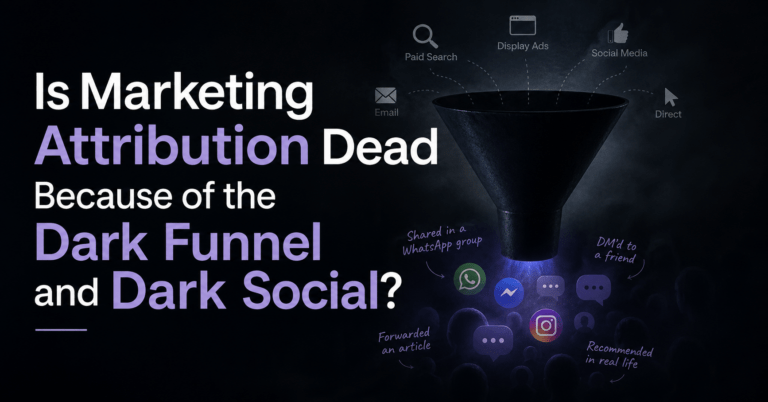
Attribution — knowing which marketing activities drove revenue — is one of the hardest problems in B2B marketing. Buyers touch many pieces of content across multiple channels before buying. No single touchpoint gets full credit.
Common attribution models for B2B:
- First-Touch Attribution — 100% credit to the channel that first brought the prospect to you. Good for measuring awareness effectiveness.
- Last-Touch Attribution — 100% credit to the final interaction before conversion. Good for measuring conversion drivers but ignores everything that built trust first.
- Linear Attribution — equal credit to every touchpoint in the buyer’s journey. Simple and balanced — a good starting point for most teams.
- W-Shaped Attribution — heavy credit to three key moments: first touch, lead creation, and opportunity creation. Well-suited to B2B where these milestones are distinct and meaningful.
📊 Not Sure Which Marketing Metrics Your B2B Company Should Be Tracking?
A Fractional CMO from The Geisheker Group can audit your current marketing performance, identify which channels and activities are actually driving revenue, and build a measurement framework your leadership team can trust. No guesswork — just clear data and actionable decisions.
AI in B2B Marketing for 2026
Artificial intelligence has moved from novelty to necessity in B2B marketing. The teams using AI effectively are producing more content, finding better prospects, personalizing at scale, and moving faster than ever. The teams ignoring it are falling behind — quickly.
The nuance: AI is a tool, not a strategy. It amplifies what your team is already doing. Give it clear direction and strong strategy to work from, and it becomes a force multiplier. Use it as a replacement for thinking, and you’ll produce a lot of mediocre content very fast.
Where AI Creates the Most Value in B2B Marketing
Content Creation and Acceleration AI dramatically speeds up content production — first drafts, outlines, research summaries, social post variations. Use it to remove the blank page, then add your expertise and voice on top.
ICP Identification and Prospecting AI-powered tools analyze your customer data to find patterns in your best customers, then identify look-alike prospects in the market. This makes targeting dramatically more precise.
Personalization at Scale AI enables dynamic content personalization — changing the message, examples, and offers based on who’s viewing. What once required a full team can now be automated and continuously optimized.
Predictive Lead Scoring AI models analyze behavioral and firmographic signals to predict which leads are most likely to convert. This helps sales teams prioritize their time on the highest-value opportunities.
SEO and Search Intelligence AI tools analyze search intent, content gaps, and ranking opportunities faster and more deeply than any manual process. Use them for keyword research, content briefs, and competitive analysis.
Email Optimization From subject line testing to send-time optimization to content personalization, AI improves every layer of email performance. Many email platforms now have AI built in — use it.
The 2026 AI-Powered B2B Marketing Stack
CRM: Salesforce or HubSpot with AI-powered lead scoring and forecasting
Marketing Automation: HubSpot, Marketo, or Pardot with AI personalization layers
Content Creation: Claude, ChatGPT, or Jasper for drafts; Canva AI for design
SEO: Semrush, Ahrefs, or Clearscope with AI content optimization
Intent Data: 6sense, Bombora, or Demandbase to identify in-market buyers
Conversational AI: Drift or Intercom AI chatbots for 24/7 lead qualification
Analytics: Google Analytics 4 with AI-powered insights, plus a BI tool like Looker or Tableau
The One Thing AI Cannot Replace: Strategy. Original thinking. Deep customer empathy. The human judgment to know what a buyer is really worried about and what they actually need to hear. AI makes marketers faster and more efficient — it doesn’t make them smarter about the fundamentals. Keep investing in that.
Frequently Asked Questions About B2B Marketing
What is the most effective B2B marketing channel?
There’s no single most effective channel — it depends on your product, audience, and stage of growth. However, the channels with the most consistent ROI for B2B are email marketing (Litmus reports $36 ROI per $1 spent), LinkedIn for reaching specific professional audiences, SEO and content marketing for long-term compounding returns, and Google Search ads for capturing active demand. Most successful B2B programs use 3–5 channels in concert.
How long does it take for B2B marketing to produce results?
It depends on the channel. Paid advertising can generate leads within days of launching. Email marketing nurture sequences begin showing results within 4–8 weeks. SEO and content marketing are long-term plays that typically take 6–12 months to generate meaningful results — but they compound powerfully over time. A healthy B2B marketing program has a mix of short-term (paid, outbound) and long-term (SEO, content) investments running simultaneously. (Source: Gartner B2B Buying Journey research)
How much should a B2B company spend on marketing?
According to the 2025 Gartner CMO Spend Survey, marketing budgets across industries have stabilized at 7.7% of total company revenue. For B2B specifically, Forrester and Gartner data compiled by Avid Demand puts the average at 8.4% of revenue. Earlier-stage companies typically invest a larger percentage (10–20%) to build brand and pipeline. The right number depends on your growth goals, competitive landscape, and cost of customer acquisition.
What is the difference between B2B demand generation and lead generation?
Demand generation creates awareness and interest in your category among people who may not know they need you yet. Lead generation captures contact information and intent signals from people who are actively evaluating solutions. Both are necessary. Demand gen fills the top of the funnel with the right buyers; lead gen converts that interest into measurable pipeline. Many B2B companies over-invest in lead gen and under-invest in demand gen — and then wonder why their leads are poor quality.
How do I build a B2B content marketing strategy from scratch?
Start with your ICP and buyer personas — understand what questions they’re asking at each stage of their journey. Map content types to each stage: educational blog posts for awareness, in-depth guides and webinars for consideration, case studies and ROI tools for decision. Prioritize consistency over volume: one excellent post per week beats ten mediocre posts. Build topic clusters around your 3–5 most important categories to establish SEO authority. Always optimize existing content before creating new content.
What B2B marketing metrics matter most?
The metrics that matter most are the ones closest to revenue: pipeline generated by marketing, cost per opportunity, win rate, and customer acquisition cost. These tell you whether marketing is actually driving the business. Secondary metrics — traffic, leads, email open rates — are useful for diagnosing performance and optimizing tactics, but should never be confused with business outcomes.
Is Account-Based Marketing (ABM) right for every B2B company?
ABM is most effective for B2B companies with high-value, complex deals (typically $20K+ ACV), a clearly defined ICP, and strong sales-marketing alignment. For companies with lower deal values and large total addressable markets, traditional demand gen and lead gen may deliver better ROI. Many companies run a hybrid: ABM for their top-tier target accounts alongside traditional lead gen for the broader market. (Source: ZoomInfo sales and marketing alignment statistics)
How many people are typically involved in a B2B purchase decision?
According to Gartner’s research, the typical buying group for a complex B2B solution involves 6 to 10 decision-makers. Forrester’s 2024 State of Business Buying Report puts the average even higher at 13 stakeholders for the typical B2B purchase, with 89% of buying decisions crossing multiple departments.
Your B2B Marketing Action Plan: What to Do in the Next 30 Days
You now have the complete blueprint. Here’s what your B2B marketing team should do in the next 30 days to start putting this guide to work:
- Audit your ICP and positioning. Is your positioning sharp and differentiated? Could a stranger read your website and know exactly who you help, with what, and why you’re the best choice? If not, start here.
- Set revenue-linked marketing goals. Calculate how much pipeline marketing needs to generate to hit your company’s revenue target. Build your channel strategy and budget from that number backward.
- Pick your 2–3 primary channels. You can’t do everything well. Based on your ICP, budget, and goals, choose the channels you’ll commit to and do exceptionally well.
- Build your content engine. Map out one pillar asset per month and the repurposed content that flows from it. Assign ownership. Build the editorial calendar. Start now — consistency compounds.
- Align with sales on lead definitions and handoffs. Schedule a joint meeting with your sales team this week. Agree on what a qualified lead looks like. Build the handoff process. This single conversation can change your pipeline performance.
🚀 Ready to Put This Strategy to Work — But Need Senior Marketing Leadership to Execute It?
Many B2B companies have the ambition but not the in-house bandwidth or expertise to build and run a high-performance marketing program. A Fractional CMO gives you the strategic leadership of a seasoned CMO at a fraction of the full-time cost — with a track record of results in B2B and B2B SaaS.
See What a Fractional CMO from The Geisheker Group Can Do for Your Business →
“The best B2B marketing doesn’t feel like marketing. It feels like the right answer arriving at exactly the right moment.”
B2B marketing is not a mystery. It’s a system — built on clear strategy, deep customer understanding, and disciplined execution across the right channels. The companies that win aren’t the ones with the biggest budgets; they’re the ones with the clearest thinking and the most consistent execution.
About the Author
Peter Geisheker is a Fractional CMO and founder of The Geisheker Group, Inc., specializing in B2B and B2B SaaS marketing strategy. With years of experience helping small and mid-size companies achieve measurable growth, Peter provides senior-level marketing expertise without the full-time executive cost.
Ready to explore how a Fractional CMO can accelerate your B2B company’s growth? Schedule a free consultation with Peter Geisheker to discuss your marketing challenges and goals.
References and Sources
This article cites research and data from the following authoritative sources:
- Gartner — “The B2B Buying Journey” — research on buying groups, self-directed buyer journey, and the 80% self-directed statistic: https://www.gartner.com/en/sales/insights/b2b-buying-journey
- Gartner — “2025 CMO Spend Survey Reveals Marketing Budgets Have Flatlined at 7.7% of Overall Company Revenue”: https://www.gartner.com/en/newsroom/press-releases/2025-05-12-gartner-2025-cmo-spend-survey-reveals-marketing-budgets-have-flatlined-at-seven-percent-of-overall-company-revenue
- Forrester — “2024 State of Business Buying Report” — 13 stakeholders average, 89% of buying decisions cross departments: Referenced via https://www.forrester.com
- Avid Demand — “2025 B2B Marketing Budgets and Priorities” — B2B marketing spend at 8.4% of revenue per Forrester and Gartner data: https://aviddemand.com/blog/2025-b2b-marketing-budgets-and-priorities/
- Foundation Inc. — “80% of B2B leads come from LinkedIn” and supporting LinkedIn statistics: https://foundationinc.co/lab/b2b-marketing-linkedin-stats/
- Sprout Social — “28 Must-Know LinkedIn Statistics for Marketers in 2025” — 89% of B2B marketers use LinkedIn for lead generation, 1.2B members, 1.77B monthly visits: https://sproutsocial.com/insights/linkedin-statistics/
- LiGo — “LinkedIn Statistics Every Marketer Should Know in 2025” — average LinkedIn CPC of $5.39: https://ligo.ertiqah.com/blog/linkedin-statistics-every-marketer-should-know-in-2025
- Litmus — “Email Marketing ROI” — $36 return for every $1 spent on email marketing: https://www.litmus.com/resources/email-marketing-roi
- MIT / InsideSales.com Lead Response Management Study — odds of qualifying a lead drop 21× when response time goes from 5 minutes to 30 minutes: https://cdn2.hubspot.net/hub/25649/file-13535879-pdf/docs/mit_study.pdf
- ZoomInfo — “20 Sales and Marketing Alignment Statistics” — 24% faster revenue growth, 67% better at closing deals, 36% higher retention: https://pipeline.zoominfo.com/sales/sales-and-marketing-alignment-statistics
- LXA Hub — “Sales and Marketing Alignment Stats and Trends” — 38% higher sales win rates, 27% faster profit growth: https://www.lxahub.com/stories/sales-and-marketing-alignment-stats-and-trends-2023
- Brixon Group — “The Modern B2B Buying Journey: Why Buyers Complete 80% of Their Journey Alone” — evolution of self-directed buying journey statistics: https://brixongroup.com/en/the-modern-b2b-buying-journey-why-buyers-complete-80-of-their-journey-alone-and-how-you-can-still-remain-visible/
- Traction Complete — “Mapping the B2B Buying Committee: 10 Roles, Strategies, and Best Practices” — Forrester 2024 data on 13 stakeholders: https://tractioncomplete.com/articles/mapping-the-b2b-buying-committee/