In my experience, many B2B marketers are solving the wrong problem. They obsess over their ads, tweak creative, adjust targeting, and pour money into media spend, while their landing pages quietly kill every lead their ads work hard to generate.
I have seen this pattern repeatedly in my work as a Fractional CMO. And fixing it has produced some of the most dramatic performance improvements I have delivered for clients.
What is B2B landing page optimization, and why does it matter more than your ads?
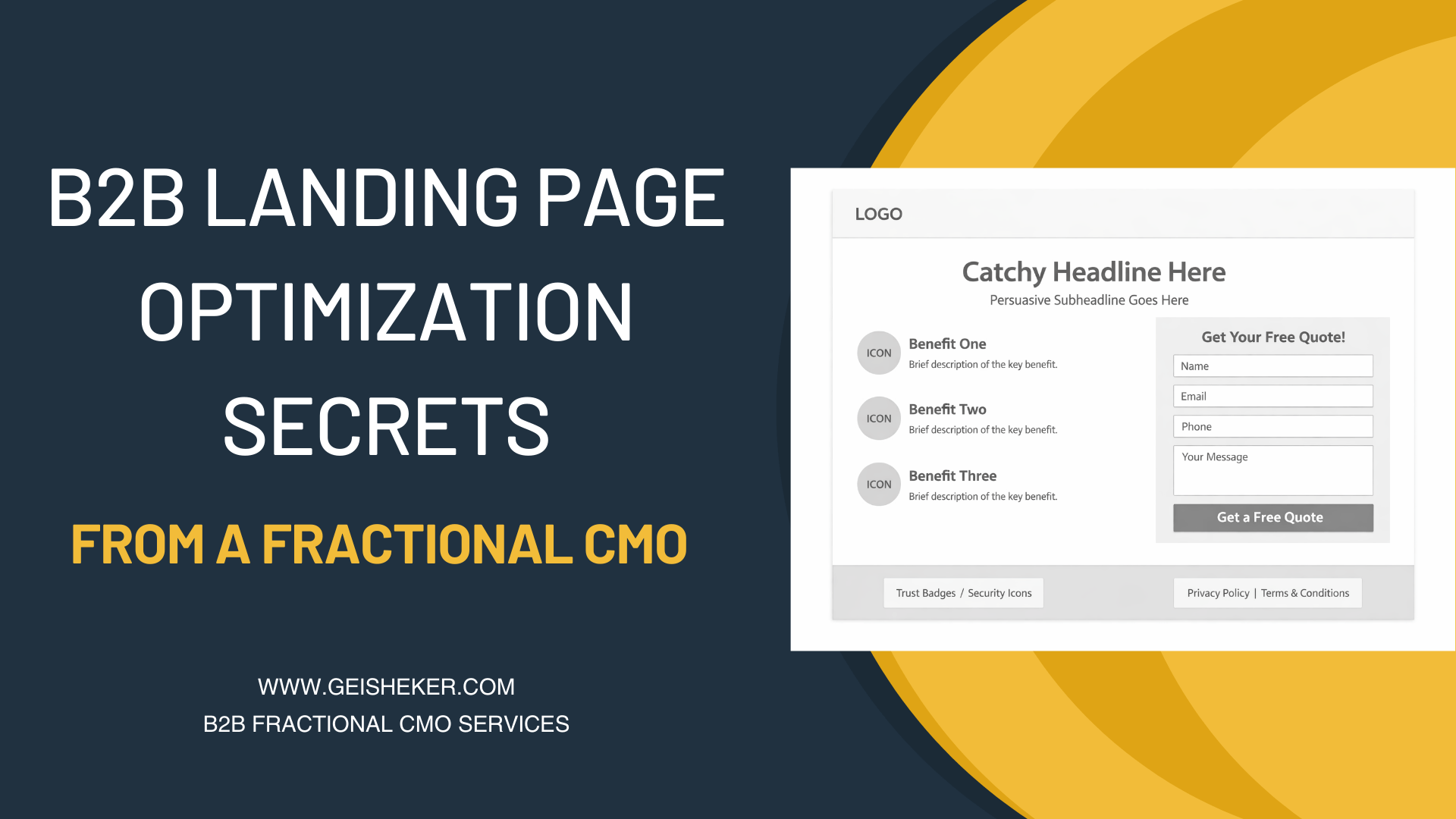
“B2B landing page optimization is the process of systematically testing and improving the pages that receive ad traffic to increase conversion rates. While ads generate interest, the landing page is your online salesperson. Its job is to convert interested visitors into leads. Strategic A/B testing of headlines and offers alone has driven conversion rate improvements from 0.5% to over 12% in real B2B campaigns.” – Peter Geisheker
The Biggest Missed Opportunity in B2B Marketing Today
Here is the uncomfortable truth: most B2B companies are paying to send traffic to landing pages that do not work.
They run Meta and LinkedIn ads or Google campaigns, watch the clicks roll in, and then wonder why the leads are not following. The instinct is to blame the ads. The targeting must be off, the creative is not resonating, the budget needs to be higher.
But when I audit a B2B marketing program and see a 0.5% to 2% conversion rate on a landing page, I am rarely looking at an ads problem. I am looking at a landing page problem.
This matters enormously from a budget perspective. According to WordStream benchmark data, the average landing page conversion rate across all industries is approximately 2.35%, but the top 25% of pages convert at 5.31% or higher (WordStream, “What Is a Good Conversion Rate?”). For B2B companies, closing the gap between average and top-quartile performance is worth far more than any incremental improvement to ad targeting.
The reason most businesses miss this opportunity is simple: ads are visible and measurable in real time. You can see impressions, clicks, and CPCs in your dashboard every day. Landing page performance is quieter. It just sits there converting (or not converting) whoever your ads send its way.
A Fractional CMO approach to B2B marketing means looking at the entire funnel holistically, not just the top of it. And when you look at the full picture, the landing page is almost always where the biggest leverage lives.
Schedule a free consultation with Peter Geisheker to talk through your B2B marketing funnel and find out where your biggest conversion opportunity may be hiding.
Understanding the Real Job of Your Ads vs. Your Landing Page
Before we get into the mechanics of B2B landing page optimization, we need to align on a foundational principle that changes how you think about your entire marketing program.
Your ad has one job: get a qualified person to raise their hand and click.
Your landing page has one job: take that interested person and convert them into a lead.
These are entirely different jobs that require entirely different skills and strategies. When you conflate them (when you judge your marketing program only by your ad metrics) you lose your grip on the most important conversion event in your funnel.
Think of it this way. Your ad is a billboard on the highway. Its job is to grab attention and generate enough curiosity that someone exits the highway. Once they exit, the billboard’s job is done. What happens next (whether they find what they expected, whether the environment is welcoming, whether the offer is compelling enough to act on) is entirely the landing page’s responsibility.
Companies with 10 to 15 landing pages generate 55% more leads than those with fewer than 10, according to HubSpot’s Marketing Benchmarks Report (HubSpot, “Why You Need to Create More Landing Pages”). The implication is clear: more pages means more targeted, tested messaging, and that targeted messaging converts.
When you internalize that your ads and your landing pages have separate, distinct jobs, you stop trying to fix a landing page problem by tweaking your ads. You go directly to the source.
How A/B Testing Landing Pages Produces Outsized B2B Results
A/B testing (the practice of running two versions of a landing page simultaneously to see which converts better) is the single highest-leverage activity I have found in B2B marketing optimization.
The reason it is so powerful is compounding. When you improve your landing page conversion rate from 1% to 5% on the same ad spend, you have just generated five times as many leads without spending an extra dollar on media. No targeting improvement, no creative refresh, and no budget increase can do that for you. It is pure leverage.
Here is a real example from my work as a Fractional CMO.
A B2B client came to me running Meta ads that were performing reasonably well by click-through standards. Their landing page was converting at 0.5%. For every 200 visitors the ads sent to the page, they were getting one lead.
We kept the ad campaigns exactly as they were, same targeting, same creative, same budget. The only variable we changed was the landing page, specifically the headline and the primary offer. Through systematic A/B testing over several months, we took that conversion rate from 0.5% to over 12%.
Let that sink in for a moment. The same ads. The same traffic. But 24 times more leads from the same media spend, driven entirely by headline and offer optimization on the landing page.
That is the power of B2B landing page optimization. And it is the reason I consider untested landing pages to be one of the costliest mistakes a B2B marketing team can make.
A/B testing a B2B landing page without changing ad spend: conversion rate improvement from 0.5% to 12%, a 24x increase in leads from identical traffic.
The Anatomy of a High-Converting B2B Landing Page
So what actually moves the needle? In my experience, two elements produce the majority of conversion rate improvement in B2B landing page optimization: the headline and the offer.
Why the Headline Is the Most Important Element on Your Landing Page
The headline is the first thing a visitor reads. It sets the entire frame for what follows. If your headline fails to immediately communicate relevance, credibility, and value to the specific person who clicked your ad, a significant percentage of your visitors will leave before they read another word.
Most B2B landing page headlines make one of two common mistakes. The first is being company-centric. They lead with who you are rather than what the prospect gets. “Welcome to Acme Corp” is a company-centric headline. Nobody came to your landing page to learn about Acme Corp. They came because they have a problem they want solved.
The second mistake is being vague. “Transform Your Business” or “Grow Faster” sound compelling in a boardroom but land as noise on a landing page. B2B buyers are sophisticated. They are evaluating vendors while managing their real jobs. Vague headlines do not stop them, specific ones do.
The most effective B2B headlines I have tested are specific, outcome-focused, and speak directly to the problem the prospect was trying to solve when they clicked the ad. They create an immediate sense of: “This is exactly what I was looking for.”
In the 0.5% to 12% case study, the headline was the primary driver of improvement. When we replaced a company-centric, generic headline with one that named the specific outcome the prospect wanted (in language that matched how they described their own problem) conversion rates began climbing almost immediately.
The Offer: What You’re Asking Visitors to Do and What They Get in Return
The offer is the exchange you are proposing: “Give me your contact information, and I will give you this.”
B2B offers come in many forms, free consultations, assessments, demos, downloadable guides, webinars, calculators, or trials. The right offer depends on where your prospect is in their decision-making process, and this is where many B2B landing pages leave significant conversion opportunities behind.
If your ad is targeting cold audiences who are problem-aware but solution-unaware, asking for a sales call as your primary CTA is too aggressive. The prospect does not know you well enough to commit to a conversation yet. A lower-friction offer (a guide, an assessment, or a calculator) will convert dramatically better at that stage.
Need help building a winning B2B marketing strategy for your B2B business? Our B2B Fractional CMO services help companies turn strategy into a predictable pipeline and revenue growth. Contact us to learn more.
Conversely, if your ad is retargeting warm audiences who have already engaged with your content, offering a free guide when they are ready for a demo undersells the relationship. Matching offer intensity to prospect temperature is one of the most reliable ways to improve B2B landing page conversion rates.
A useful framework for thinking about this: the offer should ask for the smallest commitment the prospect can make that still moves them meaningfully toward a sale. For cold B2B traffic, that is usually something educational. For warm traffic, it is usually a conversation.
Research by Gartner found that 75% of B2B buyers now prefer a rep-free experience during the research phase, doing their own evaluation before engaging a vendor (Gartner, “Future of B2B Buying”). That data supports building an offer ladder, starting with lower-commitment content offers for cold traffic and escalating toward consultation offers for warmer, decision-ready prospects.
The Practical Guide to A/B Testing B2B Landing Pages
Understanding why landing pages matter is one thing. Knowing how to systematically test them is another. Here is the tactical process I use with clients.
Step 1: Establish Your Baseline
Before you can improve your conversion rate, you need to know what it is. Install conversion tracking precisely, not just “form submitted” but attributable to the specific landing page and the specific traffic source. Google Analytics 4, along with your ad platform’s native conversion tracking, should give you this visibility.
Run your current page long enough to establish a statistically meaningful baseline. For most B2B campaigns with moderate traffic, this means at least 100 to 200 visitors per variant before drawing conclusions. The lower your current conversion rate, the more traffic you will need to reach statistical significance.
Step 2: Form a Hypothesis, Test One Variable at a Time
This is where most amateur A/B tests go wrong. They change the headline, the image, the CTA button, the form fields, and the offer all at once, and then cannot tell which change produced the result.
Effective B2B landing page A/B testing changes one variable at a time, with a clear hypothesis. “I believe that changing the headline from [X] to [Y] will increase conversion rate because [reason]” is a proper testing hypothesis. It keeps you honest about what you are measuring and why.
The testing priority order I follow with clients, based on impact potential, is: headline first, offer second, CTA copy third, form length fourth, social proof elements fifth.
Step 3: Choose the Right Tools
Several tools make A/B testing accessible without requiring a development team. For most B2B companies, I recommend one of the following based on budget and technical capacity.
VWO and Optimizely provide sophisticated testing capabilities for teams with higher traffic volumes and are the industry standard for mid-market B2B programs. Unbounce is particularly strong for landing pages specifically, with built-in A/B testing and smart traffic allocation. For B2B companies using HubSpot, the platform’s native A/B testing tool is fully sufficient for headline and CTA testing on landing pages created within the platform (HubSpot A/B Testing).
Note: Google Optimize was discontinued in September 2023. If you were using it previously, the tools above are the current recommended alternatives.


Try two senior CMOs before you hire them
30 minutes with both of us. No hard sell. Written plan in 3 business days.
Step 4: Determine Required Sample Size Before You Start
One of the most common mistakes in A/B testing is calling a winner too early. When you are staring at a dashboard showing Variant B outperforming Variant A by 40%, the temptation to declare victory after 50 visitors per variant is powerful. Resist it.
Use a statistical significance calculator before the test begins (Evan Miller’s free online calculator (evanmiller.org) is widely trusted by conversion optimization professionals) to determine the minimum sample size you need before the result is valid. For a conversion rate starting at 2%, detecting a meaningful lift to 4% with 80% statistical power requires approximately 800 visitors per variant.
For B2B companies with lower traffic volumes, this creates a challenge: you may need to run tests for weeks or months before reaching significance. That is not a reason to shortcut the process. It is a reason to prioritize your highest-traffic landing pages first and to focus your ad spend effectively during the test period.
Step 5: Iterate, Don’t Stop
The biggest difference between B2B companies that transform their marketing performance and those that see modest improvement is iteration discipline.
One winning test is not a strategy. It is a starting point. The companies that see conversion rates move from 0.5% to 12% do so across a series of tests, each one building on the learning from the last. Winning headline? Now test the offer. Winning offer? Now test the CTA copy. Winning CTA copy? Now test the social proof.
This is exactly the type of systematic, data-driven marketing program that a Fractional CMO engagement is designed to build and maintain.
CXL Institute research on A/B testing best practices recommends running tests for a minimum of two to four weeks to account for a full business cycle and produce statistically reliable results (CXL, “A/B Testing Guide”).
Want help building a systematic A/B testing program for your B2B landing pages? Schedule a free consultation with Peter Geisheker to discuss what a structured optimization program could look like for your business.
Common B2B Landing Page Mistakes That Kill Conversion Rates
Beyond headlines and offers, a number of landing page design and copy decisions consistently suppress B2B conversion rates. Here are the ones I see most frequently.
Too Many Exit Points
A landing page is not a website. Websites are designed for exploration. Landing pages are designed for one action. Every navigation link, social media icon, blog post preview, and “About Us” link is a door for your prospect to walk out of before converting.
High-converting B2B landing pages remove all navigation. They give the visitor a clear, singular path: read the page, consider the offer, take action or leave. That is it.
Form Fields That Ask for Too Much Too Soon
B2B marketers often want to qualify leads from the landing page itself, so they load forms with eight to twelve fields asking for company size, annual revenue, current tools, timeline, and budget. The friction this creates is enormous.
For cold traffic, ask for the minimum viable information, typically name, email, and company. You can qualify leads through a discovery call or a short follow-up survey. Every additional form field reduces conversion rate, and the right time to gather detailed qualification data is after the prospect has self-selected, not before.
Social Proof That Doesn’t Match the Audience
“Trusted by over 10,000 customers” is a strong social proof signal for a consumer brand. For a B2B company selling to mid-market manufacturing firms, it means little. B2B social proof needs to be specific, credible, and relevant to the reader.
Client logos from recognizable companies in the prospect’s industry, case study results with specific metrics, and testimonials that describe outcomes relevant to the prospect’s role are far more powerful than generic volume claims. LinkedIn’s B2B Institute research on B2B decision-making found that peer recommendations and industry-relevant case studies are among the top factors influencing B2B purchase decisions (LinkedIn B2B Institute).
Page Speed Issues That Bleed Conversions
According to Google research, 53% of mobile site visits are abandoned if a page takes longer than three seconds to load (Think With Google, “The Need for Mobile Speed”). B2B buyers are almost always mobile multi-taskers. They see an ad on their phone, click through, and make an immediate judgment. Slow load times end the conversation before it starts.
Run your landing pages through Google PageSpeed Insights (pagespeed.web.dev) regularly. Compressed images, minimal third-party scripts, and fast hosting are the three levers that most directly affect B2B landing page load time.
A Comparison Framework: Optimized vs. Unoptimized B2B Landing Pages
| Element | Unoptimized Landing Page | Optimized Landing Page |
|---|---|---|
| Headline | Company-centric or vague | Outcome-focused, prospect-specific |
| Offer | One-size-fits-all | Matched to prospect temperature |
| Navigation | Full website navigation present | No navigation, single path |
| Form | 8–12 fields | 2–4 fields for cold traffic |
| Social Proof | Generic volume claims | Industry-specific case studies, logos |
| CTA Copy | “Submit” or “Contact Us” | Outcome-specific (e.g., “Get My Free Assessment”) |
| Page Speed | 4–6+ second load time | Under 2 seconds |
| A/B Testing | None | Ongoing, systematic, hypothesis-driven |
| Conversion Rate | 0.5–2% | 5–15%+ |
B2B Landing Page Optimization Secrets: Frequently Asked Questions
What is the average B2B landing page conversion rate?
The average landing page conversion rate across all industries is approximately 2.35%, according to WordStream benchmark data (WordStream). The top 25% of pages convert at 5.31% or higher. Well-optimized B2B landing pages with targeted offers and tested headlines regularly achieve 5–15%. The gap between average and top-performing pages is almost always attributable to systematic A/B testing rather than inherent traffic quality differences.
How long should I run an A/B test on a B2B landing page?
You should run a B2B landing page A/B test until you have reached statistical significance, typically 95% confidence, using a reliable sample size calculator. At most B2B traffic volumes, this means a minimum of two to four full weeks of runtime and at least 100 to 200 conversions per variant. CXL Institute recommends always running tests for full business cycles, not just raw time (CXL, “A/B Testing Guide”). Calling a test early is one of the most common and costly mistakes in conversion rate optimization.
Should I test headlines or offers first?
In my experience as a Fractional CMO, test headlines first. Headlines have the highest immediate impact on conversion rate because they determine whether a visitor reads anything else on the page. A prospect who does not connect with your headline will not evaluate your offer at all. Once you have identified a winning headline, shift your testing focus to the offer.
What tools should I use for B2B landing page A/B testing?
The right tool depends on your traffic volume and technical resources. VWO and Optimizely are the industry standard for mid-market and enterprise B2B programs. Unbounce is ideal if you are building dedicated landing pages outside your main CMS. HubSpot’s native testing is excellent for companies already on that platform (HubSpot A/B Testing). Note that Google Optimize was discontinued in September 2023 and is no longer available.
How do I know when a landing page test result is valid?
A result is valid when it reaches 95% statistical significance with your pre-determined minimum sample size. Use a free calculator like Evan Miller’s (evanmiller.org/ab-testing/sample-size.html) before starting the test to determine how many visitors per variant you need. If you declare a winner before reaching that number, you risk acting on a false positive, one of the most common and expensive mistakes in CRO.
What is the most common reason B2B landing pages fail to convert?
In my work as a Fractional CMO, the single most common reason B2B landing pages underperform is a headline that fails to communicate relevance and value to the specific prospect immediately. Generic or company-centric headlines lose visitors before they evaluate the offer. The second most common issue is an offer mismatched to the prospect’s stage in the buying journey, asking for too much commitment from cold traffic, or too little from warm prospects who are ready to act.
How many landing pages should a B2B company have?
More than most B2B companies think. HubSpot’s Marketing Benchmarks Report found that companies with 10 to 15 landing pages generate 55% more leads than those with fewer than 10 (HubSpot). Different audiences, different campaigns, and different offers should each have a dedicated landing page with messaging tailored to that specific context. A single generic landing page receiving all your ad traffic is a significant conversion bottleneck.
Should B2B landing pages have navigation menus?
No. Dedicated B2B landing pages should remove all navigation to eliminate exit paths and keep prospects focused on a single action. This is one of the most consistent and reliable conversion rate improvements I implement with new clients, removing the navigation menu from a landing page regularly produces a measurable lift in conversion rate. If you are driving paid traffic to a page that still has your full website navigation, you are leaking leads on every visit.
Can a Fractional CMO help with landing page optimization?
Yes, and it is one of the highest-ROI activities a Fractional CMO typically delivers. Because landing page optimization produces compounding returns (better conversion rates mean more leads from the same ad spend) the financial impact of a systematic testing program often far exceeds its cost within the first few months. A Fractional CMO brings both the strategic framework and the hands-on experience to identify what to test, in what order, and how to interpret results accurately. Schedule a free consultation to discuss what a landing page optimization program could look like for your B2B business.
Conclusion: Stop Fixing Your Ads and Start Testing Your Landing Pages
The most reliable way to dramatically improve B2B lead generation performance is not to spend more on ads. It is to convert a higher percentage of the traffic your ads already generate.
Your ads are responsible for one thing: getting a qualified prospect to click. Once they click, the entire outcome is in your landing page’s hands. And if your landing page has never been systematically tested (if you have never run a structured A/B test on your headline, offer, or CTA) you are almost certainly leaving a significant volume of leads on the table every single day.
The jump from a 0.5% landing page conversion rate to 12% did not happen because the ads got better. It happened because we applied a systematic, data-driven testing methodology to the page that does the actual converting. That same methodology is available to any B2B company willing to prioritize the right part of the funnel.
Start with your headline. Form a hypothesis. Test it properly. Iterate on the results. And do it consistently, not once.
That is what B2B landing page optimization actually looks like in practice, and it is one of the most powerful growth levers available to any B2B marketing program.
About Peter Geisheker
Peter Geisheker is a B2B Fractional CMO and founder of The Geisheker Group, Inc., specializing in B2B marketing strategy. With extensive experience helping small and mid-size companies achieve measurable growth, Peter provides senior-level marketing expertise (including landing page optimization, full-funnel strategy, and systematic A/B testing programs) without the full-time executive cost.
Ready to explore how a Fractional CMO can accelerate your B2B lead generation? Schedule a free consultation with Peter Geisheker.
References and Sources
This article cites research and data from the following authoritative sources:
- WordStream, “What Is a Good Conversion Rate?”, Landing Page Benchmark Data (2.35% median, 5.31% top quartile): https://www.wordstream.com/blog/ws/2014/03/17/what-is-a-good-conversion-rate
- HubSpot, “Why You Need to Create More Landing Pages”, 55% more leads with 10–15 landing pages: https://blog.hubspot.com/blog/tabid/6307/bid/33756/why-you-need-to-create-more-landing-pages.aspx
- HubSpot, A/B Testing Tools and Platform: https://www.hubspot.com/products/marketing/ab-testing
- Gartner, “Future of B2B Buying”, 75% of B2B buyers prefer a rep-free research experience: https://www.gartner.com/en/sales/insights/b2b-buying-journey
- CXL Institute, “A/B Testing Guide”, Minimum 2–4 week test runtime guidance: https://cxl.com/blog/ab-testing-guide/
- Evan Miller, Free A/B Testing Sample Size Calculator: https://www.evanmiller.org/ab-testing/sample-size.html
- VWO, A/B Testing Platform: https://www.vwo.com
- Optimizely, Experimentation Platform: https://www.optimizely.com
- Unbounce, Landing Page Builder and A/B Testing: https://www.unbounce.com
- LinkedIn B2B Institute, B2B Decision-Making and Social Proof Research: https://business.linkedin.com/marketing-solutions/b2b-institute
- Think With Google, “The Need for Mobile Speed”, 53% mobile abandonment at 3+ seconds: https://www.thinkwithgoogle.com/intl/en-emea/marketing-strategies/app-and-mobile/need-mobile-speed-how-mobile-latency-impacts-publisher-revenue/
- Google PageSpeed Insights, Page Speed Testing Tool: https://pagespeed.web.dev/
Free Written Growth Plan
Wondering if a fractional CMO is right for you?
Try us before you hire us. Book a free 30-minute working session with both of us and get a written growth plan you can use whether or not you hire us.
Get My Free Growth Plan →No hard sell on the call. Your plan arrives within 3 business days. See a sample plan