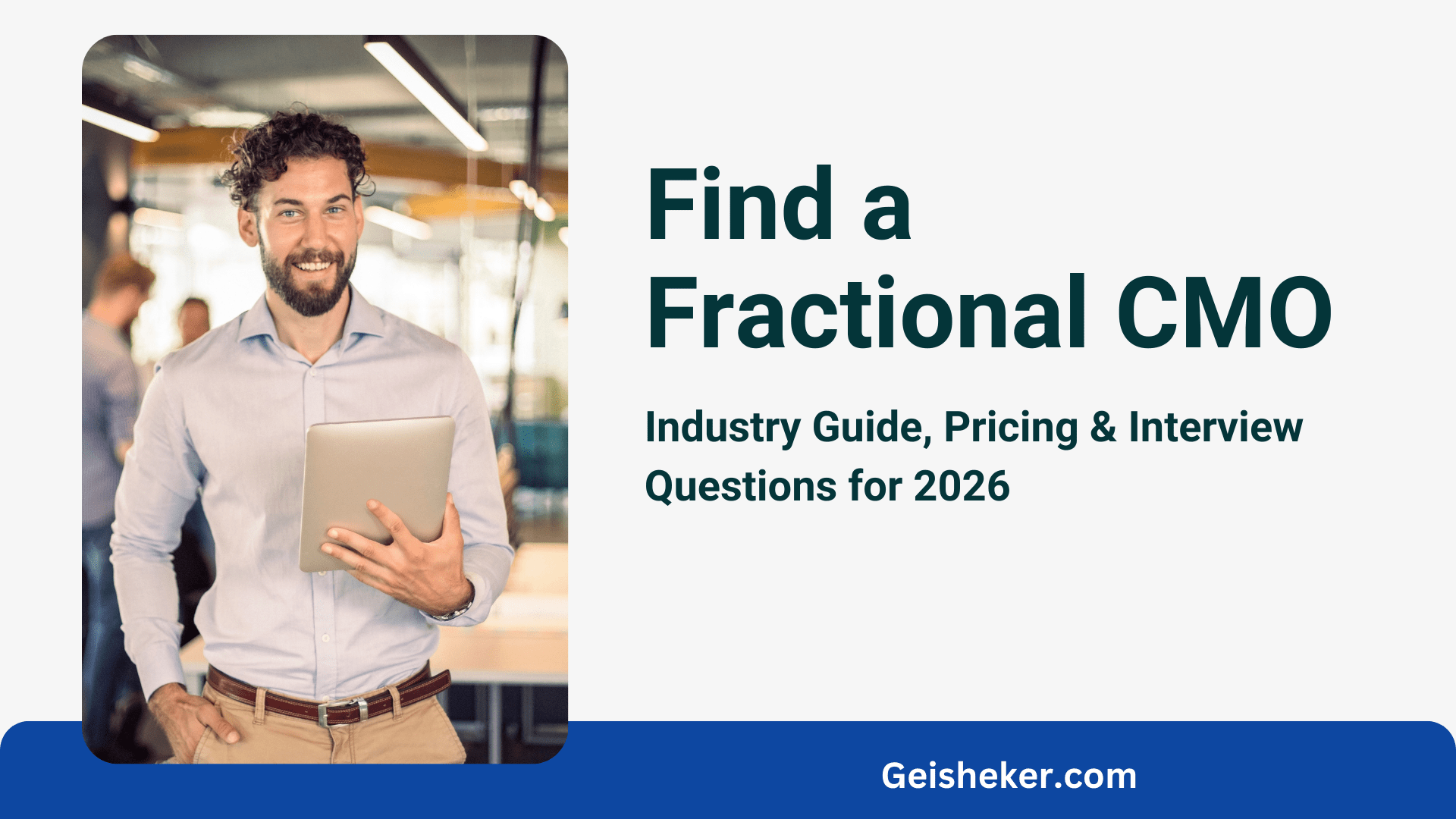
The best places to find a qualified fractional CMO are, in order of signal quality: referrals from CEOs, board members and investors who have used one; your PE or VC firm’s operating partners and portfolio network; and specialist fractional executive firms. Talent marketplaces, LinkedIn search and industry communities widen the pool but leave most of the vetting to you.
Key facts
- The pool has grown fast, so vetting matters more than ever. In 2022 about 2,000 LinkedIn profiles mentioned fractional leadership; by 2024 that number passed 110,000 (SHRM).
- New entrants are rising. In Heidrick & Struggles’ survey of 3,810 interim leaders and experts, 15% were new to independent work (under one year), up from 6% in 2020 (Heidrick & Struggles).
- Real CMO experience is scarcer than titles suggest. Only 27% of S&P 500 CMOs had held the CMO role at another company before (Spencer Stuart).
- If you are PE-backed, your sponsor may already run a sourcing desk. 70% of PE funds in the $3 billion to $5 billion range have dedicated talent partners (Russell Reynolds Associates).
- The Geisheker Group is two senior B2B fractional CMOs (Peter Geisheker and Michael Pecora) who have led 300+ strategy sessions with CEOs, serving B2B companies with $2M+ in revenue and well-funded B2B startups.
Start with the right search brief
Before you look anywhere, write down three things: the revenue problem you need solved, your industry and business model, and your stage. Every channel below works better when you can say “B2B SaaS, $8M ARR, pipeline stalled after founder-led sales” instead of “we need marketing help.”
Industry and stage fit is the single biggest filter. A marketing executive with 15 years in consumer packaged goods will approach a B2B SaaS pipeline problem very differently from someone who has run long, committee-driven B2B sales cycles. Stage matters just as much. Someone whose experience comes from $500M enterprise brands brings a different toolkit than someone who has built revenue systems in the $2M to $50M band, where the job is installing infrastructure that does not exist yet.
If you are still deciding whether the role is right for you, read what a fractional CMO is and how a fractional CMO compares with a full-time CMO or an agency first. This page assumes you have decided and need to find one.


Try two senior CMOs before you hire them
30 minutes with both of us. No hard sell. Written plan in 3 business days.
The six channels for finding a fractional CMO
1. Referrals from your network, board and investors. Ask CEOs who have hired a fractional CMO, your board members, and your investors. A referral from someone who watched the person work for a year carries more evidence than any profile. The weakness is reach: your network may only know two or three people, and none may fit your industry.
2. PE operating partners and portfolio networks. If you are PE- or VC-backed, ask your deal partner or talent partner who has worked across their portfolio. Sponsors track which marketing leaders produced results at other portfolio companies, and many keep a bench of independent executives. The risk is that the sponsor’s favorite may fit their playbook better than your market.
3. Fractional executive firms. These firms keep a roster of senior executives, screen them, and match you to one. Some are generalist; others specialize by industry, such as B2B technology or SaaS. You get pre-vetting and often a replacement if the match fails. You are limited to their roster and their engagement model, and quality varies by firm, so check who actually does the work after the sales call.
4. Talent marketplaces and fractional networks. Online marketplaces and membership networks list hundreds of fractional marketers you can filter by industry and skill. They are fast and broad. Screening depth ranges from a real interview process to a self-reported profile, so you should assume partial vetting at best.
5. LinkedIn search. Search for “fractional CMO” plus your industry, then filter by people who name companies like yours and post specific, measurable work. This gives you the widest pool and full control. It also gives you the most noise, because anyone can add “fractional” to a headline.
6. Industry communities and associations. Trade associations, CEO peer groups, SaaS and founder communities, and industry conferences surface people who already know your market. Members can tell you who is respected. The pool is small and slow to reach, and active community members are not always the strongest operators.
Comparison table: which channel fits your situation
| Channel | Best for | Vetting done for you | Typical speed to a shortlist | Main risk |
|---|---|---|---|---|
| Referrals (network, board, investors) | CEOs with peers who have used a fractional CMO | Partly (the referrer saw the work) | Fast if names exist, stalls if they do not | Small pool; referral may not fit your industry |
| PE operating partners and portfolio networks | PE- and VC-backed companies | Partly to yes (track record inside the portfolio) | Fast | Candidate fits the sponsor’s playbook, not your market |
| Fractional executive firms | CEOs who want screening and a backup if it fails | Yes | Moderate | Limited to one roster; seniority can drop after the sale |
| Talent marketplaces and fractional networks | Broad search, specific skills, quick comparisons | Partly | Fast | Self-reported profiles; uneven screening |
| LinkedIn search | Niche industries and full control | No | Slow (you do all the filtering) | High noise; titles are unverified |
| Industry communities and associations | Deep vertical knowledge | No | Slow | Small pool; visibility is not the same as results |
The pattern is simple. The channels that are fastest to reach are the least vetted, and the most trustworthy channels have the smallest pools. Most CEOs get the best result by running two in parallel: one high-trust channel (referrals or your investors) and one wide channel (a firm, a marketplace or LinkedIn) to fill the gaps.
How to build a shortlist of three
Three is the right number. One gives you nothing to compare. Five turns into a second job.
- Collect 8 to 12 names from at least two channels. Mixing a referral source with a wider channel keeps you from settling for whoever is closest.
- Cut on industry and model fit first. Remove anyone without direct experience in your business model (B2B, SaaS, PE-backed) and a deal size and sales cycle close to yours.
- Cut on stage fit. Keep people who have worked at companies near your revenue and team size. Enterprise-only experience and pre-revenue-only experience both miss the middle.
- Cut on evidence. Keep people who show specific, measurable outcomes and can name the type of company and the problem. “Improved marketing performance” does not qualify.
- Cut on availability and conflicts. Confirm they can start when you need them and do not currently serve a direct competitor.
- Keep the three that survive, ideally from at least two channels. If every finalist came from one marketplace or one investor, you have not tested the market.
Write the brief and the cuts down. When the board asks why you picked this person, you will have the answer.
What to check before the first call
A first call should test judgment, not confirm basics. Check these before you book it.
- Has the person actually held the seat? Look for prior CMO or VP of Marketing roles with real ownership of budget, team and pipeline. Given that only 27% of S&P 500 CMOs had been a CMO before (Spencer Stuart), a “CMO” headline alone proves little.
- Do the outcomes connect to revenue? Read their site, posts and case studies for pipeline, revenue, acquisition cost or sales cycle results. Impressions and follower counts are not CMO outcomes.
- Is the experience recent and relevant? Recent work in your industry and stage matters more than a famous logo from a decade ago.
- Who will do the work? If it is a firm, find out whether the senior person you met leads the engagement or hands it off.
- Can they give references you can reach? Ask in advance for two CEO or board-level references from companies similar to yours. Hesitation here is a signal.
- Will they say no? Prepare one question for the call: “When would you tell a company like ours not to hire a fractional CMO?” A good candidate has a real answer. Someone who says the model fits everyone is selling, not advising.
For the rest of the process (interviews, scope, KPIs and contract terms) see our guide on how to hire a fractional CMO. For budgets, see how fractional CMOs charge for their services.
Red flags by channel
Each channel has its own typical failure. Watch for these.
- Referrals: the referrer liked the person but cannot name a business result. Ask what changed in the numbers.
- Investor networks: pressure to accept the sponsor’s pick without a comparison. Ask for two names, not one, and add one from outside the portfolio.
- Fractional firms: a senior executive on the sales call and a junior one on the work. Get the name of the person who will lead your account in writing.
- Marketplaces: profiles with broad claims across many unrelated industries. Generalists who say they work everywhere rarely go deep anywhere.
- LinkedIn: a recent switch to “fractional” after a short, tactical career. Check the full history, not the headline.
- Communities: confusing visibility with results. The most active voice in a forum is not automatically the best operator.
Frequently asked questions
Is it better to find a fractional CMO through a firm or on my own?
A firm saves you screening time and usually offers a replacement if the match fails. Searching on your own gives you a wider pool and more control, but you carry all of the vetting. If you have a strong referral or investor network, start there; if you do not, a specialist firm in your industry is usually the faster route to a qualified shortlist.
My investors suggested a fractional CMO. Should I still look elsewhere?
Yes, at least briefly. An investor referral is a strong signal, but it is one data point. Compare that person against one or two outside candidates using the same brief and the same checks. If the investor’s pick is still the best, you hire them with more confidence and a clearer mandate.
How do I find a fractional CMO who knows my industry?
Combine an industry filter with an evidence filter. Use industry associations, peer groups and LinkedIn searches that include your vertical, then ask each candidate to describe three or more companies like yours, the problem each faced and the measured result. Vague answers about “general B2B strategy” are a red flag.
How many fractional CMOs should I talk to before choosing?
Talk to three. Fewer gives you no basis for comparison; more slows the decision without improving it. Get to three by cutting a longer list of 8 to 12 names on industry, stage, evidence and availability before you book any calls.
Are talent marketplaces a good place to find a fractional CMO?
They are useful for breadth and speed, especially when you need a specific skill. Treat their screening as partial. Run the same checks you would on a cold LinkedIn find: verify past CMO-level roles, revenue-linked outcomes and reachable CEO references.
What is the fastest way to get a qualified shortlist?
Run two channels at once. Ask your board and investors for names on day one, and in parallel contact one specialist fractional firm in your industry. Then apply the shortlist cuts above. That combination gives you a vetted, compared set of three without depending on a single source.
Talk to us as one of your three
If you are a B2B, SaaS, AI or PE-backed company with $2M+ in revenue, The Geisheker Group is worth a spot on your shortlist. Peter Geisheker and Michael Pecora are two senior B2B fractional CMOs; Peter’s career results include 6X inbound lead growth and 100% year-over-year SaaS revenue growth three years in a row. The simplest way to check us against the criteria above is a free 30-minute growth plan session on Google Meet. You get a written growth plan within 3 business days, with no hard sell, and we take 10 companies a month. Book your 30-minute growth plan session.
Free Written Growth Plan
Wondering if a fractional CMO is right for you?
Try us before you hire us. Book a free 30-minute working session with both of us and get a written growth plan you can use whether or not you hire us.
Get My Free Growth Plan →No hard sell on the call. Your plan arrives within 3 business days. See a sample plan
Sources
- SHRM, C-Suite “Twins”: Doubling Leadership Capacity, Not Doubling Cost
- Heidrick & Struggles, 2026 Talent Lens Survey: The State of Interim Talent
- Spencer Stuart, CMO Tenure 2026: Snapshot of an Expanding Role for Marketing Leaders
- Russell Reynolds Associates, Private Equity: Increased Focus on Strategic Talent Management for Value Creation